Executive Summary
Antimicrobial resistance ranks among the World Health Organization's top ten global health threats, with resistant infections projected to cause up to 10 million deaths a year by 2050.
Resistance arises through multiple intrinsic and acquired mechanisms, from altered cell wall permeability and efflux pumps to genetic mutation and enzymatic degradation of drugs.
New antibiotic development lags dangerously behind the pace of resistance, hindered by biofilms, Gram-negative defenses, poor return on investment, and 10 to 15 year timelines.
Alternatives such as bacterial vaccines, antimicrobial peptides, bacteriophages, and stringent response inhibition offer promising routes beyond conventional small-molecule antibiotics.
Advanced material solutions and emerging AI-driven discovery methods hold potential to shorten development timelines and reduce reliance on traditional antibiotics. In August 2205, researchers at MIT reported the invention of antibiotics using generative AI against drug-resistant strains of gonorrhea and Staphylococcus aureus.
Update, May 2026: the FDA approved Zaynich, an antibiotic that resists bacterial adaptation by attacking three bacterial proteins at once rather than one, giving clinicians a treatment option against drug-resistant infections that previously had almost none.
The World Health Organization (WHO) defines a microorganism that is not killed/inactivated after the due course of treatment as ‘resistant’, and the rise in resistant organisms is multifactorial. According to the Centers for Disease Control and Prevention (CDC), more than 2.8 million antibiotic-resistant bacterial infections occur each year, resulting in 35,000+ deaths. Worryingly, projections made by the World Bank estimate this number might increase to 10 million deaths a year by 2050.
As such, the WHO has declared antimicrobial resistance as one of the top ten primary health concerns, and new solutions are urgently needed.
Antibiotic resistance is multifactorial
Antibiotic resistance can result from both intrinsic and acquired factors. Intrinsic factors include cell wall permeability, modified drug targets, activation of efflux pumps, and enzymatic degradation of antibiotics. Acquired resistance arises from the gain of new genetic material or mutation in the bacterial genome that mediates survival.

The need for new antibacterial treatments
Antibiotics cover many different classes. Each one is categorized by its structure and how it tackles bacteria in the body.
| Antibiotic class | Structure |
| Aminoglycosides (e.g., streptomycin, 57-92-1) |  |
| Beta-lactams (e.g., penicillin, 61-33-6) |  |
| Sulfonamides (e.g., sulfadiazine, 68-35-9) |  |
| Amphenicols (e.g., chloramphenicol, 56-75-7) |  |
| Polymyxins (e.g., polymixin B, 1404-26-8) |  |
| Tetracyclines (e.g., tetracycline, 60-54-8) |  |
| Macrolides (e.g., clarithromycin, 81103-11-9) |  |
| Pyrimidines (e.g., sulfadiazine 68-35-9) |  |
| Rifamycins (e.g., rifampicin, 13292-46-1) |  |
| Quinolones and fluoroquinolones (e.g., nalidixic acid, 389-08-2) |  |
| Streptogramins (e.g., quinupristin, 120138-50-3) |  |
| Lincosamides (e.g., lincomycin, 154-21-2) |  |
| Pleuromutilins (e.g., lefamulin, 1061337-51-6) |  |
| Oxazolidinones (e.g., linezolid, 165800-03-3) |  |
Table 1. The different classes of antibiotics.
Despite these established treatment options, many infections are becoming resistant to existing antibiotic treatments. Coupled with an estimated rise in related deaths, there is a pressing need to rethink how we tackle bacterial infections.
The challenges new antimicrobials face
While the rise in antimicrobial resistance is multifaceted, it is compounded by the slower pace of developing new treatment options compared to the rate of antimicrobial resistance development.
This is apparent when looking at the number of journal publications around antimicrobial resistance vs. the low proportion of patents (Figure 2). This indicates that researchers in academia are taking a more prominent role in developing new antimicrobials — and that these efforts must be translated into commercially available therapies.

This can be explained by several factors that make antimicrobial development challenging. Beyond many innate or acquired mechanisms microbes can use to resist antimicrobials (Figure 1), there are also broader factors that make development difficult (Figure 3).
The ability of bacteria to tolerate antimicrobials, combined with the high development cost and long timeframes (Figure 3), has led to few antibiotics reaching the market in recent decades despite the dire need.
Alternatives to conventional antibiotics
Bringing new antibiotics to market is a time-consuming challenge (Figure 3), so alternatives are helping combat antimicrobial resistance.
The future of antimicrobials
Enhanced drug delivery methods through materials can provide localized, prolonged, and stimulus-dependent antibacterial activity. There are several ways of achieving antimicrobial delivery outside of traditional administration. Medical devices such as implants and catheters can be infection sources, which can be potentially prevented by using antimicrobial materials. Likewise, antimicrobial coatings on high-traffic surfaces can reduce the transmission of microbes and minimize the need for cleaning.
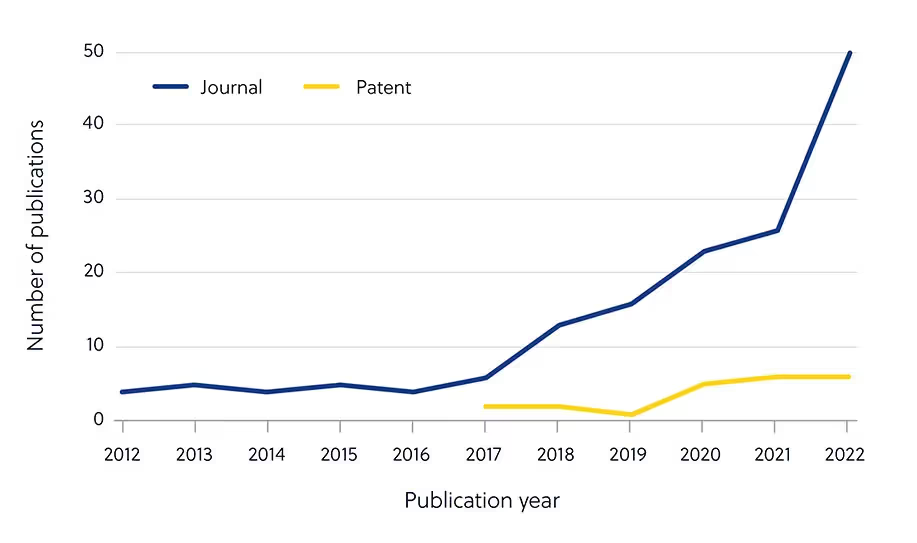
Advances in artificial intelligence (AI) have led to an acceleration in antimicrobial drug development using algorithms to identify potential new molecules. Although the number of journal publications has steadily increased, there hasn’t been a corresponding surge in patent applications, suggesting that most antimicrobial AI research is still in the academic stage(Figure 5).
The rise in multi-drug-resistant bacteria poses an alarming threat to human health, and the need to develop novel antibiotics and antibacterial materials is urgent. Widespread AI use is still in its infancy; however, it holds promise for streamlining and reducing timelines for future efforts. Learn more about AI’s impact on chemistry in our Insight Report, the rise of large-language models, and how biomaterials are being used across the therapeutic landscape in a variety of new approaches.