

Executive Summary
- Nanocellulose is a type of nanomaterial derived from cellulose, the primary component of plant cell walls. It has unique characteristics, including high strength, large surface area, and the ability to be modified and combined with other materials. It’s also biodegradable and biocompatible.
- This advanced material is useful in many applications, like packaging and coatings, while specialized bacterial nanocellulose is valuable in biomedical applications.
- Production methods must be more scalable and economical for industries to take full advantage of nanocellulose’s capabilities.
What is nanocellulose?
Nanocellulose is an emerging class of bio‑based nanomaterials derived from cellulose, the most abundant organic polymer and the primary structural component of plant cell walls. It comprises cellulose structures with at least one nanoscale dimension, typically between 1 and 100 nm, which retain the chemical identity of cellulose while exhibiting markedly different properties due to their high surface area, nanoscale dimensions, and ordered crystalline domains. As such, nanocellulose represents a unique convergence of renewable biomaterials and advanced nanotechnology.
Growing interest in nanocellulose is driven by its exceptional combination of high mechanical strength, low density, large surface area, tunable surface chemistry, optical transparency, and distinctive rheological behavior. In addition to these performance advantages, nanocellulose is biodegradable, biocompatible, and derived from abundant renewable resources, making it an attractive alternative to petroleum‑based, non‑degradable polymers. As we’ll see, nanocellulose production is poised to address significant waste issues and drive meaningful improvements in the circular economy.
Nanocellulose is therefore gaining commercial importance as industries seek materials that combine high performance with sustainability and regulatory compliance. It shows strong potential across sectors including packaging, composites, coatings, electronics, energy storage, biomedicine, and water purification, and it is transitioning from laboratory research to industrial deployment as the global market expands.
Nanocellulose's potential in enabling the circular economy
Plant-based waste products like agricultural waste and biomass can be repurposed as feedstocks for various products, rather than being processed simply as waste. Turning these materials into nanocellulose, which then is made into many commercial and industrial products, is a critical step towards building a circular economy and tackling persistent waste issues.
In addition, we know that textile waste is a significant global challenge with the rise of fast fashion and the doubling of clothing production in the first decades of the 21st century. Textile waste is projected to reach 150 million tons by 2030, underscoring the urgent need to recycle or repurpose these fibers and reduce landfilling and incineration of used clothing. Researchers are obtaining nanocellulose from recycled textile waste as well.
We leveraged the CAS Content CollectionTM, the largest human-curated repository of scientific information, to extract actionable insights on nanocellulose from a vast body of published research. A search query was developed by our subject matter experts in CAS IP Finder®, powered by STNTM to capture all publications on nanocellulose, yielding over 50,000 documents. The growing scientific and commercial interest in nanocellulose is reflected in the dramatic increase in research activity over the past two decades (see Figure 1).
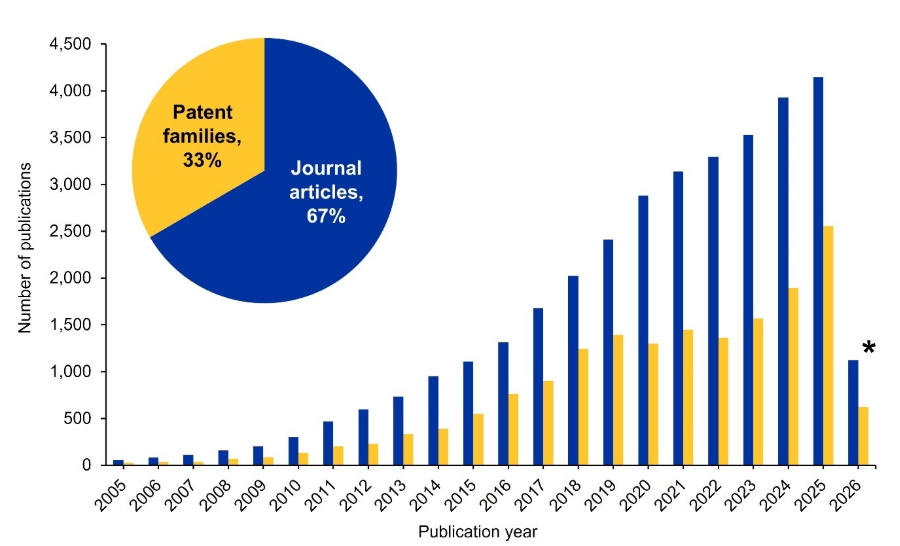
The publication trends demonstrate steep growth in journal articles and patent families, indicating that nanocellulose has evolved from a niche research topic to a major focus area in materials science. Notably, there is a healthy balance between fundamental research publications and patent activity, which shows that academic discoveries are translating into commercial innovations. The substantial patent activity signals confidence in nanocellulose's industrial applicability and the ongoing efforts to develop proprietary technologies for production and application across various sectors.
The publication trends in Figure 1 were analyzed using CAS SciFinder®. Researchers exploring similar trends can access AI-enabled search capabilities to identify patterns in their specific research areas.
By the numbers
Textile waste is projected to reach 150 million tons by 2030, underscoring the urgent need to recycle or repurpose these fibers and reduce landfilling and incineration of used clothing.
Types of nanocellulose
Nanocellulose can be classified into three main types based on morphology and production method: cellulose nanocrystals (CNC), characterized by rod‑like crystalline structures; cellulose nanofibrils (CNF), consisting of long, flexible fibrils with crystalline and amorphous regions; and bacterial nanocellulose (BNC), produced via microbial fermentation and exhibiting a unique three‑dimensional network. Our analysis of publication trends reveals distinct development trajectories, with CNF emerging as the primary focus of research followed by CNC, while BNC remains a specialized but well‑defined niche within the field (see Figure 2).
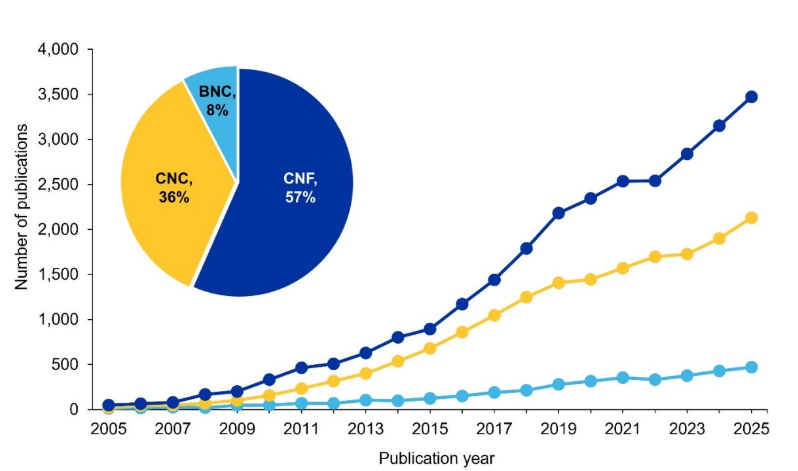
The dominance of CNFs in the research landscape reflects their versatility and strong practical relevance. Their semi‑crystalline structure, high aspect ratio, large surface area, and ability to form interconnected networks impart excellent film‑forming, thickening, barrier, and mechanical properties, including flexibility and high tensile strength. Advances in scalable and cost‑effective production have further strengthened their appeal for large‑scale applications, particularly in packaging and paper products. This positions CNF as the most promising nanocellulose type for technological development and commercialization.
CNC occupies a strong secondary position in nanocellulose research, with sustained growth alongside CNF. This continued interest is driven by CNC’s high stiffness, crystallinity, tensile strength, and elastic modulus, combined with low density, large surface area, and tunable surface chemistry. Their rigid structure and high aspect ratio make CNCs effective as reinforcing agents in nanocomposites, while their well‑defined crystalline and optical properties support high‑performance applications in composites, sensors, and biomedical systems. Together, these attributes position CNC as a complementary material to CNF rather than a competing one in advancing nanocellulose technologies.
The comparatively lower yet sustained research interest in BNC reflects a distinct dynamic within the nanocellulose landscape. While its modest publication volume is likely due to production challenges — such as lower yields, longer processing times, and higher costs relative to plant‑derived nanocelluloses — the continued growth in BNC research underscores recognition of its unique attributes. BNC is indispensable for high‑value biomedical applications due to its characteristics: exceptional purity (free from lignin, hemicellulose, pectin, and other plant‑derived components), porous three‑dimensional networks, high crystallinity, mechanical stability, and superior biocompatibility. These capabilities justify its specialized but stable niche despite higher manufacturing costs.
The type-by-type publication picture in Figure 2 comes from the CAS Content Collection, the largest human-curated repository of scientific information. See what the collection covers and how it is curated.
Key takeaway
CNF may be the most promising nanocellulose type for technological development and commercialization.
Feedstocks and production methods depend on economic and environmental factors
Nanocellulose can be derived from numerous cellulose‑rich feedstocks. Feedstock selection influences processing routes, yield, material properties, cost, and environmental impact. To identify the most used feedstocks, we analyzed CAS‑indexed concepts from our nanocellulose dataset, also accessible via CAS SciFinder®. These feedstocks were systematically classified into processed cellulosic materials, plant-based sources, agricultural and industrial residues, and biological producers (see Figure 3).
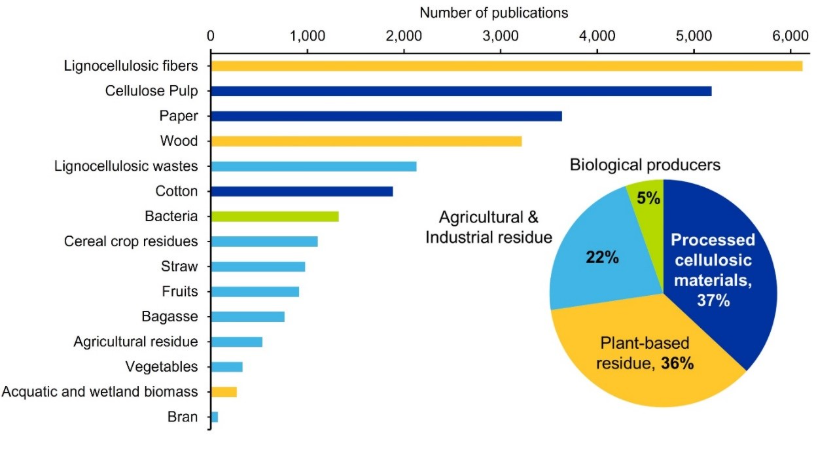
Processed cellulosic materials are the most prominent feedstocks for nanocellulose production due to their reliability, high cellulose content, and compatibility with existing industrial infrastructure. Widely used intermediates such as cellulose pulp, paper, and cotton integrate seamlessly into pulp and paper value chains, enabling large‑scale production. Certain solvents, such as deep eutectic solvents, are key to transforming cotton-based textile waste into nanocellulose. These cotton-based sources — including linters, textiles, and garment waste — offer near-pure cellulose and excellent mechanical performance under mild processing conditions. Although the extraction process does require multiple steps, this is one of the most important feedstocks to generate nanocellulose and address fast fashion waste issues.
Plant‑based residues form the second-most-prominent feedstock category, reflecting increased emphasis on sustainability and biomass valorization through minimally processed materials. This group includes diverse lignocellulosic sources, with strong research focus on fibers such as hemp, flax, jute, kenaf, ramie, sisal, abaca, and bamboo, which offer rapid growth, low resource requirements, and suitability for growth on marginal lands. Wood from both softwood and hardwood species remains important but requires more intensive delignification when used in its native form. Aquatic and wetland biomass, including algae and seaweed, is an emerging opportunity for cellulose sourcing without competing for agricultural land, despite current processing challenges.
Agricultural and industrial residues represent a significant feedstock category, reflecting efforts to valorize waste streams into high‑value nanocellulose while addressing waste management challenges. This category is dominated by lignocellulosic wastes from agricultural byproducts and industrial residues, including cereal crop residues such as rice husk, corncobs, and straw, as well as sugarcane bagasse and fruit and vegetable wastes. These feedstocks are attractive due to their low cost, wide availability, and sustainability benefits, although their heterogeneous composition typically requires more intensive pretreatment to remove lignin, hemicellulose, and mineral components.
Biological producers constitute the smallest feedstock category but occupy a distinct and important niche in nanocellulose research. This category primarily involves bacterial sources, with microorganisms such as Komagataeibacter and Acetobacter producing BNC. The exceptional purity, unique three‑dimensional network structure, and superior mechanical and biocompatible properties of BNC sustain research interest despite challenges related to lower yields, longer production times, and higher costs compared to plant‑derived sources.
Major production technologies for nanocellulose
Nanocellulose production encompasses many processing technologies classified into cellulose isolation, chemical, mechanical, and biosynthetic processes. The production route depends on factors such as the targeted nanocellulose type, feedstock characteristics, desired properties, production scale, economic feasibility, and environmental impact. To identify dominant processing pathways, we analyzed CAS‑indexed concepts from our nanocellulose dataset, as shown in Figure 4.
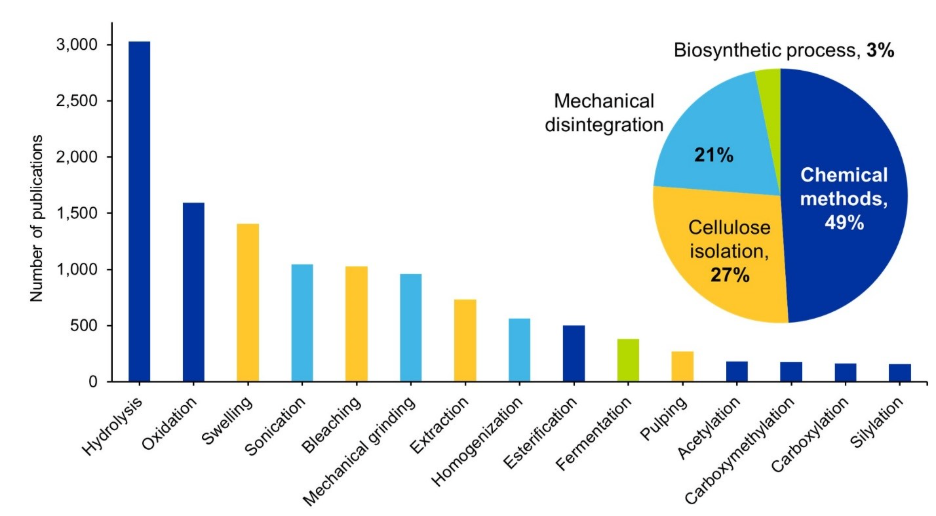
- Chemical methods dominate nanocellulose production research due to their versatility in direct synthesis and feedstock pretreatment. Within this category, hydrolysis, particularly using sulfuric or hydrochloric acid, is the most established approach for producing CNCs with well‑controlled dimensions. Another prominent process is oxidation, especially TEMPO‑mediated oxidation, enabling efficient CNF production by introducing carboxylate groups that reduce mechanical fibrillation energy. Additional chemical modifications, including esterification, acetylation, carboxymethylation, carboxylation, and silylation, further allow tailored surface chemistry, improved processability, and application‑specific functionality.
- Cellulose isolation is the next-most-common production category, highlighting the critical role of feedstock preparation in determining nanocellulose quality and performance. This category includes processes that remove lignin, hemicellulose, pectin, extractives, and mineral matter, with swelling receiving particular attention for its ability to enhance cellulose accessibility, improve chemical penetration, and reduce the energy required for subsequent mechanical fibrillation. Other essential isolation techniques, including bleaching, extraction, and pulping, yield purified cellulose fractions for downstream processing.
- Mechanical disintegration plays a key role in nanocellulose production, emphasizing physical routes for cellulose nanofibril manufacture and ongoing efforts to improve efficiency and scalability. These methods apply mechanical forces to liberate nanofibrils, often aided by mild chemical or enzymatic pretreatments to reduce energy demand. Sonication is widely used at the laboratory scale, while mechanical grinding remains an established approach. High‑pressure homogenization is regarded as the most promising route for industrial‑scale CNF production due to its ability to generate consistent nanofibrils.
- Biosynthetic processes represent the smallest production‑technology category, yet they retain a distinct and important role due to the unique properties of biologically produced nanocellulose. This category is primarily driven by bacterial fermentation of carbon-rich substrates such as sugars, molasses, fruit juices, fruit pulps, alcohol and other agricultural residues, wherein microorganisms directly synthesize nanocellulose through metabolic activity, rather than relying on extraction and processing of plant‑derived cellulose. The relatively limited research volume reflects the specialized nature and inherent challenges of biosynthetic production, rather than a lack of interest in the resulting materials.
Greener processing is the bottleneck for nanocellulose at industrial scale. Mechanochemistry is one route researchers are taking to cut toxic solvents out of synthesis.
In practice
High‑pressure homogenization is regarded as the most promising route for industrial‑scale CNF production due to its ability to generate consistent nanofibrils.
Key applications of nanocellulose
We analyzed the application domains in nanocellulose research to understand where this versatile nanomaterial is making the most significant scientific and commercial impact, and to assess the alignment between academic research and industrial innovation (see Figure 5A). This analysis provides insights into which applications have matured from laboratory research toward practical implementation and where gaps or opportunities may exist between scientific exploration and commercial translation.
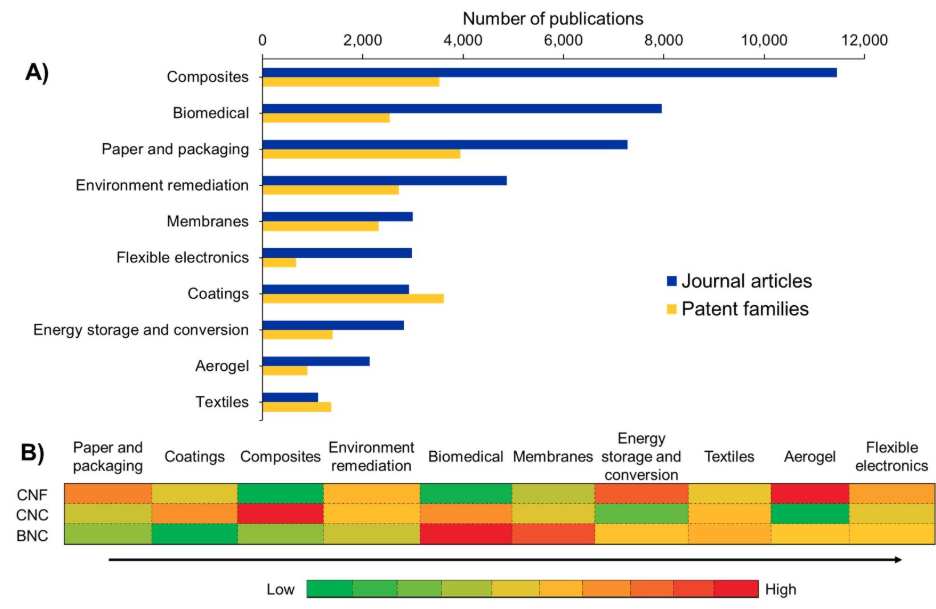
Nanocellulose is used across multiple sectors, with composites emerging as the most prominent area due to their role as a sustainable, high‑performance reinforcement material compatible with bio‑based and conventional polymers. Biomedical applications also show strong activity, driven by nanocellulose’s biocompatibility, tunable surface chemistry, and structural similarity to biological tissues, enabling uses in wound dressings, tissue engineering, drug delivery, and implants.
Paper and packaging remains a major application area, as nanocellulose integrates easily with existing pulp and paper infrastructure while enhancing strength, barrier performance, and coating functionality. Its use in food packaging provides protection against oxygen, moisture, oils, and greases, preventing food degradation, extending shelf life, and maintaining quality.
We’re seeing growing interest in environmental remediation and membrane technologies, where high surface area, porosity, and tunability support the use of nanocellulose in water purification, wastewater treatment, heavy metal adsorption, pollutant removal, filtration, gas separation, oil-water separation, dye removal, proton-exchange membranes, and battery separators.
Beyond structural roles, nanocellulose enables flexible electronics, including flexible displays, printed electronics, flexible solar cells, sensors, wearables, health monitors, and human–machine interfaces. It’s also emerging in energy storage applications, such as energy‑harvesting devices, batteries, and fuel cells through its mechanical flexibility and chemical tunability. Coatings show strong commercial momentum, leveraging nanocellulose’s film‑forming and reinforcement capabilities for protective and functional surfaces, while emerging applications such as aerogels and textiles highlight its potential in lightweight insulation and sustainable fabric technologies.
To assess the relationships between different types of nanocellulose (CNF, CNC, and BNC) and their respective application domains, we performed a chi-square test of independence based on publication frequencies as shown in Figure 5B. This analysis is critical because the three nanocellulose types possess distinct morphological, physical, and chemical characteristics that make them differently suited for various applications.
CNFs show the strongest association with aerogels, energy storage and conversion, and paper and packaging applications. Their long, flexible, and entangled fibrillar morphology enables robust three‑dimensional networks that maintain structural integrity in aerogels, support use as separators and binders in energy devices, and integrate seamlessly into papermaking processes. Extensive nanoscale hydrogen bonding significantly enhances strength and mechanical performance even at low CNF loadings.
A pronounced association is also observed between CNCs and composites, as CNCs exhibit high crystallinity, stiffness, and well‑defined nanoscale dimensions, making them ideal for applications requiring precise mechanical reinforcement, dimensional stability, and tunable surface interactions. CNC forms composites with biopolymers such as polylactic acid, polyhydroxyalkanoates, starch-based polymers, and natural rubber as well as with conventional polymers. It can also be combined with carbon nanotubes and metal nanoparticles, reflecting the widespread use of CNC in high‑performance nanocomposites where rigidity, optical properties, or controlled reinforcement are critical.
As noted, BNC shows the strongest association with biomedical applications, reflecting its unique suitability for this domain. Its exceptional purity, highly porous three‑dimensional network, and excellent biocompatibility make BNC well suited for wound dressings, tissue engineering scaffolds, and implantable materials. Unlike plant‑derived nanocelluloses, BNC can be biosynthesized into predefined shapes and architectures, reinforcing its dominance in biomedical applications where purity, biocompatibility, and structural mimicry of biological tissues are prioritized over reinforcement efficiency.
Overall, the strong associations highlighted in the heatmap demonstrate that nanocellulose types are not interchangeable across applications but rather are selected based on how their intrinsic structural, mechanical, and surface properties align with application‑specific demands.
Established and emerging patent assignees reveal commercial opportunities
We analyzed the landscape of commercial patent assignees in nanocellulose technology to understand the industrial sectors investing most in this material and assess the evolution of commercial activity (see Figure 6A).
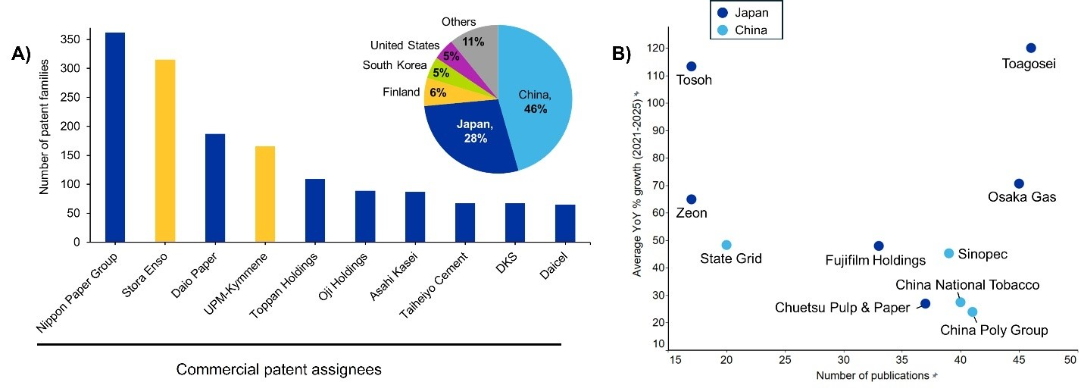
When we analyzed the commercial landscape, we found that Asia and Europe are the leading geographic regions in patent activity, largely due to industrial maturity in advanced materials, biomedicine, and forestry/paper. The distribution of patent families among leading commercial assignees reveals clear leadership by companies rooted in the pulp, paper, and advanced materials sectors. Established paper, packaging, and forest-products companies — including Nippon Paper Group, Stora Enso, Daio Paper, UPM-Kymmene, Toppan Holdings, and Oji Holdings — dominate the landscape, reflecting their strategic advantage in leveraging existing cellulose supply chains, processing infrastructure, and application expertise to translate nanocellulose from laboratory research into commercial products.
Moreover, the presence of chemical and materials companies such as Asahi Kasei, Taiheiyo Cement, DKS, and Daicel further indicates diversification beyond traditional paper applications into composites, coatings, functional materials, and specialty products (e.g., JP6560779 B1, JP6805316 B1). This distribution suggests that nanocellulose commercialization is being driven by incumbent industries extending and adapting their core competencies rather than by new market entrants alone.
Besides identifying leading patent assignees, we also analyzed emerging patent assignees to identify fast‑growing industrial players shaping the next phase of nanocellulose commercialization beyond established incumbents. Emerging companies were identified based on growth rate percentage during 2021–2025, providing insight into where innovation momentum is accelerating in recent years, which sectors are exploring nanocellulose, and how industries are positioning the material within their technology portfolios (see Figure 6B).
The analysis shows that emerging commercialization activity is dominated by companies from Japan and China, underscoring the continued leadership of these regions in translating nanocellulose research into protected technologies. Chemical and materials companies such as Tosoh, Zeon, and Toagosei stand out, reflecting nanocellulose’s growing role as a functional reinforcement in advanced polymers, elastomers, coatings, and specialty chemicals to enhance mechanical performance, adhesion, rheology, barrier properties, and sustainability (e.g., JP2021130790 A).
Energy and gas‑related firms indicate interest in nanocellulose for energy storage, insulation, coatings, and functional composites relevant to infrastructure and energy systems (e.g., CN118459840 A). Meanwhile, pulp, paper, imaging, and diversified conglomerates illustrate application-driven adoption of nanocellulose across traditional fiber-based industries and non-traditional sectors.
Overall, our analysis highlights that rather than being confined to pulp and paper, nanocellulose is being adopted by chemical, energy, materials, and diversified industrial players, signaling a transition toward broader, cross‑industry commercialization driven by performance enhancement and sustainability imperatives.
The assignee analysis above was built in CAS IP Finder. Teams tracking filing activity in their own field can search the same patent landscape there.
Worth knowing
Nanocellulose commercialization is being driven by incumbent industries extending and adapting their core competencies rather than by new market entrants alone.
Challenges and opportunities for nanocellulose
Despite extensive research progress, nanocellulose faces several challenges that limit widespread adoption. Chief among these is scalable and cost‑effective production, as many current processes remain energy‑intensive, chemically demanding, and sensitive to feedstock variability. In addition, variability in material properties arising from differences in raw materials and processing routes complicates standardization, reproducibility, and industrial specification.
The hydrophilic nature of nanocellulose also negatively impacts moisture resistance, dimensional stability, and long‑term performance in humid or aqueous environments, which constrains its performance in packaging, construction, and outdoor applications. These technical hurdles are compounded by evolving regulatory, safety, and life‑cycle assessment requirements, particularly for food‑contact, biomedical, and environmental applications, underscoring the need for integrated process optimization and clearer standards.
Nevertheless, the future of nanocellulose is promising, driven by advances in energy‑efficient processing technologies, greener chemical and enzymatic treatments, and growing demand for sustainable, bio‑based materials. Continued progress in scalable manufacturing and surface functionalization is expected to improve cost competitiveness and material consistency, enabling broader adoption across composites, packaging, coatings, membranes, energy systems, and flexible electronics.
Alignment with circular‑economy and bioeconomy strategies, through the use of renewable feedstocks, agricultural residues, and recycled cellulose, further strengthens its long‑term potential. As application‑driven research intensifies and collaboration between academia, industry, and policymakers deepens, nanocellulose is well positioned to transition from an emerging material to a core component of next‑generation sustainable material systems.
Why it matters