
In December 2025, the CAS Insights team named eight scientific trends to watch across human health and energy. Recently, five members of that team sat down to ask the questions: which predictions held up, which fell short, and what caught the field by surprise?
The discussion opens on the trend that resonated most with readers: opioid-free pain relief. Nearly everyone knows someone living with chronic pain, and Janet Sasso, lead scientist in life sciences, walks through why a new class of drugs that blocks pain signals at the nerve rather than the brain matters for it. Real-world data reported in March 2026 showed that 91% of patients were opioid-free after surgery. The first approvals target short-term, acute pain, but they bring forward the hope of a genuine breakthrough for the far larger population managing pain over the long term. Angela Zhou, who leads the CAS science team, connects the pain-relief story to a wider shift in how new drugs are designed, from small molecules toward antibodies, RNA therapies, and protein degraders.
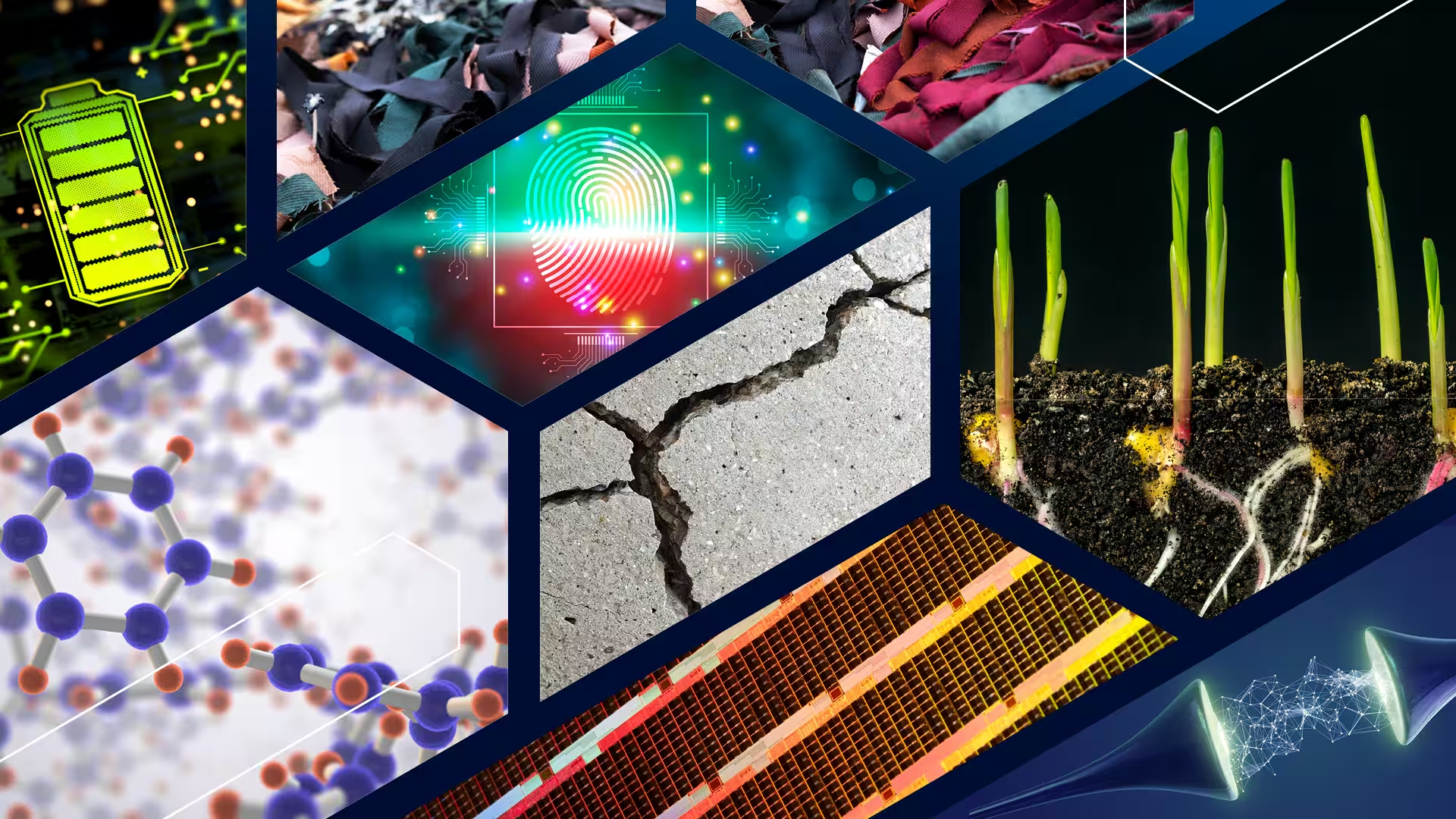
From there, the panel moves through the trends they know best. Jean-Marc Pecourt and Jeremy Krogman track where perovskite and silicon tandem solar cells now stand as efficiency records inch toward their theoretical limit, and where the research focus has shifted from proving these cells work to making them stable, durable, and commercially viable. Jeremy also discussed self-healing materials and the recyclable polymers known as vitrimers.
The through-line through many of these trends, and others covered at CAS Insights, is artificial intelligence. Andrea Jacobs, who leads the CAS AI team behind CAS Newton℠, makes the point that treating AI’s impact on one field was, in retrospect, too narrow a focus. AI is now moving from looking up the science to helping do the science. As one example, she describes an AI system that generated novel hypotheses and reproduced roughly a decade of a laboratory’s private research in about two days. The panelists closed on what makes that kind of AI possible: the quality of the underlying data and the scientific expertise required to use it well.
Read the original 2026 trends to watch article, and be sure to subscribe to CAS Insights to hear about next year’s trends.
This panel is grading its own forecasts. Read the original 2026 Trends to Watch to see their original predictions.