
3D printing has revolutionized manufacturing and prototyping due to its speed and specificity when designing components or systems. This technology, also known as additive manufacturing, has advanced rapidly as materials and printers have improved, and researchers are now taking it a step further with 4D printing, which introduces time as an active dimension of precision-engineered products.
4D printing enables 3D-printed structures to transform their shape, properties, or functionality in response to external stimuli such as heat, light, moisture, pH, or magnetic fields. First conceptualized in 2013, this adaptability is achieved through smart materials like shape-memory polymers, hydrogels, liquid crystal elastomers, and composites that can be programmed for controlled, reversible changes. Programming typically involves setting an original shape during fabrication, deforming the object into a temporary shape under specific conditions (e.g., heating above a transition temperature), then fixing it until a stimulus triggers recovery.
4D-printed materials allow for self-assembly, shape-shifting, and adaptive performance, opening possibilities for applications in biomedicine, aerospace, soft robotics, and smart packaging. Printer capabilities are evolving to support these transformations, with multi-material deposition, voxel-level control, and high-resolution stereolithography enabling precise placement of responsive materials. New hybrid printing approaches combine additive and subtractive processes for improved accuracy, while integration with AI and Internet of Things (IoT) devices allows real-time monitoring and predictive control of stimuli-driven changes.
As the technology moves from laboratory prototypes toward real-world use, materials remain the foundation of innovation. Despite rapid market growth, projected to reach USD 1.3 billion by 2030, the field faces a critical challenge: there are limited libraries of robust, multifunctional materials that can meet diverse application requirements. Understanding this material ecosystem, and the printer capabilities that enable its full potential, is key to unlocking the future of 4D printing.
Understanding 4D printing research trends through publication activity
Using the query "Four-dimensional printing" OR "4-Dimensional printing" OR "4D printing" OR "Four-dimensional printers" in CAS IP Finder, powered by STN™, we obtained information on the current research landscape (see Figure 1). This was possible thanks to the analyze function offered by this tool, similar to the capabilities accessible via CAS SciFinder®.
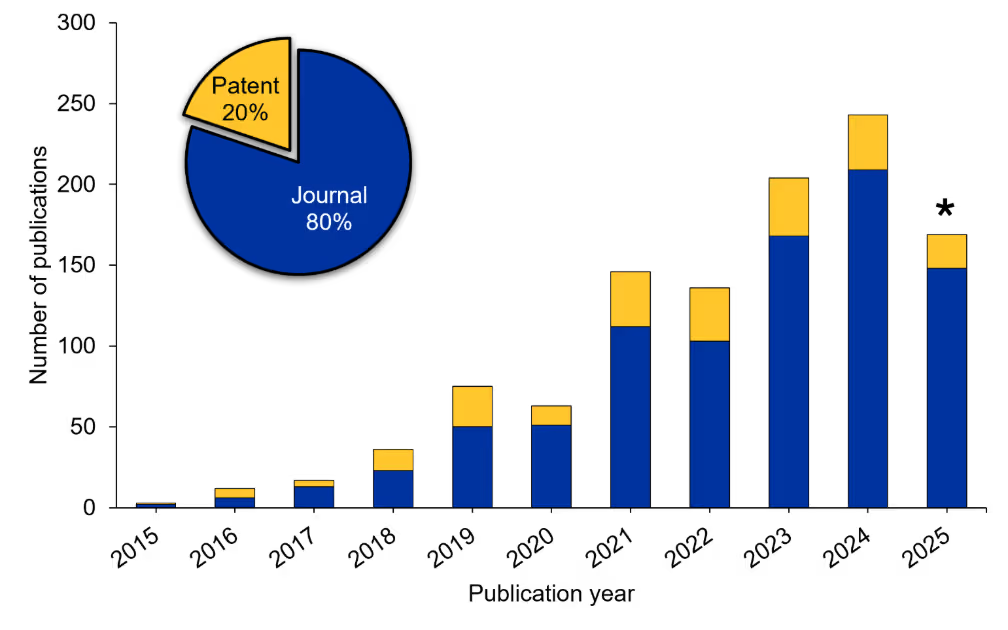
Figure 1: Publication trends in 4D printing. Bar chart shows annual trends for journal publications (blue) and patent publications (yellow). The pie chart illustrates their overall percentage share. Source: CAS Content Collection™ accessed via CAS IP Finder, powered by STN. Data for 2025 is through November.
The current research landscape in 4D printing materials is dominated by academic publications (80%), with patents accounting for only 20%. This suggests that while technology is advancing rapidly in research, commercial adoption is still in its early stages. The relatively low patent activity reflects limited industrial implementation, reinforcing the need for scalable processes and cost-effective materials to bridge the gap between laboratory innovation and market readiness.
CAS IP Finder also allowed us to access the CAS-indexed concepts on this topic for more advanced trend visualization and detailed material landscape mapping. Additionally, to generate Figures 2, 3, and 5, we employed the CAS-enhanced concept classification system known as CLA codes, which can be analyzed by CAS experts and is offered as a CAS special service.
Key material categories in 4D printing
Although 4D printing often builds on established material classes, it is relatively complex due to the need for specialized formulations and multifunctional properties that enable controlled, stimuli-responsive transformations. As a result, the materials landscape encompasses stimuli-responsive materials, those composing the structural matrix, reinforcement materials, and manufacturing/processing aids (see Figure 2).
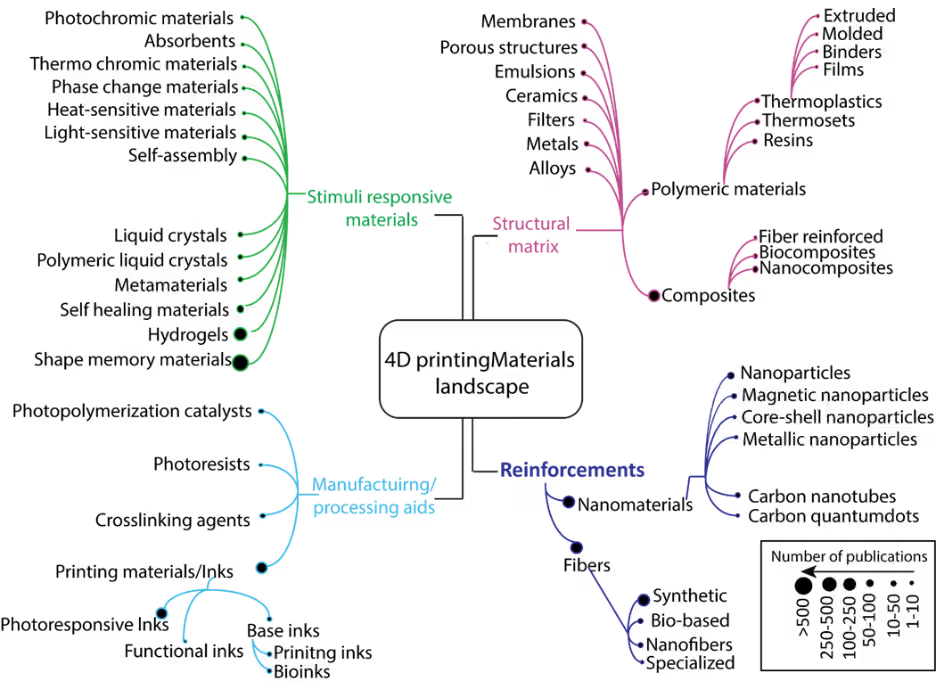
Figure 2: Material landscape across 4D printing publications (journal articles and patents). Source: CAS Content Collection accessed via CAS IP Finder™.
Stimuli responsive materials: The intelligent layer
Stimuli-responsive materials are redefining the future of smart manufacturing. For example, shape memory materials exhibit dynamic behaviors including bending, folding, twisting, or expanding when exposed to heat, light, moisture, pH changes, or magnetic or electric fields. Chromic material systems alter optical properties, changing color, transparency, or reflectivity, while others regulate thermal energy or trigger actuation for movement.
Structural matrices provide strength and dimensional stability, while reinforcements like nanocomposites and nanofibers enhance load-bearing capacity, conductivity, and actuation speed. Together, these foundational materials create a stable yet adaptive framework for intelligent behavior without compromising performance.
Recent developments in stimuli-responsive materials signal a shift toward multifunctionality and sustainability. Shape memory polymer (SMP) systems now include biopolymer-based formulations reinforced with nanofillers for strength and programmability. SMPs recover their original shape when heat softens polymer chains and releases stored strain energy. Another advance is multi-SMPs, which can cycle through several configurations under different stimuli, such as moderate heat and higher heat, or lower light and brighter light, before returning to their permanent shape. Each temporary shape corresponds to a specific activation threshold (e.g., glass transition temperature).
In metallic materials, shape memory alloys (SMA) like Nitinol remain critical for aerospace and biomedical applications, while additive techniques enable architected lattices with tailored morphing and self-healing capabilities.
At the molecular level, SMAs respond to thermal or magnetic stimuli through a diffusion-less phase transformation between martensite and austenite, where atoms cooperatively rearrange to restore the original shape without bond breakage. Chromic systems are evolving into integrated smart surfaces where, for example, a self-powered smart window can be made to darken in sunlight, change hue with temperature, and can even act as a battery, switching among four states (transparent, milky, electrochromic blue, and fully opaque) in one smart, energy-efficient unit. This capability is enabled by controlled ion migration, electronic band structure changes, and phase transitions at the molecular level.
Materials with programmable liquid-vapor phase change are being explored for flexible grippers or deformation switches in soft robotics and electronics. Fiber-reinforced liquid crystal elastomers support self-deployable actuators and hybrid architectures, integrating freestanding elements with printed supports for complex lattices and smart wearables.
Metamaterials are advancing toward voxel-level programmability (digital metamaterials), delivering shape-shifting architectures with tunable stiffness. By digitally programming these voxels, the overall metamaterial can change shape, redistribute stress, and tune stiffness levels dynamically, which is achieved through geometry-driven mechanics rather than chemical changes.
Self-healing polymers now combine reversible chemistry with shape-memory behavior, allowing components to restore form and repair damage under mild thermal or photothermal stimuli. These polymers incorporate reversible covalent or supramolecular bonds for healing, along with shape-memory segments for restoring form.
Together, these stimuli-responsive materials form the intelligent layer of 4D printing, enabling dynamic systems that sense, respond, and adapt to their environment.
Structural matrix and reinforcement materials: The performance backbone
Structural matrices and reinforcements are emerging as the foundation for reliable 4D printing. The focus is shifting toward designs that combine adaptability with strength, such as lightweight frameworks reinforced with nanocomposites or nanofibers to maintain integrity during transformation. 4D printing relies on polymer classes such as polyesters, polyurethanes, polyoxyalkylenes, lactic acid-based polyesters, and blends, typically synthesized via polycondensation, ring-opening polymerization, or reactive extrusion, and processed through extrusion-based printing, vat photopolymerization, or multi-material deposition (see Figure 3). These enable core functionalities of 4D-printed components like shape memory and self-healing.
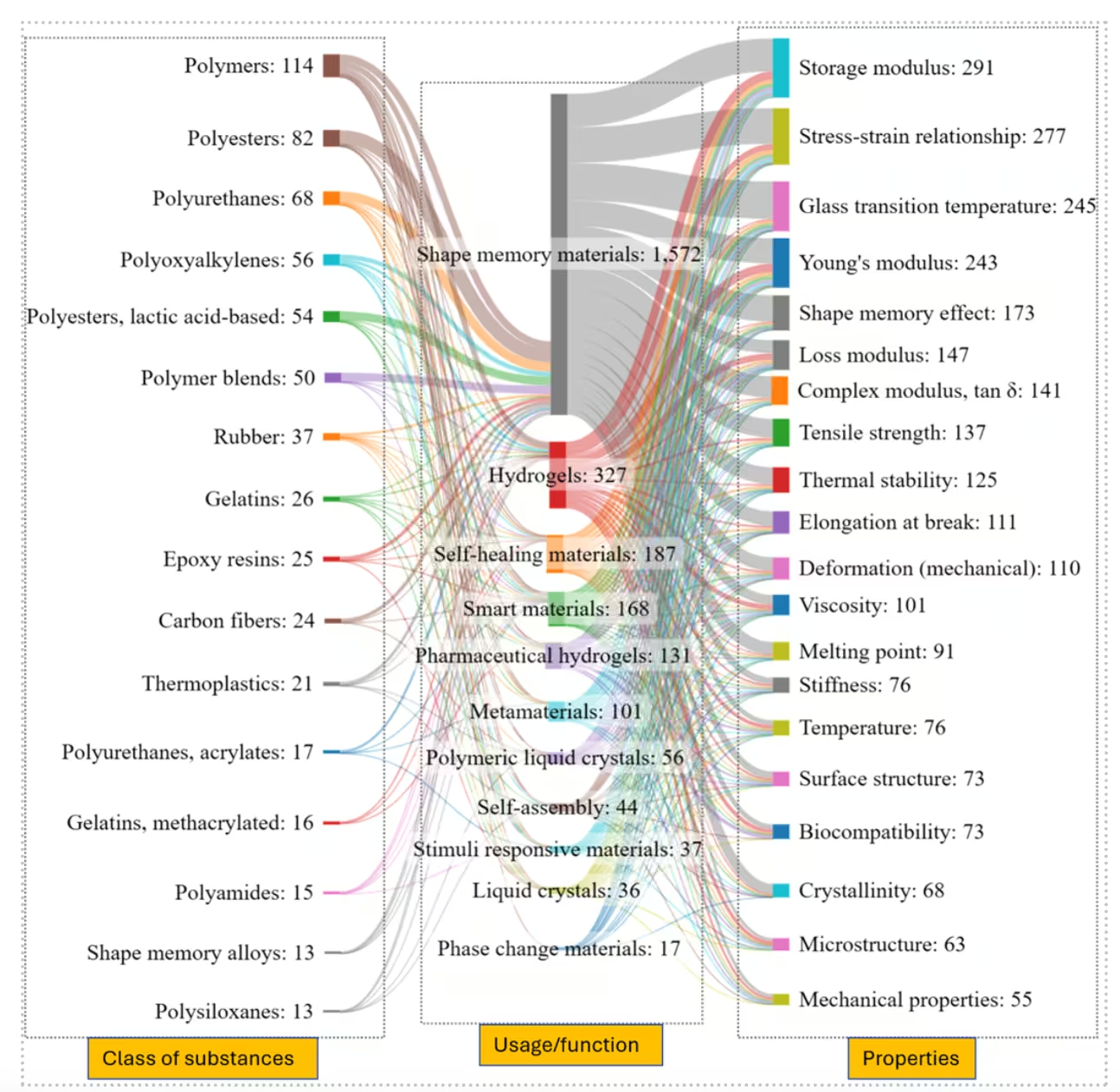
Figure 3: Material-property relationships in 4D printing: connection between specific substance classes and their functional properties, with flow thickness indicating research volume in stimuli-responsive systems. Source: CAS Content Collection.
We see this in recent engineering developments: shape memory polymers (SMPs) now integrate nanofillers for programmable stiffness, hydrogels incorporate bioactive cues for smart drug delivery, self-healing polymers combine reversible bonds with shape-memory behavior, and metamaterials achieve voxel-level programmability for adaptive architectures.
Metallic materials are used similarly. For example, architected shape memory alloy (SMA) lattices use SMAs arranged in designed architectures to provide high strength and adaptive shape change, enabling structural components that morph without losing durability.
Reinforcement materials in elastomeric systems accelerate actuation and improve load-bearing capacity, while composite architectures strengthen metamaterials and chromic systems for faster response and greater resilience. This is enabled by molecular-level mechanisms such as enhanced polymer chain alignment, improved stress transfer through nanofillers, and dynamic bond interactions that maintain integrity during deformation. These trends point to a clear goal: transforming responsive materials into robust, multifunctional platforms ready for real-world applications in aerospace, biomedical devices, and smart wearables.
Manufacturing and processing aids: The enabling technologies
Processing aids are emerging as critical enablers of precision and scalability in 4D printing. The trend is toward formulations that not only support deposition and curing but also add functionality, conductivity, biocompatibility, and responsiveness.
Printing inks are evolving from simple polymer binders to advanced systems incorporating nanofillers for electrical performance and programmable viscosity for complex geometries. Bioinks based on hydrogels and living cells are opening pathways for organ-on-chip and tissue engineering, while conductive inks are driving flexible electronics.
Similarly, photoresists are shifting from static epoxy blends to adaptive formulations with tunable crosslink density and integrated fillers for mechanical and electrical control. These developments demonstrate how processing aids are no longer passive, but rather they are active contributors to high-resolution, multifunctional architectures that bridge design complexity with manufacturing reliability.
Mapping substances and material properties
Understanding the classes of chemical substances in these materials, and the properties that make them suitable for 4D printing, is essential for leveraging these four material branches effectively. As seen in Figure 4, the CAS substance class distribution shows polymers as the dominant category, followed by organic and inorganic small molecules.
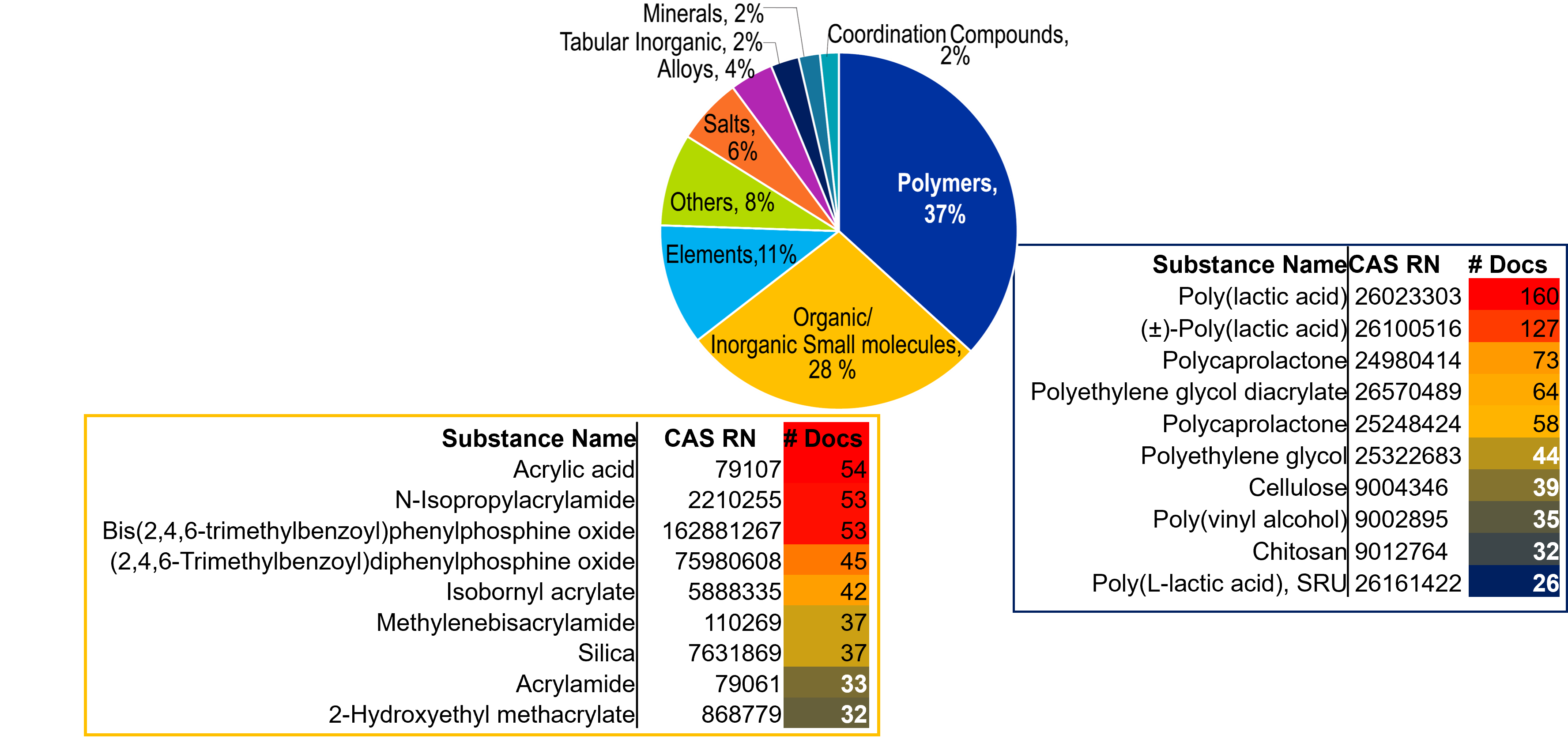
Figure 4: CAS substance class distribution across the journal and patent publications. Pie chart shows the distribution of substances classes. The heat-maps are the top 10 substances in their respective category. Source: CAS Content Collection accessed through CAS IP Finder.
Within polymers, poly(lactic acid) (PLA) and its variants are widely used as biodegradable, thermally responsive shape memory materials for temperature-triggered transformations. This is possible because of their semi-crystalline structure and defined glass transition temperature that allows chain mobility for shape recovery upon heating.
CAS BioFinder™ subscribers can view the structure, pharmacology, ADME, and related diseases for Poly(lactic acid) (PLA) here.
Polycaprolactone (PCL) ranks among the top substances for its biocompatible shape-memory properties. Polyethylene glycol (PEG), PEG diacrylate, and poly(vinyl alcohol) are key water-responsive polymers for pH, moisture, or humidity-sensitive applications. The prevalence of PLA, PCL, and PEG indicates a convergence toward proven, biocompatible platforms rather than entirely novel chemistries.
Small molecules complement these systems by enabling stimuli responsiveness through ionization and coil-to-globule transitions (e.g., acrylic acid for pH-triggered ionization, N-isopropylacrylamide for thermal LCST transition). They control mechanical properties via covalent crosslinking, such as methylenebisacrylamide forming stable network bridges. Small molecules also support photopolymerization through radical generation (e.g., bis(2,4,6-trimethylbenzoyl) phenylphosphine oxide initiating polymerization under UV) and enhance performance through interfacial bonding and stress transfer in reinforced composites.
The application landscape of 4D-printed materials
The biomedical and pharmaceutical sectors currently see the most applications of 4D-printed materials (see Figure 5). However, applications are gradually expanding into diverse industrial fields.
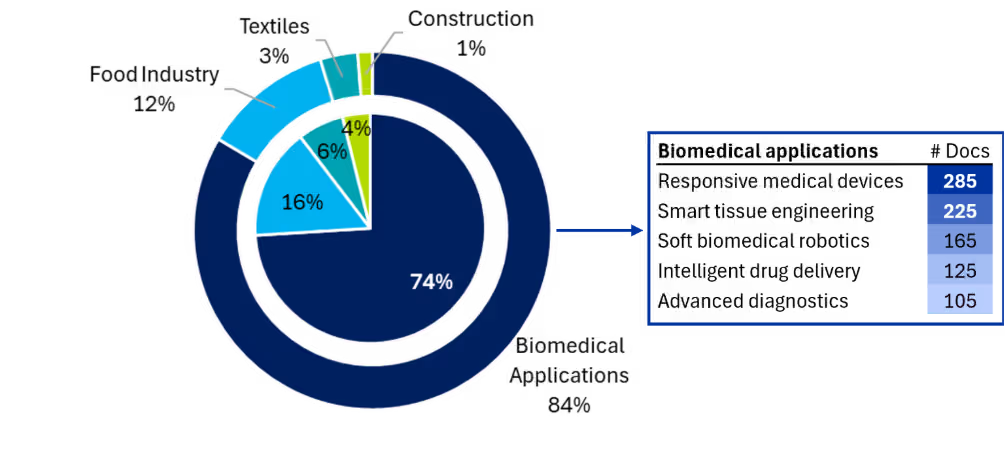
Figure 5: Application mapping of 4D printing: Central pie chart shows patent publications, outer donut chart represents journal publications, and heat map illustrates the biomedical application domains of 4D-printed objects. Source: CAS Content Collection accessed through CAS IP Finder.
In biomedicine, we observed five intertwined categories: responsive medical devices, smart tissue engineering, soft biomedical robotics, intelligent drug delivery, and advanced diagnostics.
Recent developments across these categories illustrate how 4D printing moves beyond static structures to create adaptive, multifunctional solutions. For instance, SMP-hydrophilic copolymer stents capable of holding multiple programmed shapes and responding to heat and hydration are enabling minimally invasive delivery and in-situ transformation without manual intervention. Mechanistically, these behaviors arise from SMP chain mobility under thermal stimulus and hydration-induced swelling that activates reversible crosslinks, converting local chemical potentials into controlled macroscopic actuation.
Beyond stents, adaptive orthopedic implants are also emerging, such as tissue-engineered scaffolds and prosthetic systems that mimic natural muscle or skin responses. For example, researchers have demonstrated biomimetic periosteum with shape-shifting hydrogels that wrap complex bone surfaces and promote angiogenesis and osteogenesis.
Hybrid approaches using GelMA-alginate blends or dECM-based bioinks within SMP frameworks combine mechanical adaptability with biological functionality, supporting tissue regeneration and integration. 4D bioprinting further advances smart scaffolds for minimally invasive surgery, showing biocompatibility, osteochondral regeneration, and responsiveness to stimuli like NIR light.
Soft biomedical robotics translates 4D printing principles into actuation-sensing synergies: an SMP composite gripper that lies flat for storage and curls to grasp under body heat or electrical input, or a wearable patch that tightens/loosens with sweat driven pH protonation/deprotonation.
Intelligent drug delivery systems developed through 4D printing are used in oral, implantable, and transdermal platforms by enabling dynamic, stimuli-responsive drug release tailored to physiological conditions. Recent innovations include biodegradable intestinal devices with shape-memory effects, floating tablets that morph from helical to tablet-like forms, and expandable gastric retention systems based on SMPs, ensuring prolonged residence and controlled release in the gastrointestinal tract.
You can use CAS SciFinder, which aggregates patent, chemical, and related science data from global sources, to research topics such as 4D printing. Researchers exploring similar trends can access AI-enabled search capabilities to identify patterns in their specific research areas.
4D printing introduces microdevices that enable dynamic sensing and advanced diagnostic functions in real time. For example, 4D-printed platforms for ctDNA and miRNA detection in pancreatic cancer overcome the limitations of PCR and NGS by regulating capture timing and improving interaction with fragile nucleic acids.
Similarly, dynamic designs such as optical microcavities and needle panel meters allow continuous monitoring of metabolites like glucose, urea, and pH. Even tools such as pH-sensing claws and ultrasound-guided nerve block models demonstrate how programmable morphing enhances diagnostic precision.
Across these categories, 4D printing transforms materials science into a design language where molecular-scale transformations become programmable dials for device functioning. This convergence of chemistry, mechanics, and computation is catalyzing a shift toward adaptive, multifunctional systems that operate in sync with physiology, paving the way for personalized, minimally invasive healthcare.
Outside healthcare, food applications remain a small fraction (12%) yet show potential for adaptive textures, controlled flavor release, and smart packaging that responds to spoilage or temperature. Demonstrations include emulsion gels, microcapsules, and pasta formulations that change color as cooking indicators.
Industrial applications remain in early development but are highly promising. Adaptive structural systems, self-assembling construction components, and aerospace prototypes such as shape-shifting airfoils highlight opportunities for efficiency and performance optimization. Responsive textiles and smart manufacturing tools further underscore the versatility of this technology.
What makes 4D printing exciting across these applications is the integration of time as a functional dimension. Unlike conventional 3D-printed objects, 4D-printed structures evolve after fabrication responding to stimuli, adapting to environments, and delivering multifunctionality. This shift positions 4D printing not just as an additive process, but as a platform for intelligent, adaptive systems that redefine product design and performance.
Challenges and future directions in 4D printing
Since its inception in 2013, 4D printing has built upon the foundations of 3D additive manufacturing, but the combination of advanced materials and software tools coupled with the need for scalability and reliable performance presents ongoing challenges. These include:
Smart material limitations: While SMPs and hydrogels have enabled dynamic transformations, challenges remain in achieving durability, multi-stimuli responsiveness, and scalable production of novel responsive materials.
Complex design and simulation requirements: Modeling time-dependent behavior accurately requires sophisticated software and computational tools to predict and control transformations. These tools exist, but many are still emerging.
Fabrication constraints: Adapting conventional 3D printers to print multi-material smart composites introduces complexity in process control, layer adhesion, and post-processing for reliable actuation.
Reversibility and repeatability: Ensuring printed structures can undergo repeated shape changes without degradation is challenging; many demonstrations are limited to one-time transformations.
Despite these challenges, the future of 4D printing is bright thanks to continuing advances in materials science and computational ability. Innovation in materials, for example, will drive the development of multi-responsive, durable smart materials, and composites will be key to enabling complex, repeatable functionality.
Investment in simulation platforms and CAD-to-4D pipelines will enhance predictability, optimize performance, and reduce trial-and-error cycles in formatting shape transformations. Progress in print hardware and process control will also support embedded actuation, finer feature resolution, and the integration of functional domains (e.g., electronics and sensors).
The precipitous growth of 3D printing shows that this technology is here to stay and will only improve over time. As researchers tackle the challenges in time-dependent production, 4D printing will also become a common method for developing breakthrough devices and designs across medicine, the food industry, aerospace, and beyond.