
Executive Summary
- Biological data is spread across thousands of journals, databases, repositories, and patents with no common framework. The same gene, protein, or disease is often described in many different ways.
- AI models fueled with unharmonized data can interpret one biological entity as several. Without harmonized identities, AI can reinforce gaps in the data rather than solve them.
- Authority constructs assign each biological entity a single authoritative identity, and biology ontologies map the relationships between entities.
- Building trustworthy biology ontologies requires resolving edge cases, keeping pace with new evidence, and applying governance across millions of records.
- CAS applies the organizing principle behind CAS REGISTRY® to biological entities, forming the foundation of CAS BioFinder®.
Growing AI investment raises the stakes for biology data
With global pharmaceutical R&D spending reaching approximately $260 billion in 2023 and projected to exceed $300 billion by 2028, pharmaceutical companies are investing in R&D at unprecedented levels. A growing share of that investment is flowing into artificial intelligence (AI), with the market expected to expand from $6.93 billion in 2025 to $16.52 billion by 2034. This worldwide trend reflects organizations’ confidence in AI's ability to transform drug discovery as machine learning models support target identification, biomarker discovery, lead optimization, and competitive intelligence. However, AI generating reliable insights depends on the information it is fed.
Researchers and AI models have access to an unprecedented volume of scientific data, but volume alone does not guarantee its quality. As AI becomes more embedded in drug discovery workflows, an important question remains: can organizations be confident that the information fueling their models is trustworthy enough to support high-stakes decisions?
In drug discovery, every decision is informed by biology. When biological information is missing, disconnected, or unreliable, risks increase across the pipeline while models continue to generate confident yet incorrect outputs. As AI takes on greater responsibility for analyzing biological evidence and generating insights, organizations must ensure their data accurately represents the science.
Most AI tools were built for language, but CAS Newton℠ is built on over 150 years of peer-reviewed scientific literature that is curated by CAS scientists and interconnected across disciplines. Answers are sourced and cited so you can verify candidates most likely to succeed.
Expert perspective
“A lot of people are using machine learning and AI in pharmaceutical research and industry, and some of them are moving forward without giving a second thought to whether the information feeding those models is comprehensive, or even trustworthy.”
Brian Caldwell, Information Scientist at CAS
Biology data: fragmented by design, unharmonized by default
Biological information spans thousands of journals, databases, repositories, and patents without a common framework for connecting information across sources. Genes, proteins, diseases, organisms, and bioactivity data are collected and maintained by different organizations for different purposes, creating an ecosystem in which each resource captures a portion of the scientific landscape but few were designed to work together.
At the center of this fragmentation lies a biological identity problem. Across databases, publications, and research groups, the same target, gene, or disease may be described differently, making it difficult to recognize related evidence as part of the same biological entity.
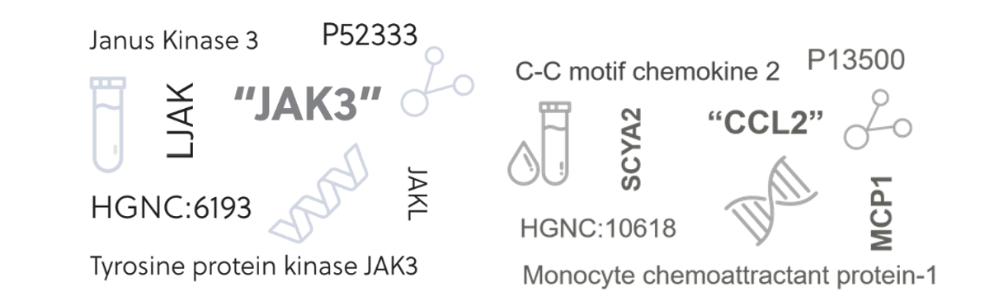
As new discoveries emerge and terminology evolves, the number of aliases, identifiers, and naming conventions continues to grow. Searches conducted under a single identifier often only return part of the available evidence, with little indication that additional information exists under a different name.
“The risk is thinking you have a complete picture when critical information is missing. If your data is not properly harmonized to bring all identities together, you might retrieve half of the relevant evidence while missing the other half without realizing it.”
Nicole Walters, Information Scientist at CAS
AI is increasingly used to identify patterns, relationships, and opportunities across vast amounts of biological information. However, the quality of those insights depends on the model's ability to recognize when different records refer to the same biological entity. When models are fueled with unstructured data, they can interpret the same protein, gene, or disease as different entities, leading to an incomplete view of the underlying biology. Without harmonized biological identities, AI can reinforce the gaps and inconsistencies present in the underlying data layer, rather than solving them.
Expert perspective
“AI systems inherit the gaps and inconsistencies present in the underlying biology data. If identities are fragmented, the model learns fragmented biology and reinforces blind spots across drug discovery workflows.”
Nicole Walters, Information Scientist at CAS
Giving life sciences data a common language
Solving the biological identity problem requires two things: a shared system of identity and a structured map of relationships. Authority constructs provide the foundation by assigning every biological entity a single, authoritative identity. Synonyms, cross-references, and alternative names are reconciled within a single record, allowing information about the same entity to be viewed together.
Biology ontologies build on this foundation by organizing the relationships between entities. They connect genes to proteins, proteins to diseases, and diseases to treatments along with other biological concepts, creating a structured view of how biological knowledge fits together.
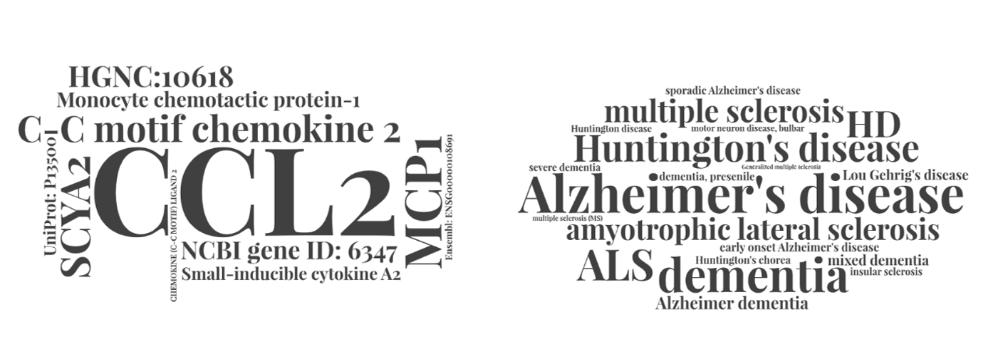
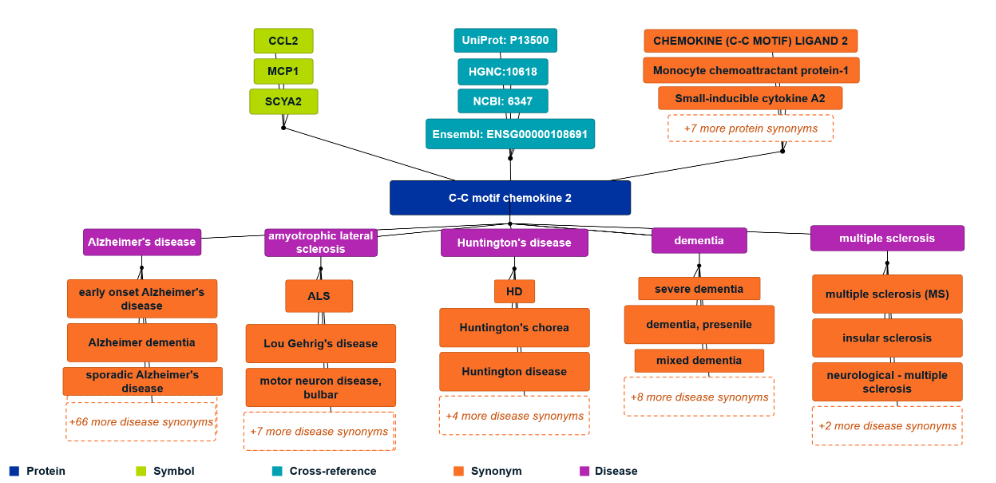
For R&D teams, this changes what can be seen and how decisions are made. A researcher investigating a protein target may discover previously overlooked connections to multiple biological pathways, providing additional context for its biological function and disease relevance. That same protein may also serve as a biomarker, revealing relationships that would otherwise remain hidden. By bringing identities and relationships together within a common framework, biology ontologies help reduce the risk of missed signals, duplicated research efforts, and unanticipated off-target effects linked to fragmented or incomplete information.
“You might come in with your protein target with no awareness that it is a member of three or four biological pathways. But when you find that identity within the ontology, you now see all those connections. Being able to aggregate all the information from different places around one identity creates value that was not previously accessible.”
Brian Caldwell, Information Scientist at CAS
For AI-enabled drug discovery workflows, the stakes are even higher. Authority constructs and biology ontologies provide a structured representation of biological knowledge. Unified identities and mapped relationships help models interpret biological information within the context of related entities rather than as isolated observations. Relationships spanning sources and domains become part of the evidence available for evaluating patterns, associations, and biological relevance. The result is a more complete picture of the underlying biology, helping organizations evaluate evidence, opportunities, and risk with greater confidence.
Key terms
– An authority construct is a standardized record that assigns a single, authoritative identity to a biological entity, reconciling all synonyms, alternative names, and cross-references into one unified source.
– A biology ontology is a structured system that organizes biological entities and maps the relationships between them, connecting genes to proteins, proteins to diseases, and diseases to treatments within a common framework.
The three barriers to building trustworthy biology ontologies
The benefits of biology ontologies depend on the quality of the underlying knowledge framework. However, establishing authoritative identities and relationships at scale presents three persistent challenges:
1. Ontology quality is shaped by the exceptions.
Public databases and automated aggregation can capture a significant portion of the biological landscape. The value of an ontology is often determined by the remaining records, where inconsistencies, ambiguities, and edge cases require scientific interpretation rather than automated matching. How these records are reconciled shapes the quality of the identities and relationships represented throughout the ontology. However, establishing authoritative representations requires scientific expertise, dedicated resources, and a heavy investment that extends beyond data aggregation.
“The first ~80% is the easy part. Many open-source databases get teams that far. The last 20% is where the real value sits, and where most organizations stop.”
Brian Caldwell, Information Scientist at CAS
2. Biology ontologies must keep pace with scientific discovery.
Everyday, new publications, patents, and database updates introduce new evidence and refine scientific understanding of biology. As new information enters the scientific landscape, existing representations of biological entities and relationships must be reviewed, validated, and updated to reflect the current state of the science. Maintaining an ontology is an ongoing process of incorporating new evidence and reconciling it with existing biological knowledge, which requires organizations to dedicate scientific resources beyond initial development.
3. Ontology development requires governance at scale.
Biological knowledge does not grow in a single direction. New entities, relationships, identifiers, and sources are added continuously across disciplines, therapeutic areas, and research domains. Maintaining consistency across that expanding body of knowledge requires governance processes capable of applying the same standards across millions of interconnected records. Governance must scale alongside the science, preserving the integrity of the ontology as new entities, relationships, and evidence are introduced.
Together, these challenges influence the completeness and reliability of the biological knowledge used to support R&D decisions.
How CAS brings structure to biological knowledge
The challenges outlined above are not new. Since 1965, CAS REGISTRY has assigned a unique, unambiguous identifier to each chemical substance it registers, regardless of what it is named in any given source. Today, thousands of organizations, including governmental agencies worldwide, rely on CAS Registry Numbers® for substance identification in regulatory applications. CAS is now applying the same organizing principle to biological entities, bringing the same rigor and reliability to proteins, genes, diseases, and organisms.
Drawing on decades of experience organizing scientific information, CAS information specialists establish authoritative biological identities and map the relationships between them, connecting genes to proteins, proteins to diseases, and diseases to treatments across biological, chemical, and pharmacological data. By integrating these domains within a single knowledge environment, CAS helps reveal connections that can remain hidden when information is distributed across disconnected sources. This forms the foundation of CAS BioFinder, a unified drug discovery platform designed to support evidence-based discovery decisions through connected scientific knowledge. By addressing the edge cases, ambiguities, and scientific information judgement calls that can be difficult to resolve through public databases and automated aggregation alone, CAS helps researchers interpret biological evidence within a broader scientific context.
Speed up drug discovery at every stage with comprehensive pharmaceutical data, AI-enhanced predictive technology, and critical information to prioritize the targets and drug candidates most likely to succeed.
Expert perspective
“CAS has been organizing scientific information for over a century. We have applied that same rigor to biology and built it into CAS BioFinder so R&D teams can see connections across biological data that would otherwise remain buried.”
Nicole Walters, Information Scientist at CAS
A catalyst for confident AI-driven drug discovery workflows
The promise of AI in drug discovery has never been greater, but neither has the importance of the data that supports it. The pharmaceutical organizations best positioned to benefit from AI will be those that can see beyond fragmented information to the broader biological context. Working hand in hand, authority constructs and ontologies give biology the structure needed to connect fragmented information and reduce blind spots.
Making that structure available at scale requires the same scientific expertise, curation, and governance discussed throughout this article. CAS BioFinder provides access to that connected view of biological knowledge, helping researchers work from a more complete understanding of the science so organizations can make high-stakes decisions with confidence.