

Executive Summary
- Drug discovery research for medications that can cross the blood-brain barrier and treat central nervous system conditions is evolving from passive permeability models to active delivery models.
- Research is moving beyond the small molecules that dominate approved central nervous system drugs. Proteins and peptides account for nearly 25% of therapeutic substances in blood-brain barrier research, compared with 4% of approved central nervous system drugs.
- Strategies that involve endogenous biological processes show the strongest growth in blood-brain barrier research. Examples include exosomes, receptor targeting, and nanobodies.
- Patent growth is most intense for antibody-based and gene delivery-based formats. Efflux modulation and computational design approaches are most prevalent in academic research.
The blood-brain barrier (BBB) is one of the most effective biological defense systems in the human body, tightly regulating molecular transport between circulation and the central nervous system. Tight junctions, limited vesicular transport, and active efflux mechanisms protect the brain from potentially harmful substances while preserving neural homeostasis. However, these same features also pose a major challenge for drug development, preventing many therapeutics from reaching clinically meaningful concentrations in the brain.
For decades, successful central nervous system (CNS) drug discovery largely relied on small molecules capable of crossing the barrier through passive diffusion. As a result, approved therapies for neurological and psychiatric disorders are concentrated in a physicochemical space favorable to passive diffusion, with a few exceptions that either exploit endogenous transporters or bypass the barrier by direct delivery into cerebrospinal fluid. Today, the range of therapeutic modalities is widening. Emerging disease-modifying approaches include monoclonal antibodies, recombinant proteins, peptides, nucleic acid therapeutics, and other advanced modalities that fall well outside the molecular characteristics traditionally associated with brain penetration.
This shift is changing how researchers approach CNS drug development. Rather than limiting discovery efforts to molecules that fit the constraints of the BBB, researchers areemphasizing more strategies that expand access to the brain for a broader range of therapeutic modalities. Advances in molecular design, protein engineering, delivery systems, and device-assisted approaches are enabling researchers to address transport as a design challenge rather than an inherent limitation.
The analysis presented here suggests that research is evolving from a model centered on passive permeability toward one focused on active delivery. By examining therapeutic modalities, molecular design principles, delivery technologies, innovation activity, and clinical progress, this article shows how advances across multiple disciplines are changing brain-directed drug development and broadening opportunities for the treatment of CNS diseases.
Publication trends in blood-brain barrier drug delivery
Using CAS IP Finder®, Powered by STN™, CAS scientists accessed the CAS Content Collection™, the the world's largest collection of scientist-curated data, to identify and extract data related to the BBB. The search returned more than 39,000 journal articles and over 3,900 patent families (see Figure 1).
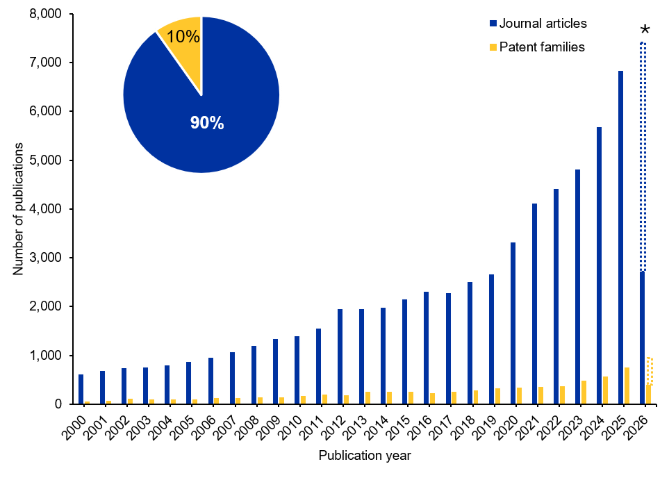
Journal publication output grew at an average of 12.9% a year between 2016 and 2025, while patent families more than tripled over the same period, from 225 to 738. The parallel growth of scientific and intellectual property activity suggests sustained interest in the field. Based on partial 2026 data, publication and patent activity are expected to continue increasing year-over-year.
Although considerable attention has been devoted to drug delivery strategies across the blood-brain barrier, it constitutes only one component of the research. Approximately 30% of the publications examined focus on one or more strategies, while the remainder address topics such as barrier biology, neuroinflammation, disease-associated dysfunction, and experimental models. The analysis that follows focuses on the delivery-oriented segment of the field, highlighting the molecular design principles, transport strategies, and emerging clinical approaches being explored to expand therapeutic access to the central nervous system.
Speed up drug discovery at every stage with comprehensive pharmaceutical data, AI-enhanced predictive technology, and critical information to prioritize the targets and drug candidates most likely to succeed.
Expanding beyond conventional CNS drug space
Before examining the strategies used to overcome the blood-brain barrier, it is useful to consider the nature of the therapeutic cargo these approaches are intended to transport. Historically, CNS drug development has been dominated by small molecules, which account for 94% of approved CNS drugs (see Figure 2A). In contrast, the current literature encompasses many more therapeutic modalities. The analysis covered substances in this dataset indexed with CAS roles THU (therapeutic), PAC (pharmacologic), and PKT (pharmacokinetic). While small molecules remain the largest category, representing 67% of substances, proteins and peptides account for nearly 25%, compared with just 4% of approved CNS drugs. Nucleic acid therapeutics contribute a further 6% (see Figure 2B). This distribution suggests a growing focus on targets that are difficult to address using conventional small molecule approaches.

The ability of a molecule to cross the barrier by passive diffusion is influenced by physicochemical properties such as molecular weight, polarity, lipophilicity, and hydrogen-bonding capacity. As therapeutic modalities diversify, one question is whether contemporary targeted drug discovery remains anchored to the design principles that characterized successful CNS drugs or is expanding into a broader chemical space.
To address this question, the analysis compared small molecules reported in the literature with approved small molecule CNS drugs using Lipinski's Rule of Five and a CNS-oriented Rule of Five together with polar surface area (see Figure 3). Lipinski's Rule of Five was derived to predict oral absorption rather than brain penetration, and it remains the most applied druglikeness filter, including in CNS programs.

The CNS variant adds tighter constraints that distinguish brain-penetrant molecules. Most substances in the dataset remain broadly drug-like: 73% satisfy all four Lipinski criteria, compared with 91% of approved CNS drugs. The divergence becomes more apparent when CNS-associated criteria are applied. Whereas 70% of approved CNS drugs satisfy all five criteria, only 38% of small molecules in the dataset do so. These results indicate that small molecules reported in the research occupy a broader physicochemical space than marketed CNS therapeutics.
While the dataset encompasses compounds at different stages of development and with varying intended applications, the overall trend suggests that many do not conform to the physicochemical profile traditionally associated with CNS drugs. This increases the importance of delivery strategies capable of overcoming intrinsic permeability limitations.
Chemical class influences blood-brain barrier permeability but does not determine success
It is well established that CNS drugs tend to occupy a distinct physicochemical space characterized by lower polarity and moderate lipophilicity. However, blood-barin barrier permeability is also influenced by molecular architecture. To explore this relationship, compounds in the corpus were assigned to structural classes by substructure matching using RDKit and evaluated according to the proportions predicted either to distribute readily into the brain (logBB > 0.3) or be excluded (logBB < -1).
The analysis reveals pronounced differences between chemical classes (see Figure 4). Piperazine-, piperidine-, carbamate-, and sulfonamide-containing molecules are enriched among compounds predicted to penetrate the BBB, whereas glycosides, peptidomimetics, carboxylic acids, and other oxygen-rich scaffolds are associated with exclusion. Closely related heterocycles also diverge sharply. Piperazine-containing compounds show a greater likelihood of favorable brain distribution than morpholine-containing analogues, illustrating how minor structural changes can substantially affect predicted BBB permeability.
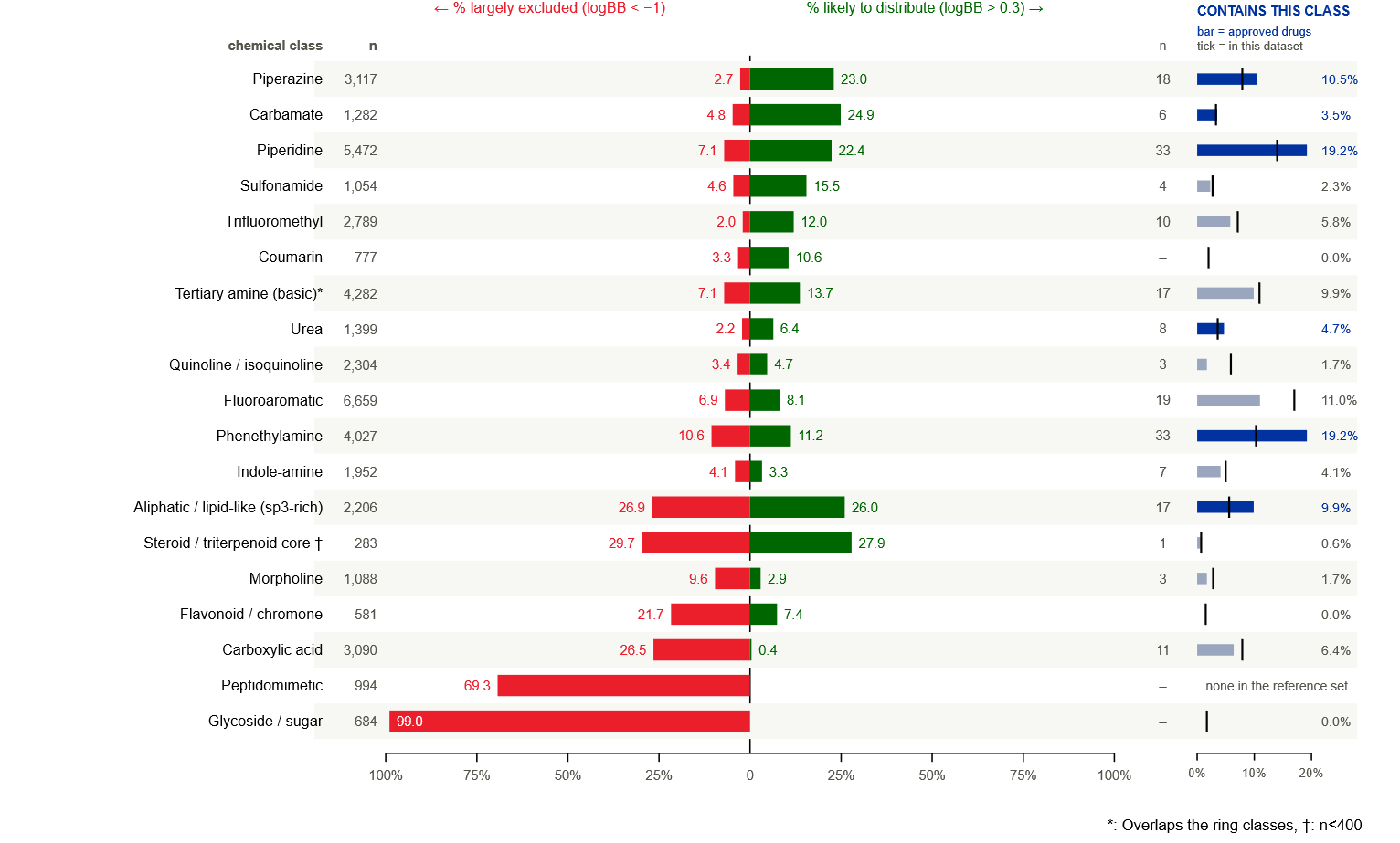
Comparison with 172 approved CNS small molecule drugs - those of the 226 small molecules in the approved-drug set whose structures could be matched and described by the five computed descriptors - suggests that these trends are informative but not deterministic. Several classes associated with favorable BBB penetration, including piperidines and piperazines, are also common among marketed CNS medicines, supporting the relevance of the observed patterns.
At the same time, scaffold prevalence among approved drugs does not always mirror predicted permeability. Phenethylamines, for example, are among the most frequent motifs in approved CNS therapies despite exhibiting only average predicted distribution in the broader corpus. Conversely, strongly excluded classes such as glycosides remain nearly absent from marketed CNS drugs. Together, these findings indicate that chemical class can significantly influence the likelihood of penetration, while therapeutic success depends on a broader combination of target biology, pharmacology, safety, and molecular optimization.
Advances in medicinal chemistry can improve the probability of brain exposure, but many promising therapeutics continue to fall outside traditional chemical space. As a result, researchers are complementing molecular optimization with delivery technologies designed to exploit endogenous transport mechanisms, package therapeutics within specialized carriers, or bypass the barrier altogether.
Key takeaway
The overall trend suggests that many compounds do not conform to the physicochemical profile traditionally associated with CNS drugs. This increases the importance of delivery strategies capable of overcoming intrinsic permeability limitations.
Strategies to cross the blood-brain barrier: shifts in research focus
Researchers are developing a diverse set of blood-brain-crossing strategies due to the variety of molecules under examination for CNS indications. Although the relative distribution of major strategy families has remained stable over the past decade, closer examination reveals important shifts in research priorities, with growing interest in biologically derived delivery systems and declining emphasis on approaches that modulate physiology (see Figure 5).

Nanoparticle carriers consistently represent the largest share, accounting for approximately one-quarter of annual mentions throughout the period, indicating sustained interest despite ongoing translational challenges. In contrast, biological vesicle and cell carriers have expanded, rising from a minor share in 2016 to roughly 14% of strategy mentions by 2025, making them one of the fastest-growing categories.
Receptor-mediated transcytosis and bypass/direct-delivery approaches have maintained relatively stable shares at around 12%, reflecting continued confidence in these clinically validated routes. Energy-based approaches show a modest increase from 5% to 8%. Meanwhile, efflux-modulation strategies have steadily declined, suggesting reduced enthusiasm for pharmacological manipulation of transporters.
A text-mining and natural language processing analysis then examined each strategy family in more detail. Figure 6 reveals that the apparent stability of the major strategy families masks substantial differences in the trajectories of individual approaches.

Within receptor-mediated transcytosis, the transferrin receptor, LRP1/angiopep-2 and ApoE/lipoprotein mimetics are the most studied targets, while folate and lactoferrin receptors account for a smaller share of the literature. In the nanoparticle category, research activity remains distributed across numerous formats, including liposomes, polymeric nanoparticles, nanocarriers, and lipid nanoparticles, indicating continued exploration rather than convergence around a preferred carrier platform.
By contrast, the strongest growth signals originate from the vesicle and cell carrier family, where exosomes, engineered exosomes, and cell-membrane camouflage approaches have expanded rapidly, suggesting growing confidence in biologically derived delivery systems.
The analysis also highlights a broader shift in how researchers are attempting to overcome the BBB. Strategies that work with endogenous biological processes, such as exosomes, receptor targeting, nanobodies, engineered viral vectors, and AAV capsid engineering, generally show stronger growth than approaches that seek to modify BBB physiology directly. In contrast, families centered on efflux inhibition and several forms of chemical or osmotic barrier modulation are declining, reflecting reduced emphasis on pharmacologically manipulating transporter activity or disrupting barrier integrity.
Variation within families is equally revealing. For example, within adsorptive transcytosis, traditional cell-penetrating peptides such as TAT and penetratin show weaker momentum than newer polymer- and material-based approaches, while within energy-based opening, focused ultrasound remains the dominant strategy but newer photothermal and photodynamic methods are gaining visibility.
Taken together, Figure 6 suggests that BBB research is focused on enabling transport, with less emphasis on pharmacologically altering barrier permeability. The field appears to be diversifying into multiple complementary approaches, with innovation concentrated in biologically inspired delivery systems and engineered transport technologies.
Translational research and patent trends across blood-brain barrier delivery strategies
Differences in the balance between scientific publications and patent filings provide additional insight into how BBB-delivery technologies are evolving. Comparing these two outputs reveals which strategies are attracting commercial investment and intellectual property activity, and which remain the focus of academic research.
Figure 7 compares the relative emphasis placed on different BBB-crossing strategies in the patent and scientific literature. Strategies appearing to the right of the dashed line account for a larger share of patents than publications, suggesting stronger commercial interest, whereas those to the left are represented more in journals than patent filings.

Protein engineering is the most patent-intensive strategy family, driven by antibody-based formats such as nanobodies, bispecific antibodies, and antibody fragments. Gene delivery vectors, particularly AAV-based approaches, also show a strong patent bias, indicating sustained commercial investment. At the opposite end of the spectrum, efflux modulation and computational approaches remain publication-led.
The analysis also reveals that family-level trends can mask important differences among individual approaches. For example, receptor-mediated transport as a whole shows a patent advantage, driven by transferrin receptor-targeting technologies, while carrier-mediated transport shows the widest internal spread of any family: prodrug conjugation appears at 4.65 times its journal share, while MCT1-directed work appears at 0.28 times. Similar contrasts are observed for chemical and osmotic modulation, where emerging targets such as claudin-5 attract less patent activity than more established approaches.
Viewed alongside the publication trends, the figure highlights two distinct types of opportunity: areas supported by extensive scientific research but limited commercial activity, and areas where patent filings appear to be advancing faster than the published evidence base. This distinction provides insight into where the field may be maturing versus where future competitive activity may be concentrated.
CAS Connections℠ brings the CAS Content Collection and CAS Newton℠ agentic AI directly into your existing research platforms, AI environments, and agentic workflows, so the science your organization depends on is available wherever decisions are made.
Key takeaway
The field appears to be diversifying into multiple complementary approaches, with innovation concentrated in biologically inspired delivery systems and engineered transport technologies.
Strategies in clinical development
While publication and patent trends identify emerging areas of interest, clinical data show which delivery strategies have progressed beyond proof of concept. Among 241 approved CNS drugs examined in this analysis, 192 achieve brain exposure through passive diffusion, while most of the remainder rely on a small number of alternative routes. Bypass approaches account for the largest group, ranging from intranasal formulations of established drugs to intrathecal and intraventricular administration of biologics such as nusinersen, tofersen, and cerliponase alfa.
A smaller number exploit endogenous transport systems, including LAT1-mediated uptake of levodopa, gabapentin, and pregabalin. Therapies specifically engineered to exploit blood-brain barrier transport mechanisms have only recently begun reaching regulatory approval: pabinafusp alfa approved in Japan in 2021 and tividenofusp alfa which received FDA accelerated approval in the U.S. in March 2026, with a confirmatory trial ongoing. Onasemnogene abeparvovec, approved in 2019, reaches the CNS after intravenous administration by exploiting the natural tropism of the AAV9 capsid, an intrinsic property of the serotype rather than a designed transport mechanism.
| Delivery strategy | Highest phase | Representative candidates | Indications (Number of trials) |
|---|---|---|---|
| Receptor-mediated transcytosis | Phase III | Trontinemab (3 trials); ANG1005 and GRN1005 (angiopep-2 conjugates, both stopped); SGT-53 (transferrin-receptor liposome carrying p53 DNA) | Alzheimer's disease (4); oncology (4) |
| Bypass/direct routes | Phase III | Salanersen (3 trials, intrathecal); GC101 AAV; AB-1005 (intraputaminal, 2 trials); AMT-260; NGN-101 and TSHA-101 | Spinal muscular atrophy (6); lysosomal and monogenic disease (4); Parkinson's disease (3); MPS II (1); epilepsy (1) |
| Energy-based opening | Phase III | Exablate and NaviFUS; sonodynamic therapy with 5-ALA; SonALAsense programs (terminated and suspended) | Oncology (9); Alzheimer's disease (1); Parkinson's disease (1); ALS (1) |
| Nanoparticle carriers | Phase III | Liposomal transcrocetin; AGuIX gadolinium nanoparticles; intra-arterial carboplatin with liposomal doxorubicin; rhenium-186 obisbemeda | Oncology (10) |
| Vesicle and cell carriers | Phase I/II | MSC-derived exosomes (intranasal); iNSC-EV01; NouvSoma001; AlloEx; hUC-MSC-sEV-001 | Stroke (4); frontotemporal dementia (1) |
| Gene delivery vectors, systemic | Phase I/II | AAV9-GLB1 (systemic administration); BFB-101; CTx1000 | Lysosomal and monogenic disease (2); ALS (1) |
| None (passive diffusion) | Phase III | RO7771950; furmonertinib; selumetinib (3 trials); tucatinib (3 trials); silevertinib; WSD0922-FU | Oncology (12) |
Table 1: Representative CNS clinical candidates in development, analyzed by indication, strategy, and stage. Data compiled from 65 registered clinical trials. Source: ClinicalTrials.gov
Among currently investigated delivery approaches, receptor-mediated transcytosis provides the strongest evidence of clinical feasibility (see Table 1). JCR Pharmaceuticals' pabinafusp alfa and Denali Therapeutics' tividenofusp alfa (NCT05371613) demonstrate that endogenous transport pathways can be used for CNS delivery of biologics, while Roche's Brainshuttle platform, represented by trontinemab, is testing the scalability of this concept in large Phase III Alzheimer's disease studies (NCT07169578, NCT07170150, NCT07717411).
Several other approaches have also progressed into late-stage development, including focused-ultrasound platforms such as Exablate (NCT05317858) and NaviFUS (NCT06496971), nanoparticle-enabled therapies such as liposomal transcrocetin (NCT06477939) and rhenium-186 obisbemeda (NCT01906385), and bypass-based programs such as Biogen's salanersen (NCT07444450, NCT07444476, NCT07221669). Many of these technologies function as delivery enablers, designed to improve access for antibodies, enzymes, nucleic acids, or other therapeutic cargos.
Clinical activity remains concentrated by indication. Glioblastoma and brain metastases account for most trials involving nanoparticle carriers and energy-based openings, whereas receptor-mediated transcytosis has been validated in MPS II. Bypass approaches remain prominent in spinal muscular atrophy and other rare neurological disorders, including AAV gene therapies delivered intraventricularly or by convection-enhanced delivery (NCT06063850). This distinction is important because tumor-associated vasculature is often partially disrupted, reducing the barrier function that characterizes neurodegenerative disease. Consequently, success in neuro-oncology may not translate to disorders such as Alzheimer's or Parkinson's disease, where the blood-brain barrier remains largely intact.
At present, no single delivery strategy dominates clinical development. Brain-shuttle antibodies, focused ultrasound, intrathecal delivery, gene vectors, nanoparticles, and conventional brain-penetrant small molecules are all advancing in parallel. Taken together, the clinical data indicate that proof of concept has been achieved for several BBB-delivery strategies, but broad clinical validation remains limited and highly indication-dependent.
Key takeaway
The clinical data indicate that proof of concept has been achieved for several blood-brain barrier delivery strategies, but broad clinical validation remains limited and highly indication-dependent.
Looking ahead to drug development for crossing the blood-brain barrier
BBB delivery is entering a phase in which emerging technologies are being tested for meaningful clinical validation. Receptor-mediated transcytosis has established proof of concept and is now being tested at large scale through programs such as Roche's trontinemab, while several of the fastest-growing research areas, including vesicle and cell carriers, remain mainly at an early stage of development.
At the same time, approaches that work in tumors must still demonstrate that they can overcome the intact BBB characteristic of neurodegenerative disease. These trends point to a future of brain delivery built on a portfolio of complementary approaches, whose success will depend on their ability to address the specific biological and therapeutic challenges of different CNS disorders.