

Executive Summary
- Neuroinflammation is a commonality across numerous neurological disorders, including Alzheimer's disease, Parkinson’s disease, ALS, and depression. Researchers are interested in treating neuroinflammation as part of therapeutic strategies to combat these and other neurological conditions.
- Neuroinflammation can have protective effects, but we are now seeing a close relationship between chronic neuroinflammation and neurodegeneration.
- Neuroinflammation pathways are similar across diseases, but specific targets are gaining greater attention for particular conditions, including TREM2 and NLRP3 for Alzheimer's treatment and IL-17 for treating multiple sclerosis.
- Repurposed drugs account for 76% of neuroinflammation-focused clinical candidates, while less than a quarter (24%) are novel therapeutics. This underscores the complexity of neurological drug development in terms of safety and efficacy.
Neuroinflammation: A fundamental driver of pathology
Neuroinflammation, the activation of innate and adaptive immune responses within the central nervous system, has emerged as one of the most dynamic areas of neuroscience research. Once considered merely a consequence of neurological injury or disease, neuroinflammation is now recognized as a fundamental driver of pathology across a spectrum of conditions, ranging from acute brain injuries to chronic neurodegenerative diseases like Alzheimer’s and psychiatric disorders including major depression.
The brain's immune response is orchestrated primarily by resident glial cells, particularly microglia and astrocytes, which respond to various stimuli including protein aggregation, cellular debris, pathogens, and metabolic stress. While acute neuroinflammation serves protective and reparative functions, chronic or dysregulated inflammatory responses contribute to progressive neuronal damage, synaptic dysfunction, and clinical decline.
As researchers have recognized the importance of neuroinflammation, they are identifying it as a potential target for therapeutic intervention. We leveraged the CAS Content Collection™, the largest human‑curated repository of scientific information, to understand neuroinflammation research trends. Recent years have witnessed explosive growth in publications related to neuroinflammation, with annual journal publications rising from approximately 200 in 2000 to over 9,000 in 2025, while patent families have grown from fewer than 50 to nearly 800 during the same period (see Figure 1).
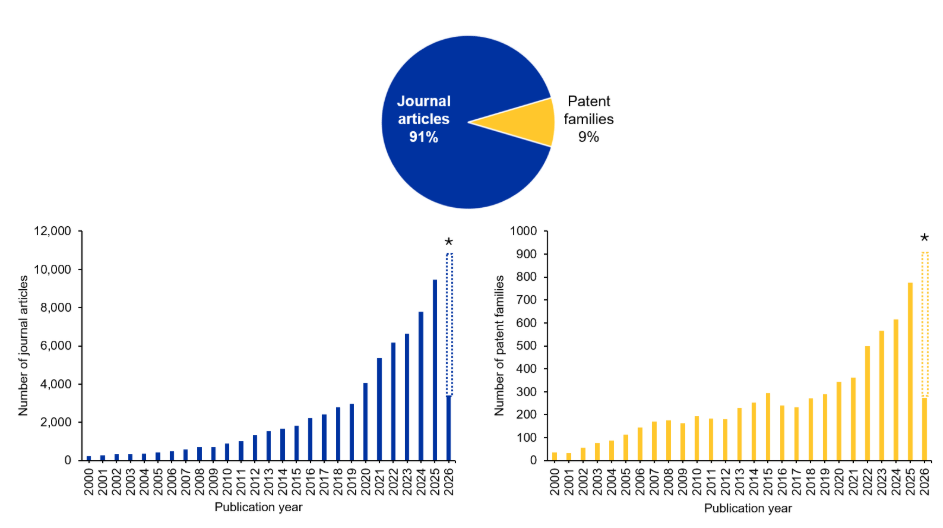
This represents a compelling shift in fundamental research and commercial interest, driven by improved understanding of inflammatory mechanisms, advanced diagnostic tools, and the urgent need for disease-modifying therapies in neurological conditions.
Get emerging trends, useful connections, and future opportunities at the intersection of science, technology, and innovation delivered to your inbox.
The disease landscape: where neuroinflammation matters
Neuroinflammation intersects with almost every major neurological condition, but its relevance varies across diseases. Analysis of publication and patent data reveals distinct patterns in research intensity and commercial interest (see Figure 2).
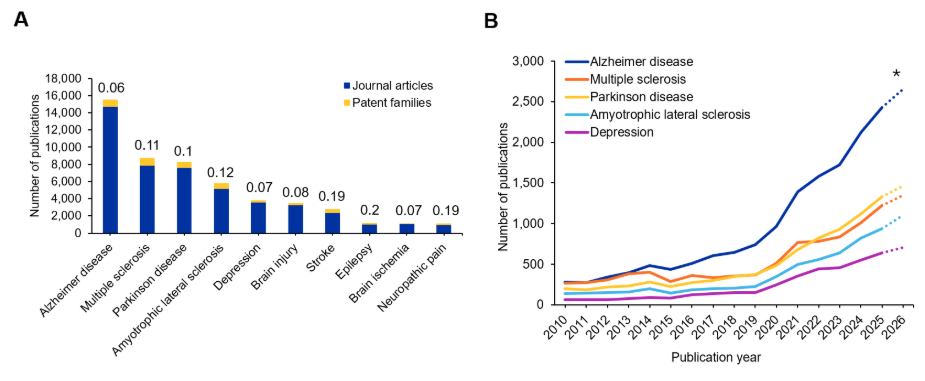
- Alzheimer's disease dominates the neuroinflammation research landscape, accounting for the largest share of publications among neurological conditions. The patent-to-journal article ratio of 0.06 for Alzheimer's disease reflects the substantial basic research foundation supporting translational efforts. Publication trends show dramatic growth from 2010 to 2025, with journal article output increasing approximately tenfold. This intense focus on Alzheimer's disease reflects accumulating evidence that neuroinflammation is not just a response to amyloid-β plaques and tau tangles, but an important contributor to disease progression. Genetic studies identifying TREM2, CD33, and other immune-related risk genes have reinforced the causal role of neuroinflammation in Alzheimer's pathogenesis.
- Multiple sclerosis (MS) represents the second-largest disease area in neuroinflammation research, with a patent-to-journal ratio of 0.11 indicating higher commercial development activity. As a primary neuroinflammatory condition where immune dysfunction drives demyelination, MS has been a proving ground for anti-inflammatory therapeutics.
- Parkinson's disease ranks third, with publication volumes reaching around 1,300 annually and a patent-to-journal ratio of 0.10. The recognition that α-synuclein aggregates trigger microglial activation and chronic inflammation has repositioned Parkinson's disease from a primarily dopaminergic disorder to one with significant inflammatory components.
- Amyotrophic lateral sclerosis (ALS) shows a patent-to-journal ratio of 0.12, suggesting relatively robust translational interest given the smaller research base. The involvement of neuroinflammation in motor neuron degeneration has opened new therapeutic avenues beyond traditional neuroprotective approaches.
- Depression rounds out the top five neurological conditions, with approximately 500-600 annual publications addressing neuroinflammatory mechanisms. This represents an important expansion of neuroinflammation research beyond classical neurological disorders into psychiatry, supported by evidence linking peripheral inflammation, microglial activation, and mood disorders.
Other significant conditions include stroke, brain injury, epilepsy, and neuropathic pain, each with distinct inflammatory profiles and therapeutic considerations. Despite the diversity of these conditions, neuroinflammation is implicated in their pathophysiology, warranting therapeutic intervention across multiple disease contexts.
Drivers and regulators of neuroinflammation
Neuroinflammation arises from a complex network of interactions between resident immune cells, inflammatory mediators, immune surveillance pathways, and disease-associated proteins. To better understand the molecular landscape of neuroinflammation, we used indexed concepts from the CAS Content Collection, resulting from full document analysis by CAS analysts. The concepts were acquired through CAS IP Finder®, Powered by STN™, which provides advanced access to the CAS Content Collection alongside powerful semantic indexing and analytical tools.
We categorized top concepts as mechanistic regulators, biomarkers, and potential therapeutic targets. Figure 3 reveals substantial overlap between these categories, indicating that many of the molecules implicated in disease pathogenesis are also being explored as diagnostic indicators and therapeutic intervention points.
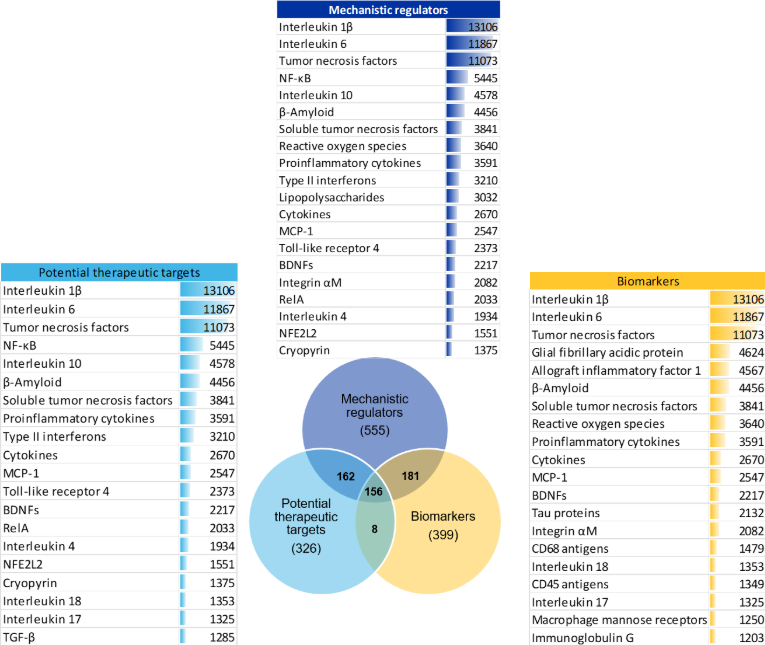
A dominant theme emerging from the analysis is the central role of inflammatory cytokine networks. Interleukin-1β (IL-1β), interleukin-6 (IL-6), and tumor necrosis factor (TNF) rank among the most frequently indexed concepts across all three categories, reflecting their importance in coordinating neuroimmune responses. Produced primarily by activated microglia and infiltrating immune cells, these cytokines regulate leukocyte recruitment, blood-brain barrier permeability, synaptic function, and neuronal survival. Persistent activation of these signaling pathways can transform a protective immune response into chronic neuroinflammation that contributes to neurodegeneration.
Upstream of many inflammatory pathways lies NF-κB, a transcription factor that functions as a master regulator of immune activation. NF-κB integrates signals from cytokine receptors, pattern-recognition receptors, and cellular stress pathways to induce expression of inflammatory mediators, adhesion molecules, and chemokines. Its prominence in the literature reflects its role as a key signaling hub through which diverse inflammatory stimuli converge.
The analysis also highlights the importance of innate immune sensing mechanisms. Toll-like receptor 4 (TLR4) and lipopolysaccharide (LPS) are among the leading mechanistic regulators, underscoring the widespread use of TLR4-mediated signaling as a model for studying neuroinflammatory activation. Beyond microbial products, TLR4 can also be activated by endogenous danger-associated molecular patterns released during tissue injury and neurodegeneration. This activation promotes cytokine production, microglial activation, and amplification of inflammatory signaling cascades. Similarly, MCP-1 (CCL2), a chemokine involved in monocyte trafficking, reflects the important contribution of peripheral immune-cell recruitment to central nervous system inflammation.
Microglia, the brain's resident macrophages, occupy a central position within this network. Under physiological conditions, microglia continuously monitor their environment and support tissue homeostasis. However, exposure to protein aggregates, cellular debris, or chronic stress signals can drive sustained activation, resulting in excessive cytokine release, oxidative stress, and synaptic dysfunction. The prominence of molecules such as integrin αM (CD11b), MCP-1, and proinflammatory cytokines reflects the importance of microglial activation across diverse neurological disorders.
A second major theme is the close relationship between neuroinflammation and neurodegeneration. β-Amyloid ranks highly among regulators, biomarkers, and therapeutic targets, illustrating its dual role as a pathological hallmark of Alzheimer's disease and a potent trigger of innate immune activation. Likewise, tau proteins appear among leading biomarkers, supporting growing evidence that pathological protein aggregates participate in inflammatory signaling rather than solely serving as disease markers. Through activation of microglia and inflammasome pathways, these protein aggregates can establish self-perpetuating cycles of inflammation and neuronal injury.
Although canonical mitochondrial regulators such as PINK1, Parkin, or TFAM do not appear among the most prominent concepts, the presence of reactive oxygen species (ROS) and NRF2 (NFE2L2) highlights the important contribution of oxidative stress to neuroinflammatory pathology. Mitochondrial dysfunction can increase ROS production, which in turn activates NF-κB signaling, inflammasome assembly, and cytokine secretion. NRF2 serves as a key counter-regulatory pathway by inducing antioxidant defenses that limit oxidative damage and inflammatory activation. Together, these observations illustrate how inflammatory, metabolic, and neurodegenerative processes converge to shape the neuroinflammatory response.
Key takeaway
Neuroinflammation arises from a complex network of interactions between resident immune cells, inflammatory mediators, immune surveillance pathways, and disease-associated proteins.
Emerging targets and translational research opportunities
Building on this broad mechanistic landscape, we next examined neuroinflammation-associated targets through the lens of research activity, patenting intensity, and growth in scientific interest. Targets were prioritized using publication volume, patent activity, patent-to-journal ratios, and changes in document counts over the past decade (see Figure 4).
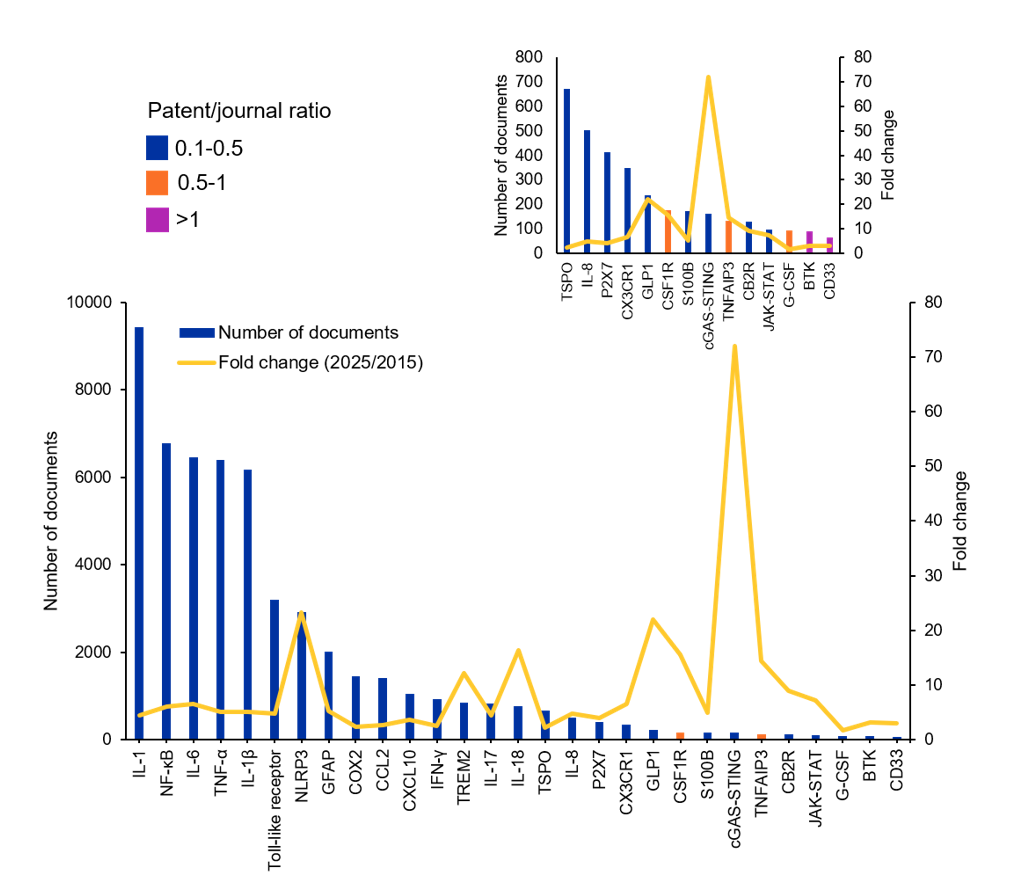
The analysis reveals a clear distinction between established inflammatory pathways and emerging therapeutic opportunities. Traditional cytokine targets including IL-1β, IL-6, TNF, and NF-κB continue to dominate the literature, reflecting decades of evidence supporting their central roles in neuroinflammatory signaling. Their large publication volumes indicate that these pathways remain foundational to understanding immune-mediated neurological diseases.
In contrast, several targets exhibit disproportionately rapid growth relative to their document counts, suggesting increasing translational interest. Among these, NLRP3 stands out as an important emerging target. The NLRP3 inflammasome functions as an innate immunity sensor that responds to protein aggregates, mitochondrial dysfunction, oxidative stress, and cellular damage. Upon activation, it promotes maturation and release of IL-1β and IL-18, linking upstream danger signals to downstream inflammatory responses. Growing evidence implicating NLRP3 in Alzheimer's disease, Parkinson's disease, and ALS has made it an attractive target for therapeutic intervention.
Other expanding areas include pathways involved in innate immune sensing and immunometabolism. The cGAS-STING pathway, originally characterized as a cytosolic DNA-sensing system, has emerged as an important mediator of sterile neuroinflammation driven by mitochondrial damage and nucleic acid accumulation. Similarly, TREM2, a microglial receptor associated with Alzheimer's disease risk, has gained substantial attention because of its role in regulating microglial survival, metabolism, phagocytosis, and responses to amyloid plaques.
This analysis also highlights growing interest in targets that bridge inflammation and cellular metabolism. GLP-1 receptor (GLP-1R) agonists, initially developed for metabolic disease, have attracted considerable attention because of their anti-inflammatory and neuroprotective effects. Recently, GLP‑1R agonist semaglutide was shown in a preclinical model to reduce neuroinflammation by suppressing inflammatory signaling and promoting neuroprotective responses, supporting potential applications in neurodegenerative diseases. Meanwhile, BTK, a kinase involved in innate and adaptive immune signaling, is being investigated as a potential means of modulating microglial and lymphocyte activity without broad immunosuppression.
Patent activity further suggests that several emerging targets including NLRP3, BTK, cGAS-STING, and GLP-1R are attracting translational and commercial interest beyond what publication volume alone would predict. These pathways combine rapid growth in research activity with increasing patenting efforts, highlighting their potential as next-generation therapeutic targets. These trends indicate that the field is evolving from broad suppression of inflammatory pathways toward more selective modulation of innate immune sensing, microglial biology, immunometabolism, and disease-specific inflammatory mechanisms.
Disease-specific neuroinflammatory signatures
While many neuroinflammatory pathways are common across neurological disorders, their relative importance may differ substantially between diseases. To identify targets showing preferential disease associations, we analyzed co-occurrence patterns between neuroinflammation-related targets and neurological conditions using standardized residuals, highlighting deviations from expected literature associations (see Figure 5).
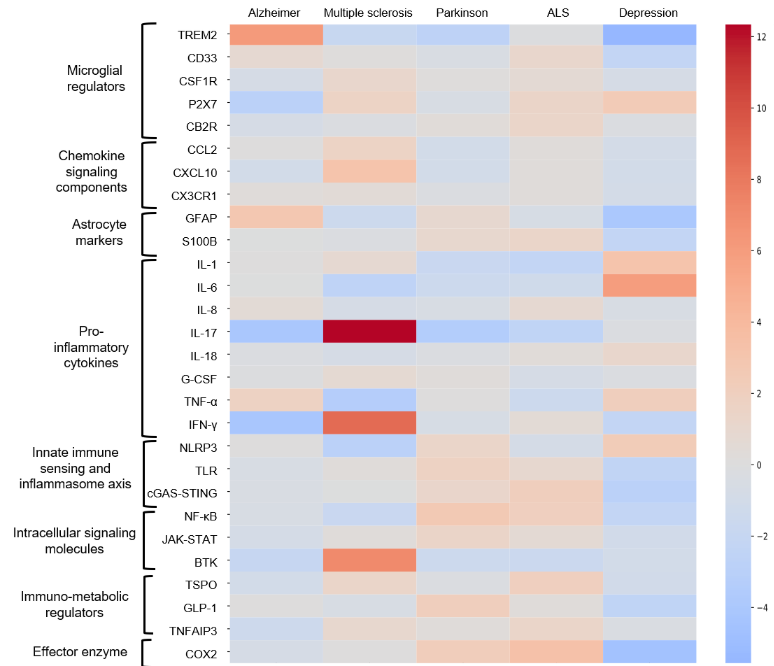
The heatmap in Figure 5 presents standardized residuals from the association analysis between neuroinflammation-related targets and neurological conditions. The color scale reflects the z-score of the residuals, where positive values (red) indicate that a target-disease association occurs more frequently than expected, and negative values (blue) indicate that it occurs less frequently than expected. Cells with |z| ≥ 2 represent noteworthy deviations from expectation and highlight areas of preferential or underrepresented association within the literature.
Rather than measuring absolute publication volume, the heatmap identifies targets that show a disproportionate association with specific diseases relative to their overall occurrence. Consequently, strong positive residuals may reflect disease-specific biological relevance, emerging research priorities, or heightened translational interest.
Among microglial regulators, TREM2 exhibits a strong positive residual in Alzheimer's disease, indicating a substantially greater association than expected. This finding is consistent with the central role of TREM2-mediated microglial responses in amyloid clearance, plaque-associated microglial activation, and Alzheimer's disease genetics. The same target shows weaker-than-expected associations in other disorders, suggesting a more disease-specific relationship. Similarly, CD33 and CSF1R, both important regulators of microglial function, show comparatively balanced patterns across diseases, reflecting their broader involvement in neuroinflammatory processes.
The most prominent positive deviation in the heatmap is observed for IL-17 in MS, highlighting the exceptional importance of IL-17-mediated immune responses in MS compared with other neurological diseases. This enrichment aligns with the established contribution of IL-17-producing T cells to autoimmune demyelination and blood-brain barrier disruption. MS also shows positive residuals for IFN-γ and BTK, further emphasizing the significant contribution of adaptive immune signaling and lymphocyte-associated pathways to disease pathogenesis.
Several innate immune pathways show moderate positive enrichment across neurodegenerative diseases. Components of the NLRP3 inflammasome, TLR signaling, and the cGAS-STING pathway tend to display positive residuals in Alzheimer's disease, Parkinson's disease, and ALS. These pathways function as cellular danger sensors that detect protein aggregates, mitochondrial dysfunction, and damaged nucleic acids. Their enrichment supports growing evidence that chronic activation of innate immune surveillance mechanisms contributes to neurodegeneration beyond classical autoimmune disorders.
Among intracellular signaling molecules, NF-κB and JAK-STAT exhibit disease-dependent residual patterns, reflecting their roles as shared downstream hubs rather than disease-exclusive pathways. Because these signaling networks integrate inputs from multiple cytokines and innate immune receptors, they appear across diverse conditions but may show stronger-than-expected associations in diseases where other inflammatory programs dominate.
The immunometabolic regulators TSPO and GLP-1R display selective enrichment in specific disorders. TSPO, widely used as a marker of activated microglia in neuroimaging studies, shows stronger-than-expected associations in diseases characterized by pronounced glial activation (MS and ALS). GLP-1R demonstrates enrichment in neurodegenerative contexts, particularly Parkinson’s, reflecting growing interest in its combined metabolic, anti-inflammatory, and neuroprotective effects.
Overall, the heatmap reveals that while many neuroinflammatory pathways are shared across neurological disorders, certain targets exhibit disease-specific enrichment patterns. These patterns provide a nuanced view of disease biology and may help prioritize targets with the greatest condition-specific translational potential.
Most AI tools were built for language, but CAS Newton℠ is built on over 150 years of peer-reviewed scientific literature that is curated by CAS scientists and interconnected across disciplines. Every answer is sourced and cited so you can verify each one.
Clinical translation of neuroinflammation research
Having established the central role of neuroinflammation in neurological disease biology, the next question is how effectively these insights are translating into therapies. Despite extensive evidence implicating inflammatory pathways in disease progression, relatively few approved therapies target neuroinflammation in neurodegenerative disorders. MS remains a notable exception, with several approved immunomodulatory therapies demonstrating clear clinical benefit, whereas most neuroinflammation-focused approaches in Alzheimer's disease, Parkinson's disease, and ALS remain investigational. This translational gap reflects the complex and context-dependent nature of neuroinflammation, where immune responses can exert protective and pathological effects depending on disease stage and cellular context.
We analyzed data from ClinicalTrials.gov and found that repurposed drugs account for 76% of neuroinflammation-focused clinical candidates, whereas only 24% represent novel therapeutics (see Figure 6A). This reliance on repurposing reflects the complexity of central nervous system drug development and the opportunity to leverage compounds with established safety profiles, particularly agents originally developed for autoimmune and inflammatory disorders.
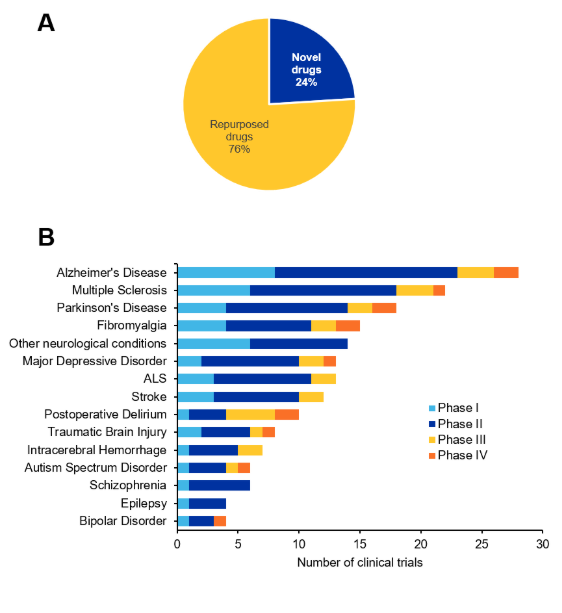
Clinical activity is most active in Alzheimer's disease, MS, and Parkinson's disease (see Figure 6B). Across most indications, the largest proportion of studies is in Phase II, suggesting that many candidates have progressed beyond initial safety evaluation and are now undergoing proof-of-concept testing. Comparatively few programs are in advanced clinical stages, highlighting the challenges involved in translating promising neuroinflammatory targets into clinically effective therapies.
Selected new drug candidates undergoing clinical evaluation are summarized in Table 1. Unlike repurposed therapies, these agents were developed to modulate neuroinflammatory processes and represent emerging approaches to disease modification.
Table 1: Selected drug candidates and their molecular targets across the neuroinflammation drug-development pipeline. Source: ClinicalTrials.gov, CAS Content Collection.
The clinical pipeline demonstrates growing confidence in neuroinflammation as a therapeutic strategy. However, the predominance of repurposed agents and mid-stage trials indicates that the field remains in a validation phase.
Challenges and opportunities in translational medicine for neuroinflammation
Despite growing interest in neuroinflammation-targeted therapies, several challenges continue to limit clinical success. A major one is delivery across the blood-brain barrier, which restricts access of many biologics and large molecules to the central nervous system. Emerging approaches include lipid nanoparticle formulations, receptor-mediated transport systems, and focused ultrasound, all of which may help improve brain delivery.
Another obstacle is the timing of intervention. Neuroinflammation can be protective during early disease stages but becomes harmful when chronically activated. As a result, therapies administered after substantial neuronal damage has occurred may show limited benefit. Earlier diagnosis and intervention will likely be critical for maximizing therapeutic efficacy.
Patient heterogeneity further complicates development. Inflammatory pathways can vary between diseases and individuals, highlighting the need for biomarker-guided patient stratification. Finally, the interconnected nature of neuroinflammatory networks suggests that single-target approaches may be insufficient, increasing interest in combination therapies that simultaneously modulate multiple disease-relevant pathways.
Key takeaway
Despite extensive evidence implicating inflammatory pathways in disease progression, relatively few approved therapies directly target neuroinflammation in neurodegenerative disorders.
Next steps for neuroinflammation therapeutics
Neuroinflammation has emerged as a unifying biological theme across numerous neurological disorders, transforming our understanding of diseases ranging from Alzheimer's disease and Parkinson's disease to MS and ALS. The field is now shifting from mechanistic discovery toward clinical implementation, supported by advances in biomarkers, diagnostics, and targeted therapeutics.
Recent developments highlight this progress. In 2026, Roche received CE mark approval for its Elecsys Neurofilament Light Chain (NfL) blood test for monitoring neuroinflammation-associated neuroaxonal damage in relapsing-remitting MS. At the same time, initiatives such as the American Brain Foundation's Cure One, Cure Many program reflect growing recognition that neuroinflammation represents a shared mechanism across hundreds of brain disorders. By supporting cross-disease research, these efforts aim to accelerate the discovery of broadly applicable biomarkers and therapeutic strategies.
Looking forward, the convergence of biomarker-driven patient selection, improved drug-delivery technologies, and precision immunomodulatory therapies is expected to reshape neurological disease management. While significant challenges remain, neuroinflammation is positioned as an actionable framework for diagnosing, monitoring, and treating disorders of the nervous system.
Key takeaway