


Executive Summary
- Rocket propellants are undergoing a major shift from pure performance optimization to a balanced approach integrating sustainability, safety, and advanced materials engineering.
- Chemical-based rocket propellants are the most common type, with solid propellants dominating followed by liquid and hybrid propellants.
- Emerging technologies are addressing toxicity and environmental concerns with rocket propellants; examples of these innovations include hydroxylammonium nitrate (HAN)-based propellant, hydrogen peroxide, and carbon-free fuels.
- Non-chemical technologies, such as electric and nuclear propulsion, offer greener alternatives to legacy fuels, and they are critical to in-space propulsion and deep-space missions.
- Reusable, sustainable rocket fuels reduce launch costs by up to 70%, which can facilitate increased space exploration, while in-situ propellant production could improve the feasibility of missions to Mars.
Rocket Propellants Improve Performance and Sustainability
Whether a rocket is used in deep space missions, reusable launch vehicles, or launching satellites, propellants play a central role in its operation. Propellants generate thrust by releasing energy through combustion or electrical acceleration, producing high-temperature, high-pressure gases or energized particles that are expelled at high velocity.
The rapidly expanding space sector is placing unprecedented demands on propulsion technologies. Reusable propellants offer economic benefits, and in-situ fuel production can enable potential missions to Mars. However, these advantages are offset by pressing environmental concerns, particularly upper-atmosphere hydrogen chloride (HCl) emissions from increasing launch frequency. Solid rocket propellants emit HCl, contributing to localized acidification and stratospheric ozone depletion. Yet, even small variations in propellant composition and structure can influence efficiency, stability, and mission success.
Traditionally, propellant development has been guided by performance metrics. The field today is transitioning toward a more balanced approach that integrates sustainability, safety, and advanced materials engineering.
Legacy propellants such as hydrazine and kerosene (RP-1) enabled reliable high-thrust missions but posed significant challenges in terms of toxicity and environmental impact. In contrast, emerging systems, such as hydroxylammonium nitrate (HAN)-based green propellants, methane-fueled (LOX–CH₄) engines, and synthetic carbon-neutral fuels, reflect a transition toward cleaner combustion, reusability, and lifecycle optimization. Some propellant technologies are moving away from chemicals altogether, in another form of sustainable innovation. This evolution underscores the growing importance of tailoring chemical and material design alongside high-performance capabilities.
Why propellant chemistry matters now
From the recent NASA Artemis mission to the growth of SpaceX and Blue Origin, there is increased activity in space travel and exploration. Additionally, more satellites are launched all the time, making propellant technology more relevant than ever. For example, SpaceX Starship launches use over 1,000 tons of methane per flight, while satellite constellations such as Starlink plan to launch nearly 12,000 satellites, with potential expansion to over 30,000.
With this growth, it’s important to note that reusable rockets reduce launch costs by about 50-70%, a figure that is significantly influenced by propellant choice and engine cleanliness. As mentioned, for Mars missions, in-situ propellant production using the Sabatier reaction to generate methane could reduce launch mass by approximately 75%, fundamentally enabling mission feasibility. Add to this the environmental concerns with propellants that emit HCl, and it’s clear that effective and greener materials are important to supporting ongoing space exploration, as well as the digital satellite-based technologies we’ve come to rely on.
Research activity for rocket fuels
Using CAS IP Finder®, powered by STNTM , we analyzed approximately 15,000 documents from the past decade (2015–2026) in the CAS Content CollectionTM, the largest human-curated repository of scientific information. The analysis revealed that research activity has more than doubled over the past decade, with patent filings growing alongside academic output, reflecting increasing commercialization and competitive innovation within the field (see Figure 1).
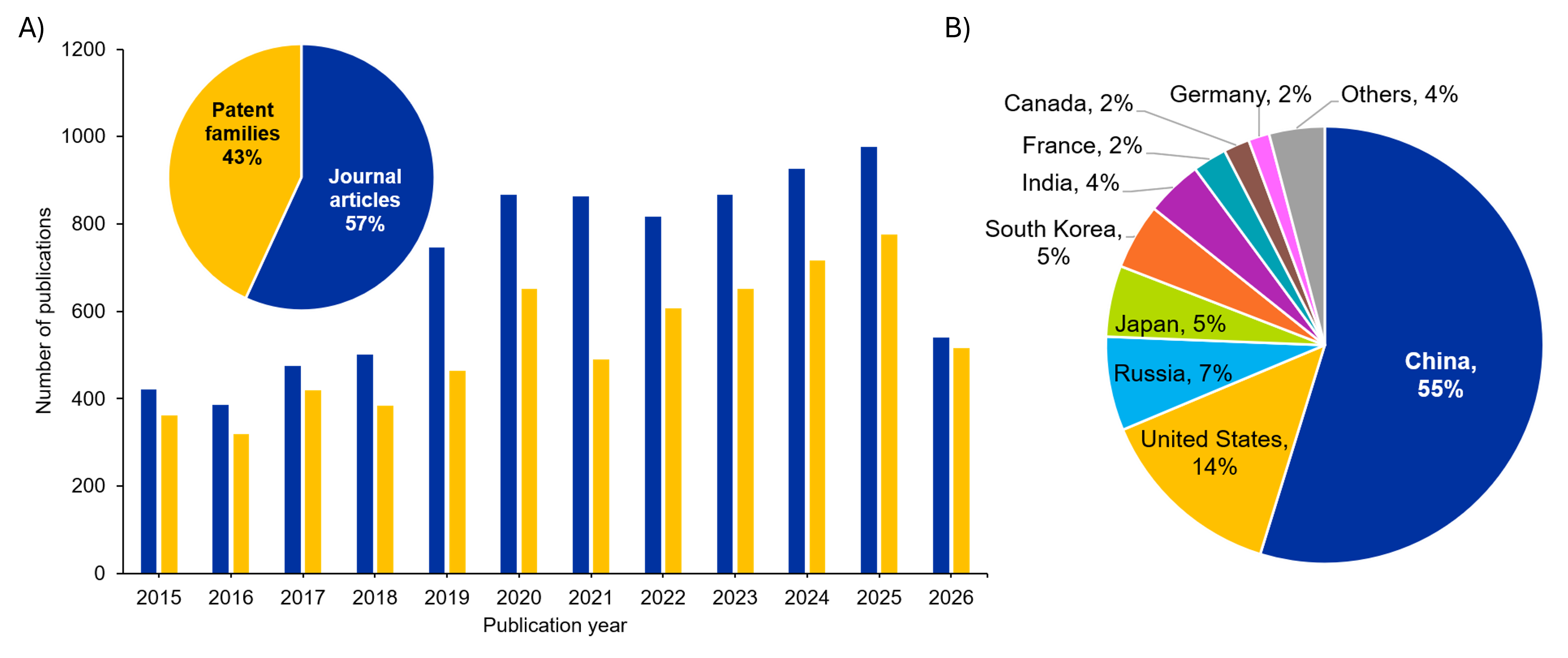
The global rocket propulsion landscape (Figure 1B) is somewhat concentrated, with China holding a large share of patent activity and broad capabilities across different propulsion technologies. The United States, while smaller in share, continues to play an important role in innovation, supported by its active commercial space sector. Other regions — including Europe, Japan, India, and South Korea — also contribute precision engineering, cost-efficient approaches, and collaborative programs, maintaining a balanced and competitive global ecosystem.
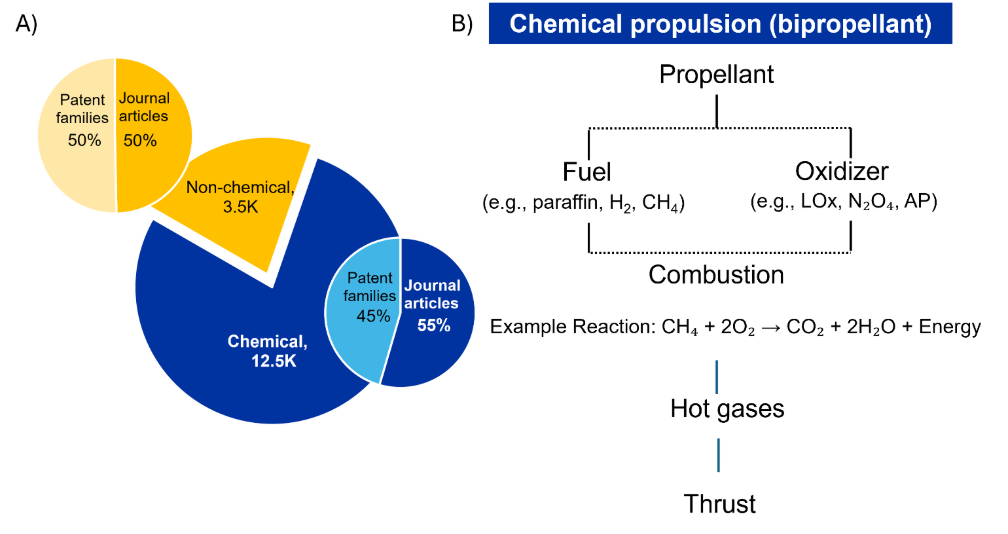
To further understand the propellant trends across the literature, we used CAS-indexed controlled terms and substances to classify propellants into two broad categories: chemical and non-chemical (see Figure 2A). Chemical propulsion systems dominate overall rocket propulsion research with a balanced journal and patent publication volume. Notably, the non-chemical segment shows an equal volume of journal and patent publications, revealing that non-chemical technologies are in accelerated commercialization despite a smaller research volume.
CAS Newton℠ enables conversational scientific discovery. Ask complex, multi-part questions and receive context-based, cited answers sourced from 150+ years of curated and human-verified science found in the CAS Content Collection, making CAS Newton the best agentic AI for science.
The landscape of chemical-based rocket propellants
Chemical-based rocket propellants generate thrust through exothermic reactions that produce high-temperature, high-pressure gases, which are expelled at high velocity. These propellants are broadly classified based on their physical state and reaction mechanism, namely solid propellants (mixtures of fuel and oxidizer in solid form), liquid propellants (fuel and oxidizer are stored separately as liquids), hypergolic propellants (ignite spontaneously upon contact), petroleum-based propellants, and hybrid propellants (combination of solid fuel and liquid/gas oxidizer).
In all chemical propulsion systems, thrust is generated through the reaction between a fuel and an oxidizer, which produces hot gases (see Figure 2B). For example, liquid hydrogen and liquid oxygen react to form water vapor while releasing significant energy, resulting in high exhaust velocity and efficient thrust generation.
Dominance of solid propellants
Solid propellants remain the most widely used rocket propellants, particularly in boosters, missiles, and launch-assist systems. These propellants consist of composite formulations, most based on ammonium perchlorate (AP-oxidizer) and hydroxyl-terminated polybutadiene (HTPB-binder) and aluminum (metallic additives). This integrated architecture, where fuel and oxidizer are cast into a single grain, provides a mechanically simple, robust, and highly reliable propulsion system.
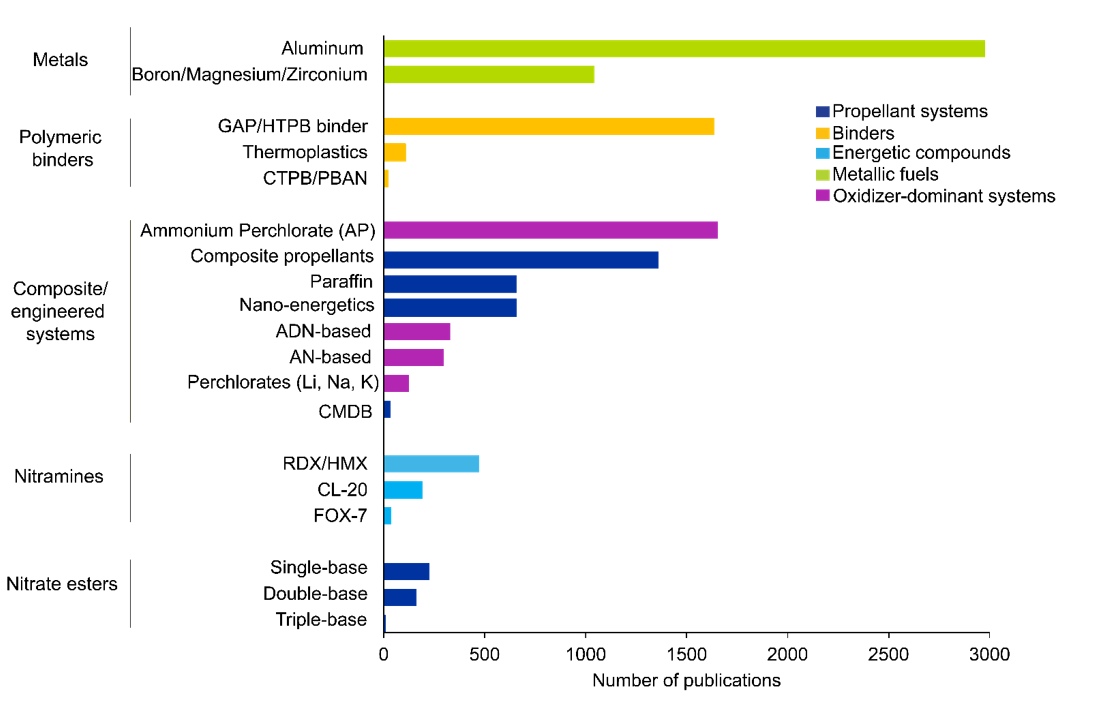
Using CAS-indexed controlled terms, we categorized substances by their functional role in the combustion system, namely fuels, oxidizers, binders, energetic compounds, and engineered formulations (see Figure 3). This chemistry-centric framework highlights how individual components contribute to redox reactions, energy release, and structural integrity, providing a systematic basis for analyzing propellant performance and research trends.
The dominance of solid propellants is driven by operational advantages, including rapid ignition, structural robustness, and their ability to be stored for long periods of time. These characteristics make them indispensable in applications such as solid rocket boosters in NASA’s Space Launch System (Artemis missions) and ESA’s Ariane 6. Despite their maturity, however, solid propulsion continues to evolve through materials innovation aimed at improving efficiency, safety, and environmental performance.
For example, metallic fuels play a crucial role in enhancing the energy output, combustion temperature, and thrust of propellant systems, making them essential components in high-performance solid rocket propulsion. The dominance of aluminum highlights its optimal combination of high energy output, cost-effectiveness, combustion stability, and ease of processing, making it the preferred metallic fuel in modern solid propellant formulations.
Polymer binders provide structural integrity while influencing mechanical and combustion properties. In addition, some binders are energetic in nature and contribute to combustion energy by combining structural integrity with energy release.
The high representation of glycidyl azide polymer/hydroxyl-terminated polybutadiene (GAP/HTPB) binders that we see in Figure 3 reflects their central role as structural matrix and energetic fuel. This also shows the sustained efforts to enhance performance through advanced binder design.
In contrast, the lower presence of carboxy-terminated polybutadiene (CTPB) and polybutadiene acrylonitrile (PBAN) binders indicates their transition to legacy materials. These materials have been superseded by HTPB due to superior mechanical properties and processability. Ongoing research in polybutadiene-based systems further highlights a shift toward multifunctional binders such as HTPB, which are modified for improved performance, recyclability, and compatibility with next-generation energetic systems.
Composite propellant systems are widely used in large launch boosters and are oxidizer-dominant, where the oxidizer constitutes the major fraction and governs the combustion behavior, energy release, and overall performance. Ammonium perchlorate (AP)-based systems are common across defense and space applications due to their high oxygen content, well-understood decomposition behavior, and manufacturability. From a chemical standpoint, oxidizers control redox energetics, decomposition pathways, and radical generation, with AP offering an optimal balance and compatibility with hydrocarbon binders and metallic fuels.
Even though solid propellants are mature technology, research remains active, focusing on particle engineering, catalytic decomposition, and stability improvements that can deliver system-level performance gains. However, environmental concerns, particularly HCl emissions, have driven interest in greener alternatives such as ammonium dinitramide (ADN) and hydroxylammonium nitrate (HAN). While these offer cleaner combustion and higher performance potential, their adoption is limited by cost, hygroscopicity, and stability challenges, resulting in a slow transition.
Paraffin-based fuels are long chain, wax-like hydrocarbon materials (C₂₀H₄₂ to C₄₀H₈₂) used primarily in hybrid rocket systems. Research efforts are focused on enhancing performance through energetic additives, nanoparticle doping, swirl-induced combustion, and optimized grain geometries. Researchers are also addressing mechanical and manufacturing challenges via polymer reinforcement and improved casting techniques.
Nano-energetic materials represent another emerging class, consisting of nanoparticles incorporated into oxidizer or fuel systems to enhance performance. These materials have shown potential in improving thermal decomposition behavior of AP-, AN-, and ADN-based systems. However, challenges such as particle agglomeration and the lack of reliable methods to quantify dispersion within the propellant matrix limit their practical application. More broadly, nano-energetics enable precise control of propellant chemistry by tailoring decomposition pathways, reaction kinetics, and combustion efficiency.
Options in liquid propellants
Liquid propellants remain central to modern propulsion due to their adaptability. Unlike solid systems, they enable throttling, restart capability, and precise control, making them critical for launch vehicles, in-space propulsion, and reusable systems. This is evident in Falcon 9 (frequent commercial and crewed missions), Starship test campaigns, and Artemis upper-stage systems.
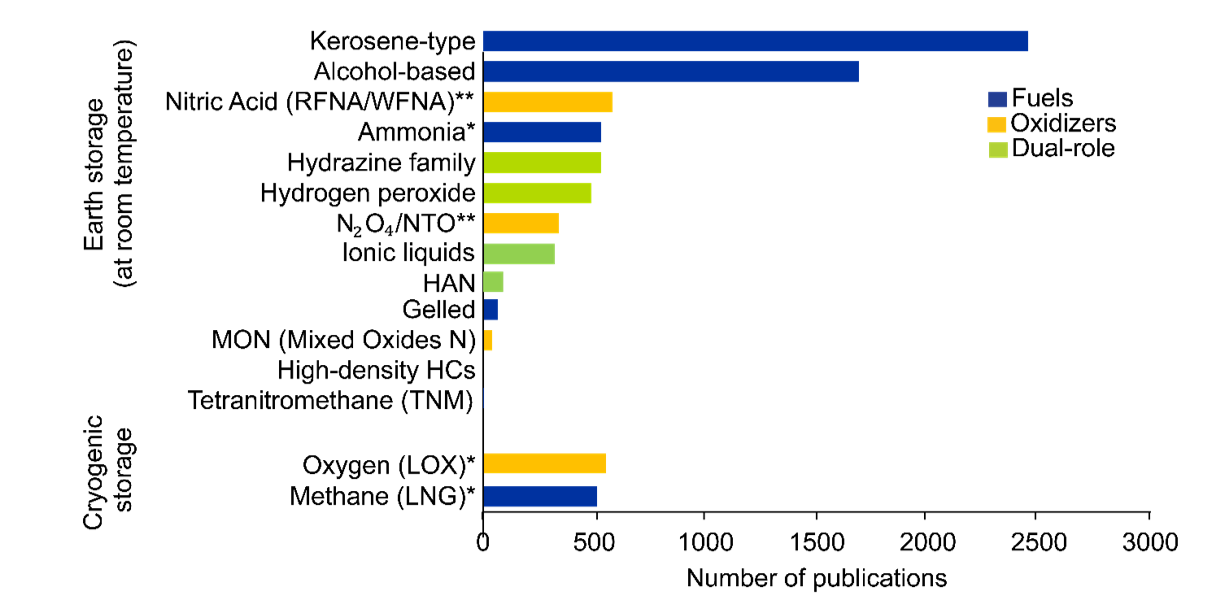
We analyzed the liquid propellant landscape based on the storage conditions and their functional roles (see Figure 4). This classification reflects fundamental differences in thermodynamic stability, reactivity, and system-level design considerations, including tank architecture, handling, and mission readiness. Cryogenic and earth-storable propellants differ significantly in temperature requirements, density, and combustion behavior, making storage-based classification chemically and operationally relevant.
Innovation in liquid propulsion reflects a balance between legacy performance and evolving safety and environmental requirements. While traditional systems remain dominant due to reliability and established infrastructure, there is an increasing emphasis on reducing toxicity and enabling cleaner combustion pathways. For example, researchers are exploring H2O2 as an oxidizer with excellent thrust control and zero toxic emissions, and hydroxylammonium nitrate (HAN) that works for chemical and electrospray propulsion with spontaneous hypergolic ignition.
Kerosene-type fuels, particularly RP‑1, have historically dominated first-stage rocket propulsion due to their high density and stability. However, their fossil-fuel origin and soot-forming combustion chemistry raise sustainability concerns. As a result, kerosene-based fuels are experiencing a dual transformation: traditional petroleum-based kerosene is being improved through advanced technologies including gelled formulations, and alternate ignition systems are transitioning toward sustainable alternatives such as bio-derived and e-kerosene produced via power-to-liquid synthesis.
Alcohol-based systems, especially ethanol-H2O2 combinations, are advancing due to improved throttleability (ability to vary thrust) and reduced environmental impact. Methane and ammonia are also emerging as key alternatives — methane for near-term reusable launch systems and ammonia for long-term carbon-free propulsion — both benefiting from integration with advanced materials and synthetic fuel pathways.
In contrast, hypergolic propellants represent a legacy domain undergoing a gradual transition. Hypergolic propellants are fuel-oxidizer combinations that ignite spontaneously upon contact, eliminating the need for an external ignition source. Hydrazine-based systems (UDMH or MMH with N₂O₄) remain widely used due to reliable self-ignition and storability but are increasingly being replaced by alternatives. Developments such as NASA’s AF‑M315E and ESA-supported LMP‑103S reflect a shift toward green monopropellant, particularly HAN-based systems, which offer low toxicity and are being used for small satellite applications.
Beyond conventional categories, gelled propellants and advanced formulations represent targeted innovation frontiers aiming to bridge liquid and solid propulsion. Research is focused on rheology, atomization, and combustion efficiency, with an emphasis on metal-loaded gels and shear-thinning fuels for improved safety and controllability, especially for defense applications.
Although earth-storable propellants dominate, as seen in Figure 4, cryogenic systems remain strategically critical for high-efficiency missions, especially beyond low Earth orbit. Current research focuses on boil-off management, supercritical combustion, and long-duration storage, including zero-boil-off technologies and advanced insulation systems.
At the oxidizer level, liquid oxygen (LOx) remains dominant due to its high reactivity, clean combustion, and compatibility with multiple fuels. In contrast, nitrogen tetroxide (N₂O₄) is declining due to toxicity concerns. Emerging trends show a shift toward hydrogen peroxide-based systems and hypergolic ionic liquids (HILs) as key platforms for next-generation green propulsion.
A major advancement is the molecular-level understanding of hypergolic ignition, particularly in ionic liquid-H₂O₂ systems, enabling ignition delays as low as milliseconds. Innovations such as biofuel-ionic liquid blends, ferrocene-functionalized ionic liquids, and strain-engineered molecules demonstrate that performance can match or exceed conventional hypergolic systems while reducing toxicity.
Overall, the liquid propulsion landscape reflects a multi-directional transition: established hydrocarbon systems continue to dominate, while green propellants, synthetic fuels, advanced materials, and catalytic innovations are redefining performance, sustainability, and mission adaptability.
The hybrid propellant niche
Hybrid propellants occupy a middle ground between solid and liquid systems, combining solid fuel with a liquid or gaseous oxidizer. This configuration offers advantages like improved safety, throttle control, and simpler design relative to fully liquid or solid systems.
Despite these benefits, hybrid propulsion remains a developing niche due to limitations such as low regression rates and inefficient fuel-oxidizer mixing. Consequently, research is focused on overcoming fundamental combustion constraints rather than system redesign. Approaches include paraffin-based systems enhanced with hypergolic additives like sodium borohydride (NaBH₄), enabling ignition delays under eight milliseconds, and high-nitrogen energetic compounds that increase regression rate through micro-explosion and catalytic effects. Emerging concepts such as boron-laden hybrid gas generators for ducted rockets, dual-fuel systems, and hybrid-electric propulsion integrating solid oxide fuel cells have demonstrated 40% efficiency improvements.
Key takeaway
The dominance of solid propellants is driven by operational advantages, including rapid ignition, structural robustness, and their ability to be stored for long periods of time.
Green and non-toxic propellants increase sustainability
The shift toward green and non-toxic propellants is a cross-cutting trend across solid and liquid propulsion, driven by environmental and safety concerns associated with conventional systems such as ammonium perchlorate and hydrazine. Alternatives like ADN, HAN, hydrogen peroxide, and ionic liquid-based propellants are gaining attention for their cleaner combustion, lower toxicity, and competitive performance.
In parallel, sustainable fuels such as bio-derived fuels, e-kerosene, methane, and ammonia are emerging to reduce lifecycle emissions. Although challenges related to cost, stability, and infrastructure remain, this transition reflects a broader move toward propulsion systems that balance performance with environmental responsibility and safer handling.
Electrical and nuclear propulsion technologies support deep-space missions
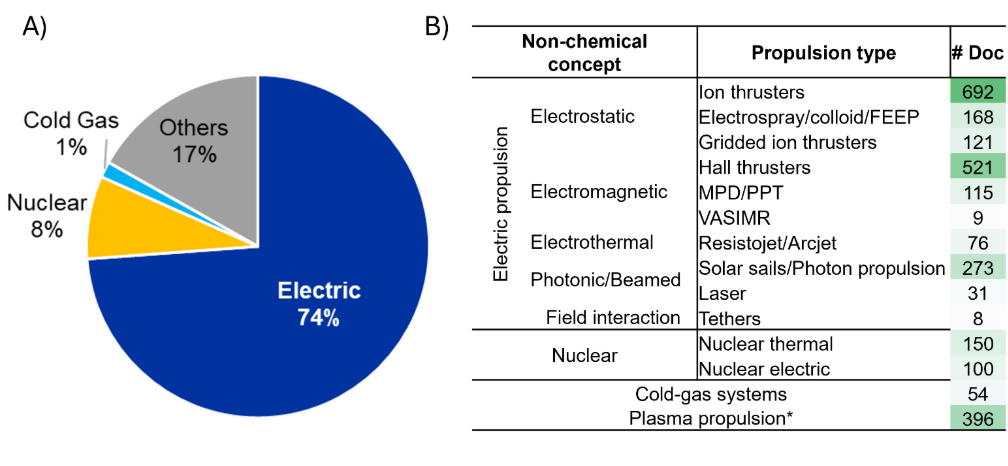
Non-chemical propulsion systems represent a fundamental shift in propulsion design. Unlike chemical systems, which derive energy from fuel–oxidizer reactions, non-chemical systems rely on external energy sources such as electricity or nuclear reactions, decoupling propulsion performance from the limitations of chemical energy density. Our analysis of the literature revealed that electric propulsion is by far the dominant technology (see Figure 5).
Electric propulsion
Electric propulsion accelerates a propellant using electric energy, achieving high exhaust velocities and specific impulse (fuel efficiency) but relatively low thrust. While unsuitable for launch operations, it is indispensable for in-space propulsion, including orbital maneuvering, station-keeping, and deep-space missions.
Dominant types of propulsion technologies include ion thrusters, Hall-effect thrusters, and advanced plasma-based systems (see Figure 5B). Ion thrusters use electrostatic fields to accelerate ions, offering extremely high efficiency and precise control for long-duration missions. Hall-effect thrusters employ coupled electric and magnetic fields to deliver a balance between thrust and efficiency, making them useful for satellite propulsion. Advanced concepts, including magnetoplasmadynamic thrusters (MPD) and variable specific impulse magnetoplasma rocket VASIMR, leverage high-energy plasma to achieve higher thrust and scalability for future deep-space applications.
Emerging approaches, such as electrospray thrusters and novel propellant systems, are further expanding performance. Advances in power generation and plasma physics are expected to enhance efficiency and enable faster, more sustainable interplanetary transport. Overall, electric propulsion shifts the paradigm from energy release to energy efficiency, establishing it as a cornerstone for long-duration space missions.
Nuclear propulsion
Nuclear propulsion extends this paradigm by leveraging energy densities far exceeding those of chemical systems. In nuclear thermal propulsion (NTP), a reactor heats a propellant such as hydrogen to high temperatures, producing thrust with specific impulses exceeding 800 seconds. This enables faster transit times and higher payload capacity for deep-space missions.
Current research focuses on improving reactor materials (e.g., tungsten-based CERMET fuels), optimized core configurations, and improved thermal management through microchannel cooling and cryogenic heat exchange. Nuclear electric propulsion (NEP) further integrates nuclear energy with electric thrusters, enabling efficient, long-duration missions.
Looking ahead, fusion-based concepts offer the potential for orders-of-magnitude improvements in performance, though they remain largely conceptual. Despite challenges related to safety, cost, and system integration, nuclear propulsion represents a transformative pathway for deep-space exploration and sustainable space operations.
Critical prior art is hiding in global databases, non-English patents, and scientific literature you're not searching. One missed reference can invalidate years of R&D investment. CAS IP Finder, powered by STNTM, gives you comprehensive coverage and precision search tools in one intuitive platform so you never miss what matters.
Looking forward
Fusion-based concepts offer the potential for orders-of-magnitude improvements in performance, though they remain largely conceptual.
The evolution of rocket fuels
Rocket propulsion is transitioning toward cleaner, more efficient, and mission-specific systems driven by sustainability priorities and deep-space exploration needs. Traditional fuels such as hydrazine and kerosene are gradually being replaced by greener alternatives, including HAN- and ADN-based propellants, while liquid methane is emerging as a key fuel for reusable launch systems due to its clean combustion and potential for in-situ resource utilization. Liquid hydrogen also remains critical for high-efficiency applications despite storage and handling challenges.
Beyond chemical propulsion, electric systems are dominant for in-space operations due to their high efficiency, while nuclear propulsion offers transformative potential for deep-space exploration.
Overall, the future propulsion landscape will be hybrid in nature, integrating methane-based launch systems, green satellite propellants, and advanced electric and nuclear technologies to enable long-duration and sustainable missions. This convergence reflects a broader shift from performance-driven design toward propulsion systems optimized for efficiency, sustainability, and mission-specific integration.
Key takeaway