Since the World Health Organization declared COVID-19 a pandemic, researchers have learned a tremendous amount about SARS-CoV-2, the new coronavirus that causes this disease. However, despite extensive effort and investment, effective therapeutic treatments for COVID-19 patients have been elusive. Though multiple vaccine candidates have already entered clinical trials globally, even if they prove safe and effective, many months or even years will be required to manufacture and distribute the vaccine and inoculate the global population. Thus, there remains an urgent need to identify effective antiviral treatments that can mitigate the virus’ impact on the many more who will become ill before the pandemic is brought under control.
Scientists have been exploring various ways to accelerate the drug development process to meet this urgent need, including using computational approaches to identify drugs already approved for other indications that may be effective in treating COVID-19. To aid that effort, a group of scientists and technologists at CAS sought to identify possible drug candidates for treating COVID-19 with machine learning models for priority protein targets of SARS-CoV-2 using a Quantitative Structure-Activity Relationship (QSAR) methodology. This work, which successfully identified a number of drugs now beginning to show clinical efficacy, including Lopinavir and Telmisartan, was recently published in ACS Omega.
Something old, something new
Given the substantial time and cost needed to bring a new drug to market, repurposing existing small-molecule drugs is an attractive alternative, especially when the need is so urgent. In addition to getting treatments to market faster, this strategy offers a number of advantages over the traditional drug development process, including lowering the risk of late-stage failure due to negative side effects.
Drug repurposing is not a new concept. However, its application to date has been mostly opportunistic rather than systematic. In some of the most successful examples of drug repurposing so far, such as Viagra and Minoxidil, new indications arose when patients reported unexpected side effects. Recently, more systematic approaches to drug repurposing have been introduced including computational methods such as signature matching, molecular docking, genetic association, pathway mapping and retrospective clinical analysis. It is hoped that a computational approach will allow researchers to reliably connect existing small-molecule therapeutics to newly identified drug targets, maximizing the therapeutic value of existing portfolios.
Closing in on a target
Coronaviruses are a large family of viruses long known to cause mild to moderate upper-respiratory illnesses in humans and many different animal species. Though it is rare for animal-specific coronaviruses to infect and spread in humans, to date three coronaviruses have proven able to make that jump: SARS-CoV-1, MERS-CoV and the new SARS-CoV-2. All three are beta-coronaviruses believed to have originated in bats. Given the similarities between these viruses and their progress to human contagion, previous SARS and MERS research provides a good starting point when seeking drugable targets for SARS-CoV-2. Among all the proteins in SARS-CoV-2, the 3-chymotrypsin-like protease (3CLpro) and RNA-dependent RNA polymerase (RdRp) are two ideal protein targets for QSAR modeling, in part due to significant similarities they share with proteins identified in SARS-CoV and MERS-CoV as well as other known coronaviruses.
3CLpro is a protease that is required for the coronavirus to cleave the polyprotein peptides into individual functional non-structural proteins (NSPs). When comparing amino acid sequences and protein structures, 3CLpro was found to be highly conserved between SARS-CoV-2 and other human coronaviruses. It shows a 96% sequence identity overlap with SARS-CoV-1, 87% with MERS-CoV, and 90% with Human-CoV. Therefore, the 3CLpro inhibitors identified in previous coronavirus-related research are promising inhibitors for SARS-CoV-2 3CLpro, and the associated structure-activity relationship (SAR) data are valuable for training machine learning models searching for new inhibitors of SARS-CoV-2 3CLpro.
RdRp is the major enzyme utilized by RNA viruses to replicate viral genomes in host cells. Structural study and sequence analysis of SARS-CoV-2 RdRp revealed that this enzyme is very similar to the structure of SARS-CoV-1 RdRp and contains several key amino acid residues that are conserved in most viral RdRps, including HCV. Fortunately, various viral RdRps have been widely studied as inhibitors of RNA viruses, especially in HCV-related research. Therefore, existing RdRp inhibitors for the RNA viruses, such as HCV, may provide valuable insights for drug development for SARS-CoV-2 RdRp inhibition.
Prioritizing existing therapeutics with machine learning
Machine learning models have increasingly been used to facilitate drug discovery in recent years. Specifically, QSAR is often one of the first steps in the modern drug discovery process. Simply put, QSARs are mathematical models approximating rather complicated biological or physicochemical properties of chemicals based on quantitative measures of their molecular structures. These predictive mathematical models are used for screening large databases of chemical structures to prioritize potential drug candidates that are most likely to be active against identified targets. This approach assumes that the activity of a chemical substance is directly related to its structure, and thus, molecules with similar structural features will exhibit similar physical properties and/or biological effects.
In this study, my colleagues and I closely collaborated to build highly predictive QSAR models for 3CLpro and RdRp protein targets. The team, which included computational scientists and chemists, curated more than 1,000 inhibitors with structure-bioactivity data as training molecules for the models. We collected data from the most current SARS-CoV-2 bioassay studies, as well as existing studies with SARS-CoV-1, MERS-CoV and other related viruses in the CAS content collection. Using these data, we applied a variety of machine learning algorithms to build several dozen QSAR models – selecting from among these the strongest performing models – one targeting 3CLpro and one targeting RdRp.
Read the full journal article QSAR machine learning models and their applications for identifying viral 3CLpro- and RdRp-targeting compounds as potential therapeutics for COVID-19 and related viral infections to see all the models tested and which potential candidates rose to the top.
We used the two resulting QSAR models to screen a large pool of potential drug candidates including 1,087 FDA-approved drugs, nearly 50,000 substances from the CAS COVID-19 Antiviral Candidate Compounds Dataset and ~113,000 substances with pharmacological activity identified or a therapeutic role indexed by CAS in SARS-, MERS- and COVID-19-related documents published since 2003. By modeling protease inhibitor activity as a function of substance structure, we identified some of the most promising candidates among substances predicted to be active inhibitors of coronavirus 3CLpro and RdRp. Additionally, a number of the substances that our models predict will inhibit 3CLpro or RdRp in SARS-CoV-2 also have previously identified therapeutic activity against other diseases that have emerged as risk factors for more severe COVID-19 infections. For example, a candidate COVID-19 antiviral that also has known activity against heart disease, such as diltiazem hydrochloride (Cardizem), could potentially provide a dual benefit, in certain cases.
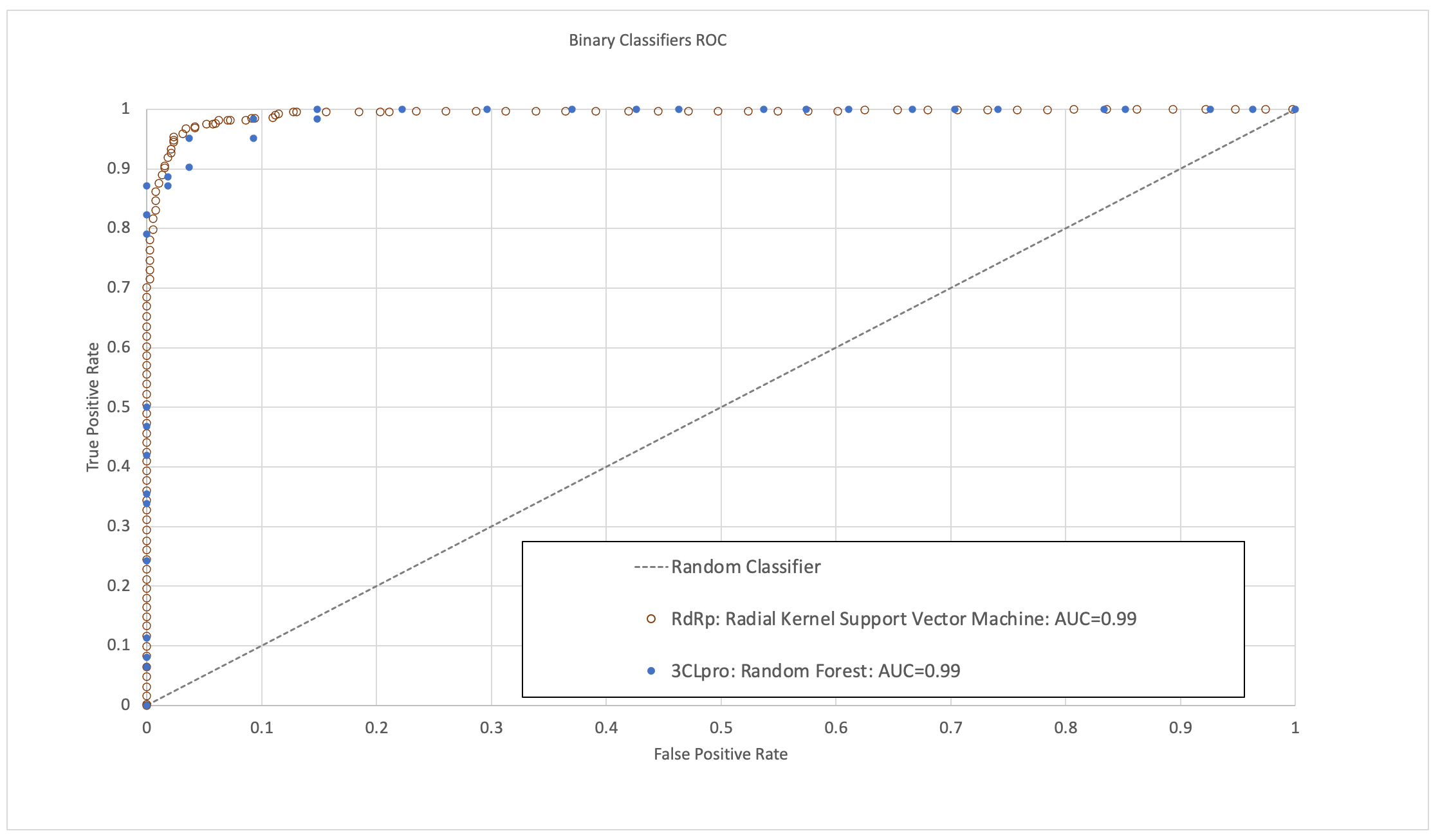
本モデルは、高いROC曲線下面積(ROC-AUC)、感度、特異度、および精度を有することが検証されました(図1)。本研究の完了後、本モデルによって高い活性が予測された一部の分子が、公開された実験的バイオアッセイ研究や臨床試験によって検証されており、その予測能力の高さが改めて示されています。
次なるパンデミックへの備え
本研究は現在のCOVID-19危機に対する潜在的な治療化合物の特定に焦点を当てたものですが、今後もウイルスを起源とするパンデミックが発生する可能性は高いと考えられます。したがって、抗ウイルス薬研究への継続的な投資と注力を行い、将来の発生に備えることが急務です。さまざまな種類のウイルスが流行を引き起こす可能性があり(コロナウイルス、インフルエンザウイルス、エボラウイルス、レトロウイルスなど)、新しい薬や適応症ごとにヒトでの安全性と有効性を試験するには依然として多大な時間を要するため、広域抗ウイルス薬やワクチンの開発が極めて重要となります。
本稿で述べた機械学習手順、分子ドッキング、バーチャルスクリーニングといったコンピュータを用いた創薬手法の継続的な開発は、中心的な役割を果たすでしょう。コンピュータの処理能力の向上、ドッキングや構造予測アルゴリズムの発展、タンパク質の結晶構造決定技術の進歩が、この取り組みを促進します。さらに、ハイスループットスクリーニング、オミクス技術、既存薬の転用といった手法も継続され、その重要性は増していくはずです。ただし、これらのテクノロジー主導の手法はヒトによる実験研究に取って代わるものではなく、効率化を通じてそれを補完するものです。私たちは、ヒトによるデータキュレーションと機械学習モデルを組み合わせてCOVID-19の潜在的な低分子医薬品候補の特定に成功した本取り組みが、創薬におけるヒトとマシンの相乗効果の価値を浮き彫りにし、COVID-19およびそれ以降の抗ウイルス研究に貢献することを期待しています。
CASは世界の科学コミュニティの一員として、すべての資産と能力を活用し、COVID-19との闘いを支援することに尽力しています。科学的知見、オープンアクセスデータセット、特別レポートなど、CASが提供するその他のCOVID-19関連リソースもぜひご覧ください。