
Executive Summary

  • This new CAS Insights Report analyzes more than 368,000 pharmaceutical patent filings from 2020 to 2025, mapping where innovation is concentrating across targets, modalities, and disease areas.
  • For executives, CAS TrendScape Reports provide a strategic overview of innovation patterns that can inform corporate development, licensing, and M&A activities.
  • For discovery scientists, this report highlights areas of intensive research activity that may suggest competitive threats or collaborative opportunities.  
  • For medicinal chemists and pharmacologists, the research identifies disease areas where mechanistic understanding is actively expanding, potentially revealing novel targets or underexplored chemical space.
  • The fastest-growing disease areas are not oncology but fibrotic diseases, genetic disorders, and rare metabolic conditions, as novel therapeutic platforms unlock previously intractable biology.
  • RNA therapeutics and AI/ML have moved from specialized tools to foundational platforms, with AI/ML-linked patents rising from 9% to nearly 24% of filings over five years.

In an industry where R&D costs exceed USD 2.3 billion per approved drug, patent intelligence has evolved from legal necessity to strategic imperative for identifying innovation trajectories, white space opportunities, and competitive positioning. This report harnesses the comprehensive global patent data encompassed in the CAS Content Collection™ and advanced natural language processing (NLP) capabilities guided by scientists to decode emerging trends shaping pharmaceutical R&D. By systematically analyzing over 368,000 patent filings across 90+ global patent offices from 2020-2025, this analysis transforms vast patent datasets into actionable competitive intelligence for pharmaceutical executives, R&D scientists, and investment decision-makers.

Download the full, free, 188-page report here

CAS Newton℠ for CAS IP Finder.  CAS Newton transforms patent and IP searching with intuitive, conversational AI that understands your intent and delivers relevant insights so you can search with confidence, reduce uncertainty, and make IP decisions faster.

CAS Newton for IP Finder

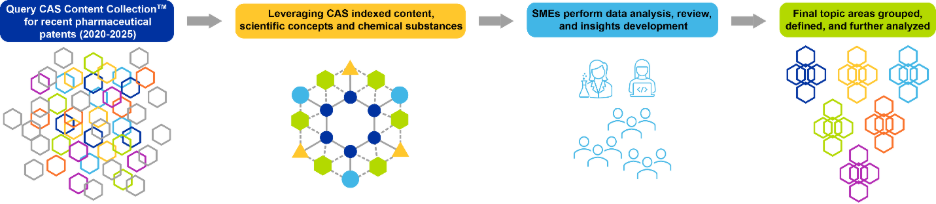
Our methodology for this report combines traditional patent analytics with sophisticated NLP techniques to extract meaningful scientific terms from patent text including titles, abstracts, claims, and CAS indexed terms from the CAS Content Collection. This analysis leverages our unique position as the world’s most comprehensive source of disclosed scientific information. Our approach integrates multiple CAS capabilities: the chemist-curated substance registry accessible via CAS REGISTRY®, extensive biological target databases accessible via CAS BioFinder®, and decades of indexing expertise accessible via CAS SciFinder® and CAS IP Finder, powered by STNTM.  

Figure 1. Schematic showing representative steps in the methodology
for data analysis and NLP-based analysis.

Critical findings and strategic takeaways: Modality diversification as competitive imperative

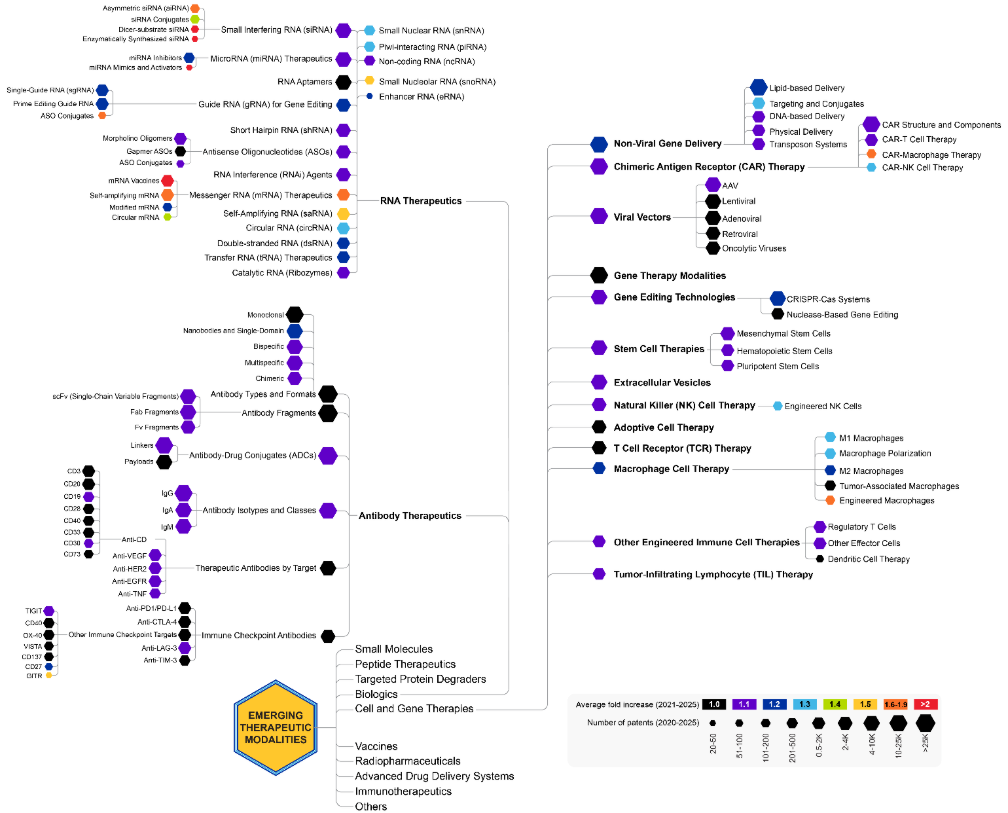
The 850+ therapeutic modality topics mapped across 4 CAS TrendScape maps reveal fundamental transformation in platform selection strategies. Figure 2 shows one of the many CAS TrendScape maps in the report focused on RNA therapeutics, antibody therapeutics, and cell and gene therapies. Small molecules constitute approximately 60% of patent activity but plateau in relative growth, indicating market maturity where innovation emphasizes refinement through enhanced selectivity and novel mechanisms like targeted protein degradation. The most pronounced growth trajectories appear in RNA therapeutics (rising to ~8% of patents) and AI/ML applications (accelerating from 9% in 2020 to nearly 24% in 2025), reflecting their evolution from specialized tools to foundational platforms reshaping the entire drug discovery pipeline.  

Leading pharmaceutical innovators now patent across 5-7 distinct therapeutic modalities versus 2-3 a decade ago, reflecting strategic diversification to match appropriate platforms with specific target biology. Biologics innovation concentrates on next-generation formats such as bispecific antibodies, antibody-drug conjugates, and engineered variants, with our analysis identifying leading patent assignees and acquisition patterns. Cell and gene therapies show CAR-NK cells demonstrating notable commercial patent growth as off-the-shelf alternatives to CAR-T, while CRISPR advances toward next-generation base and prime editing with improved precision. Targeted protein degradation represents transformative capability validated by U.S. FDA approval of vepdegestrant (Arvinas/Pfizer), with patent activity spanning PROTAC variants and molecular glues.

The role of patents in pharmaceutical innovation

Patents represent far more than legal instruments—they are strategic signals of where pharmaceutical innovation is headed. Patent intelligence occupies a critical middle ground in the pharmaceutical innovation timeline: innovations mature enough to warrant intellectual property protection yet early enough to reveal emerging trends before they become obvious to competitors. Unlike scientific publications that capture exploratory research or clinical trials that reflect late-stage development, patent data provides systematic, quantifiable records of innovation hotspots, technology convergence, and the organizations shaping medicine's future.

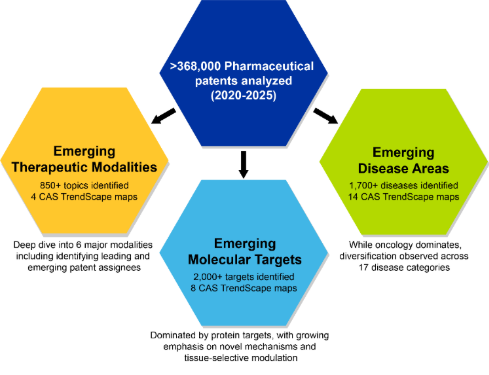
This report analyzes over 368,000 pharmaceutical patents filed globally between 2020 and 2025, leveraging advanced natural language processing (NLP) and data analytics to extract insights impossible through manual review and resulting in more than 25 comprehensive CAS TrendScape maps (Figure 3).  

Figure 2. CAS TrendScape map of emerging topics in terms of therapeutic modalities focused on biologics (antibody and RNA therapeutics) and cell and gene therapies identified using NLP-based analysis of ~368K patent publications from the CAS Content Collection for the period 2020-2025.

Figure 3. Schematic showcasing the contents of the report with a focus on emerging therapeutic targets, modalities and disease areas.

This comprehensive framework reveals not just what is being patented, but how the innovation landscape is evolving across biological targets, disease applications, therapeutic platforms, geographic regions, and institutional ecosystems.

The timing of this analysis captures pharmaceutical R&D at an inflection point. The COVID-19 pandemic accelerated the validation of non-traditional therapeutic platforms—most dramatically mRNA technology, which progressed from academic curiosity to global healthcare solution in unprecedented time. This success has catalyzed investment across multiple frontier modalities: targeted protein degraders (PROTACs validated by the recent U.S. FDA approval of vepdegestrant in May 2026), cell therapies beyond CAR-T, RNA therapeutics beyond vaccines, and radiopharmaceutical theranostics.  

Simultaneously, technological revolutions in structural biology (AlphaFold), computational chemistry, and artificial intelligence have fundamentally altered drug discovery paradigms. Targets once dismissed as "undruggable" (such as transcription factors lacking enzymatic pockets, protein-protein interactions (PPIs) with extensive binding surfaces, scaffolding proteins without catalytic activity) are now viable therapeutic opportunities through molecular glues, allosteric modulators, and proximity-induced degradation strategies. These advances enable the disease area diversification documented in this report, where fibrotic diseases, genetic disorders, and rare metabolic conditions show exceptional patent emergence as novel modalities unlock previously intractable biology.

These scientific advances intersect with evolving competitive dynamics. China has emerged as a major pharmaceutical patent filer with distinct specialization patterns, though the United States maintains superior commercial translation. Academic institutions increasingly pursue patent protection alongside traditional publications. Leading pharmaceutical companies have shifted from modality-focused organizations (small molecule companies vs. biologics companies) to platform-agnostic innovators selecting optimal approaches based on target biology rather than historical competency.

In an industry where R&D costs exceed USD 2.3 billion per approved drug (as estimated in 2024) and development timelines span 10-15 years, strategic intelligence is imperative rather than optional. Understanding where innovation is concentrating, which technologies are maturing, and where white space opportunities exist provide competitive advantage for pharmaceutical companies navigating modality selection and therapeutic area prioritization, guides academic research toward translational impact in areas showing commercial momentum, informs investment strategies, and ultimately accelerates the development of medicines that improve and extend human life.

Charting the future of pharmaceutical innovation through patent intelligence

Analysis of 368,000 pharmaceutical patents filed between 2020 and 2025 reveals fundamental shifts:

  • 2,000+ molecular targets now extend well beyond traditional kinases and GPCRs into previously undruggable space
  • 1,700+ disease areas show fastest growth in fibrotic diseases, genetic disorders, and rare metabolic conditions rather than oncology; and therapeutic modality diversification is shattering the small molecule-biologics dichotomy.
  • Small molecules continue evolving through targeted protein degraders like PROTACs, validated by FDA approval of vepdegestrant in May 2026.  
  • Biologics have grown more sophisticated, with ADCs (5,600+ patent families), bispecifics, and RNA therapeutics expanding well beyond mRNA vaccines.  
  • Cell and gene therapies are diversifying from CAR-T into CAR-NK, CAR-macrophages, and CRISPR-based editors.  
  • Peptide therapeutics are experiencing a renaissance driven by oral bioavailability breakthroughs.  
  • Emerging modalities (microbiome therapeutics, radiopharmaceutical theranostics, and AI/ML)  show remarkable early-stage patent activity, with AI/ML accelerating from 9% of patents in 2020 to nearly 24% in 2025.

In addition, data and computational capabilities represent increasingly important competitive differentiators. AI/ML's patent acceleration reflects integration across target identification, lead optimization, and clinical trial design. Organizations must invest in AI talent, infrastructure, and high-quality training data, with partnerships providing access to chemical and biological information breadth impossible to generate internally.

Conclusion

This report demonstrates how comprehensive patent intelligence, when integrated across the target-disease-modality framework and powered by the unique combination of exhaustive data coverage, scientific curation expertise, and advanced analytical capabilities at CAS, provides strategic insights essential for decision-making in an increasingly complex pharmaceutical landscape. Unlike conventional patent analytics focused on legal status and citation patterns, this approach extracts actionable intelligence from full patent specifications—identifying specific protein targets being pursued, precise modality innovations being protected, and technology convergences signaling transformative opportunities.

Download the full, free, 188-page report here.

Questions and answers

What are the biggest trends in pharmaceutical patents right now?

How is AI changing pharmaceutical R&D?

What is a pharmaceutical patent landscape analysis?

Where is there still open competitive white space in pharmaceutical R&D?

Related CAS Insights

創薬

Accelerating discovery: COVID-19 vaccine breakthroughs and their future impact

創薬

Accelerating Discovery: COVID-19 Vaccine Breakthroughs and their Future Impact

創薬

ACE2という、疾病病因特定において潜在的に重要なレセプターを標的にする

Gain new perspectives for faster progress directly to your inbox.