
Executive Summary

  • Supercritical CO2 has evolved from a niche extraction solvent into a versatile, sustainable processing medium spanning materials manufacturing, pharmaceuticals, and energy generation.  
  • CAS analysis reveals active diversification across industries, with materials processing and environmental applications emerging as the fastest-growing domains alongside well-established natural product extraction.
  • Supercritical CO2 is a scalable processing platform free of conventional solvents, which makes it a greener alternative for advanced materials, pharmaceutical and edible materials, and carbon sequestration applications.
  • Patents represent 37% of publications, signaling strong commercial momentum for supercritical CO2.

What is supercritical CO₂?

Supercritical carbon dioxide (supercritical CO₂) refers to carbon dioxide used under conditions where it exhibits unique properties between those of a gas and a liquid. This state is achieved when it is maintained above its critical temperature and pressure (31.1 °C and 7.38 MPa). In this supercritical state, CO₂ possesses low viscosity, reflecting the ease of flow typical of gases, along with high diffusivity, which enhances its ability to interact with other materials in a manner similar to liquids.  

Furthermore, the solvent strength of supercritical CO2 can be modulated through adjustments in pressure and temperature, facilitating enhanced mass transfer and targeted solubilization of specific molecular species. Because carbon dioxide is widely available, non‑flammable, and environmentally benign in this state, supercritical CO₂ has attracted interest as an alternative medium across many scientific and industrial fields (while atmospheric CO2 is a greenhouse gas, carbon dioxide’s usage in food and extraction is non-toxic and not a major contributor to emissions).

While supercritical CO₂ is often associated with extraction applications, owing to its historical use in decaffeination and natural product processing, the fluid's unique characteristics have enabled its expansion into numerous other unit operations spanning materials processing, analytical chemistry, pharmaceutical manufacturing, and textile engineering. Moreover, the adaptable properties in its supercritical state make it suitable for many processes and support the development of more sustainable technologies.

This article's analysis draws on the CAS Content Collection™, the world's largest repository of human-curated scientific data. See how CAS data helps power research like the insights you'll find here.

The CAS Content Collection

Key Insight

In its supercritical state, CO₂ possesses low viscosity, reflecting the ease of flow typical of gases, along with high diffusivity, which enhances its ability to interact with other materials in a manner similar to liquids.

Publication trends and processes involving supercritical CO2

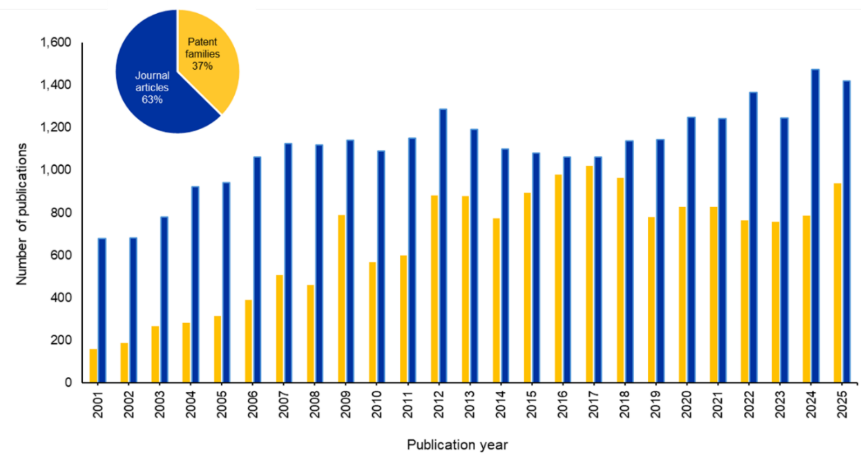
To understand the evolution of supercritical CO₂ research, we analyzed the CAS ContentCollection™, accessed through CAS IP Finder powered by STN™. This analysis reveals steady growth in supercritical CO₂ research from 2001 to 2025, with the total number of publications increasing nearly threefold over 25 years (see Figure 1).

Figure 1. Line or bar chart showing the number of supercritical CO2 patent and journal publications per year from 2001 to 2025. Publication volume rises steadily over the period, roughly tripling by 2025. Journal articles make up the larger share; patents account for about 37 percent of the total.

Patents make up 37% of the literature on this topic. You can explore the patent landscape of topics important to you using CAS IP Finder powered by STN™.

CAS IP Finder powered by STN™

Key Insight

Patents account for 37% of the total publications examined here, indicating strong commercial interest and underscoring the growing industrial relevance of supercritical CO₂‑based technologies as they transition from fundamental research to real‑world deployment.

Applications across advanced materials and process engineering

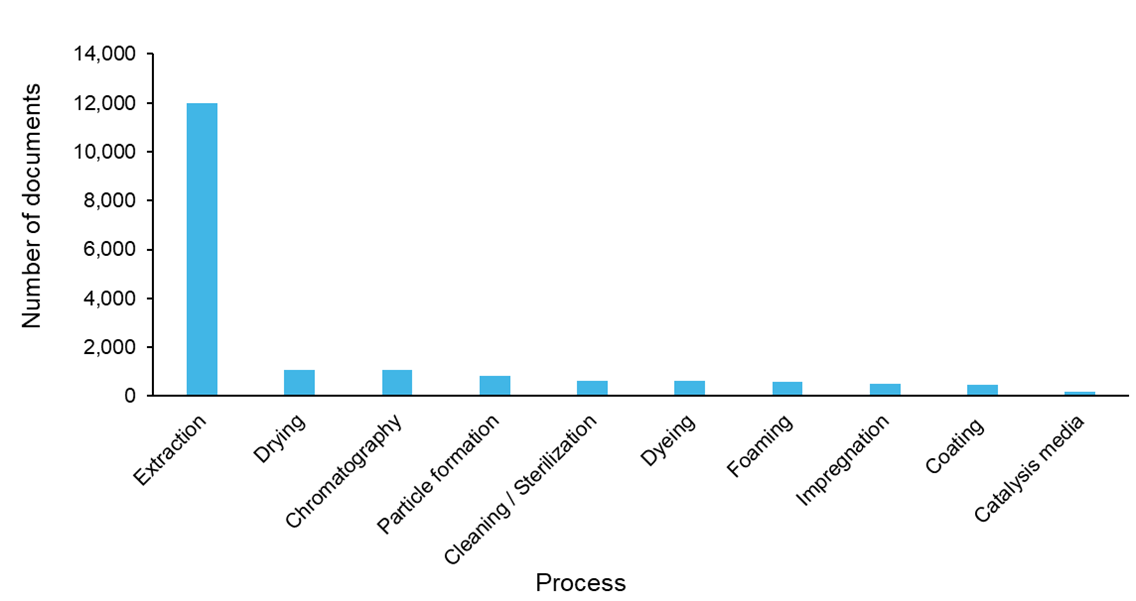
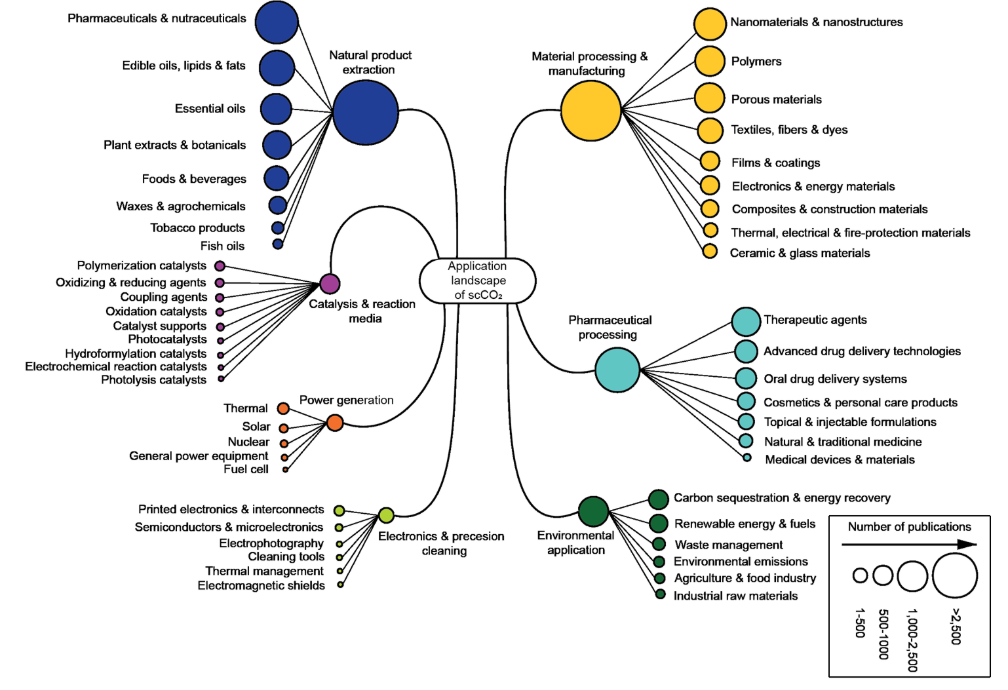
Similar to the publication numbers in Figure 2, an analysis of the larger application landscape shows that extraction is the dominant use of supercritical CO₂ — but not the only one. As seen in Figure 3, natural product extraction has the largest proportion of related documents, led by pharmaceuticals, nutraceuticals, and the extraction of other edible and naturally derived materials.

Figure 3. Chart of the supercritical CO2 application landscape by document volume. Natural product extraction holds the largest share, led by pharmaceuticals and nutraceuticals, followed by advanced materials and pharmaceutical processing, then environmental, catalysis, and power generation applications, which are progressively smaller.
Figure 3. Application landscape of supercritical CO₂. Source: CAS Content Collection

Extraction

The predominance of extraction-based applications reflects the technological maturity and wide industrial acceptance of supercritical CO₂ as a green solvent. Traditionally, such extractions — especially in the oils and fats industry — have relied on hexane. However, regulatory pressure following the1990 U.S. Clean Air Act has driven efforts to reduce hexane emissions and losses, making supercritical CO₂ a compelling alternative.

Its tunable solvating power, high diffusivity, and low viscosity enable efficient extraction of non-polar and mildly polar compounds at relatively low temperatures, preserving product quality. The non-toxic, non-flammable nature of CO₂ and the absence of residual solvents in the final product make it attractive for food, pharmaceutical, and nutraceutical applications. As a result, natural product extraction remains the most prevalent and well-established application.

Advanced materials

Materials manufacturing and processing represent the next most prominent application area, with an emphasis on nanomaterials and nanostructures. Nanomaterials are synthesized and processed using supercritical CO₂ through techniques such as supercritical antisolvent precipitation, rapid expansion of supercritical solutions, and solution-enhanced dispersion systems.

In these approaches, supercritical CO₂ functions as a solvent, antisolvent, or dispersion medium — enabling controlled nucleation, uniform particle formation, and preservation of nanostructured architectures. It is also employed for nanoparticle drying, surface functionalization, and impregnation, offering advantages in material purity, morphology control, and environmental sustainability.

Several other advanced materials processes also use the unique properties of supercritical CO₂:

•   Polymer applications are driven by supercritical CO₂-based foaming, owing to its high polymer solubility, plasticization effect, and ability to precisely control foam morphology without chemical blowing agents.

•   Porous materials including aerogels show comparable prominence, largely from supercritical CO₂-assisted drying that eliminates capillary stresses and preserves high surface areas and nanoscale porosity.

•   Textiles, fibers, and dyes benefit from supercritical CO₂-assisted dyeing of polymeric fibers, where high diffusivity and tunable solvent properties enable uniform dye penetration without water.

•   Films and coatings use supercritical CO₂ in polymer deposition, impregnation, and solvent-free coating processes.

•   Electronics and energy materials primarily involve supercritical CO₂-assisted preparation and surface modification of battery electrodes, enabling uniform material distribution and improved interfacial properties.

•   Composite and construction materials, along with thermal and fire insulators and ceramics, increasingly use supercritical CO₂for impregnation and microstructural control.

Pharmaceutical processing

Pharmaceutical processing is the next predominant research area, focused on the preparation and processing of therapeutic agents. Here supercritical CO₂ is used in drug delivery systems and drug formulation, owing to its tunable solvent and antisolvent properties. These characteristics enable micronization, encapsulation, and polymorph control — allowing precise regulation of drug particle size, morphology, and purity while minimizing thermal degradation and residual solvent content.

Beyond pharmaceuticals, supercritical CO₂ plays a role in cosmetic and personal care products, and in medical materials such as prosthetic implants, where controlled material properties, cleanliness, and biocompatibility are essential.

Carbon sequestration and environmental applications

One of the most significant contributions of supercritical CO₂ lies in carbon sequestration and enhanced oil recovery (EOR), where it is injected into geological formations to improve hydrocarbon extraction while enabling long-term CO₂ storage.

Supercritical CO₂ also supports renewable energy generation through biomass valorization, serving as a reaction medium or processing agent to convert biomass into biofuels. It is further applied in waste management and environmental remediation — pollutant extraction, waste valorization, and emission reduction— owing to its high solvating power, recyclability, and ability to remove harmful contaminants. Together, these applications position supercritical CO₂ as a critical enabler of cleaner energy technologies and sustainable environmental management.

Catalysis and reaction media

As a reaction medium in catalysis and chemical transformation, supercritical CO₂ is used in polymerization, oxidation catalysis, photocatalysis, hydroformylation, and photolytic reactions — either directly as the medium or indirectly for synthesizing, dispersing, and processing catalysts and supports.

Using supercritical CO₂ as a reaction medium provides enhanced mass-transfer characteristics and more efficient interaction between reactants and catalytic active sites. Its tunable density and solvent strength enable control over reactant solubility and reaction kinetics, while its chemical inertness and thermal stability make it compatible with many catalytic systems.

It also allows easy separation of products and catalysts through simple depressurization, minimizing solvent residues and enabling catalyst recovery — attributes that make it attractive for green and sustainable catalytic processes.

Powergeneration and electronics

Supercritical CO₂ has also been explored for power generation, electronics, and precision cleaning, though these areas are represented by fewer publications — reflecting their emerging or specialized nature and the engineering challenges of operating at high pressures.

•   In power generation, supercritical CO₂ is used as a working fluid in closed Brayton-cycle systems for thermal, solar, nuclear, and waste-heat power plants, replacing water. Its high density near the critical point reduces compression work, while its thermophysical properties enable higher thermal efficiency and more compact turbo machinery than conventional steam cycles.

•   In electronics, supercritical CO₂ is used for cooling, processing, and cleaning, thanks to low viscosity, high diffusivity, and excellent penetration into confined geometries — allowing efficient heat transfer and contaminant removal without damaging delicate micro- and nanoscale features.

•   In precision cleaning of electronic components and optical devices, supercritical CO₂ provides a solvent-free alternative that dissolves processing residues and particulates while leaving no surface residue upon depressurization.

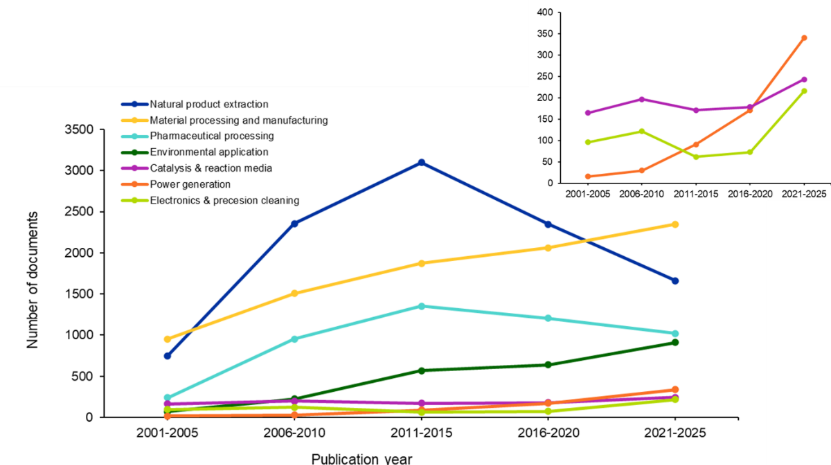
These attributes highlight the versatility of supercritical CO₂ in advanced, high-performance applications, though widespread adoption is still limited by system complexity and cost. To understand how the market for various application areas is changing, we analyzed their year-wise growth (see Figure 4).

Figure 4. Year-wise chart tracking document counts across supercritical CO2 application areas over time. Most areas grow gradually, while material processing and manufacturing shows sustained expansion and power generation rises sharply toward the later years, approaching near-exponential growth.

From tiny metal ions and polymer threads to full-sized solar panels and batteries, advanced materials are changing products across commercial and industrial uses. These innovations lie at the intersection of traditional materials science, AI-driven technology, and green chemistry.

CAS Insights: Spotlight on Advanced Materials

Key Insight

There is a growing adoption of supercritical CO₂-based techniques for advanced material synthesis, modification, and drying, driven by demand for high-performance, environmentally benign materials.

Leading substances in key supercritical CO₂ applications

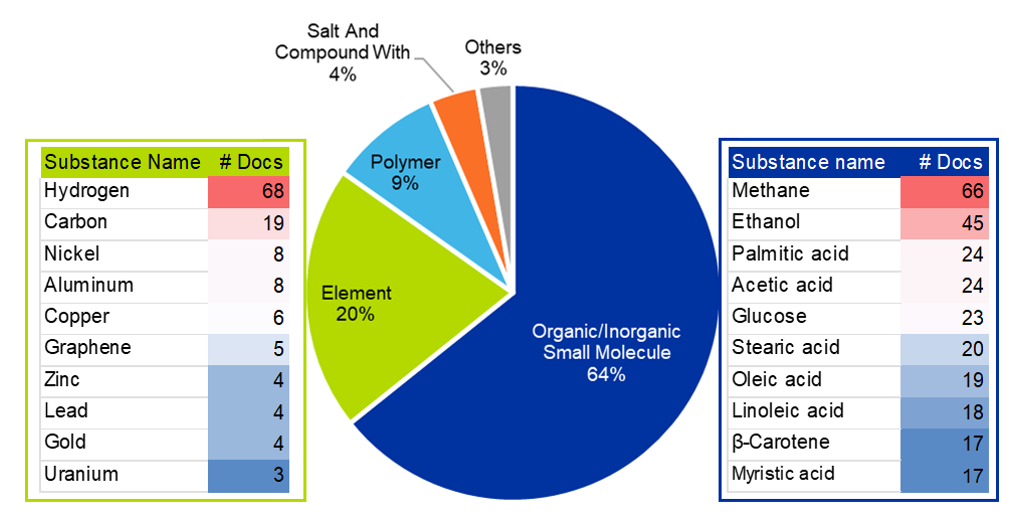
As noted in our discussion of application areas, materials manufacturing and environmental applications are rising in publication volume and technological development —tied to supercritical CO₂'s ability to act as a solvent or antisolvent and its lower environmental impact than other options. We analyzed substance data in these two areas to understand which specific substances are making the greatest impact on real-world uses.

Substances dominating advanced materials applications

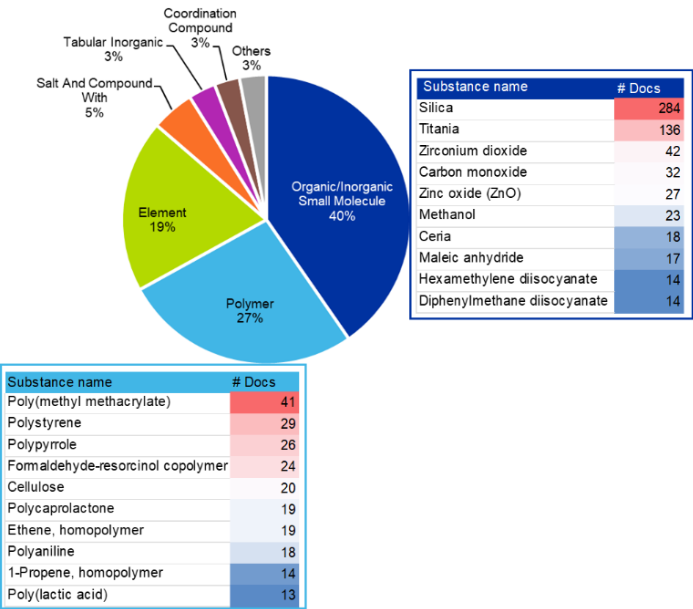
Organic and inorganic small molecules are the dominant products in materials manufacturing and processing, followed by polymers (see Figure 5).

Figure 5. CAS substance class distribution for material processing and manufacturing publications. A pie chart shows small molecules as the dominant class, followed by polymers. Accompanying heat-maps rank the top 10 substances per category, with silica and titania highest among small molecules and polymethyl acrylate, polystyrene, and polypyrrole prominent among polymers.

Aerogels benefit from supercritical CO₂-assisted drying that eliminates capillary stresses and preserves high surface areas and nanoscale porosity. Learn more about aerogel applications beyond insulation.

Aerogel Applications

Key Insight

Continued advances in high-pressure equipment, turbomachinery, materials compatibility, and process integration should accelerate the move from lab and pilot scales toward commercial deployment of CO₂.

The growth of green technologies supports supercritical CO₂

Supercritical CO₂ has evolved from a niche extraction solvent into a versatile processing and functional medium spanning materials science, pharmaceutical processing, environmental technologies, analytical methods, catalysis, and energy systems. Its tunable physicochemical properties, combined with non-toxicity and easy separation, position it as a key tool for solvent-free, low-temperature processing with precise control over structure and functionality.

Sustained growth in materials science and environmental applications underscores its continued relevance and adaptability. Ongoing advances, coupled with increasing regulatory and sustainability requirements, reinforce supercritical CO₂ as a scalable, future-ready platform for green processing and materials engineering.

Most notably, supercritical CO₂-based power generation exhibits near-exponential growth. Interest in Brayton-cycle systems reflects their ability to deliver higher thermal efficiencies, smaller footprints, and improved water management versus conventional steam cycles, attractive for next-generation nuclear reactors, concentrated solar power, waste-heat recovery, and hybrid fossil-fuel systems.

The outlook is promising. Continued advances in high-pressure equipment, turbomachinery, materials compatibility, and process integration should accelerate the move from lab and pilot scales toward commercial deployment. Challenges around capital costs, system complexity, and solubility limitations — particularly for polar compounds in reaction and catalytic systems — will require targeted research. Overall, supercritical CO₂ is positioned as a key enabler of future sustainable manufacturing and energy systems, with its greatest impact likely at the intersection of green chemistry, advanced materials, and high-efficiency power generation.

Questions and answers

Q: What makes supercritical CO2 attractive as an alternative to conventional solvents?

Q: Which application areas are showing the strongest growth momentum?

Q: What challenges remain before supercritical CO2-based technologies achieve broader commercial deployment?

Related CAS Insights

16 billion reasons for hope: How biomarkers are reshaping cancer outcomes

2023年最大の科学のブレークスルーと最新トレンド

ウェビナー:2025年に注目すべき材料科学のトレンド

Gain new perspectives for faster progress directly to your inbox.