

Resumen ejecutivo
- El CO2 supercrítico ha evolucionado de ser un disolvente de extracción especializado a convertirse en un medio de procesamiento versátil y sostenible que abarca la fabricación de materiales, la industria farmacéutica y la generación de energía.
- El análisis de CAS revela una diversificación activa en todos los sectores, donde el procesamiento de materiales y las aplicaciones medioambientales emergen como los ámbitos de mayor crecimiento, junto a la ya consolidada extracción de productos naturales.
- El CO2 supercrítico es una plataforma de procesamiento escalable libre de disolventes convencionales, lo que lo convierte en una alternativa más ecológica para materiales avanzados, productos farmacéuticos y alimentarios, y aplicaciones de captura de carbono.
- Las patentes representan el 37% de las publicaciones, lo que indica un fuerte impulso comercial para el CO2 supercrítico.
¿Qué es el CO₂ supercrítico?
El dióxido de carbono supercrítico (CO₂ supercrítico) se refiere al dióxido de carbono utilizado en condiciones en las que presenta propiedades únicas, situadas entre las de un gas y un líquido. Este estado se alcanza cuando se mantiene por encima de su temperatura y presión críticas (31,1 °C y 7,38 MPa). En este estado supercrítico, el CO₂ posee una baja viscosidad, lo que refleja la facilidad de flujo típica de los gases, junto con una alta difusividad, que mejora su capacidad para interactuar con otros materiales de forma similar a los líquidos.
Además, la capacidad disolvente del CO2 supercrítico puede modularse mediante ajustes de presión y temperatura, lo que facilita una mejor transferencia de masa y la solubilización selectiva de especies moleculares específicas. Dado que el dióxido de carbono es abundante, no inflamable y ambientalmente inocuo en este estado, el CO₂ supercrítico ha despertado interés como medio alternativo en muchos campos científicos e industriales (aunque el CO2 atmosférico es un gas de efecto invernadero, el uso de dióxido de carbono en la alimentación y la extracción no es tóxico y no contribuye significativamente a las emisiones).
Aunque el CO₂ supercrítico suele asociarse a aplicaciones de extracción, debido a su uso histórico en la descafeinización y el procesamiento de productos naturales, las características únicas del fluido han permitido su expansión a otras muchas operaciones unitarias que abarcan el procesamiento de materiales, la química analítica, la fabricación farmacéutica y la ingeniería textil. Además, las propiedades adaptables de su estado supercrítico lo hacen adecuado para numerosos procesos y favorecen el desarrollo de tecnologías más sostenibles.
El análisis de este artículo se basa en CAS Content Collection™, el mayor repositorio mundial de datos científicos seleccionados por expertos. Descubra cómo los datos de CAS ayudan a impulsar investigaciones como las que encontrará aquí.
Información clave
En su estado supercrítico, el CO₂ posee una baja viscosidad, lo que refleja la facilidad de flujo típica de los gases, junto con una alta difusividad, que mejora su capacidad para interactuar con otros materiales de forma similar a los líquidos.
Tendencias de publicación y procesos relacionados con el CO₂ supercrítico
Para comprender la evolución de la investigación sobre el CO₂ supercrítico, analizamos CAS Content Collection™, al que se accede a través de CAS IP Finder con tecnología de STN™. Este análisis revela un crecimiento constante en la investigación sobre CO₂ supercrítico entre 2001 y 2025, con un número total de publicaciones que se ha triplicado en 25 años (véase la Figura 1).
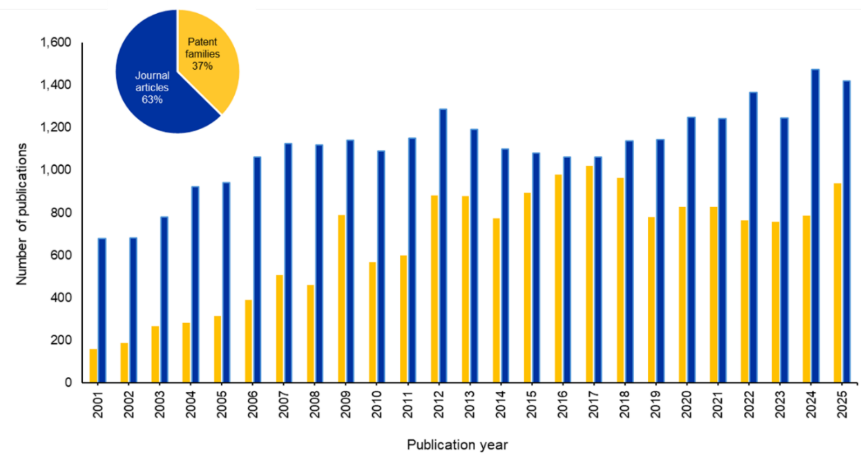
Cabe destacar que las patentes representan el 37% del total de publicaciones, lo que indica un fuerte interés comercial y subraya la creciente relevancia industrial de las tecnologías basadas en CO₂ supercrítico a medida que pasan de la investigación fundamental a su implementación en el mundo real. La combinación de beneficios medioambientales, ventajas económicas y amplia aplicabilidad hace que la tecnología de CO₂ supercrítico sea atractiva para la protección mediante patentes y el desarrollo comercial.
Asimismo, hemos examinado el número de publicaciones relacionadas con diversos procesos que utilizan CO₂ supercrítico. La versatilidad de este material queda patente en su adopción en una amplia gama de procesos industriales y científicos, cada uno de los cuales aprovecha atributos fisicoquímicos distintos del estado supercrítico (véase la Figura 2).
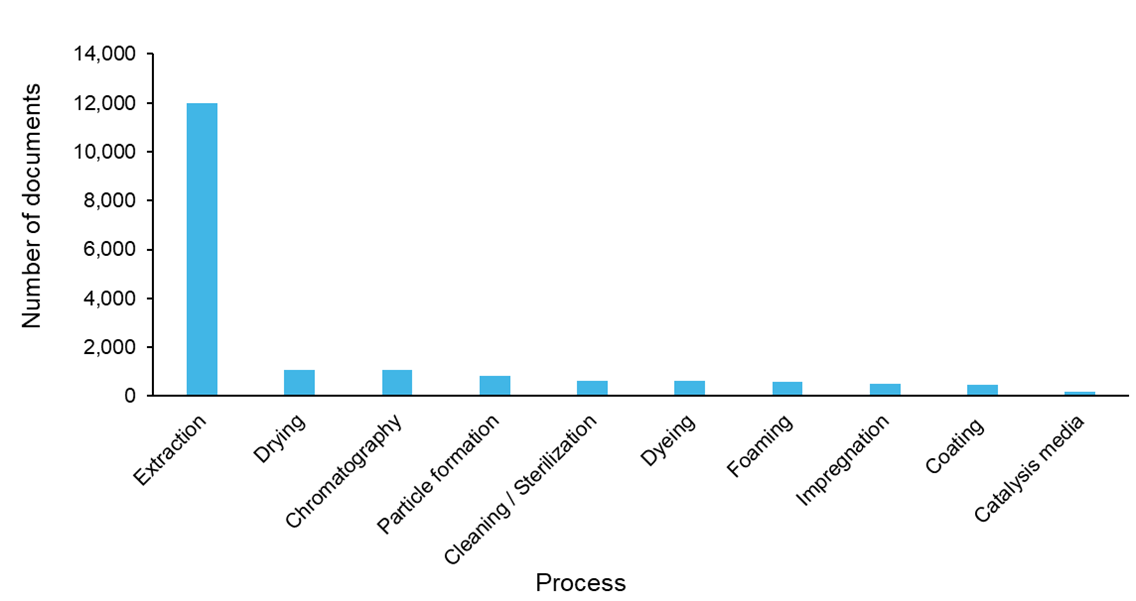
La extracción sigue siendo la aplicación más dominante y consolidada, impulsada por su capacidad de disolución ajustable, la rapidez en la transferencia de masa, su excelente penetración en matrices y la facilidad para eliminar el disolvente. No obstante, el CO₂ supercrítico se ha expandido a otras muchas operaciones unitarias, como el secado, la cromatografía, la formación de partículas (micronización y pulverización) y diversas aplicaciones de procesamiento de materiales.
El secado aprovecha la ausencia de tensión superficial para preservar micro y nanoestructuras delicadas, mientras que la formación de partículas y la impregnación utilizan el comportamiento antidisolvente y la profunda penetración en la matriz para permitir arquitecturas de materiales controladas. Las aplicaciones cromatográficas se benefician de sus propiedades de transporte similares a las de un gas y de su poder disolvente ajustable, mientras que los procesos catalíticos y mediados por reacción aprovechan la mejora en la transferencia de masa y la simplificación en la separación de productos.
Estas aplicaciones demuestran que el CO₂ supercrítico no es solo un disolvente de extracción, sino un medio de procesamiento adaptable con una relevancia creciente en materiales avanzados, fabricación química y tecnologías sostenibles.
Las patentes representan el 37% de la literatura sobre este tema. Puede explorar el panorama de patentes de los temas que le interesan utilizando CAS IP Finder, con tecnología de STN™.
Información clave
Las patentes representan el 37% del total de las publicaciones examinadas, lo que indica un fuerte interés comercial y subraya la creciente relevancia industrial de las tecnologías basadas en CO₂ supercrítico a medida que pasan de la investigación fundamental a su implementación en el mundo real.
Aplicaciones en materiales avanzados e ingeniería de procesos
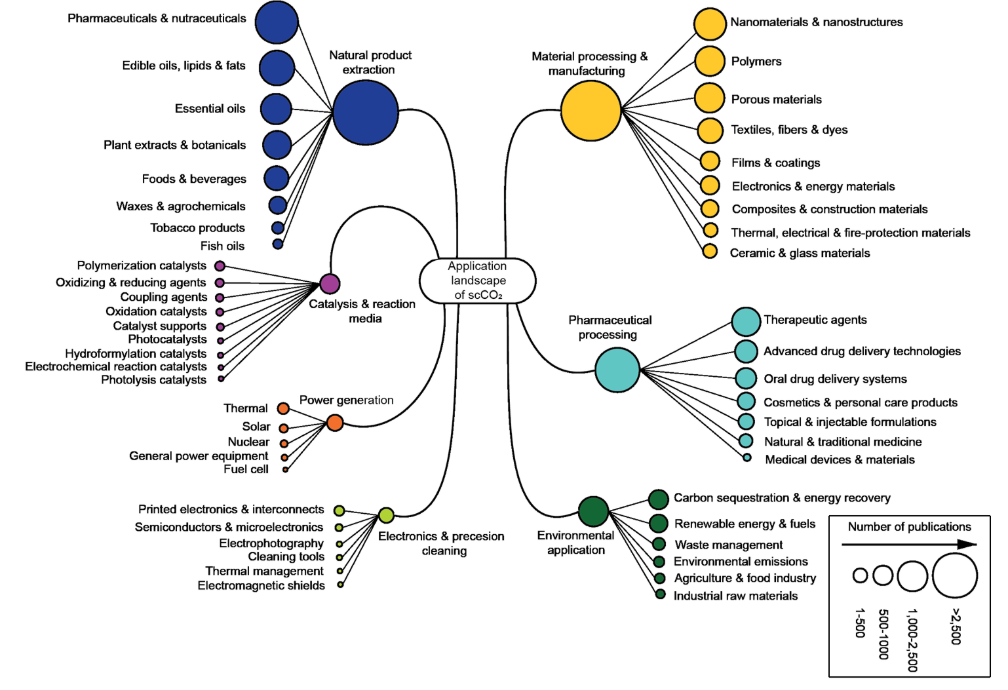
Al igual que las cifras de publicaciones de la Figura 2, un análisis del panorama general de aplicaciones muestra que la extracción es el uso predominante del CO₂ supercrítico, aunque no el único. Como se observa en la Figura 3, la extracción de productos naturales cuenta con la mayor proporción de documentos relacionados, encabezada por los sectores farmacéutico, nutracéutico y la extracción de otros materiales comestibles y de origen natural.
Extracción
La predominancia de las aplicaciones basadas en la extracción refleja la madurez tecnológica y la amplia aceptación industrial del CO₂ supercrítico como disolvente ecológico. Tradicionalmente, estas extracciones, especialmente en la industria de aceites y grasas, dependían del hexano. Sin embargo, la presión regulatoria tras la Ley de Aire Limpio de EE. UU. de 1990 ha impulsado esfuerzos para reducir las emisiones y pérdidas de hexano, convirtiendo al CO₂ supercrítico en una alternativa convincente.
Su poder disolvente ajustable, su alta difusividad y su baja viscosidad permiten una extracción eficiente de compuestos no polares y ligeramente polares a temperaturas relativamente bajas, preservando la calidad del producto. La naturaleza no tóxica e inflamable del CO₂ y la ausencia de disolventes residuales en el producto final lo hacen atractivo para aplicaciones alimentarias, farmacéuticas y nutracéuticas. Como resultado, la extracción de productos naturales sigue siendo la aplicación más prevalente y consolidada.
Materiales avanzados
La fabricación y el procesamiento de materiales representan la siguiente área de aplicación más destacada, con énfasis en los nanomateriales y las nanoestructuras. Los nanomateriales se sintetizan y procesan utilizando CO₂ supercrítico mediante técnicas como la precipitación con antidisolvente supercrítico, la expansión rápida de soluciones supercríticas y los sistemas de dispersión mejorados por solución.
En estos enfoques, el CO₂ supercrítico funciona como disolvente, antidisolvente o medio de dispersión, permitiendo una nucleación controlada, la formación uniforme de partículas y la preservación de arquitecturas nanoestructuradas. También se emplea para el secado de nanopartículas, la funcionalización de superficies y la impregnación, ofreciendo ventajas en cuanto a pureza del material, control de la morfología y sostenibilidad medioambiental.
Otros procesos de materiales avanzados también utilizan las propiedades únicas del CO₂ supercrítico:
• Las aplicaciones en polímeros están impulsadas por el espumado basado en CO₂ supercrítico, debido a su alta solubilidad en polímeros, su efecto plastificante y su capacidad para controlar con precisión la morfología de la espuma sin necesidad de agentes espumantes químicos.
• Los materiales porosos, incluidos los aerogeles, muestran una relevancia comparable, derivada en gran medida del secado asistido por CO₂ supercrítico, que elimina las tensiones capilares y preserva tanto las elevadas superficies específicas como la porosidad a nanoescala.
• Los textiles, las fibras y los tintes se benefician del teñido de fibras poliméricas asistido por CO₂ supercrítico, donde su alta difusividad y sus propiedades disolventes ajustables permiten una penetración uniforme del tinte sin necesidad de agua.
• Las películas y los recubrimientos utilizan CO₂ supercrítico en procesos de deposición de polímeros, impregnación y recubrimiento sin disolventes.
• La electrónica y los materiales energéticos implican principalmente la preparación y modificación superficial de electrodos de baterías asistidas por CO₂ supercrítico, lo que permite una distribución uniforme del material y la mejora de las propiedades interfaciales.
• Los materiales compuestos y de construcción, junto con los aislantes térmicos y contra incendios y las cerámicas, utilizan cada vez más el CO₂ supercrítico para procesos de impregnación y control microestructural.
Procesamiento farmacéutico
El procesamiento farmacéutico constituye la siguiente área de investigación predominante, centrada en la preparación y el tratamiento de agentes terapéuticos. En este ámbito, el CO₂ supercrítico se emplea en sistemas de administración de fármacos y en su formulación, gracias a sus propiedades ajustables como disolvente y antidisolvente. Estas características permiten la micronización, la encapsulación y el control de polimorfos, facilitando una regulación precisa del tamaño de partícula, la morfología y la pureza del fármaco, al tiempo que se minimizan la degradación térmica y el contenido de disolvente residual.
Más allá del sector farmacéutico, el CO₂ supercrítico desempeña un papel relevante en productos cosméticos y de cuidado personal, así como en materiales médicos como los implantes protésicos, donde son esenciales el control de las propiedades del material, la limpieza y la biocompatibilidad.
Secuestro de carbono y aplicaciones medioambientales
Una de las contribuciones más significativas del CO₂ supercrítico reside en el secuestro de carbono y la recuperación mejorada de petróleo (EOR), donde se inyecta en formaciones geológicas para mejorar la extracción de hidrocarburos y, simultáneamente, permitir el almacenamiento de CO₂ a largo plazo.
El CO₂ supercrítico también favorece la generación de energía renovable mediante la valorización de biomasa, actuando como medio de reacción o agente de procesamiento para convertir la biomasa en biocombustibles. Asimismo, se aplica en la gestión de residuos y la remediación ambiental —extracción de contaminantes, valorización de residuos y reducción de emisiones— debido a su elevado poder disolvente, su capacidad de reciclaje y su eficacia para eliminar contaminantes nocivos. En conjunto, estas aplicaciones posicionan al CO₂ supercrítico como un facilitador clave de tecnologías energéticas más limpias y de una gestión medioambiental sostenible.
Catálisis y medios de reacción
Como medio de reacción en catálisis y transformaciones químicas, el CO₂ supercrítico se utiliza en polimerización, catálisis por oxidación, fotocatálisis, hidroformilación y reacciones fotolíticas, ya sea directamente como medio o indirectamente para sintetizar, dispersar y procesar catalizadores y soportes.
El uso de CO₂ supercrítico como medio de reacción proporciona mejores características de transferencia de masa y una interacción más eficiente entre los reactivos y los sitios activos catalíticos. Su densidad y fuerza disolvente ajustables permiten controlar la solubilidad de los reactivos y la cinética de reacción, mientras que su inercia química y estabilidad térmica lo hacen compatible con numerosos sistemas catalíticos.
Asimismo, permite una fácil separación de productos y catalizadores mediante una simple despresurización, lo que minimiza los residuos de disolvente y facilita la recuperación del catalizador; atributos que lo hacen atractivo para procesos catalíticos ecológicos y sostenibles.
Generación de energía y electrónica
El CO₂ supercrítico también se ha explorado para la generación de energía, la electrónica y la limpieza de precisión, aunque estas áreas cuentan con un menor número de publicaciones, lo que refleja su carácter emergente o especializado y los desafíos de ingeniería que supone operar a altas presiones.
• En la generación de energía, el CO₂ supercrítico se utiliza como fluido de trabajo en sistemas de ciclo Brayton cerrado para plantas térmicas, solares, nucleares y de aprovechamiento de calor residual, sustituyendo al agua. Su alta densidad cerca del punto crítico reduce el trabajo de compresión, mientras que sus propiedades termofísicas permiten una mayor eficiencia térmica y una maquinaria turbo más compacta que los ciclos de vapor convencionales.
• En la electrónica, el CO₂ supercrítico se emplea para refrigeración, procesamiento y limpieza, gracias a su baja viscosidad, alta difusividad y excelente penetración en geometrías confinadas, lo que permite una transferencia de calor eficiente y la eliminación de contaminantes sin dañar las delicadas estructuras micro y nanoescala.
• En la limpieza de precisión de componentes electrónicos y dispositivos ópticos, el CO₂ supercrítico ofrece una alternativa sin disolventes que disuelve los residuos de procesamiento y las partículas, sin dejar rastro alguno en la superficie tras la despresurización.
Estos atributos subrayan la versatilidad del CO₂ supercrítico en aplicaciones avanzadas de alto rendimiento, aunque su adopción generalizada sigue limitada por la complejidad y el coste de los sistemas. Para comprender cómo está cambiando el mercado en diversas áreas de aplicación, analizamos su crecimiento anual (véase la Figura 4).
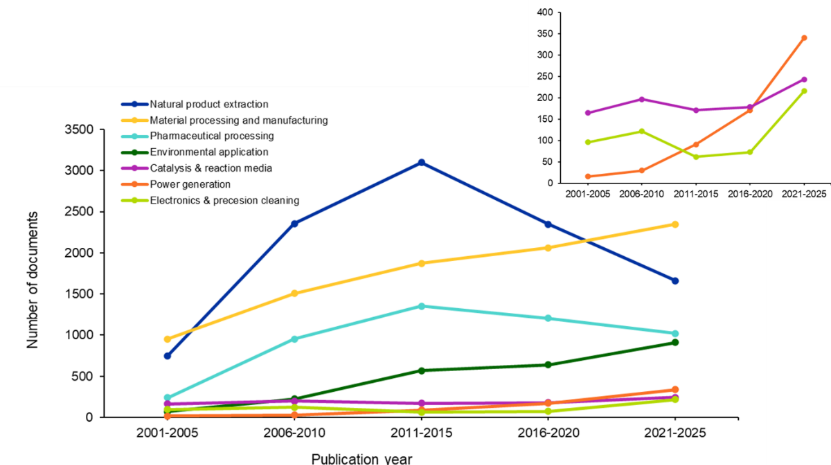
El análisis indica que el procesamiento y la fabricación de materiales siguen mostrando una expansión sostenida, lo que refleja la creciente adopción de técnicas basadas en CO₂ supercrítico para la síntesis, modificación y secado avanzado de materiales, impulsada por la demanda de materiales de alto rendimiento y respetuosos con el medio ambiente.
Desde diminutos iones metálicos e hilos de polímero hasta paneles solares y baterías de tamaño completo, los materiales avanzados están transformando productos en usos comerciales e industriales. Estas innovaciones se sitúan en la intersección de la ciencia de materiales tradicional, la tecnología impulsada por IA y la química verde.
Información clave
Existe una creciente adopción de técnicas basadas en CO₂ supercrítico para la síntesis, modificación y secado avanzado de materiales, impulsada por la demanda de materiales de alto rendimiento y respetuosos con el medio ambiente.
Sustancias líderes en aplicaciones clave de CO₂ supercrítico
Como se señaló en nuestro análisis de las áreas de aplicación, la fabricación de materiales y las aplicaciones medioambientales están aumentando en volumen de publicaciones y desarrollo tecnológico, vinculadas a la capacidad del CO₂ supercrítico para actuar como disolvente o antisolvente y a su menor impacto medioambiental en comparación con otras opciones. Analizamos los datos de sustancias en estas dos áreas para comprender qué sustancias específicas están teniendo el mayor impacto en aplicaciones reales.
Sustancias que dominan las aplicaciones de materiales avanzados
Las moléculas pequeñas orgánicas e inorgánicas son los productos dominantes en la fabricación y el procesamiento de materiales, seguidas por los polímeros (véase la Figura 5).
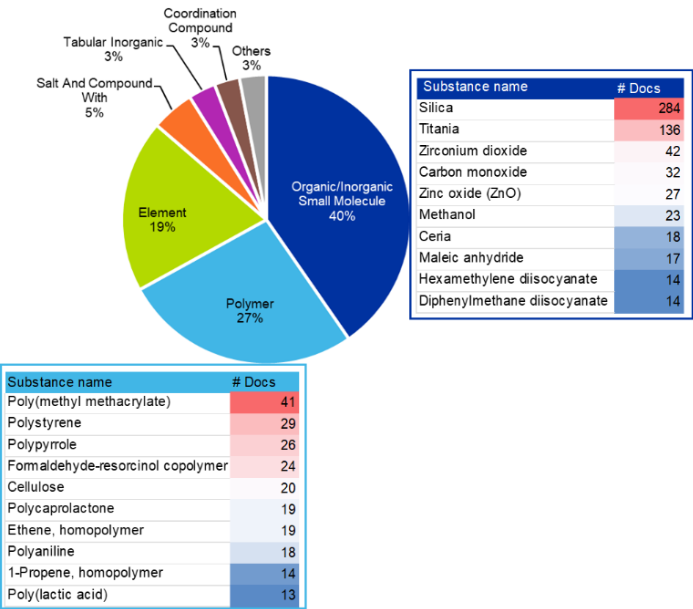
Entre las moléculas pequeñas, la sílice es la sustancia más destacada, impulsada por una extensa labor de I+D en aerogeles de sílice sintetizados mediante secado con CO₂ supercrítico. Estos aerogeles son valorados por su densidad ultrabaja, alta porosidad y gran superficie específica, factores importantes para sistemas de administración de fármacos, matrices de liberación controlada y aislamiento de formulaciones sensibles.
La titania es la segunda más destacada, lo que refleja su relevancia en catálisis, fotocatálisis, energía y aplicaciones biomédicas. El CO₂ supercrítico se utiliza ampliamente para la síntesis, secado, funcionalización superficial y nanoestructuración de TiO₂, lo que permite controlar el tamaño de partícula, la porosidad, la cristalinidad y la química superficial para fotocatálisis, células solares sensibilizadas por colorante, recubrimientos autolimpiantes e implantes biomédicos.
En la categoría de polímeros, el acrilato de poli(metilmetacrilato) se sitúa entre las sustancias principales, lo que refleja el papel del CO₂ supercrítico en la polimerización, espumado, hinchamiento e impregnación. El poliestireno es importante como sistema modelo para estudiar procesos inducidos por CO₂ supercrítico y para materiales estructurales y de aislamiento ligeros. El polipirrol destaca como polímero conductor, donde el CO₂ supercrítico favorece la polimerización controlada, el dopaje, la impregnación y la nanoestructuración para sensores, almacenamiento de energía y recubrimientos biomédicos.
Sustancias que impulsan el secuestro de carbono y las aplicaciones medioambientales
La integración del CO₂ supercrítico en tecnologías emergentes de energía y gestión de carbono ha impulsado un interés investigador sostenido. La categorización por clases de sustancias muestra que las moléculas pequeñas orgánicas e inorgánicas son la categoría de productos más prevalente, seguidas por los elementos (véase la Figura 6).
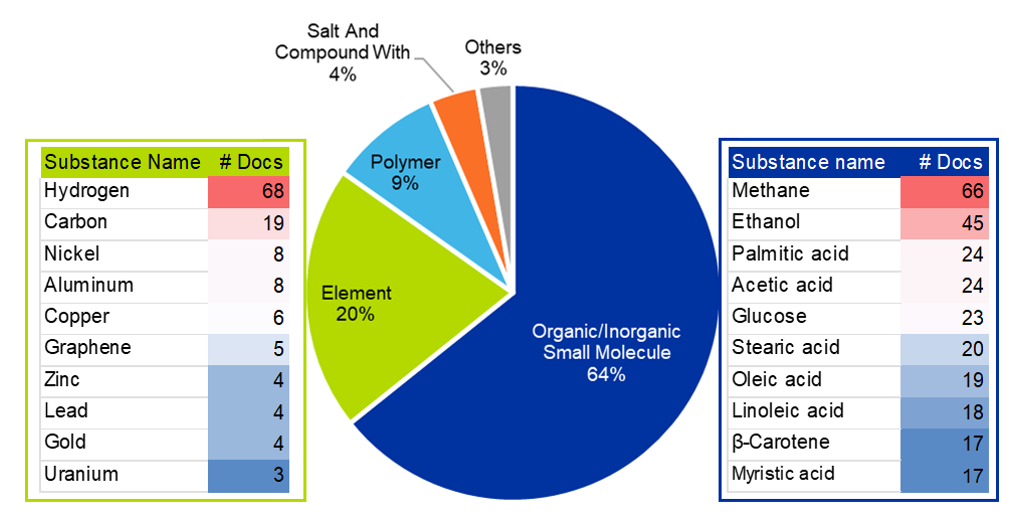
El metano ocupa el primer lugar debido a la extensa valorización de biomasa asistida por CO₂ supercrítico y a la conversión de residuos orgánicos para la producción de metano, mientras que el etanol aparece de forma destacada debido a la investigación continua sobre la producción de bioetanol asistida por CO₂ supercrítico. El ácido palmítico destaca porque se extrae habitualmente de biomasa rica en lípidos y aceites naturales con CO₂ supercrítico, sirviendo como componente clave de ácidos grasos en la producción de biodiésel y en el análisis de materias primas para biocombustibles.
Dentro de la categoría de elementos, el hidrógeno ocupa el lugar más destacado, lo que refleja el creciente interés en la producción sostenible de hidrógeno y su papel como vector energético limpio. Una actividad significativa en la síntesis de carbón activado asistida por CO₂ supercrítico posiciona al carbono como otra sustancia clave.
Se ha observado un crecimiento casi exponencial en la investigación sobre generación de energía basada en CO₂ supercrítico, impulsado por su potencial para lograr una mayor eficiencia térmica y sistemas más compactos que los ciclos de vapor convencionales. Los continuos avances en turbomaquinaria, materiales de alta temperatura e integración de sistemas lo posicionan como un área en rápida expansión. El proyecto de demostración STEP (Supercritical Transformational Electric Power), financiado por el Departamento de Energía de EE. UU. y liderado por GTI Energy, demuestra la sustitución de los ciclos de vapor convencionales por CO₂ supercrítico, lo que permite diseños de centrales eléctricas más pequeños, eficientes y con un menor consumo de agua.
Los aerogeles se benefician del secado asistido por CO₂ supercrítico, que elimina las tensiones capilares y preserva las elevadas superficies específicas y la porosidad a nanoescala. Descubra más aplicaciones de los aerogeles más allá del aislamiento.
Información clave
Los continuos avances en equipos de alta presión, turbomaquinaria, compatibilidad de materiales e integración de procesos deberían acelerar la transición desde las escalas de laboratorio y piloto hacia el despliegue comercial del CO₂.
El crecimiento de las tecnologías verdes respalda al CO₂ supercrítico
El CO₂ supercrítico ha evolucionado de ser un disolvente de extracción especializado a convertirse en un medio de procesamiento y funcional versátil que abarca la ciencia de materiales, el procesamiento farmacéutico, las tecnologías medioambientales, los métodos analíticos, la catálisis y los sistemas energéticos. Sus propiedades fisicoquímicas ajustables, combinadas con su baja toxicidad y facilidad de separación, lo posicionan como una herramienta clave para el procesamiento sin disolventes y a baja temperatura, con un control preciso sobre la estructura y la funcionalidad.
El crecimiento sostenido en la ciencia de materiales y las aplicaciones medioambientales subraya su relevancia y adaptabilidad continuas. Los avances en curso, junto con los crecientes requisitos normativos y de sostenibilidad, refuerzan al CO₂ supercrítico como una plataforma escalable y preparada para el futuro en el ámbito del procesamiento ecológico y la ingeniería de materiales.
Cabe destacar que la generación de energía basada en CO₂ supercrítico muestra un crecimiento casi exponencial. El interés en los sistemas de ciclo Brayton refleja su capacidad para ofrecer mayores eficiencias térmicas, una menor huella física y una mejor gestión del agua en comparación con los ciclos de vapor convencionales, lo que resulta atractivo para reactores nucleares de próxima generación, energía solar concentrada, recuperación de calor residual y sistemas híbridos de combustibles fósiles.
Las perspectivas son prometedoras. Los continuos avances en equipos de alta presión, turbomaquinaria, compatibilidad de materiales e integración de procesos deberían acelerar el paso de las escalas de laboratorio y piloto al despliegue comercial. Los retos relacionados con los costes de capital, la complejidad del sistema y las limitaciones de solubilidad —especialmente para compuestos polares en sistemas de reacción y catálisis— requerirán una investigación específica. En general, el CO₂ supercrítico se posiciona como un facilitador clave de los futuros sistemas de fabricación y energía sostenibles, con un impacto probablemente mayor en la intersección de la química verde, los materiales avanzados y la generación de energía de alta eficiencia.