Microelectronics frontiers: insights into emerging technologies

Microelectronics, the field dedicated to developing and manufacturing microscale electronic components and systems, is the cornerstone of modern digital innovation. Through continuous advancements in materials, device architectures, and fabrication processes, it has revolutionized modern electronics, shrinking devices from room-sized machines to compact smartphones we carry in our pockets.

The microelectronics industry is currently experiencing unprecedented transformation driven by emerging technologies such as artificial intelligence (AI), Internet of Things (IoT), 5G/6G communications, and quantum computing. These applications demand sophisticated components with enhanced performance characteristics, higher processing speeds, lower power consumption, improved thermal management, and greater miniaturization. Simultaneously, new materials like graphene, carbon nanotubes (CNTs), perovskites, and advanced III-V semiconductors are enabling novel device architectures, while manufacturing techniques such as extreme ultraviolet (EUV) lithography, atomic layer deposition (ALD), and heterogeneous integration are pushing the boundaries of Moore's Law.  

The convergence of these technological advances with growing market demands creates a complex innovation ecosystem where breakthrough discoveries can rapidly reshape entire industry segments, making timely technology intelligence critical for competitive advantage. The market opportunities are enormous — valued at $482 billion USD in 2025, the microelectronics market is expected to grow at a CAGR of 5.7% to 2035, reaching nearly $840 billion USD in value by that year.

While breakthrough discoveries offer tremendous opportunities, they also create information management challenges, including the fragmentation of critical information across disparate academic journals, patent databases, and conference proceedings, which makes it difficult to obtain a holistic view of technology development. Organizations may struggle to identify emerging applications and materials in their early research phases, missing critical opportunities for strategic positioning, partnership formation, or competitive response before these technologies reach commercial maturity. A comprehensive solution requires access to integrated, authoritative data sources that can bridge these information silos.

We leveraged the CAS Content CollectionTM, the largest human-curated repository of scientific information, to demonstrate how to efficiently extract actionable insights about microelectronics from the vast body of published information on this subject. The CAS Content Collection is accessible through CAS solutions including CAS SciFinder®, CAS STNext® and CAS BioFinder®,. It is powered by the CAS REGISTRY®, which is the authoritative source for information on more than 290 million unique organic and inorganic substances.

With these resources, we combined natural language processing (NLP) with the CAS indexing system to identify over 200 emerging scientific topic areas across journal and patent publications in microelectronics. These findings are visualized through a series of CAS TrendScape maps derived from a comprehensive analysis of approximately 1.1 million journal articles and patents each that were published in the last 20 years.  

The maps present the identified emerging scientific topic areas in an intuitive, hierarchical format organized across four primary branches: applications, devices, materials, and fabrication methods. Many of these topic areas represent early-stage emergent technologies, and the TrendScape maps are designed to provide immediate visual access to emerging topic areas, their categorical relationships, research volume, and current interest levels.

Our syndicated report contains the full analysis and all TrendScape maps. For a snapshot of these analytics, let’s explore the Applications section of our analysis of microelectronics literature to better understand important emerging technologies:

Emerging and mature applications in microelectronics

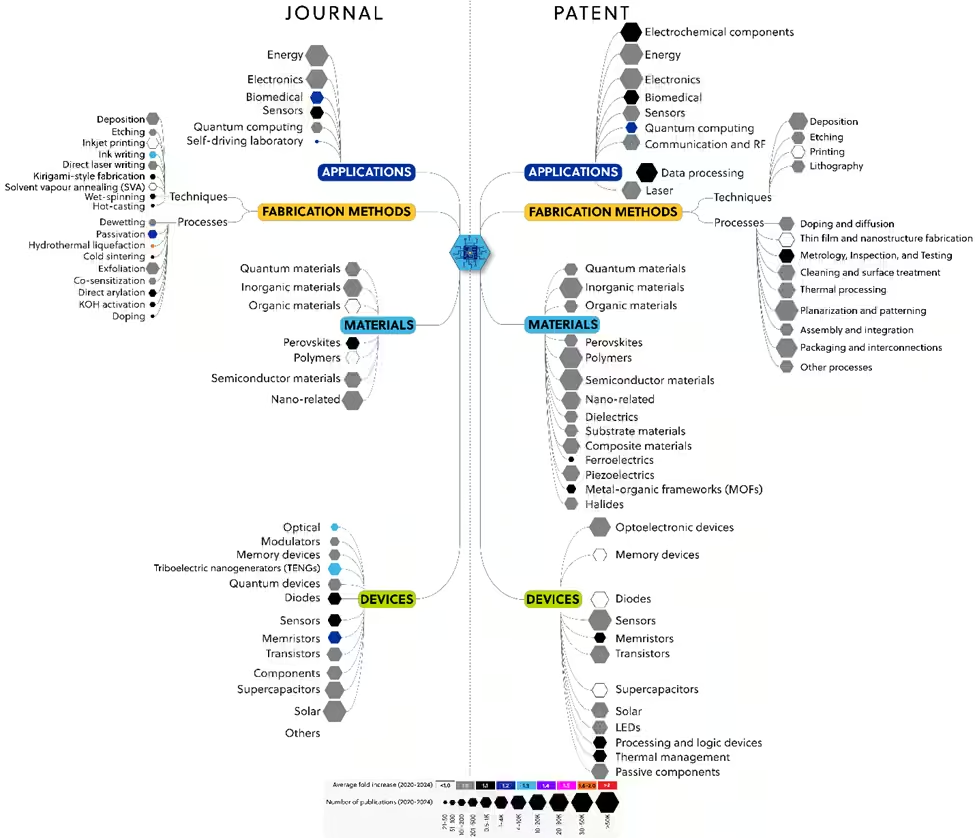
Using NLP-based analysis, we analyzed nearly 1.1 million journal and patent publications each to identify emerging topic areas. The identified topic areas were organized hierarchically to generate a CAS TrendScape encompassing four primary branches: applications, fabrication methods, devices, and materials (see Figure 1).  

Diagram comparing journal and patent activity across four categories: Applications, Fabrication Methods, Materials, and Devices in emerging technology research (2020-2024).
Figure 1: CAS TrendScape map illustrating emerging topics in microelectronics based on journal and patent publications in the CAS Content Collection.

Each branch contains sub-branches that are weighted by their respective number of journal and patent publications counts from 2020-2024. These weights are represented as hexagonal nodes of increasing size, corresponding to publication ranges from 20 to over 50,000. The hexagonal nodes are also colored according to their average fold increase, as indicated in the inset legend.

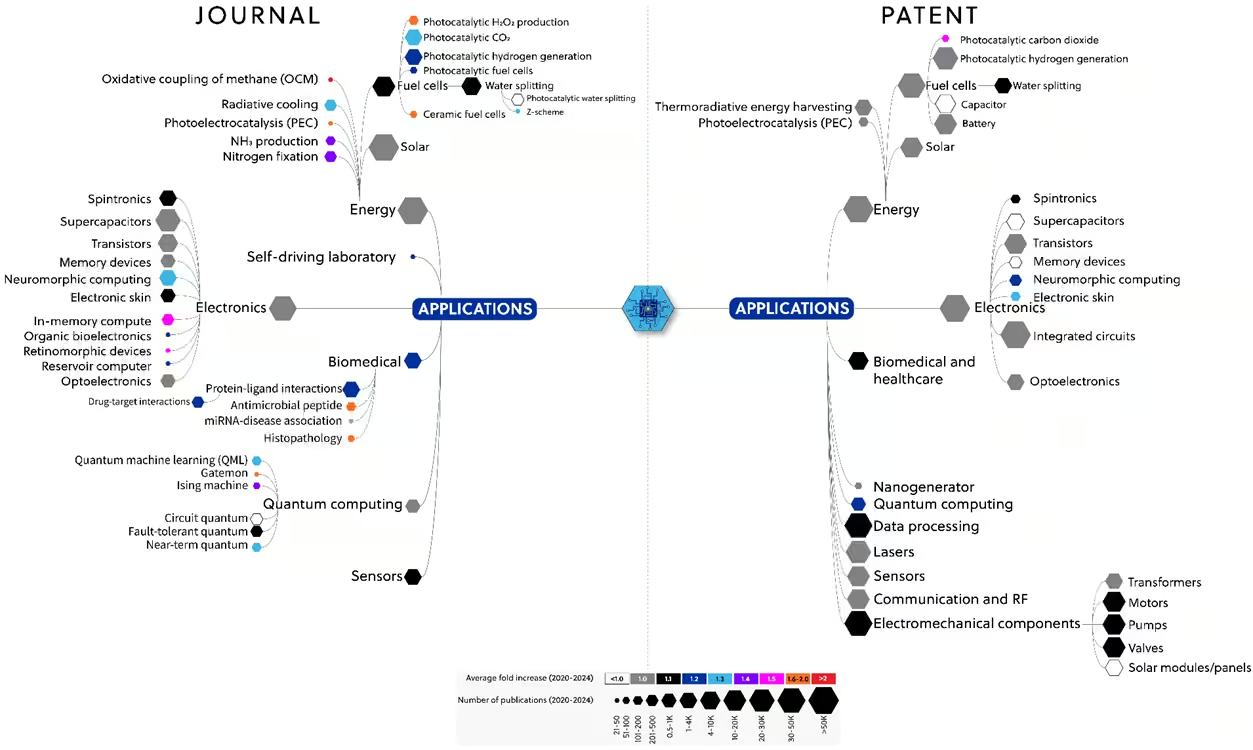
Visual inspection of the “Applications” map reveals the energy and electronics sub-branches contain the highest publication volumes in journal and patent landscapes (see Figure 2). The applications journal branch is structured into six primary sub-branches: energy, quantum computing, biomedical, electronics, sensors, and self-driving laboratory, four of which are further subdivided into specialized fields. The applications patent branch is substantially more diversified with topics such as lasers, nanogenerators, communication and radio frequency (RF), and electromechanical components.

Detailed breakdown of Applications category comparing journal and patent focus areas including energy, electronics, biomedical, quantum computing, and sensors (2020-2024).
Figure 2: CAS TrendScape map of emerging topics in the ‘Applications’ branch of microelectronics based on journal and patent publications in the CAS Content Collection.

The application domains with the lowest publication volumes include quantum computing, self-driving laboratories, and retinomorphic devices. These nascent fields represent significant opportunities for future research expansion. The relatively sparse publication landscape in these areas suggests they are in early developmental stages, with substantial potential for growth as the underlying technologies mature and practical applications emerge. We also noted key increases in patent publications for innovations like electronic skin. This disparity between established and emerging fields highlights the dynamic nature of the research landscape and identifies strategic areas for future investigation.

Electronic skin (E-skin)

E-skin comprises soft, flexible, stretchable, and self-healing electronic systems that mimic multifunctional properties of biological skin. As the body's largest organ, human skin performs critical physiological functions including thermoregulation and immune response mediation. Skin is suffused with a plethora of receptors capable of detecting several stimuli pertaining to pressure, temperature, touch, spatial orientation, among many others. To mimic the complexity of human skin, E-skin must incorporate systems capable of sensing, transmitting, and processing stimuli.

The convergence of personalized medicine with advanced sensing technologies has intensified demand for sophisticated bio signal detection and processing systems. E-skin applications span multiple domains, from biomedical implementations including prosthetics, wound healing, and continuous health surveillance, to broader applications in robotics, human-machine interfaces, and interactive entertainment systems. This diverse application landscape, combined with ongoing advances in materials science and fabrication techniques, positions E-skin as a transformative technology at the intersection of electronics, materials science, and biomedical engineering.

Our analysis found notable commercial interest, evidenced by higher average-fold increases in patents compared to journal publications (1.3X vs 1.0X). Journal publications have still grown significantly since 2015, suggesting the field remains in early development. However, the patent growth shows that E-skin is poised to make the leap to more commercial applications. Recent research has focused more on developing biodegradable E-skin systems, addressing environmental sustainability concerns while maintaining functional performance.

Quantum computing

Quantum computing represents a revolutionary computational paradigm that exploits quantum mechanical phenomena, superposition, and entanglement to achieve unprecedented processing capabilities. Unlike classical computers that process binary bits (0s and 1s), quantum computers employ quantum bits (qubits) capable of existing in multiple states simultaneously. This fundamental distinction enables exponential acceleration in information processing, potentially transforming fields constrained by classical computational limits.  

The quantum computing landscape is rapidly evolving across multiple dimensions. Quantum-centric supercomputing integrates quantum processors with traditional high-performance computing systems, creating hybrid architectures that leverage the strengths of both paradigms. Quantum machine learning exploits quantum parallelism to potentially outperform classical AI approaches for specific applications.  

Additionally, quantum internet development focuses on establishing networks for secure communication and distributed quantum computing. Researchers are also developing application-specific quantum processors optimized for specific problem domains, while achieving compelling quantum advantage demonstrations where quantum systems outperform classical supercomputers.  

Quantum computing is beginning to demonstrate practical value across diverse sectors. In pharmaceuticals, companies including Roche and Merck employ quantum algorithms to simulate molecular interactions between drugs and proteins, potentially reducing drug discovery timelines from years to months. Financial institutions such as JPMorgan Chase and Goldman Sachs are developing quantum approaches for portfolio optimization and complex derivative pricing.  

The logistics sector stands to benefit from quantum solutions to routing problems, with Volkswagen testing algorithms for traffic flow and supply chain optimization. Energy companies are leveraging quantum computing for grid optimization, battery chemistry research, and carbon capture technology development.  

In cybersecurity, quantum computing drives dual innovation, creating threats to current encryption and solutions through quantum key distribution and post-quantum cryptography protocols. This technology offers potential solutions to humanity's most pressing challenges, from climate modeling to disease treatment, while simultaneously creating entirely new problem categories that only quantum systems can address.  

Self-driving laboratories

Self-driving laboratories are defined as “a machine-learning-assisted modular experimental platform that iteratively operates a series of experiments selected by the machine learning algorithm to achieve a user-defined objective.” These innovations enable the rapid exploration of materials and process conditions that would otherwise be impractical through traditional approaches.  

In the microelectronics domain, self-driving laboratories have been explored for optimizing thin film deposition, material stability specifically of halide perovskites, and for the discovery of novel 2D materials. The adoption of self-driving laboratories offers the potential to accelerate the development of neuromorphic devices, quantum computing components, and novel memory technologies by orders of magnitude, while simultaneously reducing development costs and improving reproducibility.

Retinomorphic devices

Retinomorphic devices represent a specialized class of optical sensors that attempt to emulate the structure and function of biological retinas, performing in-sensor computing to process visual information at the point of detection. Unlike conventional image sensors that simply capture and transmit raw pixel data, retinomorphic systems integrate photodetection with local signal processing, mimicking the retina's ability to extract features such as edges, motion, and contrast before transmitting information to higher processing centers. Retinomorphic devices are finding applications in autonomous vehicles, robotics, and augmented reality systems where real-time, energy-efficient vision processing is critical.

Challenges and opportunities in microelectronics

Our comprehensive analysis reveals a microelectronics industry undergoing unprecedented transformation across multiple dimensions — from materials science breakthroughs to revolutionary system-level applications, from academic discovery to commercial implementation, and from concentrated regional innovation hubs to globally distributed research capabilities. The emergence of innovative materials coupled with breakthrough device architectures demonstrates the industry's successful evolution beyond traditional silicon-based paradigms, positioning it to meet the escalating demands of AI, IoT, and sustainable technology applications.

At the same time, the industry faces extensive challenges, such as logistical complexities, material constraints, sustainability imperatives, and regulatory uncertainties. Our full-length report delves into these issues, and our analysis of the research landscape reveals where the industry is heading and how it can overcome these challenges.  

This comprehensive landscape analysis, leveraging scientific intelligence from nearly 2.3 million publications across two decades, provides the strategic foundation necessary for stakeholders to navigate these complexities and capitalize on emerging opportunities. Whether driving R&D priorities, informing investment decisions, or positioning organizations competitively in this dynamic field, the insights presented here offer the critical advantage needed to not merely participate in the microelectronics revolution, but to lead it.

Purchase the syndicated report

Related CAS Insights

バイオテクノロジー

A therapeutic revolution: RNA in COVID-19 and beyond

バイオテクノロジー

Bioorthogonal chemistry: exploring the importance of sugars in the cell

バイオテクノロジー

Can we use existing drugs to cure Parkinson’s disease?

Gain new perspectives for faster progress directly to your inbox.