
Executive Summary

  • Researchers at Stanford University and the Arc Institute used the genome language models Evo 1 and Evo 2 to write complete bacteriophage genomes from scratch, synthesized nearly 300 designs, and recovered 16 viable viruses.
  • A cocktail of the AI-designed phages cleared E. coli strains that had evolved resistance to the natural template phage, an outcome a comparable mixture of natural phages could not achieve.
  • The remaining barrier to a therapeutic phage is now less about computing than synthesis and viability, because the number of designs that must be built and screened rises far faster than the modeling cost as genome length grows.

Artificial intelligence has been used to help design biological parts for several years. Proteins, CRISPR-Cas complexes, transposable elements, promoters, and toxin-antitoxin pairs have all been generated by various AI models. However, designing a genome is a different problem, and AI-aided design at that scale has, up until now, been out of reach.  

Recently, researchers at Stanford University and the Arc Institute report crossing that line. Using the genome language models Evo 1 and Evo 2, they generated complete bacteriophage genomes, chemically synthesized nearly 300 of them, and recovered 16 viable phages.  

A cocktail of those designs successfully inhibited bacterial strains that had evolved to resist the template phage. A comparable cocktail of natural phages could not achieve this. 

Less than 1% of genomic research has used AI 

To place these results within a wider context, we analyzed an 11,259-document corpus retrieved from the CAS Content Collection™ covering AI/ML topics applied to genomes, spanning 1989 to 2026.  The corpus is dominated by predictive and clinical genomics. Work that actually uses AI to design genomic sequences is rare, accounting for only 88 documents or 0.78% of this corpus. 

The 88 break down as follows: 

  • CRISPR and editing design (guide RNA selection, off-target and editing-outcome prediction) is the most prevalent topic, with 42 documents; it’s also the most established, having run continuously from 2018. 
  • Regulatory element design (promoters, enhancers, UTRs) accounts for 18 documents. 
  • Generative sequence design,(models that emit new nucleotide sequence rather than score existing sequence) accounts for 10 documents and is the newest, with a median publication year of 2025. 
  • Whole-genome and chromosome-scale design account for eight documents. 

These are small numbers, and the newest categories are the smallest, so they indicate where activity is starting rather than a growth rate. Of the 88 design documents, 74 are journal articles, and only eight are patents: generative genome design is still academic literature. 

How many “genomic language models” are there?

Genome language models, however, are a crowded field. A 2026 systematic review screened 469 records and identified 58 model-development studies. Most are encoders – put – a sequence in, and a score or an embedding comes out --and they dominate the corpus. DNABERT and DNABERT-2 appear in 34 documents, Enformer in 13, Caduceus in 5, HyenaDNA and the Nucleotide Transformer in four each. Yet only three of those documents fall in our verified genome-design set. AlphaGenome, the strongest recent model of this type, reads up to a million bases and predicts regulatory consequences, but does not write sequences. 

Besides published models, there are a few under development that generate sequences available only as preprints with code and weights posted publicly (see Table 1). 

Table 1. List of genome LLMs capable of designing genome

Model Origin Scale and training Status
Evo 1 Arc Institute and Stanford 7B parameters; 131k-token context; millions of prokaryotic and phage genomes Published, Science 2024
Evo 2 Arc Institute in partnership with Nvidia 7B and 40B versions; 1M-token context; 9 trillion base pairs across all domains of life Published, Nature 2026
GenomeOcean U.S. national laboratory 4B parameters; trained on metagenome co-assemblies rather than reference genomes Preprint, 2025
METAGENE-1 Academic and industry collaboration 7B parameters; ~1.5 trillion base pairs of metagenomic sequence Preprint 2025; weights public
GENERator Academic groups Long-context generative genomic model Preprint, 2025
Omni-DNA Academic groups Generative model with multi-task fine-tuning across DNA tasks Preprint, 2025

Commercial activity currently sits around the edges of this topic rather than at its center.  

  • Dyno Therapeutics designs AAV capsids for gene delivery and has licensed them to Astellas and Roche. 
  • Ginkgo Bioworks and Basecamp Research supply training data rather than models.  
  • NVIDIA co-developed and distributes Evo 2 with the Arc Institute. 
  • Tatta Bio, a nonprofit, has released the mixed-modality model gLM2.  

Programs aimed at designing genomes themselves remain scarce, and the genome-scale work so far has come largely from nonprofit and academic groups with compute partners (consistent with the patent picture in our corpus). 

Within that group, Evo has a longer track record and larger context. Evo 1 already produced functional CRISPR-Cas and transposon systems and megabase-scale sequences of plausible genomic architecture, and Evo 2 reads and writes at single-nucleotide resolution across a 1-million-token window. That context is the decisive property: a 5.4-kilobase phage genome fits inside it whole, so the model holds gene order, regulatory placement, and packaging signals in view at once rather than assembling a genome from independently scored fragments. The phage-heavy pretraining matters too, more than 2 million bacteriophage genomes, placing the target inside the distribution the models learned. 

What were the models asked to do? 

The template was ΦX174: a small lytic member of the Microviridae, whose 5.4-kilobase genome carries 11 genes and at least seven regulatory elements. Compactness, decades of characterization, and a harmless laboratory host made it an unusually safe proving ground. Both models were fine-tuned on approximately 15,000 Microviridae sequences before any candidate went to synthesis. 

AI as one step in a six-stage pipeline  

Raw generation did not produce viable genomes. The difference between this attempt and a failed one lies largely in what surrounded the model. The authors describe a six-stage pipeline:  

  1. Pretraining
  1. Supervised fine-tuning on Microviridae
  1. Prompt engineering with ΦX174 sequence
  1. Inference-time steering by separate models that scored genomic architecture and predicted host range
  1. Computational filtering
  1. Experimental validation.  

Prompting alone was not enough: at no prompt length did the base models recover ΦX174, whereas the fine-tuned versions did so. 

Filtering was where most candidates died in three tiers: basic sequence quality, specificity for the intended host, and distance from natural sequence. Quality control enforced lengths of four to six kilobases, GC content between 30 and 65%, and no homopolymer longer than 10 bases. The harder checks were biological, and this is where structure and function prediction entered the design loop rather than the write-up. Generated proteins were folded with ESMFold, and their mean pLDDT scores matched natural proteins while exceeding scrambled controls, which was evidence that the sequences encoded foldable proteins, not plausible-looking nucleotide strings. Genomes were scored by the viral classifier geNomad, and their predicted proteins aligned against the OpenGenome and PHROGs databases, returning a realistic distribution of functional annotations despite low sequence identity to anything known.  

None of six widely used gene annotation tools could annotate all 11 genes of wild-type ΦX174, because the genome's overlapping reading frames defeat standard open-reading-frame prediction, so the team built a bespoke coding-sequence predictor. Without it, there was no way to confirm that a generated genome carried a complete gene set - a generate-and-filter strategy with no filter. 

AlphaFold 3 appears as well, but downstream of design: predicting the orientation of the unusual J protein in the Evo-Φ36 capsid, and placing resistance-associated mutations on the virion exterior. Structure prediction played two roles: a filter during design and an explanatory tool afterward. 

Of 302 curated designs, 285 were successfully synthesized and assembled. The remainder failed on synthesis complexity. Sixteen inhibited the growth of Escherichia coli C - 12 of 227 sequences from Evo 1 (5.3%) and 4 of 58 from Evo 2 (6.9%). Viability tracked sequence similarity to natural genomes, reaching 46.2% among the closest designs: the further the model ventures from what evolution has sampled, the more often it fails. 

Three reasons this is a genuine advance 

  1. 1. Scale. Every prior generative success in this lineage was a part. This is a complete, self-replicating genome whose components must function together in a living host, delivered through an end-to-end framework rather than a single lucky construct.
  1. The designs are not recombinations of the template. Cryo-electron microscopy of Evo-Φ36 (one of the 285 synthesized AI-designed phage) at 2.9 Å resolution showed that the designed phage carries a truncated DNA packaging protein J from Escherichia phage G4, a distant relative (25 residues in place of 38). That swap had been reported as nonviable in wild-type ΦX174. The model assembled a context in which an otherwise incompatible part functions with this being the clearest evidence that it internalized epistatic constraints rather than memorized sequence.
  1. The designs carry real novelty Mutations with no natural counterpart, divergent genes, altered regulatory sequence, and variable genome lengths. Editing clustered in promoter A, gene J and terminator J: regulatory and structural control points. 

Outpacing bacterial resistance

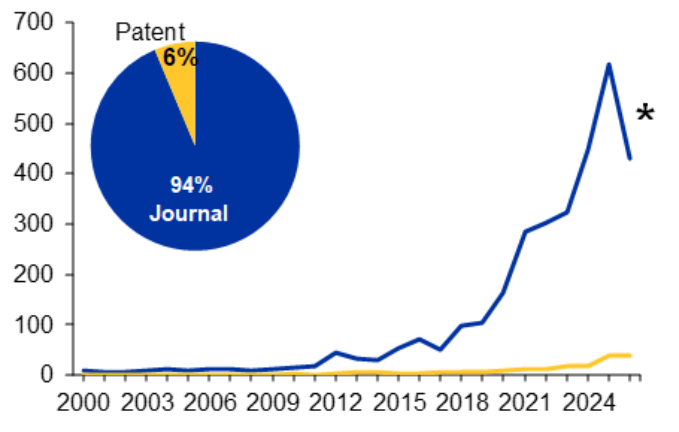
Figure 1. Line graph of publication trends for bacteriophage and phage therapy research related to multi-drug resistant bacteria, 2000 to 2026, with an inset pie chart. Journal publications stay near zero until about 2012, rise gradually through 2018, then climb steeply to a peak just above 600 in 2025 before falling to roughly 430 in 2026, a partial year marked with an asterisk. Patent publications stay low throughout, reaching about 40 by 2025. The pie chart shows 94% journals and 6% patents.

Questions and answers

Q: What is a bacteriophage?

Q: What are genome language models?

Q: How did AI write a virus genome?

Q: Why is AI being used to target antibiotic-resistant bacteria?

Related CAS Insights

16 billion reasons for hope: How biomarkers are reshaping cancer outcomes

2023 年最具影响力的科学突破和新兴趋势

2024 年值得关注的科学突破新兴趋势

Gain new perspectives for faster progress directly to your inbox.