


Resumo executivo
- Nanoenzimas são materiais em nanoescala que mimetizam a atividade catalítica de enzimas naturais.
- A pesquisa acadêmica domina o campo das nanoenzimas, o que sugere que descobertas fundamentais ainda estão sendo feitas antes da comercialização em larga escala.
- Metais e óxidos metálicos são frequentemente usados para nanoenzimas, mas estruturas metal-orgânicas e estruturas orgânicas covalentes oferecem excelente capacidade de ajuste e estabilidade.
- A pesquisa sobre nanoenzimas concentra-se nas atividades de peroxidase e oxidase.
- As principais aplicações para nanoenzimas estão na biomedicina, por exemplo, em diagnósticos e terapias, bem como em sensores e atividades de remediação ambiental.
A nanotecnologia está revolucionando áreas que vão desde a entrega de medicamentos até o armazenamento de energia, e uma das áreas de pesquisa que mais cresce é a das nanoenzimas. Nanoenzimas são materiais em nanoescala que exibem atividade catalítica intrínseca de mimetização enzimática. Essencialmente, esses materiais minúsculos são capazes de acelerar reações bioquímicas por meio de mecanismos análogos aos encontrados em enzimas naturais.
Desde sua designação formal em 2007, as nanoenzimas surgiram como alternativas atraentes às enzimas naturais, oferecendo estabilidade físico-química superior em faixas extremas de pH e temperatura, custos de produção significativamente reduzidos, propriedades catalíticas ajustáveis por meio de controle composicional e morfológico, e vida útil prolongada sem a necessidade de armazenamento a frio. Essas capacidades decorrem das propriedades únicas dos nanomateriais, incluindo sua alta área superficial, abundância de sítios ativos e estruturas eletrônicas ajustáveis dependentes de tamanho, forma e composição, que permitem um desempenho catalítico eficiente e personalizável.
As nanoenzimas representam uma convergência entre nanotecnologia, catálise e biomedicina, atraindo o interesse de bioquímicos, cientistas de materiais, engenheiros biomédicos e clínicos. Suas propriedades programáveis e robustez inerente posicionam as nanoenzimas como ferramentas transformadoras para diagnósticos de próxima geração e terapias de reposição enzimática. Elas estão impulsionando um momento de pesquisa interdisciplinar significativo, e mergulhamos fundo no cenário de pesquisa para entender melhor para onde este campo está caminhando.
Tendências de publicação em nanoenzimas
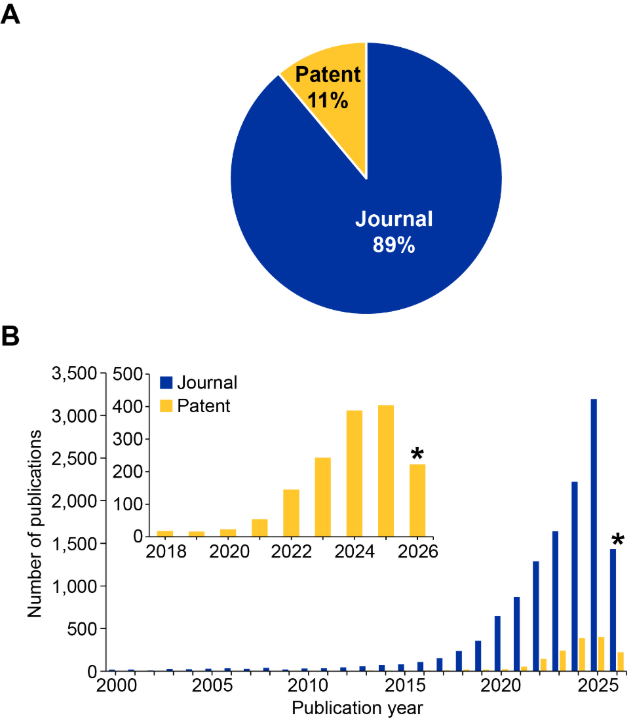
Usando o CAS IP Finder, com tecnologia STNTM, especialistas no assunto do CAS acessaram a CAS Content CollectionTM, o maior repositório de informações científicas curado por humanos, para identificar e extrair dados relacionados a nanoenzimas. Isso resultou em mais de 14.500 publicações, 11.000 conceitos exclusivos indexados pelo CAS e 14.000 substâncias.
O cenário de pesquisa é dominado por publicações em periódicos (89%) e é característico de um campo emergente ainda na fase de pesquisa fundamental, onde a compreensão mecanística e os estudos de prova de conceito precedem a comercialização generalizada (veja a Figura 1). A análise temporal indica um crescimento exponencial nas publicações em periódicos, particularmente após 2018, com esse aumento dramático possivelmente correlacionado a descobertas revolucionárias em nanoenzimas de átomo único e aplicações terapêuticas. Os depósitos de patentes mostram uma trajetória de crescimento semelhante, embora com uma linha do tempo defasada, refletindo o pipeline típico de tradução acadêmica para comercial.
Pesquisadores que exploram tendências semelhantes podem aproveitar os recursos de pesquisa habilitados por IA no CAS SciFinder® para identificar padrões e tendências em suas áreas específicas de pesquisa.
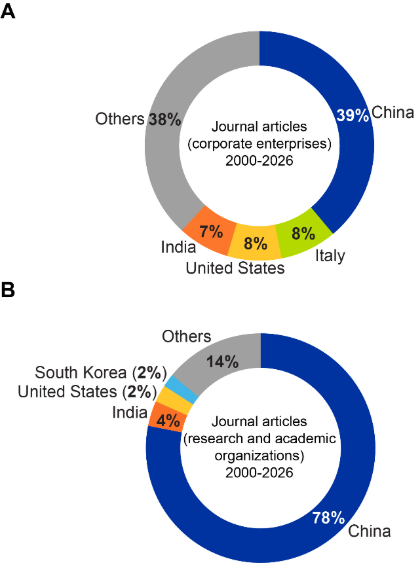
O campo permanece predominantemente impulsionado pela academia, como evidenciado pela contribuição de mais de 97% de artigos de periódicos provenientes de organizações de pesquisa e acadêmicas. A maioria dessas instituições líderes em pesquisa de nanoenzimas está localizada na China (78%), com a Índia, os EUA e a Coreia do Sul também representados (veja a Figura 2). A China também responde por 39% das publicações em periódicos de autoria corporativa, seguida pela Itália (8%), EUA (8%) e Índia (7%).
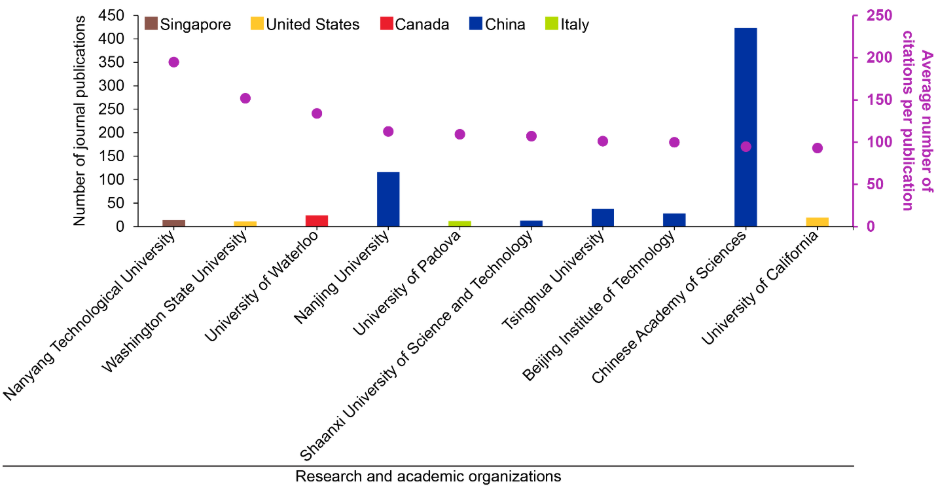
Nossa análise, considerando as métricas duplas de produção de pesquisa (número de publicações) e impacto da pesquisa (número médio de citações por publicação), revela várias tendências (veja a Figura 3). As instituições chinesas ocupam cinco das 10 primeiras posições, espelhando a participação de 78% da China nas publicações acadêmicas sobre nanoenzimas. No entanto, outras instituições alcançam impactos por artigo mais elevados, apesar de volumes de publicação menores.
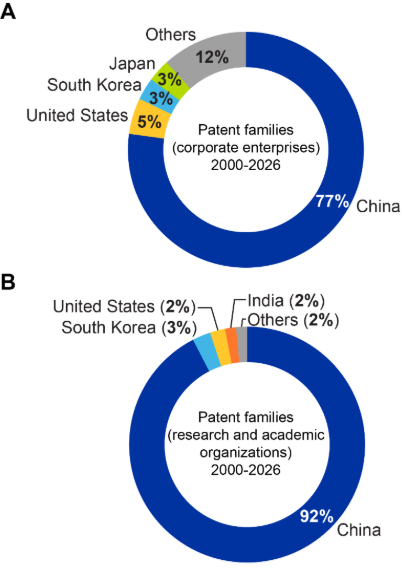
Organizações de pesquisa e acadêmicas também dominam os depósitos de patentes em comparação com empresas corporativas (90% vs. 10%). A predominância acadêmica indica que a pesquisa em nanozimas continua sendo impulsionada por universidades, sugerindo que o campo ainda está em estágio inicial de desenvolvimento, com descobertas fundamentais significativas surgindo de laboratórios acadêmicos. A participação corporativa limitada pode refletir incertezas regulatórias, escalabilidade de fabricação não otimizada ou a necessidade de validação contínua da eficácia clínica antes de um investimento industrial substancial. Entre organizações acadêmicas e corporativas, observamos novamente que a maioria está localizada na China (veja a Figura 4).
Por exemplo, várias patentes recentes relacionadas a nanozimas incluem:
- As patentes de nanozimas da Universidade Médica de Guangxi concentram-se principalmente em nanozimas à base de metais (Pd, Rh, Cu, etc.) suportados em nanomateriais 2D (Ti₃C₂Tₓ MXenes, grafeno, nitreto de carbono) e estruturas metalorgânicas (MOFs) para aplicações terapêuticas em osteoartrite, osteossarcoma e doenças neurodegenerativas (por exemplo, CN114917354 A, CN120899942 A).
- As patentes de nanozimas da Universidade de Jilin também enfatizam nanozimas à base de metais (Ag, Au, etc.) com atividades semelhantes à peroxidase e lacase para aplicações de biossensoramento, incluindo detecção de biomarcadores de câncer (por exemplo, CN109884029 A), monitoramento de resíduos de pesticidas (por exemplo, CN119500128 A, CN120718082 A) e detecção de formaldeído (por exemplo, CN120094644 A), bem como aplicações terapêuticas (cicatrização de feridas, antibacterianas, etc.) (por exemplo, CN116602933 A, CN120114614 A).
- As patentes de nanozimas da Universidade de Yangzhou concentram-se em nanozimas à base de óxidos metálicos e MOFs (Fe₃O₄, MnO₂, Cu-ZIF-8, etc.) com atividades semelhantes à peroxidase, catalase e lacase para diversas aplicações, incluindo biossensoramento (por exemplo, CN114790585 A), com ênfase em nanozimas terapêuticas para o tratamento de doenças infecciosas (por exemplo, CN116712538 A) e condições inflamatórias (por exemplo, CN121588060 A), entre outras.
Classes de materiais influenciam a biologia sintética e a atividade catalítica
Um aspecto importante do cenário dos nanozimas é entender como as escolhas de materiais influenciam o foco da pesquisa e a adoção no mundo real. Embora inúmeros nanomateriais tenham sido explorados, as diferenças em suas propriedades físico-químicas, custo e escalabilidade desempenham um papel crítico na determinação de seu potencial de translação. Para entender melhor o cenário de materiais dos nanozimas, analisamos nossos dados com base nas classes de substâncias indexadas pelo CAS e identificamos elementos (compostos por metais), óxidos metálicos, ligas e estruturas metalorgânicas (MOFs) como as categorias dominantes, cada uma exibindo diversas atividades de mimetização enzimática.
Nanozimas elementares (metálicos)
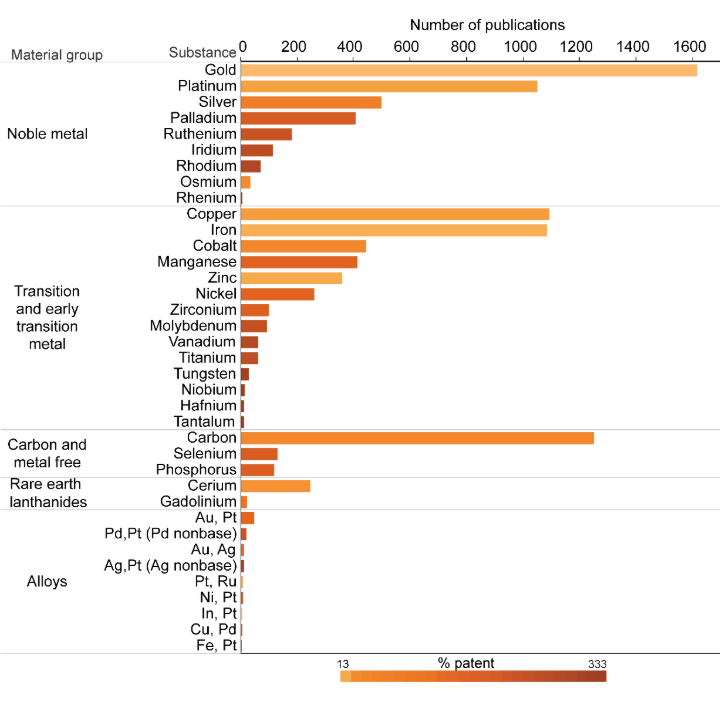
A distribuição dos elementos destaca uma clara desconexão entre a intensidade da pesquisa e a translação comercial no espaço dos nanozimas. Elementos como ouro, platina e carbono dominam a pesquisa acadêmica devido às suas propriedades bem compreendidas e facilidade de experimentação, mas sua menor atividade em patentes sugere limitações em termos de custo-benefício e escalabilidade. Em contraste, ferro e cobre mostram um forte alinhamento entre pesquisa e patentes, refletindo sua adequação para aplicações no mundo real, onde a viabilidade econômica e de fabricação é crítica (veja a Figura 5).
Essa tendência é impulsionada por fatores técnicos. Ferro e cobre se beneficiam de estados multivalentes intrínsecos que permitem um ciclo catalítico eficiente sem engenharia complexa, além de baixo custo e biocompatibilidade estabelecida. Em comparação, metais nobres como ouro e platina, apesar do desempenho catalítico superior, frequentemente exigem condições controladas e um ajuste cuidadoso do tamanho e da química de superfície, o que complica a escala industrial. Além disso, seu alto custo de material limita ainda mais as aplicações em larga escala e economicamente viáveis. Da mesma forma, sistemas à base de carbono, embora amplamente estudados, podem sofrer com atividade catalítica inconsistente e clareza mecanística limitada, restringindo o desenvolvimento de produtos.
Um padrão semelhante é observado para elementos como paládio (Pd), rutênio (Ru), irídio (Ir), ródio (Rh), níquel (Ni), selênio (Se), vanádio (V) e titânio (Ti), que apresentam menor volume de publicações, mas intensidade de patentes relativamente maior. Essa tendência está alinhada com as vantagens funcionais desses materiais, incluindo eficiência catalítica, estados de oxidação estáveis e durabilidade em condições adversas.
Por exemplo, paládio e rutênio são amplamente utilizados em catálise devido à sua alta atividade e seletividade, enquanto titânio e vanádio proporcionam estabilidade e resistência à corrosão em ambientes reativos. O níquel, em particular, oferece uma alternativa econômica aos metais nobres com desempenho catalítico razoável, tornando-o atraente para tecnologias escaláveis. Da mesma forma, sistemas à base de selênio frequentemente demonstram um comportamento redox único, relevante para aplicações biológicas e de sensoriamento. Juntas, essas características tornam tais elementos mais diretamente transponíveis para produtos funcionais, explicando sua maior representação em patentes, apesar de uma exploração acadêmica relativamente menor.
Nanozimas à base de ligas reforçam ainda mais essa tendência orientada para a translação, combinando as propriedades vantajosas de múltiplos metais para aumentar a eficiência catalítica, a estabilidade e a sintonização. Os sistemas de ligas relatados neste conjunto de dados, como visto na Figura 5, incluindo Au–Pt, Pd–Pt, Au–Ag, Pt–Ru, In–Pt, Cu–Pd, Fe–Pt e Ag–Pt, demonstram como a sinergia composicional pode modular a estrutura eletrônica e otimizar sítios ativos além do que é alcançável com sistemas de metal único. Em muitos casos, essas ligas introduzem efeitos cooperativos, como melhor transferência de elétrons, ciclo catalítico aprimorado e maior resistência à desativação, decorrentes do acoplamento intermetálico e da redistribuição eletrônica impulsionada pela interface.
Notavelmente, combinações envolvendo metais nobres são frequentemente projetadas para reduzir o conteúdo de metal nobre enquanto mantêm um alto desempenho catalítico, abordando assim as restrições de custo e escalabilidade. Por exemplo, nanozimas bimetálicas de Au–Pt exibem atividade catalítica aprimorada devido à transferência de elétrons de Au para Pt, melhorando o desempenho semelhante à oxidase e catalase em comparação com as contrapartes monometálicas. Enquanto isso, componentes não nobres, como Cu ou Fe, contribuem com atividade redox e viabilidade econômica, apoiando ainda mais as aplicações escaláveis.
Embora os sistemas de ligas permaneçam menos representados em volume de publicações em relação aos nanozimas de metal único, sua capacidade de projetar sítios ativos por meio de ajuste composicional e interações eletrônicas sinérgicas os posiciona como uma ponte importante entre os nanozimas inorgânicos convencionais e sistemas catalíticos mais orientados pelo design, com forte potencial para translação no mundo real.
Nanozimas à base de óxidos metálicos
Alguns materiais bem estabelecidos dominam a categoria de nanozimas à base de óxidos metálicos, particularmente óxidos de ferro, manganês e cobre, que combinam forte atividade catalítica com escalabilidade, biocompatibilidade e rotas de síntese comprovadas (veja a Figura 6).
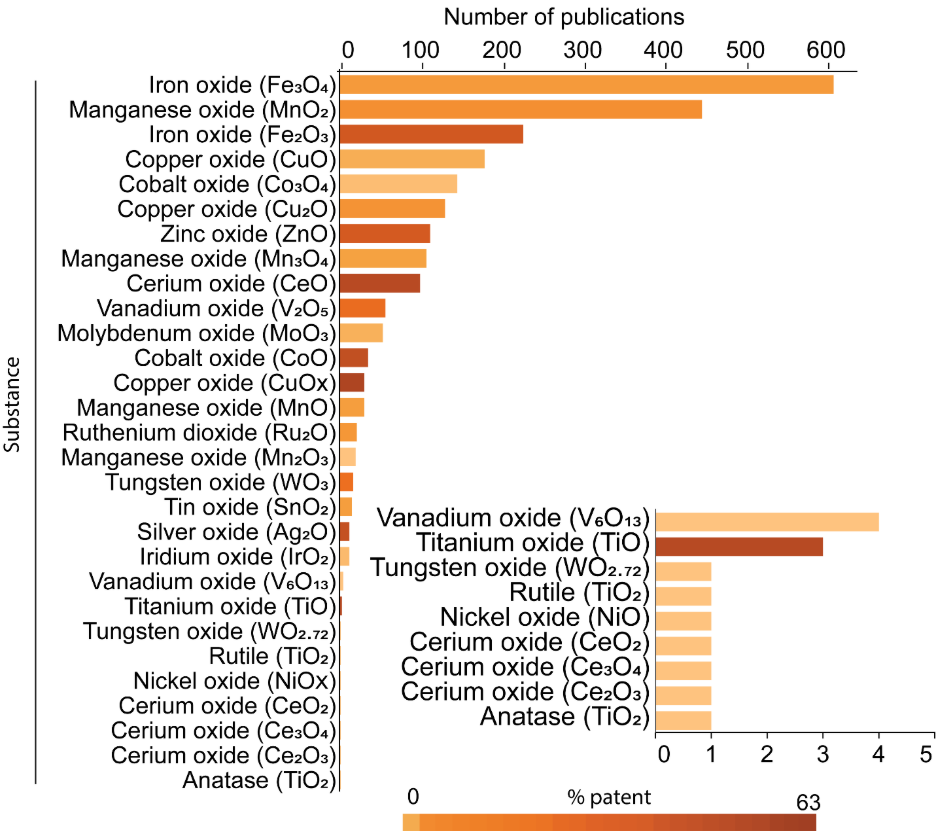
Sua alta atividade em publicações e patentes reflete uma transição bem-sucedida da pesquisa para a aplicação. Esse domínio é impulsionado por uma química redox favorável (por exemplo, ciclagem Fe²⁺/Fe³⁺, Mn³⁺/Mn⁴⁺) que permite reações catalíticas eficientes, juntamente com métodos de síntese simples e escaláveis. Por exemplo, nanozimas de MnO₂ demonstram comportamento catalítico responsivo ao ambiente para imagens e aplicações terapêuticas, nanozimas de CuO permitem catálise impulsionada por redox e biossensoriamento eficientes por meio da ciclagem Cu²⁺/Cu⁺, enquanto sistemas de Co₃O₄ exibem atividade semelhante à peroxidase de múltiplas vias, possibilitada por transições redox de Co²⁺/Co³⁺.
Sistemas emergentes, como óxido de cério e óxido de vanádio, destacam a importância de estados de oxidação dinâmicos e comportamento responsivo ao ambiente, permitindo funções como alternância entre atividade oxidase e antioxidante. Esses materiais apresentam um forte potencial, apesar do menor volume de pesquisa, indicando uma subexploração em vez de limitações intrínsecas.
Em contrapartida, vários óxidos, incluindo molibdênio, tungstênio, níquel e sistemas especializados, permanecem menos estudados, provavelmente devido à complexidade sintética, caracterização limitada ou falta de vias de aplicação estabelecidas.
Um insight importante é que o desempenho catalítico depende não apenas da composição, mas também da fase cristalina, defeitos e estrutura superficial, que influenciam os sítios ativos e os mecanismos de transferência de elétrons. No entanto, esse aspecto permanece insuficientemente explorado, já que a maioria dos estudos se concentra em fases facilmente sintetizadas em vez de otimização estrutural sistemática. No geral, a distribuição reflete um campo moldado tanto pelo desempenho do material quanto por fatores práticos, como familiaridade com a síntese e viabilidade translacional.
Nanozimas baseadas em estruturas porosas
O cenário emergente de materiais nanozimas destaca uma transição de arquiteturas inorgânicas tradicionais para arquiteturas orgânicas mais complexas e ajustáveis, como estruturas metalorgânicas (MOFs) e estruturas orgânicas covalentes (COFs). Ao contrário das nanozimas inorgânicas, as MOFs e COFs representam uma classe menor, porém rapidamente emergente, de materiais nanozimas. Sua menor representação em dados de publicações e patentes reflete seu desenvolvimento relativamente recente e a maior complexidade sintética associada a esses sistemas (ver Figura 7).
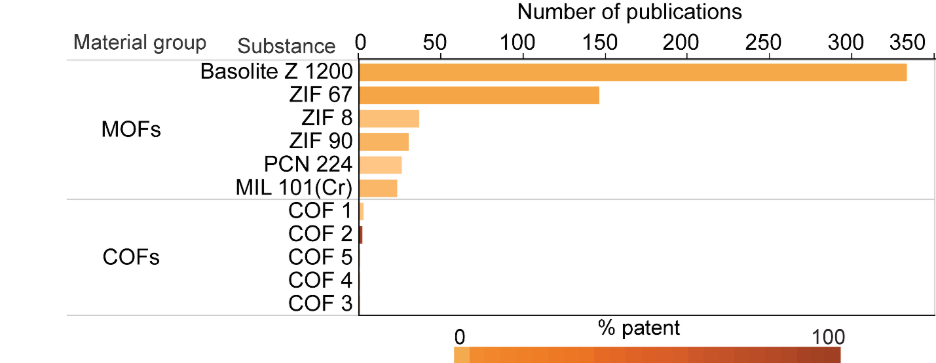
Apesar de seu volume limitado, as MOFs e COFs oferecem propriedades físico-químicas distintas que as tornam adequadas para aplicações de nanozimas. As nanozimas baseadas em MOFs, particularmente sistemas de referência como as estruturas do tipo Basolite e ZIF, dominam esse espaço devido à sua atividade catalítica comprovada, ajustabilidade estrutural e acessibilidade, tornando-as as plataformas de nanozimas porosas mais estudadas.
No entanto, esse forte foco em um subconjunto limitado de estruturas ressalta uma lacuna importante, já que a vasta maioria das químicas de MOFs permanece inexplorada, apesar de seu potencial para porosidade ajustável, engenharia de sítios ativos e design de ligantes funcionais. Da mesma forma, as COFs estão significativamente sub-representadas, mesmo que sua composição livre de metais, alta estabilidade química e arquiteturas π-conjugadas estendidas ofereçam oportunidades únicas para transporte de carga controlado e ambientes catalíticos personalizados, indicando um espaço de design inexplorado.
As nanozimas baseadas em MOFs exemplificam como a porosidade ajustável e os sítios ativos coordenados podem permitir a catálise que mimetiza enzimas, enquanto as COFs destacam o potencial de estruturas altamente projetáveis, estáveis e conjugadas para sistemas de nanozimas livres de metais.
Em conjunto, essas tendências indicam que, embora as nanozimas inorgânicas e à base de ligas sustentem atualmente os aspectos práticos e escaláveis do campo, materiais baseados em estruturas como MOFs e COFs estão surgindo como plataformas de próxima geração focadas em alcançar maior precisão e funcionalidade catalítica. Essa mudança ressalta uma transição mais ampla na pesquisa de nanozimas, da disponibilidade de materiais e atividade intrínseca para sistemas racionalmente projetados com desempenho sob medida para aplicações específicas.
A divisão catalítica: Oxidoredutases dominam, hidrolases aguardam seu momento
O cenário de atividade de nanozimas na Figura 8 revela um campo fundamentalmente limitado pela química dos materiais, e não pela demanda de aplicação, com atividades semelhantes às oxidoredutases dominando a pesquisa atual. Nanozimas que mimetizam a peroxidase representam a classe mais estudada, formando uma das maiores e mais desenvolvidas famílias devido à sua ampla aplicabilidade, métodos simples de detecção colorimétrica e compatibilidade com muitos nanomateriais.
De forma mais ampla, a pesquisa em nanozimas está fortemente centrada em atividades baseadas em redox, incluindo mimetizadores de peroxidase, oxidase, catalase e superóxido dismutase, que definem coletivamente o paradigma funcional dominante do campo e sustentam a maioria das aplicações em biossensoriamento, terapia de doenças e regulação de espécies reativas de oxigênio (ROS).
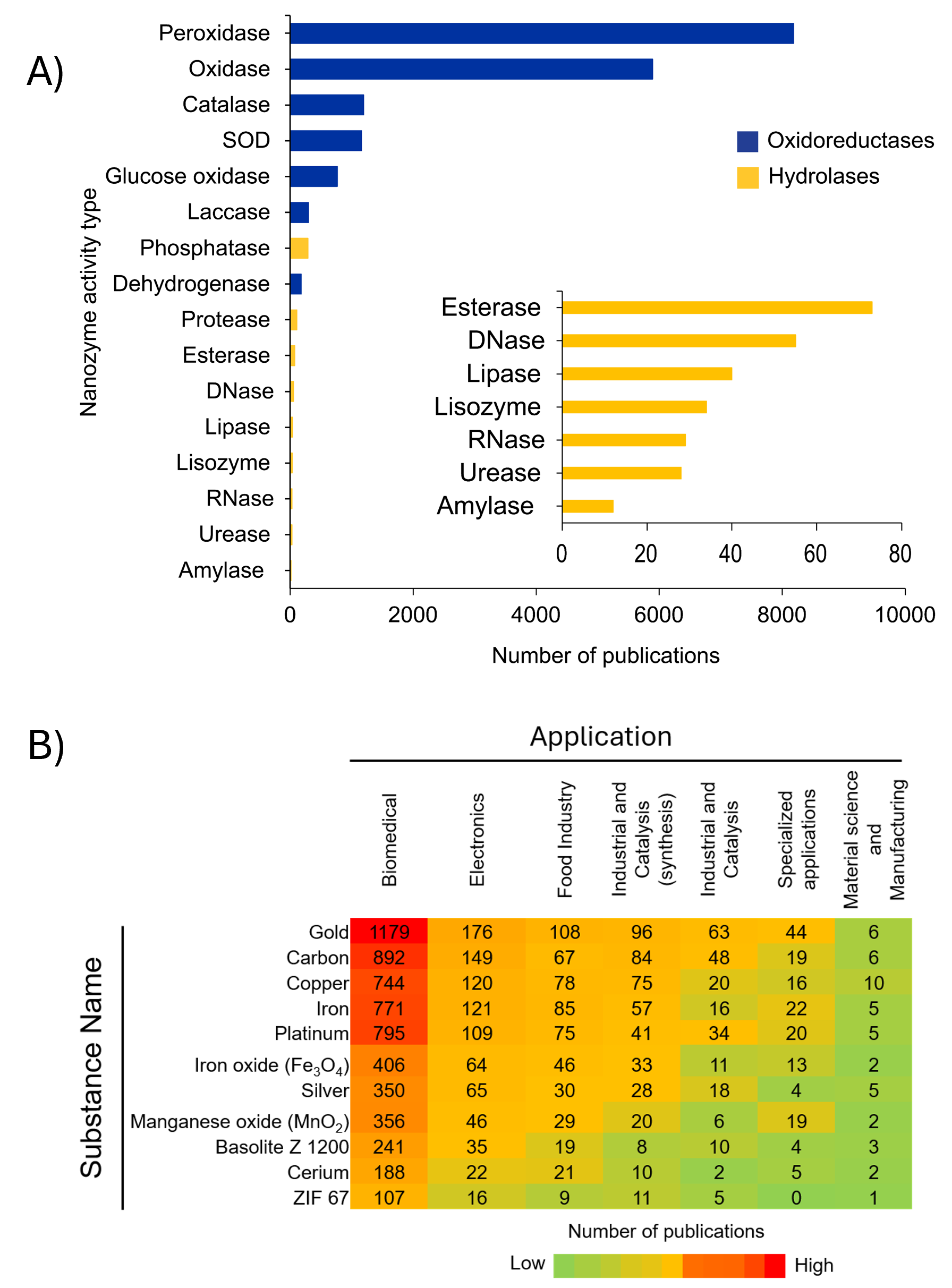
Esse desequilíbrio reflete um viés químico fundamental: nanomateriais inorgânicos favorecem inerentemente processos de transferência de elétrons por meio de pares redox superficiais, sítios de defeitos e vias condutoras, que facilitam naturalmente a catálise semelhante à das oxidoredutases. Em contrapartida, a atividade do tipo hidrolase, como a mimetização de protease, lipase ou nuclease, requer reconhecimento preciso do substrato, orientação molecular controlada e mecanismos catalíticos de várias etapas que são difíceis de replicar sem os sítios ativos tridimensionais altamente evoluídos encontrados em enzimas naturais.
A complexidade desses requisitos tornou as nanozimas hidrolíticas significativamente mais desafiadoras de projetar, e seu desenvolvimento permanece limitado e fragmentado. Ao mesmo tempo, o uso generalizado de nanozimas semelhantes à peroxidase é reforçado pela conveniência experimental e adequação à aplicação. Ensaios colorimétricos padrão (por exemplo, oxidação de TMB ou ABTS) fornecem leituras diretas e reprodutíveis que se alinham bem com diagnósticos, sensoriamento ambiental e aplicações biomédicas, acelerando ainda mais a concentração de pesquisas nesta área. Isso criou um ciclo de autorreforço no qual materiais que exibem atividade redox são estudados preferencialmente, enquanto funcionalidades catalíticas mais complexas permanecem subexploradas.
O mapa de calor na Figura 8B mostra como a pesquisa em nanozimas é distribuída entre materiais específicos (linhas) e atividades semelhantes a enzimas (colunas: atividades semelhantes a peroxidase, oxidase, catalase e SOD) usando contagens de publicações.
Em todos os materiais, incluindo ouro, ferro, cobre, óxido de manganês, materiais à base de carbono e MOFs, a pesquisa é consistentemente dominada por atividades de peroxidase e oxidase, que possuem as maiores contagens de publicações. Em contrapartida, as atividades semelhantes a catalase e SOD permanecem significativamente menos exploradas em todos os materiais, com valores muito mais baixos.
O mesmo padrão de atividade persiste em cada material, indicando que a maioria dos sistemas é investigada principalmente quanto às funções de peroxidase e oxidase, com extensão limitada para comportamentos semelhantes à catalase ou SOD. Algumas variações específicas de materiais são observadas, como o óxido de manganês apresentando maior atividade de catalase, e certos materiais (por exemplo, sistemas à base de cobre ou carbono) com contagens ligeiramente elevadas de atividade tipo SOD, mas estas permanecem como atividades de pesquisa secundárias.
No geral, o mapa de calor destaca que a pesquisa em nanozimas está concentrada em combinações específicas de material-atividade (por exemplo, Au-peroxidase, Fe-peroxidase, Cu-oxidase), com diversificação limitada para outras funções enzimáticas em todas as classes de materiais.
Os principais domínios de aplicação incluem a biomedicina e a remediação ambiental
Aplicações biomédicas: Este domínio representa cerca de 65% de toda a produção de pesquisa em nanozimas (ver Figura 9), refletindo a proposta de valor convincente das nanozimas na área da saúde. Esses nanomateriais robustos podem substituir enzimas naturais frágeis em diagnósticos (sensores de glicose, imunoensaios, detecção de patógenos), terapêutica (tratamentos antioxidantes, agentes antimicrobianos, terapia contra o câncer) e estudos de mecanismos de doenças (estresse oxidativo, inflamação).
Os desafios inerentes ao campo biomédico — instabilidade enzimática, requisitos de cadeia de frio e altos custos de produção — criam uma demanda natural por alternativas de nanozimas, impulsionando investimentos sustentados em pesquisa acadêmica e clínica. A atividade de patentes em aplicações biomédicas representa a maior proporção de patentes por publicação entre todas as categorias de aplicação. Isso sugere que as descobertas de nanozimas biomédicas são desproporcionalmente consideradas comercialmente viáveis e dignas de proteção de PI, provavelmente devido a caminhos claros para kits de diagnóstico, dispositivos de ponto de atendimento e formulações terapêuticas com vias regulatórias definidas e potencial de mercado substancial.
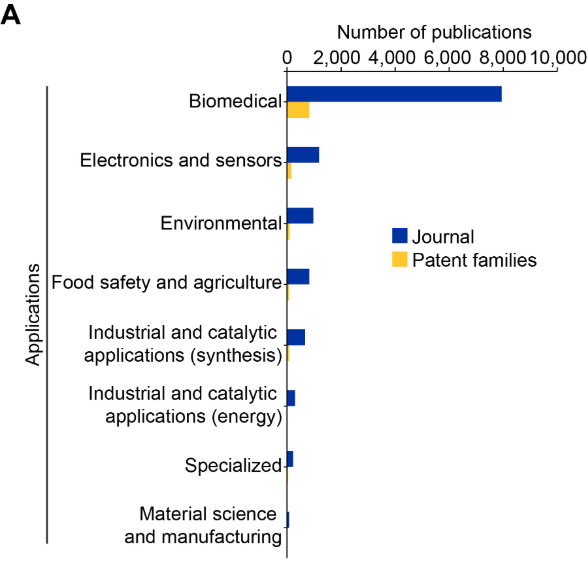
Eletrônica e sensores: Este campo ocupa o segundo lugar em termos de produção de pesquisa, representando cerca de 8-9% do total. As capacidades de amplificação de sinal catalítico das nanozimas as tornam valiosas em biossensores eletroquímicos, onde aumentam a sensibilidade para a detecção de biomoléculas, poluentes ou patógenos. A presença pequena, porém visível, de patentes indica interesse comercial em tecnologias de sensores, particularmente para monitoramento ambiental, controle de qualidade de alimentos e dispositivos de saúde vestíveis, onde transdutores baseados em nanozimas oferecem vantagens sobre os sensores convencionais baseados em enzimas em termos de estabilidade e vida útil.
Aplicações ambientais: Respondendo por aproximadamente 8% da produção total de pesquisa, a pesquisa ambiental com nanozimas concentra-se na degradação de poluentes (corantes orgânicos, pesticidas, antibióticos), tratamento de água e remediação de solo. As atividades de peroxidase e oxidase das nanozimas permitem a decomposição catalítica de contaminantes, enquanto suas propriedades fotocatalíticas (quando combinadas com semicondutores) aumentam a eficiência da degradação. A atividade mínima de patentes sugere que, embora cientificamente interessantes, as aplicações ambientais enfrentam barreiras de comercialização, possivelmente devido a preocupações com a relação custo-benefício ao competir com métodos de oxidação química estabelecidos ou desafios na implementação em larga escala e na recuperação/reciclagem de nanomateriais.
Segurança alimentar e agricultura: Estas áreas utilizam nanozimas para a detecção de resíduos de pesticidas, identificação de patógenos transmitidos por alimentos e preservação antioxidante. As aplicações incluem ensaios colorimétricos para melamina, antibióticos ou metais pesados em matrizes alimentares, bem como revestimentos antimicrobianos que prolongam a vida útil. A atividade negligenciável de patentes pode refletir as complexidades regulatórias em torno do uso de nanomateriais em aplicações de contato com alimentos, onde as avaliações de segurança são rigorosas e a aceitação do consumidor permanece incerta.
Aplicações industriais e catalíticas: Há uma pesquisa proeminente em duas subcategorias, síntese e energia. As aplicações de síntese envolvem o uso de nanozimas como catalisadores para reações orgânicas, degradação de polímeros ou processos de química verde, substituindo catalisadores de metais nobres caros. As aplicações de energia concentram-se em células de combustível (catálise de reação de redução de oxigênio), células solares (separação de carga) e baterias (mediação redox). A representação mínima desses campos sugere que as nanozimas ainda não demonstraram vantagens claras sobre os catalisadores industriais estabelecidos em termos de atividade, seletividade ou custo-benefício em escala.
Aplicações especializadas e relacionadas à ciência dos materiais: Estas apresentam atividade mínima (~1-2%), indicando aplicações de nicho ou emergentes. As aplicações especializadas incluem energia, meio ambiente e aplicações de detecção emergentes relacionadas à segurança, enquanto a ciência dos materiais e a fabricação provavelmente se referem à integração de nanozimas em materiais compostos, revestimentos ou processos de fabricação. A falta de atividade de patentes sugere que estas permanecem áreas de pesquisa exploratória sem trajetórias claras de comercialização.
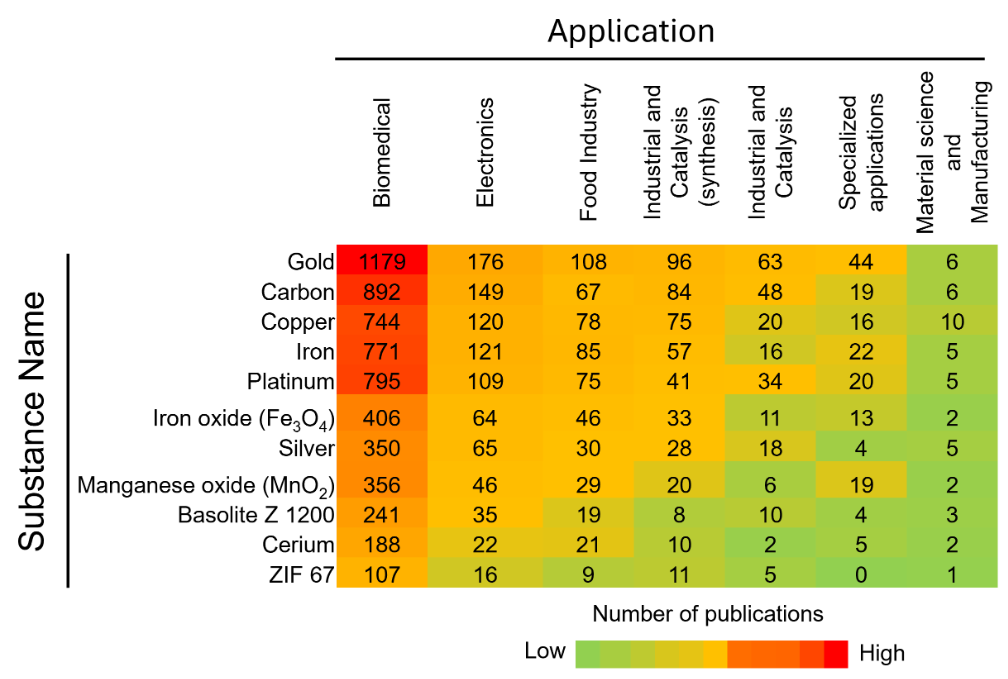
A distribuição de materiais entre os domínios de aplicação (Figura 9B) destaca uma clara predominância de nanozimas inorgânicas convencionais, particularmente ouro, carbono, cobre, ferro e platina, que exibem ampla aplicabilidade nas categorias biomédica, de sensores e industrial. Entre estas, as aplicações biomédicas impulsionam esmagadoramente a atividade de pesquisa, superando significativamente outros casos de uso. Esse desequilíbrio sugere que o desenvolvimento de nanozimas permanece amplamente orientado para aplicações diagnósticas e terapêuticas, com tradução limitada para processos catalíticos em larga escala.
Em contraste, materiais baseados em estruturas como MOFs (por exemplo, Basolite Z1200, ZIF-67) apresentam menor representação e permanecem amplamente confinados a aplicações biomédicas. Isso indica que, apesar de suas características estruturais avançadas e capacidade de ajuste, sua adoção ainda é específica para cada aplicação.
No geral, os dados revelam uma separação distinta entre sistemas inorgânicos amplamente aplicáveis e materiais estruturais mais especializados, refletindo uma transição no campo de materiais estabelecidos e escaláveis para plataformas de nanozimas mais orientadas pelo design, porém menos amplamente implementadas.
Superando desafios para um maior potencial comercial
Apesar do progresso notável, as nanozimas enfrentam desafios críticos que devem ser abordados para uma ampla adoção clínica e industrial:
- A eficiência catalítica permanece substancialmente menor do que a das enzimas naturais, com as nanozimas exibindo tipicamente constantes de Michaelis-Menten (Km) 10 a 1000 vezes maiores e números de renovação (kcat) ordens de magnitude menores do que suas contrapartes biológicas, limitando aplicações que exigem altas taxas de conversão de substrato.
- A especificidade do substrato representa outra restrição fundamental. Enquanto as enzimas naturais alcançam uma seletividade requintada por meio de sítios ativos otimizados evolutivamente, a maioria das nanozimas exibe uma reatividade ampla e promíscua que pode gerar efeitos fora do alvo ou interferir em matrizes biológicas complexas.
- Preocupações com biocompatibilidade e toxicidade persistem, com o acúmulo a longo prazo, as vias de biodegradação e a imunogenicidade exigindo uma avaliação rigorosa antes do uso terapêutico.
- A compreensão mecanística permanece incompleta. Para muitas nanozimas, os mecanismos catalíticos são mal definidos em comparação com o conhecimento em nível atômico da catálise enzimática natural, dificultando o design racional e a otimização.
Além disso, a fabricação escalável com reprodutibilidade entre lotes, a incerteza regulatória em torno da classificação de nanomateriais e dos processos de aprovação, e a estabilidade limitada em fluidos biológicos complexos apresentam barreiras práticas à comercialização. Superar essas limitações por meio de técnicas avançadas de caracterização, modelagem computacional, estratégias de engenharia de superfície e estruturas toxicológicas padronizadas será essencial para que os nanozimas alcancem seu potencial transformador como substitutos de enzimas.
Olhando para o futuro, esse potencial é evidente. O foco na pesquisa acadêmica significa que questões fundamentais estão sendo investigadas, e o crescimento da atividade de patentes mostra que essas descobertas estão começando a se traduzir no âmbito comercial. De fato, o primeiro medicamento à base de nanozimas, CX213, desenvolvido pela Cenyx Biotech, entrou em ensaios clínicos.
Ainda persiste uma lacuna significativa entre publicações e patentes fora da biomedicina, o que destaca as oportunidades para parcerias entre indústria e academia para desbloquear mais aplicações para os nanozimas. Remediação ambiental, segurança alimentar e catálise industrial são alguns dos principais setores onde essas inovações desempenharão um papel fundamental.
Os nanozimas de átomo único (SAzymes) estão surgindo como uma direção promissora no design de nanozimas. Ao dispersar átomos metálicos isolados em suportes adequados, os SAzymes maximizam a eficiência da utilização atômica e criam sítios ativos uniformes e bem definidos, permitindo um comportamento catalítico que se assemelha muito aos centros ativos de enzimas naturais. Outras áreas de pesquisa de ponta incluem sistemas de nanozimas em cascata que mimetizam vias metabólicas e nanozimas específicos para substratos por meio de engenharia de superfície racional.
No geral, esses desenvolvimentos sinalizam o crescimento dos nanozimas como uma via viável para a próxima geração de substitutos de enzimas naturais em uma infinidade de aplicações industriais.