

执行摘要
- 纳米酶是能够模拟天然酶催化活性的纳米级材料。
- 学术研究在纳米酶领域占据主导地位,这表明在实现大规模商业化之前,仍有许多基础性发现有待挖掘。
- 金属和金属氧化物常被用作纳米酶,但金属有机框架和共价有机框架展现出了卓越的可调控性和稳定性。
- 纳米酶的研究重点在于过氧化物酶和氧化酶活性。
- 纳米酶的主要应用领域包括生物医学(如诊断和治疗)、传感器以及环境修复活动。
纳米技术正在彻底改变从药物递送到能源存储的各个领域,而纳米酶是其中增长最快的研究领域之一。纳米酶是展现出内在酶模拟催化活性的纳米级材料。从本质上讲,这些微小的材料能够通过类似于天然酶的机制来加速生化反应。
自 2007 年正式命名以来,纳米酶已成为天然酶的有力替代品,在极端 pH 值和温度范围内表现出卓越的物理化学稳定性,生产成本显著降低,通过成分和形态控制可实现催化性能的调节,且无需冷藏即可延长保质期。这些能力源于纳米材料独特的特性,包括高比表面积、丰富的活性位点以及可调控的尺寸、形状和成分依赖性电子结构,从而实现了高效且可定制的催化性能。
纳米酶代表了纳米技术、催化和生物医学的融合,吸引了生物化学家、材料科学家、生物医学工程师和临床医生的关注。其可编程的特性和固有的稳健性使纳米酶成为下一代诊断和酶替代疗法的变革性工具。它们正在推动重大的跨学科研究势头,我们深入研究了该领域的研究现状,以更好地了解其未来发展方向。
纳米酶的出版趋势
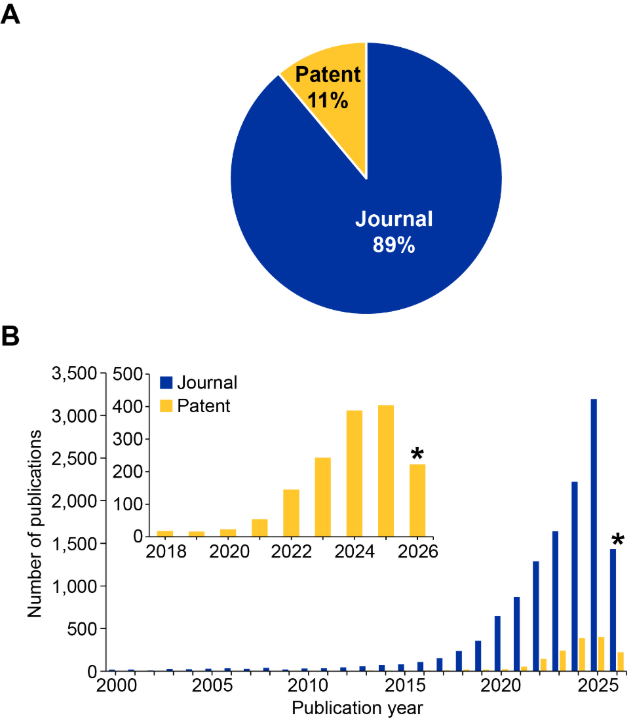
利用由 STN 提供支持的 CAS IP FinderTM,CAS 的主题专家访问了CAS Content CollectionTM(全球最大的人工标引科学信息库),以识别和提取与纳米酶相关的数据。最终获得了超过 14,500 篇出版物、11,000 个独特的 CAS 标引概念以及 14,000 种物质。
研究格局以期刊出版物为主(占 89%),这体现了该领域仍处于基础研究阶段的特征,即在广泛商业化之前,需要先进行机理理解和概念验证研究(见图 1)。时间分析显示,期刊出版物呈指数级增长,特别是在 2018 年之后,这种剧增可能与单原子纳米酶和治疗应用方面的突破性发现有关。专利申请也呈现出类似的增长轨迹,尽管时间轴有所滞后,反映了典型的从学术到商业的转化流程。
探索类似趋势的研究人员可以利用 CAS SciFinder® 中的人工智能搜索功能,识别其特定研究领域中的模式和趋势。
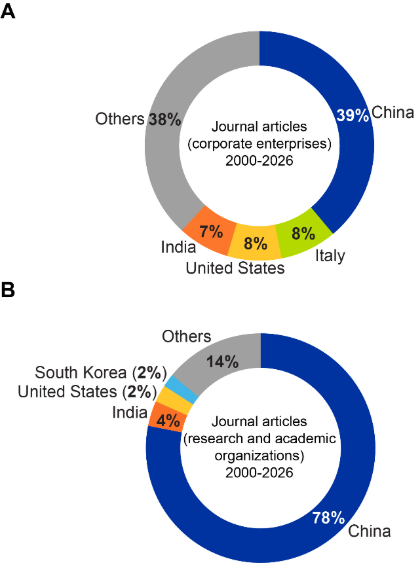
该领域仍然主要由学术界驱动,超过 97% 的期刊文章来自研究机构和学术组织,这充分证明了这一点。在纳米酶研究方面处于领先地位的机构大多位于中国(78%),印度、美国和韩国也占有一席之地(见图 2)。中国在企业撰写的期刊出版物中也占 39%,其次是意大利(8%)、美国(8%)和印度(7%)。
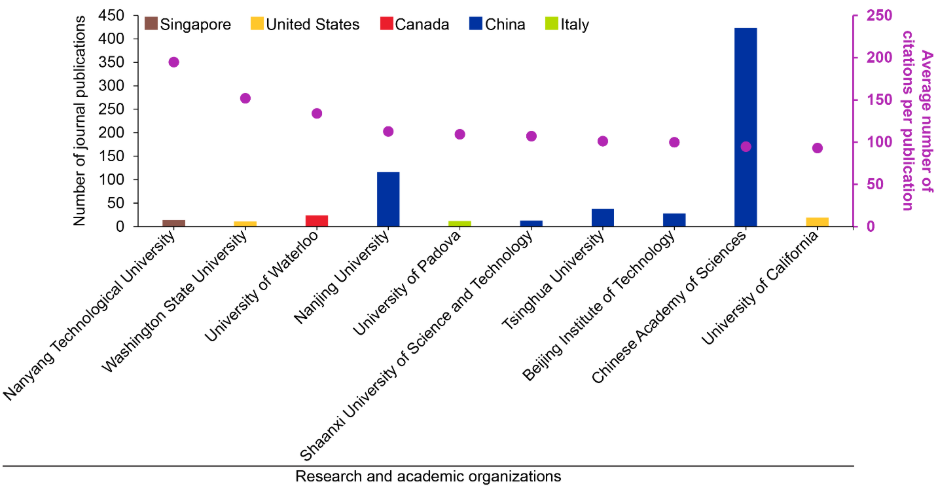
我们综合考虑研究产出(出版物数量)和研究影响力(篇均引用次数)这两个指标的分析揭示了几个趋势(见图 3)。中国机构占据了前 10 名中的 5 个席位,这与中国在学术纳米酶出版物中 78% 的份额相呼应。然而,其他一些机构尽管出版物数量较少,却实现了更高的篇均影响力。
与企业相比,研究和学术机构在专利申请方面也占据主导地位(90% 对 10%)。学术界的主导地位表明,纳米酶研究仍以高校驱动为主,说明该领域尚处于早期发展阶段,重大的基础性发现多源自学术实验室。企业参与度有限可能反映了监管的不确定性、制造规模化尚未优化,或在进行大规模工业投资前仍需对临床疗效进行持续验证。在学术和企业机构中,我们再次看到其中大多数位于中国(见图 4)。
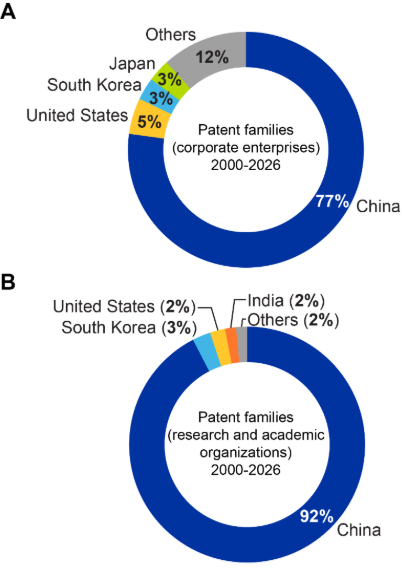
例如,近期几项与纳米酶相关的专利包括:
- 广西医科大学的纳米酶专利主要集中在 负载于二维纳米材料 (Ti₃C₂Tₓ MXenes、石墨烯、氮化碳)和金属有机框架(MOFs)上的金属基纳米酶(钯、铑、铜等),用于骨关节炎、骨肉瘤和神经退行性疾病的治疗应用(例如 CN114917354 A、CN120899942 A)。
- 吉林大学的纳米酶专利也强调了具有过氧化物酶和漆酶活性的金属基纳米酶(银、金等),用于生物传感应用,包括癌症生物标志物检测(例如 CN109884029 A)、农药残留监测(例如 CN119500128 A、CN120718082 A)和甲醛检测(例如 CN120094644 A),以及治疗应用(伤口愈合、抗菌等)(例如 CN116602933 A、CN120114614 A)。
- 扬州大学的纳米酶专利专注于金属氧化物和基于 MOF 的纳米酶 (Fe₃O₄、MnO₂、Cu-ZIF-8 等) ,这些纳米酶具有过氧化物酶、过氧化氢酶和漆酶活性,可用于多种应用,包括生物传感(例如 CN114790585 A),并重点关注用于治疗传染病(例如 CN116712538 A)和炎症性疾病(例如 CN121588060 A)等的治疗性纳米酶。
材料类别影响合成生物学和催化活性
纳米酶领域的一个重要方面是了解材料选择如何影响研究重点和实际应用。尽管人们已经探索了多种纳米材料,但它们在物理化学性质、成本和可扩展性方面的差异对于决定其转化潜力起着关键作用。为了进一步了解纳米酶的材料格局,我们根据 CAS 索引的物质类别对数据进行了分析,确定了元素(由金属组成)、金属氧化物、合金和金属有机框架(MOFs)为主要类别,每一类都表现出多种酶模拟活性。
元素(金属)纳米酶
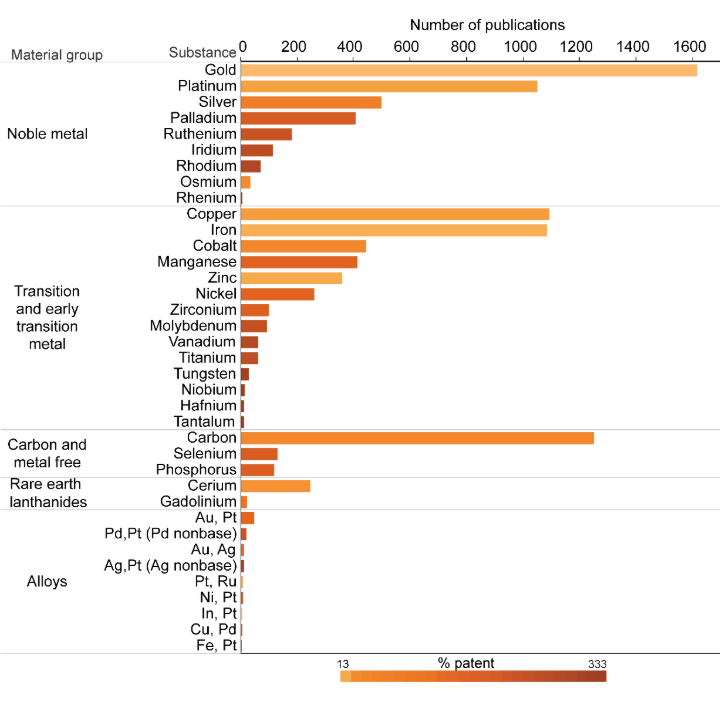
元素的分布凸显了纳米酶领域研究强度与商业转化之间的明显脱节。金、铂和碳等元素因其性质明确且易于实验而主导了学术研究,但其较低的专利活跃度表明它们在成本效益和可扩展性方面存在局限性。相比之下,铁和铜在研究与专利之间表现出高度的一致性,反映了它们在经济和制造可行性至关重要的实际应用中的适用性(见图 5)。
这一趋势是由技术因素驱动的。铁和铜受益于其固有的多价态,无需复杂的工程设计即可实现高效的催化循环,同时具有低成本和公认的生物相容性。相比之下,金和铂等贵金属尽管催化性能优越,但通常需要受控条件以及对尺寸和表面化学的精确调节,这增加了规模化的难度。此外,它们高昂的材料成本进一步限制了大规模且经济可行的应用。同样,碳基系统虽然研究广泛,但可能存在催化活性不稳定和机理不明确的问题,从而限制了产品开发。
在钯 (Pd)、钌 (Ru)、铱 (Ir)、铑 (Rh)、镍 (Ni)、硒 (Se)、钒 (V) 和钛 (Ti) 等元素中也观察到了类似的模式,这些元素发表的论文数量较少,但专利强度相对较高。这一趋势与这些材料的功能优势相一致,包括催化效率、稳定的氧化态以及在严苛条件下的耐久性。
例如,钯和钌因其高活性和选择性而被广泛用于催化,而钛和钒在反应环境中提供了稳定性和耐腐蚀性。特别是镍,作为贵金属的经济替代品,具有合理的催化性能,使其在可扩展技术中极具吸引力。同样,硒基系统通常表现出与生物和传感应用相关的独特氧化还原行为。总之,这些特性使得此类元素能够更直接地转化为功能性产品,从而解释了尽管学术探索相对较少,但它们在专利中却占有较高比例的原因。
合金基纳米酶通过结合多种金属的优势特性来提高催化效率、稳定性和可调性,进一步强化了这种以转化为导向的趋势。如图 5 所示,本数据集中的合金系统(包括 Au–Pt、Pd–Pt、Au–Ag、Pt–Ru、In–Pt、Cu–Pd、Fe–Pt 和 Ag–Pt)展示了成分协同作用如何调节电子结构并优化活性位点,从而达到单金属系统无法企及的效果。在许多情况下,这些合金通过金属间耦合和界面驱动的电子重分布,产生了诸如改善电子转移、增强催化循环和提高抗失活能力等协同效应。
值得注意的是,涉及贵金属的组合通常经过工程设计,旨在减少贵金属含量同时保持高催化性能,从而解决成本和可扩展性的限制。例如,Au–Pt 双金属纳米酶由于电子从 Au 向 Pt 转移,表现出增强的催化活性,与单金属对应物相比,改善了氧化酶和过氧化氢酶样性能。同时,铜或铁等非贵金属成分贡献了氧化还原活性并提高了经济可行性,进一步支持了可扩展应用。
尽管合金系统相对于单金属纳米酶在发表数量上仍占少数,但它们通过成分调节和协同电子相互作用设计活性位点的能力,使其成为传统无机纳米酶与更具设计导向的催化系统之间的重要桥梁,并具有强大的实际转化潜力。
金属氧化物基纳米酶
少数几种成熟的材料主导了金属氧化物基纳米酶类别,特别是铁、锰和铜的氧化物,它们将强大的催化活性与可扩展性、生物相容性以及成熟的合成路线结合在一起(见图 6)。
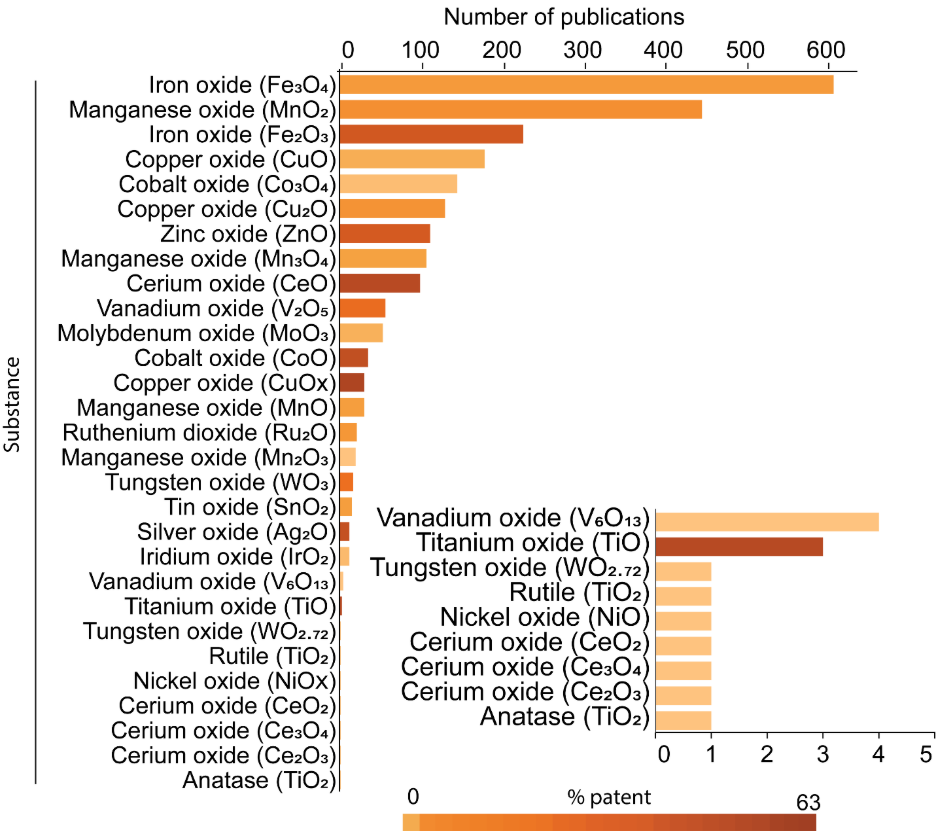
Their high publication and patent activity reflects a successful translation from research to application. This dominance is driven by favorable redox chemistry (e.g., Fe²⁺/Fe³⁺, Mn³⁺/Mn⁴⁺ cycling) that enables efficient catalytic reactions, along with simple and scalable synthesis methods. For example, MnO₂ nanozymes demonstrate environment-responsive catalytic behavior for imaging and therapy applications, CuO nanozymes enable efficient redox-driven catalysis and biosensing through Cu²⁺/Cu⁺ cycling, while Co₃O₄ systems exhibit multi-pathway peroxidase-like activity enabled by Co²⁺/Co³⁺ redox transitions.
Emerging systems such as cerium oxide and vanadium oxide highlight the importance of dynamic oxidation states and environment-responsive behavior, enabling functions such as switching between oxidase and antioxidant activity. These materials show strong potential despite lower research volume, indicating under-exploration rather than intrinsic limitations.
In contrast, several oxides, including molybdenum, tungsten, nickel, and specialty systems, remain less studied, likely due to synthetic complexity, limited characterization, or a lack of established application pathways.
An important insight is that catalytic performance depends not only on composition but also on crystal phase, defects, and surface structure, which influence active sites and electron transfer mechanisms. However, this aspect remains insufficiently explored, as most studies focus on easily synthesized phases rather than systematic structural optimization. Overall, the distribution reflects a field shaped by both material performance and practical factors such as synthesis familiarity and translational feasibility.
Porous framework-based nanozymes
The emerging nanozyme materials landscape highlights a transition from traditional inorganic to more complex and tunable organic architectures such as metal–organic frameworks (MOFs) and covalent organic frameworks (COFs). In contrast to inorganic nanozymes, MOFs and COFs represent a smaller but rapidly emerging class of nanozyme materials. Their lower representation in publication and patent data reflects their relatively recent development and the increased synthetic complexity associated with these systems (see Figure 7).
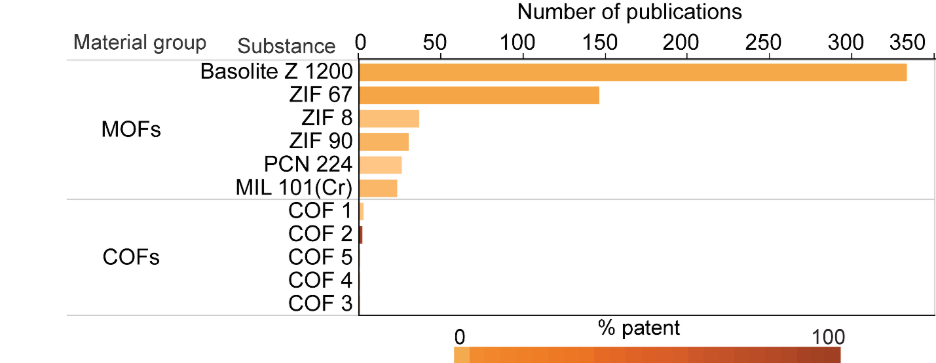
Despite their limited volume, MOFs and COFs offer distinct physicochemical properties that make them suitable for nanozyme applications. MOF-based nanozymes, particularly benchmark systems such as Basolite- and ZIF-type frameworks, dominate this space due to their proven catalytic activity, structural tunability, and accessibility, making them the most studied porous nanozyme platforms.
However, this strong focus on a limited subset of frameworks underscores a major gap, as the vast majority of MOF chemistries remain unexplored despite their potential for tunable porosity, active site engineering, and functional linker design. Likewise, COFs are significantly underrepresented, even though their metal-free composition, high chemical stability, and extended π-conjugated architectures provide unique opportunities for controlled charge transport and tailored catalytic environments, indicating an untapped design space.
MOF-based nanozymes exemplify how tunable porosity and coordinated active sites can enable enzyme-mimicking catalysis, whereas COFs highlight the potential of highly designable, stable, and conjugated frameworks for metal-free nanozyme systems.
Taken together, these trends indicate that while inorganic and alloy-based nanozymes currently underpin the practical and scalable aspects of the field, framework-based materials such as MOFs and COFs are emerging as next-generation platforms focused on achieving higher catalytic precision and functionality. This shift underscores a broader transition in nanozyme research, from material availability and intrinsic activity toward rationally engineered systems with tailored performance for specific applications.
The catalytic divide: Oxidoreductases dominate, hydrolases wait for their moment
The nanozyme activity landscape in Figure 8 reveals a field fundamentally constrained by material chemistry rather than application demand, with oxidoreductase-like activities dominating current research. Peroxidase-mimicking nanozymes represent the most studied class, forming one of the largest and most developed families due to their broad applicability, simple colorimetric detection methods, and compatibility with many nanomaterials.
More broadly, nanozyme research is heavily centered on redox-based activities, including peroxidase, oxidase, catalase, and superoxide dismutase mimics, which collectively define the dominant functional paradigm of the field and underpin most applications in biosensing, disease therapy, and reactive oxygen species (ROS) regulation.
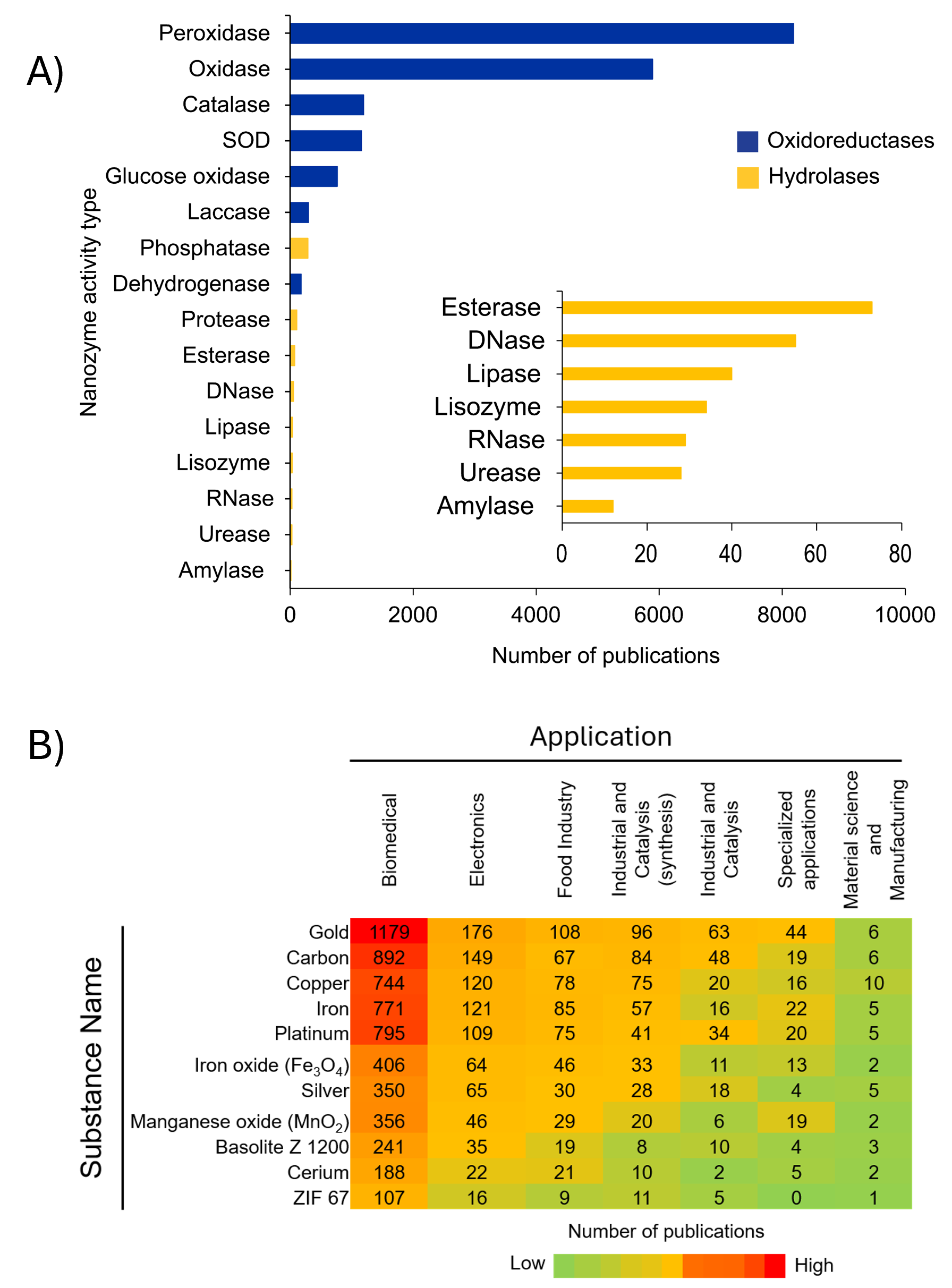
This imbalance reflects a fundamental chemical bias: inorganic nanomaterials inherently favor electron transfer processes through surface redox couples, defect sites, and conductive pathways, which naturally facilitate oxidoreductase-like catalysis. In contrast, hydrolase-type activity, such as protease, lipase, or nuclease mimicry, requires precise substrate recognition, controlled molecular orientation, and multi-step catalytic mechanisms that are difficult to replicate without the highly evolved three-dimensional active sites found in natural enzymes.
The complexity of these requirements has made hydrolytic nanozymes significantly more challenging to design, and their development remains limited and fragmented. At the same time, the widespread use of peroxidase-like nanozymes is reinforced by experimental convenience and application fit. Standard colorimetric assays (e.g., TMB or ABTS oxidation) provide straightforward, reproducible readouts that align well with diagnostics, environmental sensing, and biomedical applications, further accelerating research concentration in this area. This has created a self-reinforcing cycle in which materials that exhibit redox activity are preferentially studied, while more complex catalytic functionalities remain underexplored.
The heatmap in Figure 8B shows how nanozyme research is distributed across specific materials (rows) and enzyme-like activities (columns: peroxidase, oxidase, catalase, and SOD-like activities) using publication counts.
Across all materials, including gold, iron, copper, manganese oxide, carbon-based materials, and MOFs, research is consistently dominated by peroxidase and oxidase activities, which have the highest publication counts. In contrast, catalase and SOD-like activities remain significantly less explored across all materials, with much lower values.
各类材料中均呈现出相似的活性模式,表明大多数系统的研究主要集中于过氧化物酶和氧化酶功能,而在过氧化氢酶或超氧化物歧化酶(SOD)类行为方面的拓展相对有限。虽然观察到了一些材料特有的差异,例如氧化锰表现出更高的过氧化氢酶活性,而某些材料(如铜基或碳基系统)的SOD类活性计数略高,但这些仍属于次要的研究方向。
总体而言,热图显示纳米酶的研究主要集中在特定的“材料-活性”组合上(例如金-过氧化物酶、铁-过氧化物酶、铜-氧化酶),而在所有材料类别中,向其他酶促功能的多元化发展仍十分有限。
主要应用领域包括生物医学和环境修复
生物医学应用:该领域约占所有纳米酶研究产出的65%(见图9),反映了纳米酶在医疗保健领域极具吸引力的价值主张。这些稳健的纳米材料可以替代脆弱的天然酶,用于诊断(葡萄糖传感器、免疫分析、病原体检测)、治疗(抗氧化治疗、抗菌剂、癌症治疗)以及疾病机制研究(氧化应激、炎症)。
生物医学领域固有的挑战——酶的不稳定性、冷链要求以及高昂的生产成本——产生了对纳米酶替代品的天然需求,从而推动了持续的学术和临床研究投入。在所有应用类别中,生物医学应用的专利活动表现出最高的专利与论文比率。这表明生物医学纳米酶的发现被认为具有极高的商业可行性和知识产权保护价值,这很可能归功于其在诊断试剂盒、即时检测设备和治疗制剂方面拥有明确的路径,且具备成熟的监管流程和巨大的市场潜力。
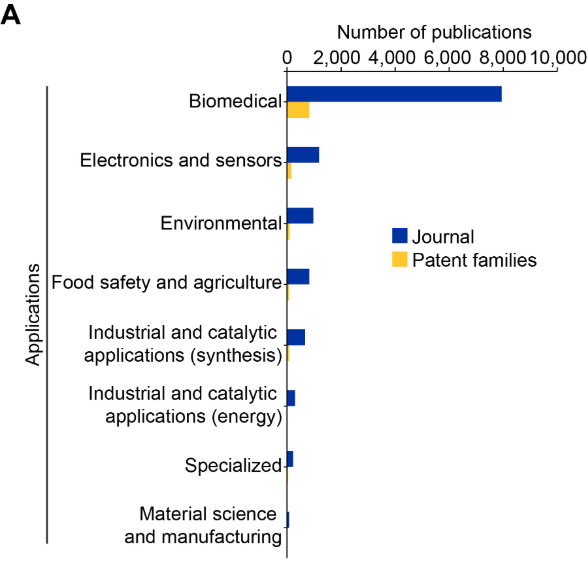
电子与传感器:该领域的研究产出排名第二,约占总产出的8-9%。纳米酶的催化信号放大能力使其在电化学生物传感器中极具价值,能够提高对生物分子、污染物或病原体检测的灵敏度。虽然专利数量较少,但已显现出商业兴趣,特别是在环境监测、食品质量控制和可穿戴健康设备领域,纳米酶基传感器在稳定性和保质期方面较传统酶传感器更具优势。
环境应用:环境纳米酶研究约占总研究产出的8%,主要集中在污染物降解(有机染料、农药、抗生素)、水处理和土壤修复方面。纳米酶的过氧化物酶和氧化酶活性能够催化分解污染物,而其光催化性能(与半导体结合时)则进一步提高了降解效率。极少的专利活动表明,尽管环境应用在科学上具有吸引力,但可能由于在与成熟的化学氧化法竞争时存在成本效益方面的顾虑,或在大规模部署及纳米材料回收/循环利用方面面临挑战,从而导致其商业化受阻。
食品安全与农业:这些领域利用纳米酶进行农药残留检测、食源性病原体识别和抗氧化保鲜。应用包括针对食品基质中三聚氰胺、抗生素或重金属的比色分析,以及延长保质期的抗菌涂层。专利活动微乎其微,这可能反映了纳米材料在食品接触应用中面临的监管复杂性,因为此类应用的安全评估极为严格,且消费者接受度尚不明确。
工业与催化应用:在合成和能源两个子领域有显著的研究。合成应用涉及将纳米酶用作有机反应、聚合物降解或绿色化学过程的催化剂,以替代昂贵的贵金属催化剂。能源应用则聚焦于燃料电池(氧还原反应催化)、太阳能电池(电荷分离)和电池(氧化还原介导)。这些领域的研究占比极小,表明纳米酶在活性、选择性或规模化成本效益方面尚未展现出超越现有工业催化剂的明显优势。
专业化及材料科学相关应用:这些领域的活动极少(约1-2%),表明它们属于利基市场或新兴应用。专业化应用包括能源、环境以及新兴的安全相关传感应用,而材料科学与制造可能指纳米酶在复合材料、涂层或制造工艺中的集成。专利活动的缺失表明这些仍处于探索性研究阶段,尚未形成明确的商业化路径。
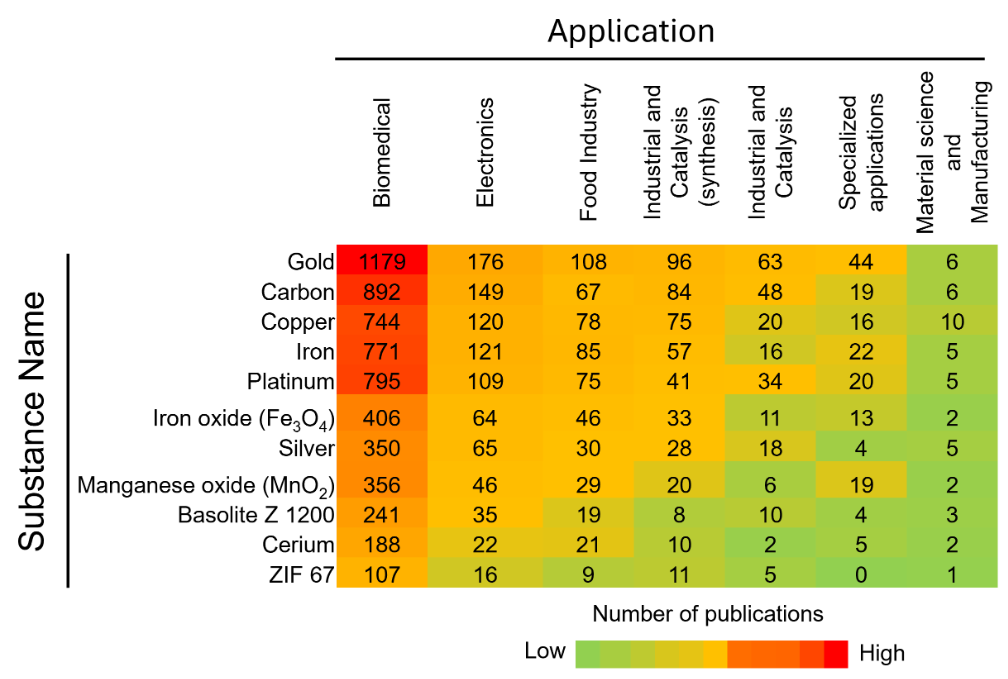
各应用领域的材料分布(图9B)凸显了传统无机纳米酶的绝对主导地位,特别是金、碳、铜、铁和铂,它们在生物医学、传感和工业类别中展现出广泛的适用性。其中,生物医学应用占据了绝大部分研究活动,远超其他用途。这种失衡表明纳米酶的开发仍主要面向诊断和治疗应用,在向大规模催化工艺转化方面进展有限。
相比之下,基于框架的材料如MOFs(例如Basolite Z1200、ZIF-67)的代表性较低,且主要局限于生物医学应用。这表明尽管它们具有先进的结构特征和可调性,但其应用仍具有高度的针对性。
总体而言,数据揭示了广泛适用的无机系统与更具专业性的框架材料之间存在明显的界限,反映了该领域正从成熟、可扩展的材料向更具设计导向但应用范围较窄的纳米酶平台转型。
克服挑战以提升商业潜力
尽管取得了显著进展,但纳米酶仍面临关键挑战,必须解决这些问题才能实现广泛的临床和工业应用:
- 催化效率仍显著低于天然酶。纳米酶的米氏常数(Km)通常比生物酶高出10-1000倍,而转换数(kcat)则低几个数量级,这限制了其在需要高底物转化率场景中的应用。
- 底物特异性是另一个根本性制约因素。天然酶通过进化优化的活性位点实现极高的选择性,而大多数纳米酶表现出广泛的混杂反应性,这可能产生脱靶效应或干扰复杂的生物基质。
- 生物相容性和毒性问题依然存在,长期积累、生物降解途径和免疫原性在治疗应用前均需进行严格评估。
- 机制理解尚不完整。与天然酶催化在原子层面的认知相比,许多纳米酶的催化机制定义模糊,这阻碍了对其进行合理的理性设计与优化。
此外,可扩展的制造工艺需具备批次间的一致性,纳米材料分类与审批路径的监管不确定性,以及在复杂生物流体中的稳定性有限,这些都是商业化面临的实际障碍。通过先进的表征技术、计算建模、表面工程策略和标准化的毒理学框架来解决这些局限性,对于纳米酶实现其作为酶替代品的变革潜力至关重要。
展望未来,这种潜力显而易见。学术研究的重点在于对基础问题的探索,而专利活动的日益活跃则表明这些研究成果正开始向商业领域转化。事实上,首款基于纳米酶的药物——由 Cenyx Biotech 开发的 CX213,已进入临床试验阶段。
在生物医学领域之外,从学术论文到专利的转化仍存在显著差距,这凸显了通过产学研合作挖掘纳米酶更多应用潜力的空间。环境修复、食品安全和工业催化是这些创新将发挥关键作用的主要领域。
单原子纳米酶(SAzymes)正成为纳米酶设计的一个极具前景的方向。通过将孤立的金属原子分散在合适的载体上,单原子纳米酶最大限度地提高了原子利用效率,并创造了均匀、明确的活性位点,从而实现了与天然酶活性中心高度相似的催化行为。其他前沿研究领域还包括模拟代谢途径的级联纳米酶系统以及通过合理表面工程设计的底物特异性纳米酶。
总而言之,这些进展标志着纳米酶正逐渐成为众多工业应用中替代下一代天然酶的可行途径。