


Resumen ejecutivo
- Las nanozimas son materiales a nanoescala que imitan la actividad catalítica de las enzimas naturales.
- La investigación académica domina el campo de las nanozimas, lo que sugiere que aún se están realizando descubrimientos fundamentales antes de su comercialización a gran escala.
- Los metales y los óxidos metálicos se utilizan a menudo para las nanozimas, pero los marcos metal-orgánicos y los marcos orgánicos covalentes ofrecen una excelente capacidad de ajuste y estabilidad.
- La investigación sobre nanozimas se centra en las actividades de peroxidasa y oxidasa.
- Las principales aplicaciones de las nanozimas se encuentran en la biomedicina, por ejemplo, en diagnósticos y terapias, así como en sensores y actividades de remediación ambiental.
La nanotecnología está revolucionando campos que van desde la administración de fármacos hasta el almacenamiento de energía, y una de las áreas de investigación de más rápido crecimiento son las nanozimas. Las nanozimas son materiales a nanoescala que exhiben una actividad catalítica intrínseca de imitación enzimática. En esencia, estos materiales diminutos son capaces de acelerar reacciones bioquímicas mediante mecanismos análogos a los que se encuentran en las enzimas naturales.
Desde su designación formal en 2007, las nanozimas han surgido como alternativas convincentes a las enzimas naturales, ofreciendo una estabilidad fisicoquímica superior en rangos extremos de pH y temperatura, costes de producción significativamente reducidos, propiedades catalíticas ajustables mediante el control de la composición y la morfología, y una vida útil prolongada sin necesidad de almacenamiento en frío. Estas capacidades se derivan de las propiedades únicas de los nanomateriales, incluyendo su gran área superficial, abundantes sitios activos y estructuras electrónicas ajustables según el tamaño, la forma y la composición, lo que permite un rendimiento catalítico eficiente y personalizable.
Las nanozimas representan una convergencia de la nanotecnología, la catálisis y la biomedicina, atrayendo el interés de bioquímicos, científicos de materiales, ingenieros biomédicos y clínicos. Sus propiedades programables y su robustez inherente posicionan a las nanozimas como herramientas transformadoras para la próxima generación de diagnósticos y terapias de reemplazo enzimático. Están impulsando un importante impulso de investigación interdisciplinaria, y hemos analizado en profundidad el panorama de la investigación para comprender mejor hacia dónde se dirige este campo.
Tendencias de publicación en nanozimas
Utilizando CAS IP Finder, con tecnología de STNTM, los expertos en la materia de CAS accedieron a la CAS Content CollectionTM, el mayor repositorio de información científica curado por expertos, para identificar y extraer datos relacionados con las nanozimas. Esto dio como resultado más de 14 500 publicaciones, 11 000 conceptos únicos indexados por CAS y 14 000 sustancias.
El panorama de la investigación está dominado por publicaciones en revistas (89%) y es característico de un campo emergente que aún se encuentra en la fase de investigación fundamental, donde la comprensión mecanicista y los estudios de prueba de concepto preceden a la comercialización generalizada (véase la Figura 1). El análisis temporal indica un crecimiento exponencial en las publicaciones en revistas, particularmente después de 2018, con este aumento drástico posiblemente correlacionado con descubrimientos revolucionarios en nanozimas de un solo átomo y aplicaciones terapéuticas. Las solicitudes de patentes muestran una trayectoria de crecimiento similar, aunque con una línea de tiempo desplazada que refleja el proceso típico de traslación de la academia a la comercialización.
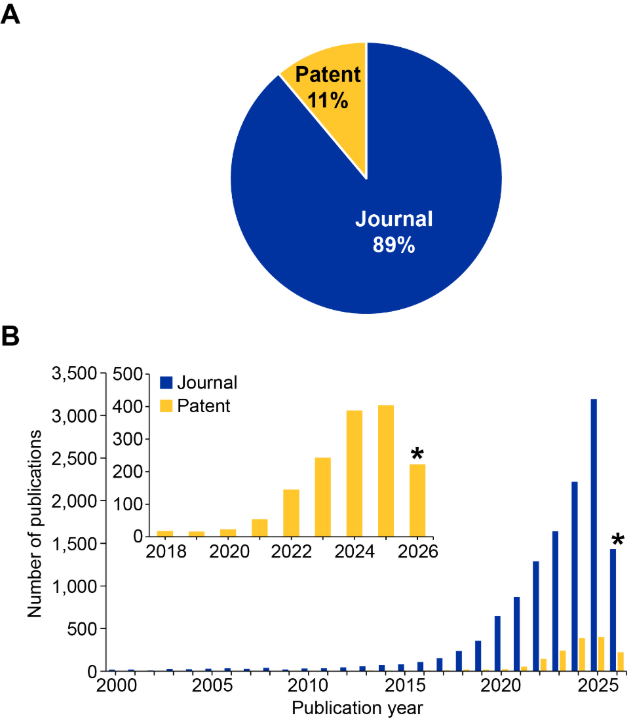
Los investigadores que exploran tendencias similares pueden aprovechar las capacidades de búsqueda basadas en IA en CAS SciFinder® para identificar patrones y tendencias en sus áreas de investigación específicas.
El campo sigue estando impulsado abrumadoramente por el ámbito académico, como lo demuestra la contribución de más del 97% de los artículos de revistas procedentes de organizaciones de investigación y académicas. La mayoría de estas instituciones líderes en investigación de nanozimas se encuentran en China (78%), con presencia también de India, EE. UU. y Corea del Sur (véase la Figura 2). China también representa el 39% de las publicaciones en revistas de autoría corporativa, seguida de Italia (8%), EE. UU. (8%) e India (7%).
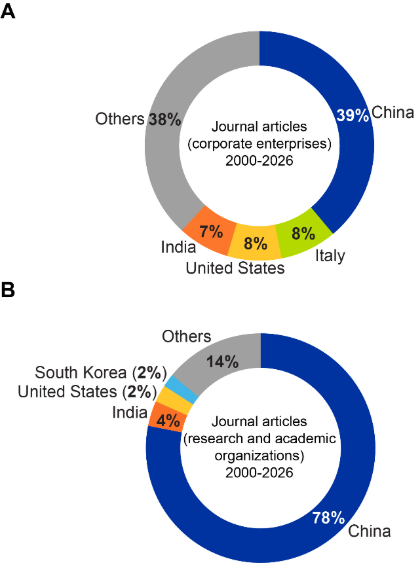
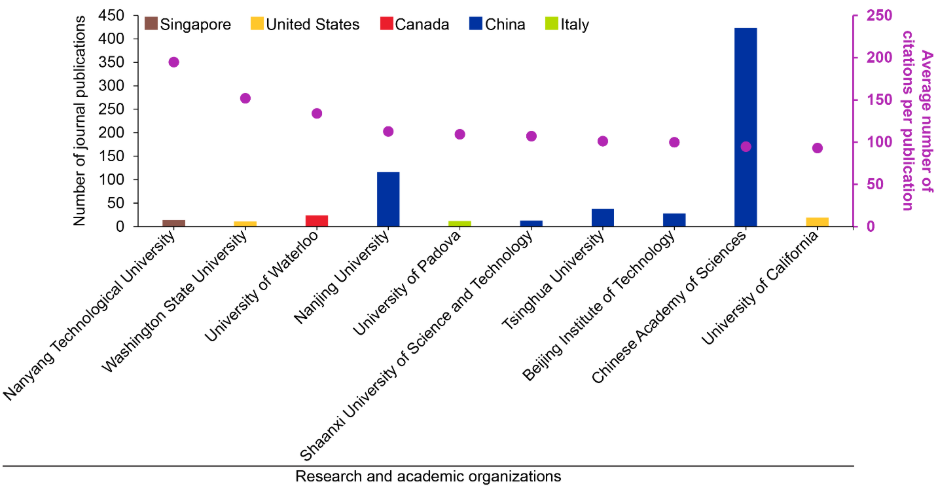
Nuestro análisis, que considera los indicadores duales de producción investigadora (número de publicaciones) e impacto de la investigación (número medio de citas por publicación), revela varias tendencias (véase la Figura 3). Las instituciones chinas ocupan cinco de los 10 primeros puestos, lo que refleja la cuota del 78% de China en las publicaciones académicas sobre nanozimas. Sin embargo, otras instituciones logran un mayor impacto por artículo a pesar de tener volúmenes de publicación menores.
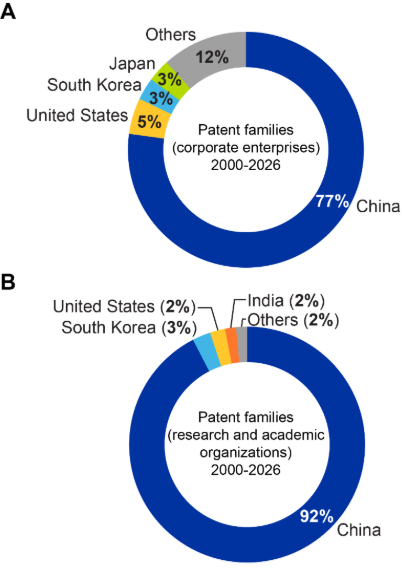
Las organizaciones académicas y de investigación también predominan en las solicitudes de patentes frente a las empresas corporativas (90% frente a 10%). Este predominio académico indica que la investigación sobre nanoenzimas sigue impulsada por las universidades, lo que sugiere que el campo se encuentra en una fase de desarrollo inicial, con importantes descubrimientos fundamentales surgiendo de laboratorios académicos. La limitada participación corporativa puede reflejar incertidumbres regulatorias, una escalabilidad de fabricación aún no optimizada o la necesidad de validar la eficacia clínica antes de realizar inversiones industriales sustanciales. Tanto en el ámbito académico como en el corporativo, observamos nuevamente que la mayoría de estas organizaciones se encuentran en China (véase la Figura 4).
Por ejemplo, algunas patentes recientes relacionadas con nanoenzimas incluyen:
- Las patentes de nanoenzimas de la Universidad Médica de Guangxi se centran principalmente en nanoenzimas basadas en metales (Pd, Rh, Cu, etc.) soportadas sobre nanomateriales 2D (MXenos Ti₃C₂Tₓ, grafeno, nitruro de carbono) y estructuras metal-orgánicas (MOF) para aplicaciones terapéuticas en artrosis, osteosarcoma y enfermedades neurodegenerativas (p. ej., CN114917354 A, CN120899942 A).
- Las patentes de nanoenzimas de la Universidad de Jilin también destacan las nanoenzimas basadas en metales (Ag, Au, etc.) con actividades similares a la peroxidasa y la lacasa para aplicaciones de biodetección, incluida la detección de biomarcadores de cáncer (p. ej., CN109884029 A), el control de residuos de pesticidas (p. ej., CN119500128 A, CN120718082 A) y la detección de formaldehído (p. ej., CN120094644 A), así como aplicaciones terapéuticas (cicatrización de heridas, antibacterianas, etc.) (p. ej., CN116602933 A, CN120114614 A).
- Las patentes de nanoenzimas de la Universidad de Yangzhou se centran en nanoenzimas basadas en óxidos metálicos y MOF (Fe₃O₄, MnO₂, Cu-ZIF-8, etc.) con actividades similares a la peroxidasa, catalasa y lacasa para diversas aplicaciones, incluida la biodetección (p. ej., CN114790585 A), con énfasis en nanoenzimas terapéuticas para el tratamiento de enfermedades infecciosas (p. ej., CN116712538 A) y afecciones inflamatorias (p. ej., CN121588060 A), entre otras.
Las clases de materiales influyen en la biología sintética y la actividad catalítica
Un aspecto importante del panorama de las nanoenzimas es comprender cómo la elección de los materiales influye en el enfoque de la investigación y su adopción en el mundo real. Aunque se han explorado numerosos nanomateriales, las diferencias en sus propiedades fisicoquímicas, coste y escalabilidad desempeñan un papel fundamental a la hora de determinar su potencial de traslación. Para comprender mejor el panorama de los materiales de las nanoenzimas, analizamos nuestros datos basándonos en las clases de sustancias indexadas por CAS e identificamos los elementos (compuestos por metales), los óxidos metálicos, las aleaciones y las estructuras metal-orgánicas (MOF) como las categorías dominantes, cada una de las cuales exhibe diversas actividades de imitación enzimática.
Nanoenzimas elementales (metálicas)
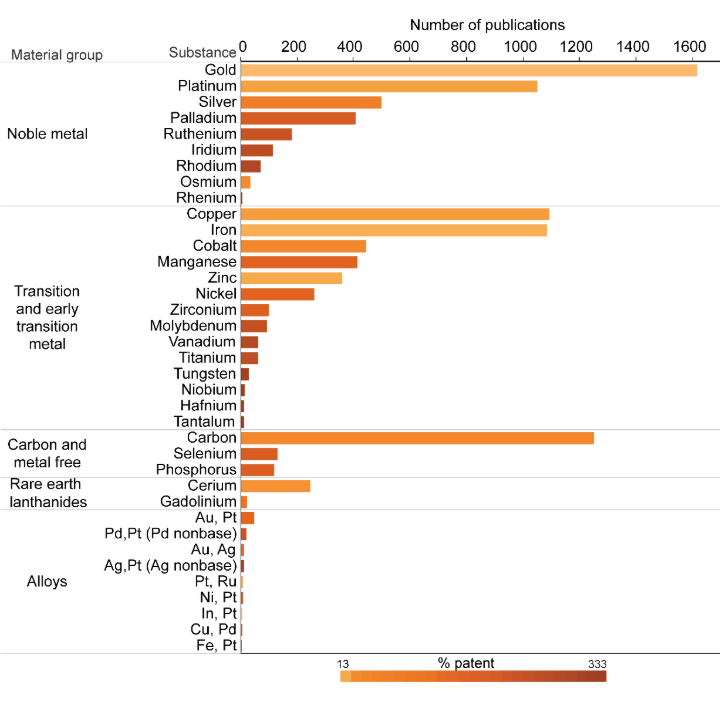
La distribución de los elementos pone de relieve una clara desconexión entre la intensidad de la investigación y la traslación comercial en el ámbito de las nanoenzimas. Elementos como el oro, el platino y el carbono dominan la investigación académica debido a sus propiedades bien conocidas y a la facilidad de experimentación; sin embargo, su menor actividad en patentes sugiere limitaciones en cuanto a rentabilidad y escalabilidad. Por el contrario, el hierro y el cobre muestran una fuerte alineación entre la investigación y las patentes, lo que refleja su idoneidad para aplicaciones reales donde la viabilidad económica y de fabricación es crítica (véase la Figura 5).
Esta tendencia está impulsada por factores técnicos. El hierro y el cobre se benefician de estados multivalentes intrínsecos que permiten ciclos catalíticos eficientes sin necesidad de una ingeniería compleja, además de su bajo coste y biocompatibilidad demostrada. En comparación, los metales nobles como el oro y el platino, a pesar de su rendimiento catalítico superior, a menudo requieren condiciones controladas y un ajuste preciso del tamaño y la química superficial, lo que complica su escalado. Además, su elevado coste material limita aún más las aplicaciones a gran escala y económicamente viables. Del mismo modo, los sistemas basados en carbono, aunque ampliamente estudiados, pueden sufrir de una actividad catalítica inconsistente y una claridad mecanística limitada, lo que restringe el desarrollo de productos.
Se observa un patrón similar en elementos como el paladio (Pd), el rutenio (Ru), el iridio (Ir), el rodio (Rh), el níquel (Ni), el selenio (Se), el vanadio (V) y el titanio (Ti), que muestran un menor volumen de publicaciones pero una intensidad de patentes relativamente mayor. Esta tendencia se alinea con las ventajas funcionales de estos materiales, incluyendo la eficiencia catalítica, estados de oxidación estables y durabilidad en condiciones adversas.
Por ejemplo, el paladio y el rutenio se utilizan ampliamente en catálisis debido a su alta actividad y selectividad, mientras que el titanio y el vanadio proporcionan estabilidad y resistencia a la corrosión en entornos reactivos. El níquel, en particular, ofrece una alternativa rentable a los metales nobles con un rendimiento catalítico razonable, lo que lo hace atractivo para tecnologías escalables. De manera similar, los sistemas basados en selenio a menudo demuestran un comportamiento redox único relevante para aplicaciones biológicas y de detección. En conjunto, estas características hacen que dichos elementos sean más directamente trasladables a productos funcionales, lo que explica su mayor representación en patentes a pesar de una exploración académica relativamente menor.
Las nanoenzimas basadas en aleaciones refuerzan aún más esta tendencia orientada a la traslación al combinar las propiedades ventajosas de múltiples metales para mejorar la eficiencia catalítica, la estabilidad y la capacidad de ajuste. Los sistemas de aleación reportados en este conjunto de datos, como se observa en la Figura 5, incluyendo Au–Pt, Pd–Pt, Au–Ag, Pt–Ru, In–Pt, Cu–Pd, Fe–Pt y Ag–Pt, demuestran cómo la sinergia composicional puede modular la estructura electrónica y optimizar los sitios activos más allá de lo que es posible con sistemas de un solo metal. En muchos casos, estas aleaciones introducen efectos cooperativos como una mejor transferencia de electrones, ciclos catalíticos mejorados y una mayor resistencia a la desactivación, derivados del acoplamiento intermetálico y la redistribución electrónica impulsada por la interfaz.
Cabe destacar que las combinaciones que involucran metales nobles a menudo se diseñan para reducir el contenido de metal noble manteniendo un alto rendimiento catalítico, abordando así las limitaciones de coste y escalabilidad. Por ejemplo, las nanoenzimas bimetálicas de Au–Pt exhiben una actividad catalítica mejorada debido a la transferencia de electrones de Au a Pt, mejorando el rendimiento similar a la oxidasa y la catalasa en comparación con sus homólogos monometálicos. Mientras tanto, los componentes no nobles como el Cu o el Fe contribuyen a la actividad redox y a la viabilidad económica, apoyando aún más las aplicaciones escalables.
Aunque los sistemas de aleación siguen estando menos representados en el volumen de publicaciones en relación con las nanoenzimas de un solo metal, su capacidad para diseñar sitios activos mediante el ajuste composicional y las interacciones electrónicas sinérgicas los posiciona como un puente importante entre las nanoenzimas inorgánicas convencionales y los sistemas catalíticos más orientados al diseño, con un gran potencial para la traslación al mundo real.
Nanoenzimas basadas en óxidos metálicos
Unos pocos materiales bien establecidos dominan la categoría de nanoenzimas basadas en óxidos metálicos, particularmente los óxidos de hierro, manganeso y cobre, que combinan una fuerte actividad catalítica con escalabilidad, biocompatibilidad y rutas de síntesis probadas (véase la Figura 6).
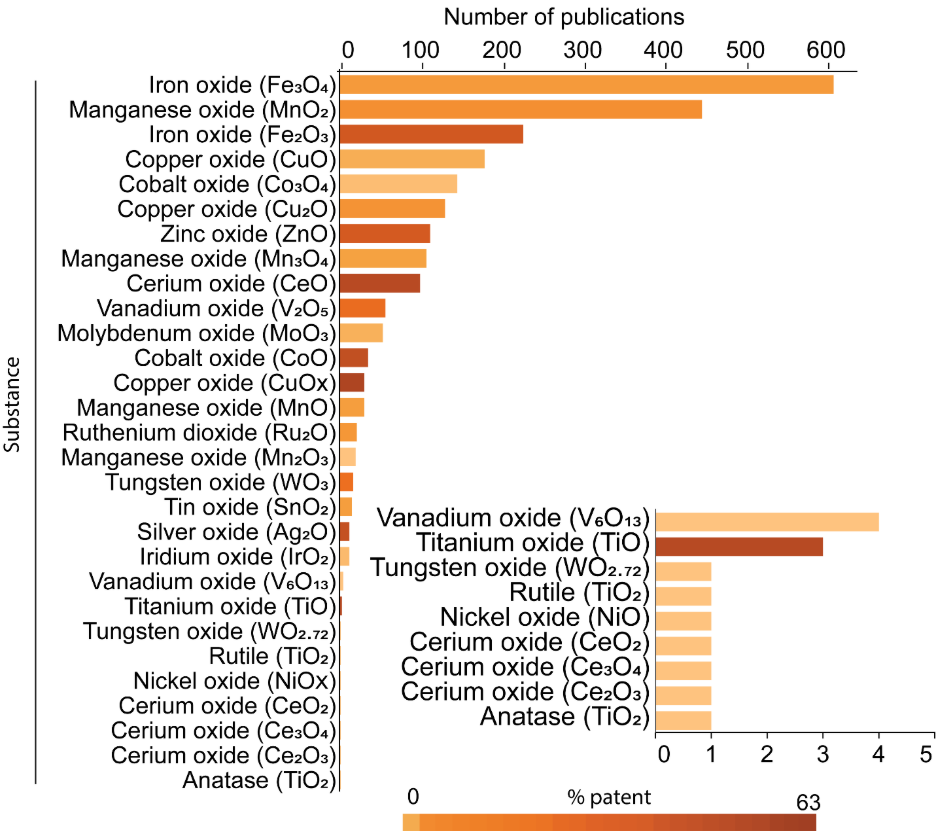
Su elevada actividad en publicaciones y patentes refleja una transferencia exitosa de la investigación a la aplicación. Este dominio se debe a una química redox favorable (por ejemplo, los ciclos Fe²⁺/Fe³⁺, Mn³⁺/Mn⁴⁺) que permite reacciones catalíticas eficientes, junto con métodos de síntesis sencillos y escalables. Por ejemplo, las nanozimas de MnO₂ demuestran un comportamiento catalítico sensible al entorno para aplicaciones de imagen y terapia, las nanozimas de CuO permiten una catálisis impulsada por redox y biosensores mediante el ciclo Cu²⁺/Cu⁺, mientras que los sistemas de Co₃O₄ exhiben una actividad similar a la peroxidasa multivía facilitada por las transiciones redox de Co²⁺/Co³⁺.
Los sistemas emergentes, como los óxidos de cerio y vanadio, destacan la importancia de los estados de oxidación dinámicos y el comportamiento sensible al entorno, lo que permite funciones como alternar entre actividad oxidasa y antioxidante. Estos materiales muestran un gran potencial a pesar de su menor volumen de investigación, lo que indica una falta de exploración más que limitaciones intrínsecas.
Por el contrario, varios óxidos, incluidos los de molibdeno, tungsteno, níquel y otros sistemas especializados, siguen estando menos estudiados, probablemente debido a su complejidad sintética, su caracterización limitada o la falta de vías de aplicación establecidas.
Una conclusión importante es que el rendimiento catalítico depende no solo de la composición, sino también de la fase cristalina, los defectos y la estructura superficial, que influyen en los centros activos y en los mecanismos de transferencia electrónica. Sin embargo, este aspecto sigue sin explorarse lo suficiente, ya que la mayoría de los estudios se centran en fases fáciles de sintetizar en lugar de en una optimización estructural sistemática. En general, la distribución refleja un campo determinado tanto por el rendimiento del material como por factores prácticos, como la familiaridad con la síntesis y la viabilidad traslacional.
Nanozimas basadas en estructuras porosas
El panorama emergente de los materiales de nanozimas destaca una transición de los inorgánicos tradicionales a arquitecturas orgánicas más complejas y ajustables, como los marcos metal-orgánicos (MOF) y los marcos orgánicos covalentes (COF). A diferencia de las nanozimas inorgánicas, los MOF y los COF representan una clase de materiales de nanozimas más pequeña pero en rápido crecimiento. Su menor representación en los datos de publicaciones y patentes refleja su desarrollo relativamente reciente y la mayor complejidad sintética asociada a estos sistemas (véase la Figura 7).
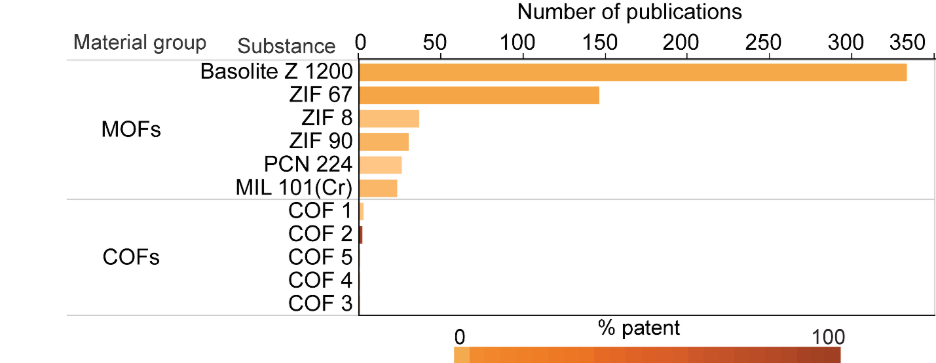
A pesar de su volumen limitado, los MOF y los COF ofrecen propiedades fisicoquímicas distintivas que los hacen adecuados para aplicaciones de nanozimas. Las nanozimas basadas en MOF, en particular los sistemas de referencia como los marcos de tipo Basolite y ZIF, dominan este espacio debido a su probada actividad catalítica, su capacidad de ajuste estructural y su accesibilidad, lo que los convierte en las plataformas de nanozimas porosas más estudiadas.
Sin embargo, este fuerte enfoque en un subconjunto limitado de marcos subraya una brecha importante, ya que la gran mayoría de las químicas de los MOF permanecen inexploradas a pesar de su potencial para la porosidad ajustable, la ingeniería de centros activos y el diseño de enlazadores funcionales. Del mismo modo, los COF están significativamente subrepresentados, a pesar de que su composición libre de metales, su alta estabilidad química y sus arquitecturas π-conjugadas extendidas ofrecen oportunidades únicas para el transporte de carga controlado y entornos catalíticos a medida, lo que indica un espacio de diseño sin explotar.
Las nanozimas basadas en MOF ejemplifican cómo la porosidad ajustable y los centros activos coordinados pueden permitir una catálisis que imita a las enzimas, mientras que los COF destacan el potencial de marcos altamente diseñables, estables y conjugados para sistemas de nanozimas libres de metales.
En conjunto, estas tendencias indican que, si bien las nanozimas inorgánicas y basadas en aleaciones sustentan actualmente los aspectos prácticos y escalables del campo, los materiales basados en marcos como los MOF y los COF están emergiendo como plataformas de próxima generación centradas en lograr una mayor precisión y funcionalidad catalítica. Este cambio subraya una transición más amplia en la investigación de nanozimas, desde la disponibilidad de materiales y la actividad intrínseca hacia sistemas diseñados racionalmente con un rendimiento adaptado para aplicaciones específicas.
La brecha catalítica: las oxidorreductasas dominan, las hidrolasas esperan su momento
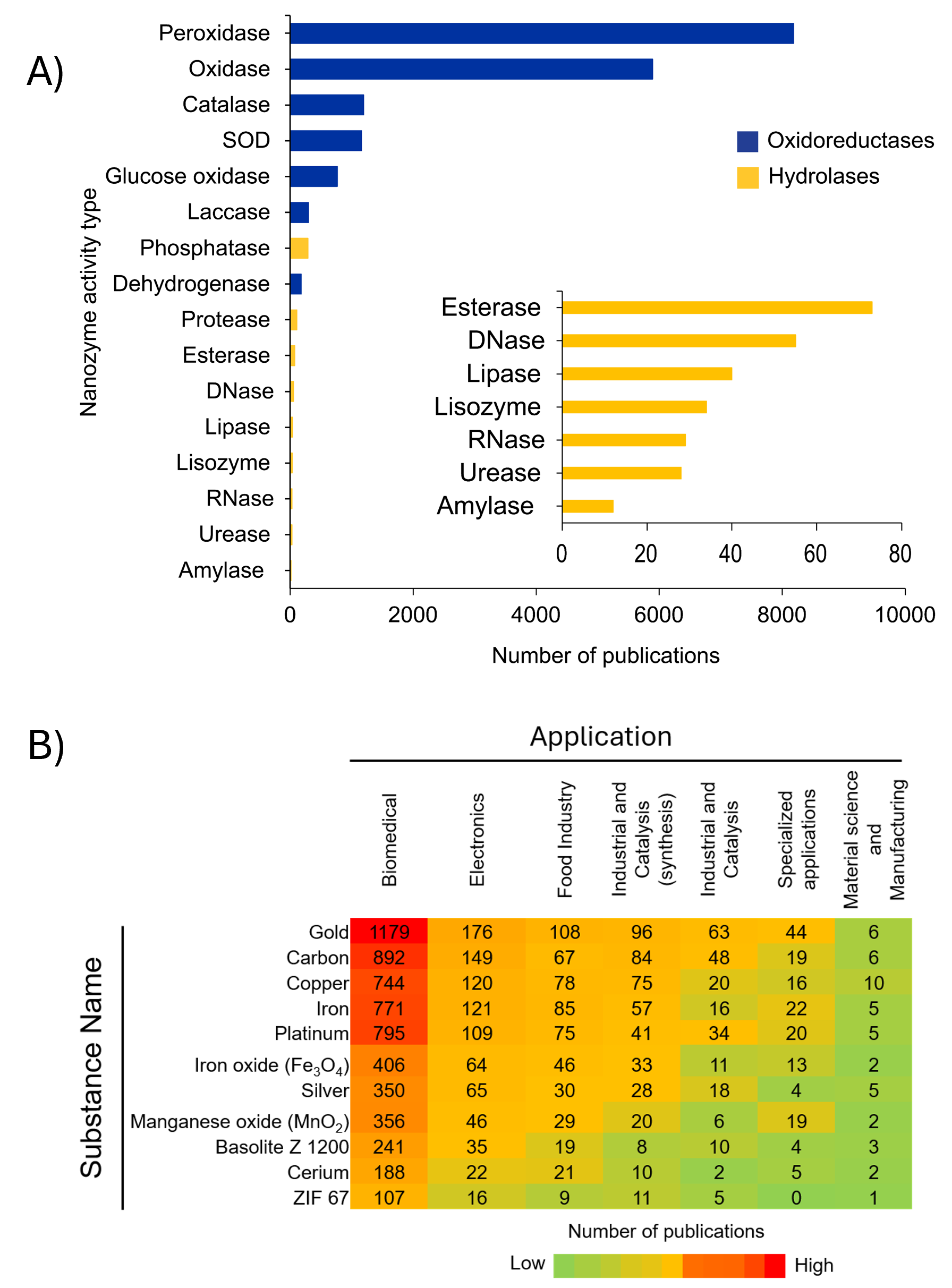
El panorama de la actividad de las nanozimas en la Figura 8 revela un campo fundamentalmente limitado por la química de los materiales más que por la demanda de aplicaciones, con una predominancia de las actividades similares a las oxidorreductasas en la investigación actual. Las nanozimas que imitan a la peroxidasa representan la clase más estudiada, formando una de las familias más grandes y desarrolladas debido a su amplia aplicabilidad, sus métodos de detección colorimétrica sencillos y su compatibilidad con muchos nanomateriales.
En términos más generales, la investigación sobre nanozimas se centra en gran medida en actividades basadas en redox, incluidos los imitadores de peroxidasa, oxidasa, catalasa y superóxido dismutasa, que definen colectivamente el paradigma funcional dominante del campo y sustentan la mayoría de las aplicaciones en biosensores, terapia de enfermedades y regulación de especies reactivas de oxígeno (ROS).
Este desequilibrio refleja un sesgo químico fundamental: los nanomateriales inorgánicos favorecen intrínsecamente los procesos de transferencia electrónica a través de pares redox superficiales, sitios de defectos y vías conductoras, que facilitan naturalmente la catálisis similar a la de las oxidorreductasas. Por el contrario, la actividad de tipo hidrolasa, como la imitación de proteasas, lipasas o nucleasas, requiere un reconocimiento preciso del sustrato, una orientación molecular controlada y mecanismos catalíticos de varios pasos que son difíciles de replicar sin los centros activos tridimensionales altamente evolucionados que se encuentran en las enzimas naturales.
La complejidad de estos requisitos ha hecho que las nanozimas hidrolíticas sean significativamente más difíciles de diseñar, y su desarrollo sigue siendo limitado y fragmentado. Al mismo tiempo, el uso generalizado de nanozimas similares a la peroxidasa se ve reforzado por la conveniencia experimental y la adecuación a la aplicación. Los ensayos colorimétricos estándar (por ejemplo, la oxidación de TMB o ABTS) proporcionan lecturas directas y reproducibles que se alinean bien con el diagnóstico, la detección ambiental y las aplicaciones biomédicas, lo que acelera aún más la concentración de la investigación en esta área. Esto ha creado un ciclo de autorrefuerzo en el que se estudian preferentemente los materiales que exhiben actividad redox, mientras que las funcionalidades catalíticas más complejas siguen sin explorarse.
El mapa de calor de la Figura 8B muestra cómo se distribuye la investigación sobre nanozimas entre materiales específicos (filas) y actividades similares a las enzimas (columnas: actividades similares a peroxidasa, oxidasa, catalasa y SOD) utilizando el recuento de publicaciones.
En todos los materiales, incluidos el oro, el hierro, el cobre, el óxido de manganeso, los materiales a base de carbono y los MOF, la investigación está dominada sistemáticamente por las actividades de peroxidasa y oxidasa, que tienen el mayor número de publicaciones. Por el contrario, las actividades similares a la catalasa y a la SOD siguen estando significativamente menos exploradas en todos los materiales, con valores mucho más bajos.
El mismo patrón de actividad persiste en cada material, lo que indica que la mayoría de los sistemas se investigan principalmente por sus funciones de peroxidasa y oxidasa, con una extensión limitada hacia comportamientos similares a la catalasa o la SOD. Se observan algunas variaciones específicas según el material, como el óxido de manganeso, que muestra una mayor actividad de catalasa, y ciertos materiales (por ejemplo, sistemas basados en cobre o carbono) con recuentos ligeramente elevados de actividad similar a la SOD, pero estas siguen siendo actividades de investigación secundarias.
En general, el mapa de calor destaca que la investigación sobre nanozimas se concentra en combinaciones específicas de material y actividad (por ejemplo, Au-peroxidasa, Fe-peroxidasa, Cu-oxidasa), con una diversificación limitada hacia otras funciones enzimáticas en todas las clases de materiales.
Los ámbitos de aplicación clave incluyen la biomedicina y la remediación ambiental
Aplicaciones biomédicas: Este ámbito representa aproximadamente el 65 % de toda la producción de investigación sobre nanozimas (véase la Figura 9), lo que refleja la convincente propuesta de valor de las nanozimas en el sector sanitario. Estos robustos nanomateriales pueden sustituir a las frágiles enzimas naturales en diagnósticos (sensores de glucosa, inmunoensayos, detección de patógenos), terapias (tratamientos antioxidantes, agentes antimicrobianos, terapia contra el cáncer) y estudios de mecanismos de enfermedades (estrés oxidativo, inflamación).
Los desafíos inherentes al campo biomédico —inestabilidad enzimática, requisitos de cadena de frío y elevados costes de producción— generan una demanda natural de alternativas basadas en nanozimas, lo que impulsa una inversión sostenida en investigación académica y clínica. La actividad de patentes en aplicaciones biomédicas representa la mayor proporción de patentes frente a publicaciones entre todas las categorías de aplicación. Esto sugiere que los descubrimientos de nanozimas biomédicas se consideran desproporcionadamente viables desde el punto de vista comercial y dignos de protección de propiedad intelectual, probablemente debido a las claras vías hacia kits de diagnóstico, dispositivos de punto de atención y formulaciones terapéuticas con rutas regulatorias definidas y un potencial de mercado sustancial.
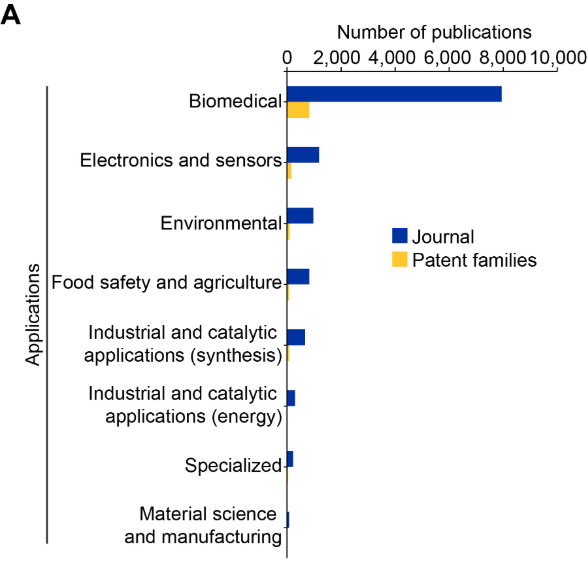
Electrónica y sensores: Este campo ocupa el segundo lugar en términos de producción de investigación, representando alrededor del 8-9 % del total. Las capacidades de amplificación de señal catalítica de las nanozimas las hacen valiosas en biosensores electroquímicos, donde mejoran la sensibilidad para detectar biomoléculas, contaminantes o patógenos. La pequeña pero visible presencia de patentes indica un interés comercial en las tecnologías de sensores, particularmente para el monitoreo ambiental, el control de calidad de los alimentos y los dispositivos de salud portátiles, donde los transductores basados en nanozimas ofrecen ventajas sobre los sensores convencionales basados en enzimas en términos de estabilidad y vida útil.
Aplicaciones ambientales: Con aproximadamente el 8 % de la producción total de investigación, la investigación sobre nanozimas ambientales se centra en la degradación de contaminantes (tintes orgánicos, pesticidas, antibióticos), el tratamiento de aguas y la remediación de suelos. Las actividades de peroxidasa y oxidasa de las nanozimas permiten la descomposición catalítica de contaminantes, mientras que sus propiedades fotocatalíticas (cuando se combinan con semiconductores) mejoran la eficiencia de degradación. La mínima actividad de patentes sugiere que, aunque son científicamente interesantes, las aplicaciones ambientales enfrentan barreras de comercialización, posiblemente debido a preocupaciones sobre la rentabilidad al competir con métodos de oxidación química establecidos o desafíos en el despliegue a gran escala y la recuperación/reciclaje de nanomateriales.
Seguridad alimentaria y agricultura: Estos sectores aprovechan las nanozimas para la detección de residuos de pesticidas, la identificación de patógenos transmitidos por los alimentos y la conservación mediante antioxidantes. Las aplicaciones incluyen ensayos colorimétricos para melamina, antibióticos o metales pesados en matrices alimentarias, así como recubrimientos antimicrobianos que prolongan la vida útil. La insignificante actividad de patentes puede reflejar las complejidades regulatorias que rodean el uso de nanomateriales en aplicaciones en contacto con alimentos, donde las evaluaciones de seguridad son estrictas y la aceptación del consumidor sigue siendo incierta.
Aplicaciones industriales y catalíticas: Existe una investigación destacada en dos subcategorías, síntesis y energía. Las aplicaciones de síntesis implican el uso de nanozimas como catalizadores para reacciones orgánicas, degradación de polímeros o procesos de química verde, sustituyendo a los costosos catalizadores de metales nobles. Las aplicaciones energéticas se centran en pilas de combustible (catálisis de la reacción de reducción de oxígeno), células solares (separación de carga) y baterías (mediación redox). La mínima representación de estos campos sugiere que las nanozimas aún no han demostrado ventajas claras sobre los catalizadores industriales establecidos en términos de actividad, selectividad o rentabilidad a escala.
Aplicaciones especializadas y relacionadas con la ciencia de materiales: Estas muestran una actividad mínima (~1-2 %), lo que indica aplicaciones de nicho o emergentes. Las aplicaciones especializadas incluyen energía, medio ambiente y aplicaciones de detección emergentes relacionadas con la seguridad, mientras que la ciencia de materiales y la fabricación probablemente se refieren a la integración de nanozimas en materiales compuestos, recubrimientos o procesos de fabricación. La falta de actividad de patentes sugiere que estas siguen siendo áreas de investigación exploratoria sin trayectorias de comercialización claras.
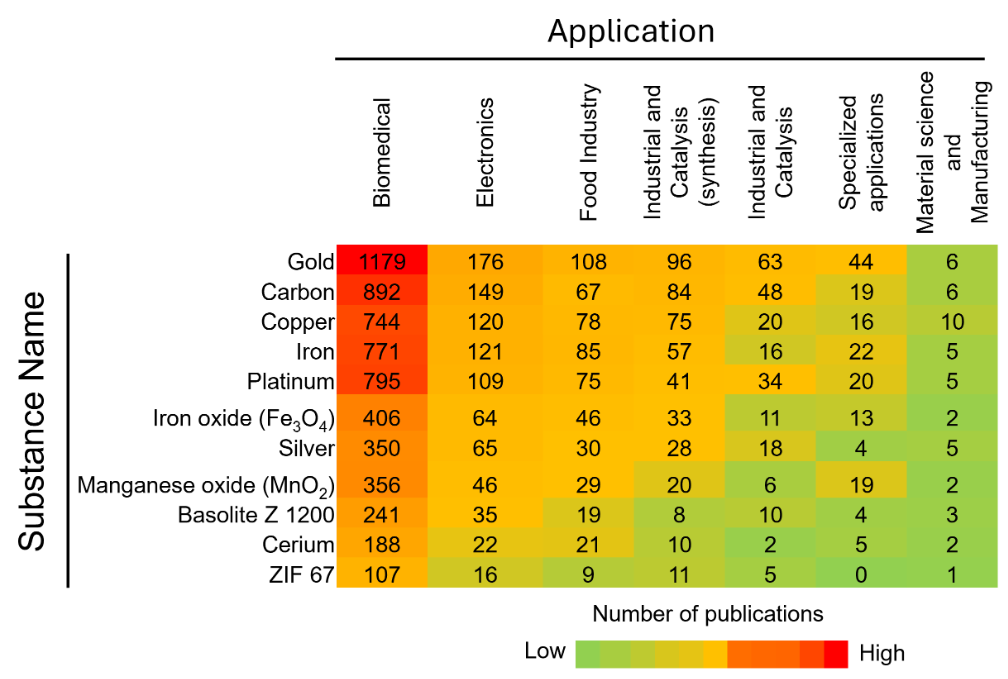
La distribución de materiales en los dominios de aplicación (Figura 9B) destaca una clara dominancia de las nanozimas inorgánicas convencionales, particularmente oro, carbono, cobre, hierro y platino, que exhiben una amplia aplicabilidad en categorías biomédicas, de detección e industriales. Entre ellas, las aplicaciones biomédicas impulsan abrumadoramente la actividad investigadora, superando significativamente a otros casos de uso. Este desequilibrio sugiere que el desarrollo de nanozimas sigue estando orientado en gran medida hacia aplicaciones diagnósticas y terapéuticas, con una traducción limitada hacia procesos catalíticos a gran escala.
Por el contrario, los materiales basados en estructuras como los MOF (por ejemplo, Basolite Z1200, ZIF-67) muestran una menor representación y permanecen confinados en gran medida a aplicaciones biomédicas. Esto indica que, a pesar de sus características estructurales avanzadas y su capacidad de ajuste, su adopción sigue siendo específica para cada aplicación.
En general, los datos revelan una clara separación entre los sistemas inorgánicos de amplia aplicación y los materiales estructurales más especializados, lo que refleja una transición en el campo desde materiales establecidos y escalables hacia plataformas de nanozimas más orientadas al diseño pero menos implementadas a gran escala.
Superar los desafíos para un mayor potencial comercial
A pesar de los notables avances, las nanozimas enfrentan desafíos críticos que deben abordarse para su adopción clínica e industrial generalizada:
- La eficiencia catalítica sigue siendo sustancialmente menor que la de las enzimas naturales, con nanozimas que suelen exhibir constantes de Michaelis-Menten (Km) de 10 a 1000 veces superiores y números de recambio (kcat) órdenes de magnitud inferiores a los de sus homólogos biológicos, lo que limita las aplicaciones que requieren altas tasas de conversión de sustrato.
- La especificidad del sustrato plantea otra limitación fundamental. Mientras que las enzimas naturales logran una selectividad exquisita a través de sitios activos optimizados evolutivamente, la mayoría de las nanozimas muestran una reactividad amplia y promiscua que puede generar efectos fuera del objetivo o interferir con matrices biológicas complejas.
- Las preocupaciones sobre la biocompatibilidad y la toxicidad persisten, ya que la acumulación a largo plazo, las vías de biodegradación y la inmunogenicidad requieren una evaluación rigurosa antes de su uso terapéutico.
- La comprensión mecanicista sigue siendo incompleta. Para muchas nanozimas, los mecanismos catalíticos están mal definidos en comparación con el conocimiento a nivel atómico de la catálisis enzimática natural, lo que dificulta el diseño y la optimización racionales.
Asimismo, la fabricación escalable con reproducibilidad entre lotes, la incertidumbre regulatoria en torno a la clasificación de nanomateriales y los procesos de aprobación, y la estabilidad limitada en fluidos biológicos complejos suponen barreras prácticas para su comercialización. Abordar estas limitaciones mediante técnicas de caracterización avanzadas, modelos computacionales, estrategias de ingeniería de superficies y marcos toxicológicos estandarizados será esencial para que los nanozimas alcancen su potencial transformador como sustitutos de enzimas.
De cara al futuro, dicho potencial es evidente. El enfoque en la investigación académica permite estudiar cuestiones fundamentales, y el aumento de la actividad en patentes demuestra que estos hallazgos comienzan a trasladarse al ámbito comercial. De hecho, el primer fármaco basado en nanozimas, CX213, desarrollado por Cenyx Biotech, ha entrado en ensayos clínicos.
Persiste una brecha significativa entre publicaciones y patentes fuera del ámbito biomédico, lo que pone de relieve las oportunidades para que las asociaciones entre la industria y el mundo académico desbloqueen más aplicaciones para los nanozimas. La recuperación medioambiental, la seguridad alimentaria y la catálisis industrial son algunos de los sectores principales donde estas innovaciones desempeñarán un papel clave.
Los nanozimas de átomo único (SAzymes) emergen como una dirección prometedora en el diseño de nanozimas. Al dispersar átomos metálicos aislados sobre soportes adecuados, los SAzymes maximizan la eficiencia de utilización atómica y crean centros activos uniformes y bien definidos, lo que permite un comportamiento catalítico muy similar al de los centros activos de las enzimas naturales. Otras áreas de investigación puntera incluyen los sistemas de nanozimas en cascada que imitan rutas metabólicas y los nanozimas específicos de sustrato mediante una ingeniería de superficies racional.
En conjunto, estos avances señalan el crecimiento de los nanozimas como una vía viable para la próxima generación de sustitutos de enzimas naturales en multitud de aplicaciones industriales.