Advanced materials: innovations making the leap from the lab

Executive Summary

  • Advanced materials facilitate green chemistry and more efficient energy storage methods.
  • Sensors and biomedical devices benefit from advanced materials like metal-organic frameworks and conductive polymers.
  • AI-powered tools can identify promising advanced materials quickly.
  • Sophisticated recycling methods reclaim more materials from waste streams and support the circular economy.

From tiny metal ions and polymer threads to full-sized solar panels and batteries, advanced materials are changing products across commercial and industrial uses. These innovations lie at the intersection of traditional materials science, AI-driven technology, and green chemistry. Furthermore, breakthroughs are now moving from the lab to real-world applications. The key question for investors and product strategists is this: which innovation is the next one ready to make the leap?

Our comprehensive view of the materials science landscape via the CAS Content CollectionTM, the largest human-curated repository of scientific information, provides us with unique insights on research and patent trends related to advanced materials. This perspective is critical to understanding how materials are moving from proof-of-concept studies to marketable products and where the next breakthroughs are happening.

Our experts are continually exploring how advanced materials are impacting fields like energy storage and consumer products. The resources we’ve gathered in this hub share the latest findings for researchers, patent specialists, and R&D teams:

Metal-organic frameworks cross the commercial threshold

With incredibly high surface area and porosity plus tunable chemical properties, metal-organic frameworks (MOFs) are tiny materials making an outsized impact on energy storage, decarbonization efforts, and even biomedicine. MOFs show promising progress in gas separation and carbon capture, energy storage and conversion, water harvesting, and biomedical applications like sensors and imaging. With AI-driven technology, researchers are overcoming the trial-and-error approach that has slowed down MOF synthesis and are identifying effective structures faster:

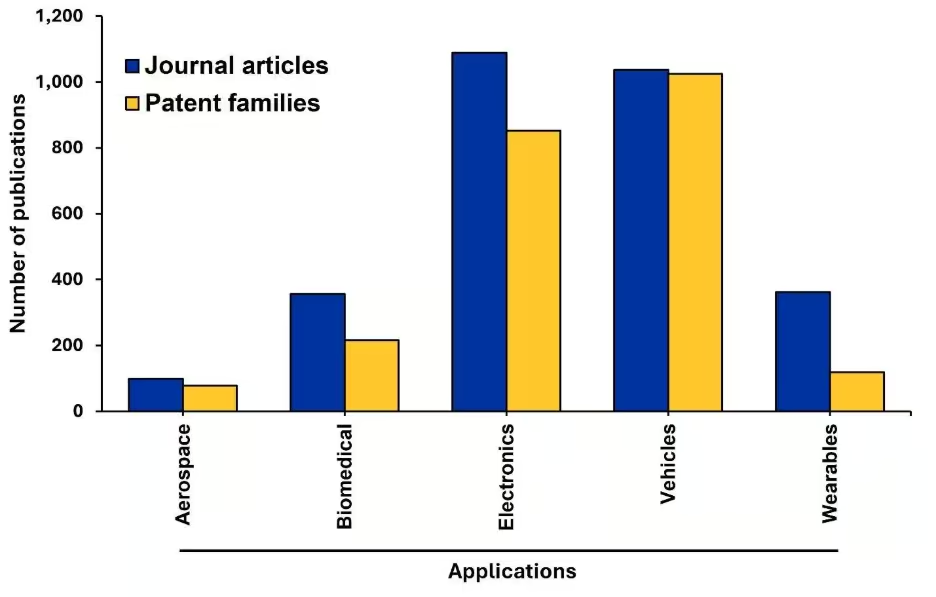
Number of publications and percentage of basic patents related to various applications in the MOF dataset. Source: CAS Content Collection

Read article: MOFs at a commercial tipping point

CAS Insights Spotlight

Stay up-to-date on the latest materials science trends

What other breakthroughs are relevant in materials science? Subscribe to CAS Insights and keep up-to-date on the newest research and industry trends.

Subscribe to CAS Insights today.

Advanced materials drive better energy storage   

The energy transition is the catalyst for many new technologies, and materials science is turning those technologies into reality. New battery technologies, such as solid-state batteries, improve upon liquid-electrolyte lithium-ion batteries with greater energy density and safety. Thermal energy storage also uses innovative materials to store heat and cold for conversion back to electricity or for use as heating and air conditioning that uses less energy than traditional gas- or electricity-powered sources. Can advanced materials generate more energy for storage in these types of batteries? As we see with perovskite solar cells, the answer is yes.

Patent trends show promising applications for solid-state batteries. Source: CAS Content Collection.

Read more: Solid-state batteries are promising alternatives to conventional lithium batteries.

Conductive polymers blend clothing and electronics

Can our clothes conduct electricity? Specialized polymers with certain molecular bonds doped with charge carriers can, and they’re changing biomedical sensing and drug delivery. These innovative materials can even go beyond wearables to potential applications as artificial muscles and implantable prosthetics.

Number of documents for the most common conductive polymers. Source: CAS Content Collection.

Read more: Conductive polymers move to commercial applications

Read more: Reliable power from the smallest sources

What are MXenes?

MXenes are two-dimensional materials with unique properties and the ability to have their composition adjusted to suit many applications. These materials are used in batteries, supercapacitors, and other energy-storage components, as well as electronics, sensors, and environmental remediation applications. MXenes differ from other 2D materials in that they combine conductivity, flexibility, and hydrophilic surfaces that can be chemically modified for specific properties.

Read more: Capacitors, catalysts and coatings: MXenes drive industrial innovations

The future of advanced materials 

Materials science is a driving force in the energy transition, healthcare advances, and so much more that impacts the modern economy. As innovations multiply, it’s more important than ever for researchers to identify the compounds poised to make a breakthrough and the technologies ready to move out of

Access to CAS data and analytical capabilities provides an important advantage, and our solutions such as CAS SciFinder® and CAS IP Finder, powered by STN™, allow the team at CAS to have unique insights into data governance and knowledge management strategies. We’ll keep updating this space with the key developments in advanced materials from across the research landcape.  

The advanced material topics above were analyzed using the CAS Content Collection, CAS SciFinder, and CAS IP FinderTM, which aggregate chemistry and related science data from global sources. Researchers exploring similar trends can access AI-enabled search capabilities across all these areas using CAS Newton to identify patterns in their specific research areas.

Questions and answers

What are advanced materials?

How is AI changing materials discovery?

Why are MOFs and graphene seen as commercial inflection cases?

Why are advanced materials important in energy storage?

Related CAS Insights

材料

Advanced materials: innovations making the leap from the lab

材料

Are metal-organic frameworks (MOFs) at a commercial tipping ​​point?

材料

Beyond insulation: New applications for aerogels

Gain new perspectives for faster progress directly to your inbox.