

微RNA(miRNA/miR)是长度为20-22个核苷酸的非编码RNA,通过与靶信使RNA(mRNA)分子相互作用,在基因调控中发挥关键作用。据估计,微RNA可在翻译水平上调节人类基因组中高达60%的蛋白质编码基因。它们参与分化、增殖、凋亡和发育等多种生理过程,其失调与多种病理疾病有关。
2024年诺贝尔生理学或医学奖凸显了微RNA的重要性,该奖项授予了Victor Ambros和Gary Ruvkun,以表彰他们“发现微RNA及其在转录后基因调控中的作用”。2024年诺贝尔生理学或医学奖这些科学家于1993年首次发表了关于微RNA的发现,到2000年,Ruvkun的研究小组已经鉴定出let-7,这是一种由let-7基因编码的微RNA,在多种动物物种中高度保守。自那时起,开发微RNA疗法引起了人们的极大兴趣。
这些核酸的毒性和有效递送问题一直是一项挑战。进入临床试验的微RNA疗法不到20种,且均未进入III期临床。由于微RNA的毒性及其他严重副作用,约有一半已启动的微RNA疗法试验被迫暂停或终止。
然而,新的研究正在取得进展。纳米级药物递送系统的进步正在解决疗效和毒性问题,随着递送方法的不断改进,微RNA疗法可能会得到更广泛的应用。
微RNA的生物合成与作用机制
微RNA可以作为独立的转录单元存在,也可以嵌入其他基因的内含子或外显子中。微RNA的生物合成有两条途径:经典途径和非经典途径(见图1)。

在经典途径中,微RNA由RNA聚合酶II(有时为RNA聚合酶III)从微RNA基因转录为长链初级微RNA转录本(pri-miRNA)。Pri-miRNA可长达数千碱基,具有5’和3’侧翼序列,并可包含多个成熟微RNA的茎环结构。Pri-miRNA由核蛋白DGCR8(迪乔治综合征关键区8蛋白)和DROSHA酶加工成发夹状结构,即pre-miRNA转录本。
在非经典途径中,位于mRNA内含子内的微RNA前体被剪接出来,绕过了DGCR8/DROSHA步骤。随后,pre-miRNA在exportin-5的帮助下被转运至细胞质。一旦进入细胞质,RNase酶DICER作用于pre-miRNA发夹环并将其切割,产生成熟的微RNA双链。微RNA双链的一条链(引导链)与RNA诱导的沉默复合物(RISC)中的Argonaut(AGO)蛋白结合,而另一条链(过客链)则被降解。通常,基于热力学稳定性等因素,RISC会优先选择其中一条链。最后,靶mRNA要么被降解,要么发生翻译抑制。
改进的递送方法使突破更进一步
由于微RNA疗法的不稳定性和易降解性,实现其向靶细胞的有效递送是一个复杂的挑战。目前的递送方法包括病毒系统(腺相关病毒、腺病毒和慢病毒载体)和非病毒系统(脂质纳米颗粒、聚合物纳米颗粒、无机纳米颗粒、细胞外囊泡和肽)。
病毒介导的微RNA递送已被证明有效,但该方法也表现出高免疫原性。非病毒载体则表现出相对稳定性和低免疫原性。因此,研究人员正在探索多种类型的非病毒纳米载体,以将微RNA有效地递送至细胞。
脂质纳米颗粒(LNP)是最常用的载体,因为它们能保护微RNA并具有良好的生物相容性。LNP最近已开发出由可电离阳离子脂质组成的版本,以实现更高效的微RNA递送。LNP还可以包含胆固醇或二油酰磷脂酰乙醇胺(DOPE)等“辅助脂质”,以提高稳定性并降低毒性。研究表明,掺入聚乙二醇(PEG)可以减少纳米颗粒的聚集并延长循环时间。显示出
Emerging breakthroughs are also occurring with polymer-based carriers, including poly (lactic-co-glycolic acid) (PLGA). Researchers developed a microRNA-210 inhibition strategy with antisense γ peptide nucleic acids (γPNAs) with improved RNA-binding efficacy and encapsulated them in PLGA nanoparticles. PLGA has received FDA approval as a delivery vehicle and is in phase II trials for small interfering RNA (siRNA) therapies.
Inorganic nanoparticles such as gold and silica also show potential as microRNA carriers, but ongoing toxicity concerns, particularly with gold, may limit their clinical usage.
Different strategies of using microRNAs as therapeutics
We examined the CAS Content CollectionTM, the largest human-curated repository of scientific information, to better understand the research landscape of microRNA.There was a notable increase in publications relating to microRNA in the last few years, although journal publications are now decreasing slightly. However, patent publications continue to increase, suggesting sustained commercial interest in this area (see Figure 2).

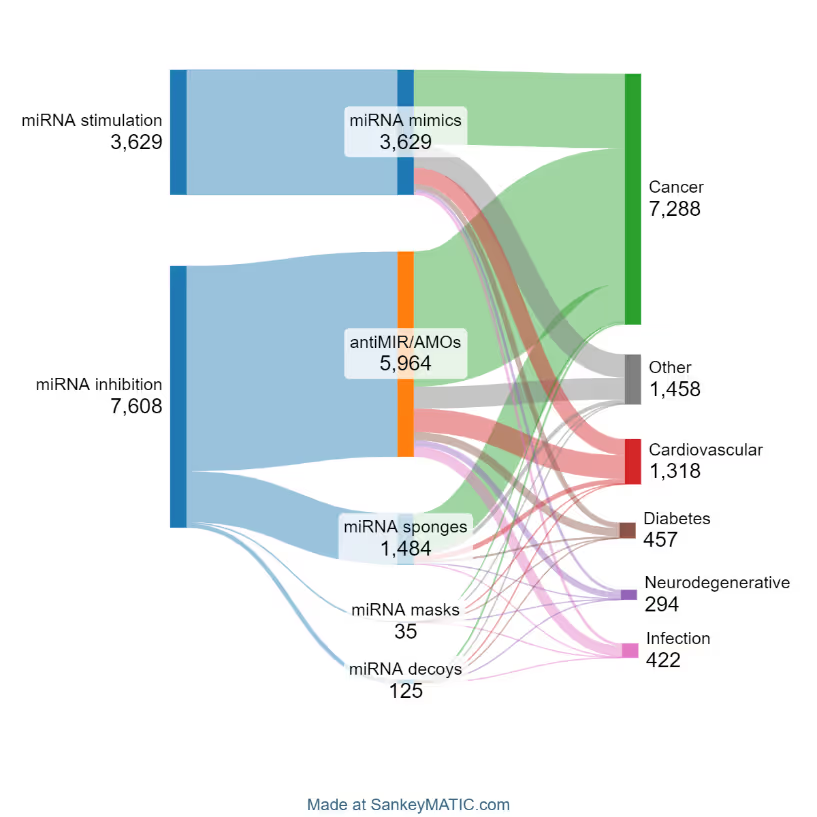
The goal of microRNA therapeutics is to alter and ideally restore abnormal or pathological microRNA expression patterns. There are currently two approaches to achieve this — microRNA stimulators or enhancers and microRNA inhibitors. The first group mainly includes microRNA mimics, while the second group comprises antiMIR oligonucleotides (AMOs), microRNA masks, sponges, and decoys. As seen in Figure 3, most publications pertain to microRNA inhibitors (67.7%).AMOs are the most common among these publications.

These various strategies work as follows:
- microRNA mimic: Synthetic double-stranded small RNA molecules that match the corresponding microRNA sequence, mimicking the action of naturally synthesized microRNA. The aim is to functionally replenish the lost or decreased microRNA expression in pathological conditions.
- antiMIRs/AMOs/antagomiRs: Synthetic single-stranded small RNA molecules based on first-generation antisense oligonucleotides, which may have chemical modifications (e.g., antiMIRs with a 2-O-methoxyethyl modification are also called antagomiRs). These functionally bind to microRNAs with complementary sequences and prevent their interaction with target mRNA, eventually increasing their expression.
- microRNA sponges: Artificial microRNA containing tandem repeats of oligonucleotide sequences with microRNA binding sites (MBSs) for a mature microRNA of interest. They sequester the target endogenous microRNAs, leaving the MBS on target mRNAs free, thus leading to their upregulation. CircmiRs are circular microRNA sponges with the same mechanism of action but are more stable.
- microRNA decoys: A variation of microRNA sponges characterized by stem and loop structures (loop contains MBSs).
- microRNA masks: Single-stranded oligonucleotides with 2ʹ-O-methoxyethyl modification (or other chemical modification). They are perfectly complementary to the MBSs in the 3’UTR of the target mRNA, hindering the microRNA-mRNA interaction and increasing mRNA expression levels.
Exploring the potential of microRNA as therapeutics
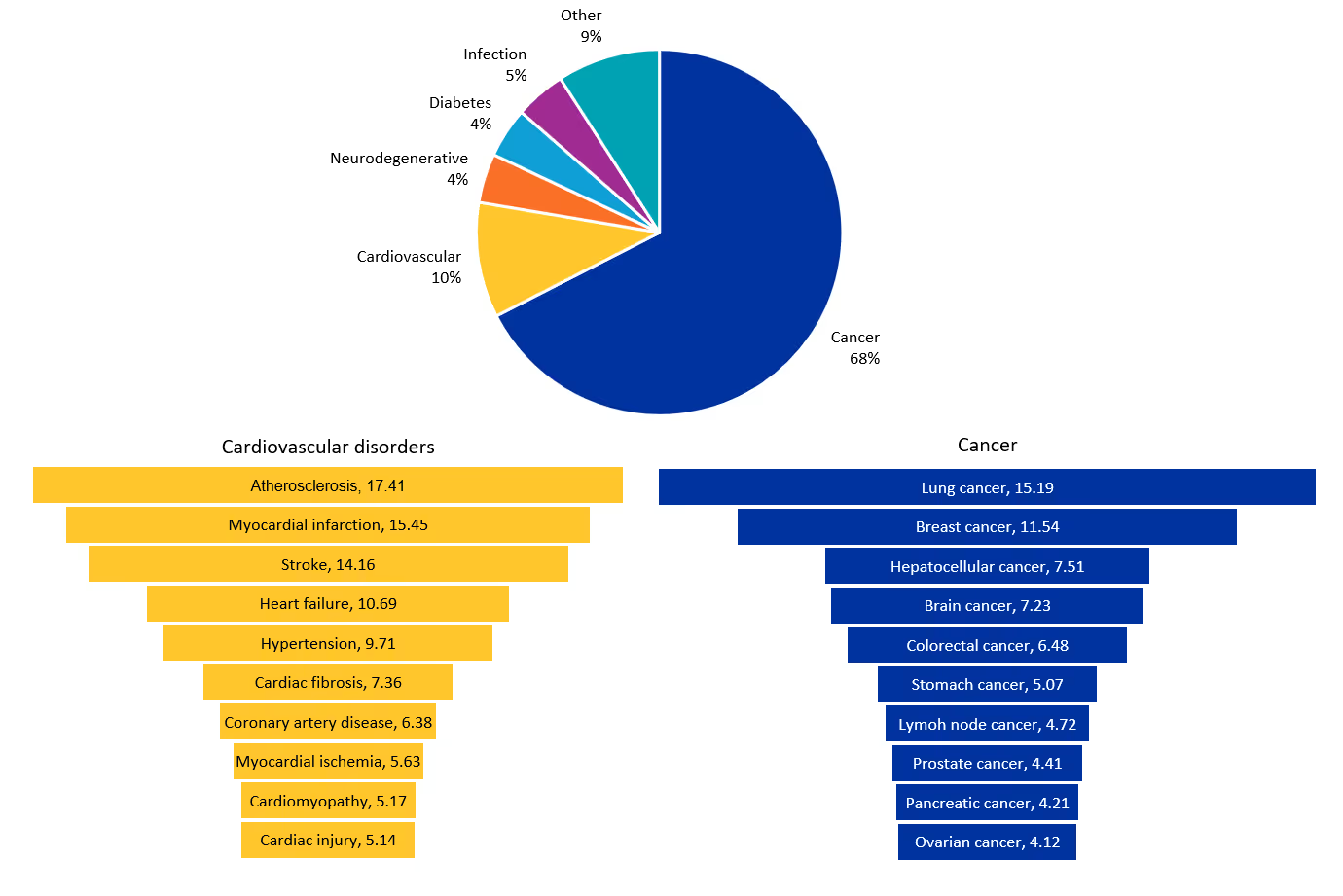
MicroRNA could address a variety of diseases due to its range of functions in gene expression. According to our analysis of the CAS Content Collection, cancer is the most prominent therapeutic area researched (67.5%), followed by cardiovascular disorders (10.2%), infections (4.5%), diabetes (4.4%), and neurodegenerative disorders (4.3%) (see Figure 4).
Cancer
Oncogenic miRNAs (oncomiRs) influence cancer development substantially by participating in many signaling pathways, including the suppression of tumor-suppressor genes and the activation of oncogenes. The miR-34 family (miR-34a, miR-34b, miR-34c), which are under the control of TP53 tumor suppressor gene regulation, downregulate several genes, like Cyclin D1, E2, CDK4, CDK6, BCl2, and Myc, leading to cell cycle arrest and apoptosis and restricting tumor growth. The MiR-17-92 cluster, commonly referred to as “oncomir-1,” targets and inhibits tumor suppressors like PTEN, p21, and E2F, leading to increased cell proliferation, survival, and angiogenesis. MiR-21 mainly targets PTEN, PDCD4, and TIMP3 and activates survival-supportive pathways like PI3K/Akt and MAPK, further promoting tumor growth, invasion, and metastasis. MicroRNAs also play a critical role in modulating drug resistance of cancer cells apart from regulating tumor suppressors and oncogenes.
Cardiovascular diseases
Recent profiling studies have identified many microRNAs that are differentially expressed in cardiovascular diseases (CVD) in a spatiotemporal manner, pointing to a new approach to regulating conditions like myocardial infarction, atherosclerosis, heart failure, stroke, and hypertension, among others. Examples include miRNA-29 in cardiac fibrosis, miRNA-21 and miR-155 in cardiomyopathy, and miRNA-34 in myocardial infarction. MiR-21 and miR-29 also play crucial roles in extracellular matrix deposition during pathological cardiac remodeling. Dicer, an enzyme required for the maturation of all microRNAs, shows aberrant expression during heart failure. Functional studies have demonstrated that cardiac-specific knock-out of Dicer leads to progressive cardiomyopathy, heart failure, and death in mice. The available data suggests collectively that Dicer/microRNAs play critical roles in normal cardiac functions as well as under pathological conditions and are being explored as therapeutic targets in CVD.
Infections
MicroRNAs are being explored in the host-pathogen interactions of more than 50 infections (bacterial, viral, fungal, and parasitic). There are multiple ways microRNAs can help combat infectious diseases. They regulate specific proteins involved in innate and adaptive immune pathways, helping to fine-tune the immune response to infections. They can be used to target pathogen genes and inhibit their replication. For example, treatments like RG-101 and miravirsen (inhibitors of miR-122) target host microRNAs to fight hepatitis C infection. MicroRNAs are also being investigated to create attenuated vaccines by incorporating microRNA response elements into viral vaccine genomes. Some pathogens, such as Ebola, produce their own microRNAs, which can be targeted to reduce their pathogenicity and improve treatment outcomes.
Diabetes
Emerging evidence suggests that microRNAs play a key role in beta-cell functions (survival, proliferation, differentiation, and insulin secretion) and in modulating insulin resistance or sensitivity. They can influence inflammatory responses, which are typically heightened in diabetic patients. By lowering inflammation, microRNAs can assist in managing complications associated with diabetes. Several pre-clinical trials and in-vitro studies aiming to find microRNA-based therapeutics for diabetes have shown promising results.
神经退行性疾病
微小RNA(microRNA)能够调节与神经退行性疾病相关的基因表达,减轻神经炎症,并保护神经元免受凋亡。例如,miR-124和miR-132有助于维持神经元的健康与功能;miR-29和miR-34家族则靶向与阿尔茨海默病中β-淀粉样蛋白生成相关的基因。此外,微小RNA还能促进对大脑修复至关重要的神经发生,其中miR-9和miR-124被公认在神经发生中发挥重要作用。微小RNA的失调可能导致神经功能恶化并引发神经退行性疾病。因此,调节这些微小RNA为治疗此类疾病提供了新的方向。
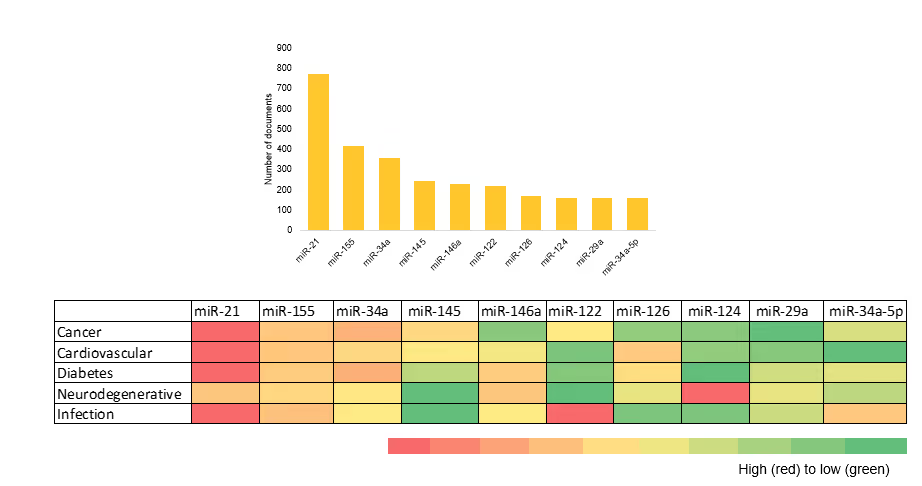
作为分析的一部分,我们绘制了文献数据集中出现频率最高的微小RNA,并将其在五大治疗领域的分布进行了可视化展示(见图5)。
我们还进行了共现分析,以确定文献中五大主要疾病与各类微小RNA疗法之间的关联程度(见图6)。
微小RNA疗法的前景
微小RNA疗法已取得令人振奋的新进展。然而,在这些疗法进入临床实践之前,仍需克服诸多持续存在的挑战。必须通过临床试验来验证不同微小RNA策略及递送方法的安全性和有效性。此外,不良免疫反应、非特异性组织蓄积以及内体降解也是开发微小RNA疗法时面临的重大难题。
近期研究表明,相关领域正不断取得突破,这些疗法的前景十分广阔。利用CRISPR/Cas技术靶向微小RNA基因,以及应用人工智能模型预测微小RNA靶点,为开发微小RNA疗法带来了令人振奋的机遇。
随着持续的创新,微小RNA疗法有望在不久的将来改变多种疾病的患者护理方式。