

마이크로RNA(miRNA/miR)는 20~22개의 뉴클레오타이드로 구성된 짧은 비암호화 RNA로, 표적 메신저 RNA(mRNA) 분자와 상호작용하여 유전자 조절에 중요한 역할을 합니다. 추정치에 따르면 마이크로RNA는 인간 게놈 내 단백질 암호화 유전자의 최대 60%를 번역 수준에서 조절할 수 있습니다. 이들은 분화, 증식, 세포 사멸, 발달과 같은 여러 생리적 과정에 관여하며, 이들의 조절 이상은 다양한 병리학적 질환과 관련이 있습니다.
마이크로RNA의 중요성은 2024년 노벨 생리의학상을 통해 강조되었습니다. 이 상은 "마이크로RNA의 발견과 전사 후 유전자 조절에서의 역할"을 규명한 빅터 앰브로스와 게리 러브컨에게 수여되었습니다. 이 과학자들은 1993년에 마이크로RNA 발견을 처음 발표했으며, 2000년에는 러브컨 연구팀이 let-7을 확인했습니다. let-7은 let-7 유전자에 의해 암호화되는 마이크로RNA로, 다양한 동물 종에서 고도로 보존되어 있습니다. 그 이후로 마이크로RNA 치료제 개발에 대한 관심이 크게 높아졌습니다.
이러한 핵산의 독성 및 효과적인 전달 문제는 여전히 과제로 남아 있습니다. 임상 시험에 진입한 마이크로RNA 치료제는 20개 미만이며, 3상 단계에 도달한 것은 없습니다. 시작된 마이크로RNA 치료제 임상 시험 중 약 절반은 마이크로RNA 독성 및 기타 심각한 부작용으로 인해 중단되거나 종료되었습니다.
그러나 새로운 연구를 통해 진전이 이루어지고 있습니다. 나노 규모 약물 전달 시스템의 발전으로 효능 및 독성 문제가 해결되고 있으며, 전달 방식이 지속적으로 개선됨에 따라 마이크로RNA 치료제가 더욱 널리 활용될 수 있을 것입니다.
마이크로RNA의 생합성 및 작용 기전
마이크로RNA는 독립적인 전사 단위로 존재하거나 다른 유전자의 인트론 또는 엑손 내에 포함되어 있을 수 있습니다. 마이크로RNA 생합성에는 표준 경로와 비표준 경로의 두 가지 경로가 있습니다(그림 1 참조).

표준 경로에서 마이크로RNA는 RNA 중합효소 II(때로는 RNA 중합효소 III)에 의해 긴 일차 마이크로RNA 전사체(pri-miRNA)로 마이크로RNA 유전자에서 전사됩니다. Pri-miRNA는 수 킬로베이스 길이일 수 있으며, 5' 및 3' 측면 서열을 가지고 있고 여러 성숙한 마이크로RNA의 줄기-고리 구조를 포함할 수 있습니다. Pri-miRNA는 핵 단백질 DGCR8(디조지 증후군 핵심 영역 8)과 효소 DROSHA에 의해 처리되어 pre-miRNA 전사체라고 불리는 머리핀 모양의 구조로 변환됩니다.
비표준 경로에서는 mRNA 인트론 내에 위치한 마이크로RNA 전구체가 스플라이싱을 통해 제거되며, DGCR8/DROSHA 단계를 거치지 않습니다. Pre-miRNA는 이후 엑스포틴-5의 도움을 받아 세포질로 배출됩니다. 세포질에 도달하면 RNase 효소인 DICER가 pre-miRNA 머리핀 고리에 작용하여 이를 절단하고 성숙한 마이크로RNA 이중 가닥을 생성합니다. 마이크로RNA 이중 가닥 중 한 가닥(가이드 가닥)은 RNA 유도 침묵 복합체(RISC) 내의 아르고노트(AGO) 단백질과 결합하고, 다른 한 가닥(승객 가닥)은 분해됩니다. 일반적으로 열역학적 안정성과 같은 요인에 따라 어떤 가닥이 RISC에 포함될지가 결정됩니다. 마지막으로, 표적 mRNA는 분해되거나 번역 억제를 겪게 됩니다.
개선된 전달 방식이 가져오는 돌파구
마이크로RNA 치료제를 표적 세포에 효과적으로 전달하는 것은 불안정성과 분해되기 쉬운 특성 때문에 복잡한 과제입니다. 현재 방법론에는 바이러스 시스템(아데노 부속 바이러스, 아데노바이러스, 렌티바이러스 벡터)과 비바이러스 시스템(지질 기반 나노입자, 고분자 나노입자, 무기 나노입자, 세포외 소포체, 펩타이드)이 포함됩니다.
바이러스 매개 마이크로RNA 전달은 효과적인 것으로 입증되었으나, 이 방법은 높은 면역원성을 보입니다. 반면 비바이러스 벡터는 상대적인 안정성과 낮은 면역원성을 나타냅니다. 결과적으로 연구자들은 마이크로RNA를 세포에 효과적으로 전달하기 위해 다양한 유형의 비바이러스 나노 운반체를 탐구하고 있습니다.
지질 기반 나노입자(LNP)는 마이크로RNA를 보호하고 생체 적합성이 뛰어나 가장 흔히 사용되는 운반체입니다. 최근 LNP는 마이크로RNA를 더욱 효율적으로 전달하기 위해 이온화 가능한 양이온성 지질로부터 개발되었습니다. 또한 LNP는 안정성을 높이고 독성을 줄이기 위해 콜레스테롤이나 디올레오일포스파티딜에탄올아민(DOPE)과 같은 "보조 지질"을 포함할 수 있습니다. 폴리에틸렌 글리콜(PEG)을 결합하면 나노입자의 응집을 줄이고 순환 시간을 늘리는 효과가 입증되었습니다.
Emerging breakthroughs are also occurring with polymer-based carriers, including poly (lactic-co-glycolic acid) (PLGA). Researchers developed a microRNA-210 inhibition strategy with antisense γ peptide nucleic acids (γPNAs) with improved RNA-binding efficacy and encapsulated them in PLGA nanoparticles. PLGA has received FDA approval as a delivery vehicle and is in phase II trials for small interfering RNA (siRNA) therapies.
Inorganic nanoparticles such as gold and silica also show potential as microRNA carriers, but ongoing toxicity concerns, particularly with gold, may limit their clinical usage.
Different strategies of using microRNAs as therapeutics
We examined the CAS Content CollectionTM, the largest human-curated repository of scientific information, to better understand the research landscape of microRNA.There was a notable increase in publications relating to microRNA in the last few years, although journal publications are now decreasing slightly. However, patent publications continue to increase, suggesting sustained commercial interest in this area (see Figure 2).

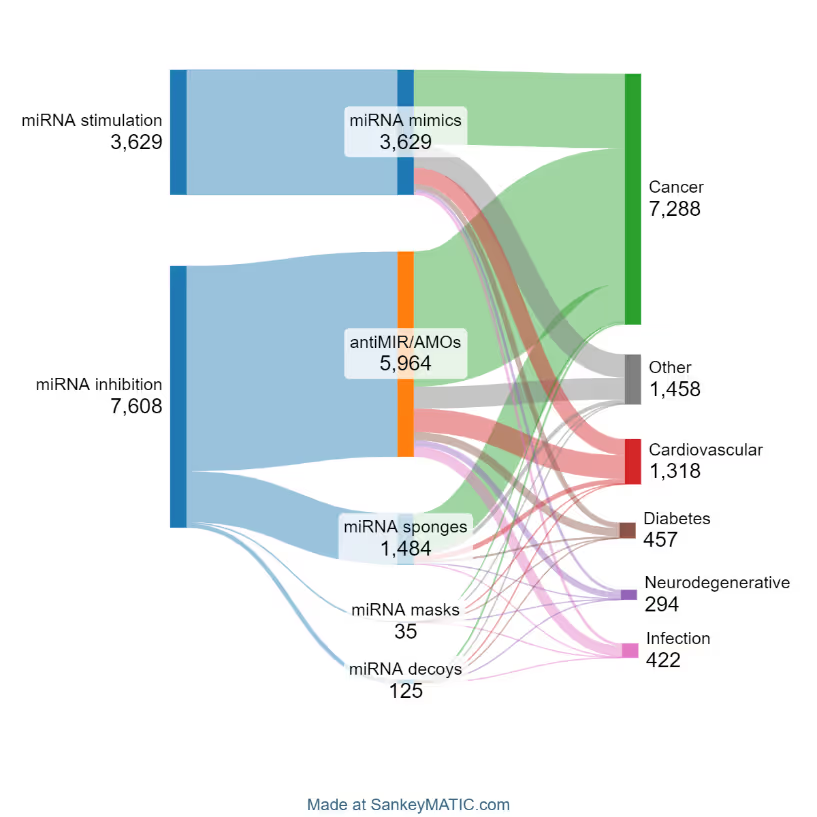
The goal of microRNA therapeutics is to alter and ideally restore abnormal or pathological microRNA expression patterns. There are currently two approaches to achieve this — microRNA stimulators or enhancers and microRNA inhibitors. The first group mainly includes microRNA mimics, while the second group comprises antiMIR oligonucleotides (AMOs), microRNA masks, sponges, and decoys. As seen in Figure 3, most publications pertain to microRNA inhibitors (67.7%).AMOs are the most common among these publications.

These various strategies work as follows:
- microRNA mimic: Synthetic double-stranded small RNA molecules that match the corresponding microRNA sequence, mimicking the action of naturally synthesized microRNA. The aim is to functionally replenish the lost or decreased microRNA expression in pathological conditions.
- antiMIRs/AMOs/antagomiRs: Synthetic single-stranded small RNA molecules based on first-generation antisense oligonucleotides, which may have chemical modifications (e.g., antiMIRs with a 2-O-methoxyethyl modification are also called antagomiRs). These functionally bind to microRNAs with complementary sequences and prevent their interaction with target mRNA, eventually increasing their expression.
- microRNA sponges: Artificial microRNA containing tandem repeats of oligonucleotide sequences with microRNA binding sites (MBSs) for a mature microRNA of interest. They sequester the target endogenous microRNAs, leaving the MBS on target mRNAs free, thus leading to their upregulation. CircmiRs are circular microRNA sponges with the same mechanism of action but are more stable.
- microRNA decoys: A variation of microRNA sponges characterized by stem and loop structures (loop contains MBSs).
- microRNA masks: Single-stranded oligonucleotides with 2ʹ-O-methoxyethyl modification (or other chemical modification). They are perfectly complementary to the MBSs in the 3’UTR of the target mRNA, hindering the microRNA-mRNA interaction and increasing mRNA expression levels.
Exploring the potential of microRNA as therapeutics
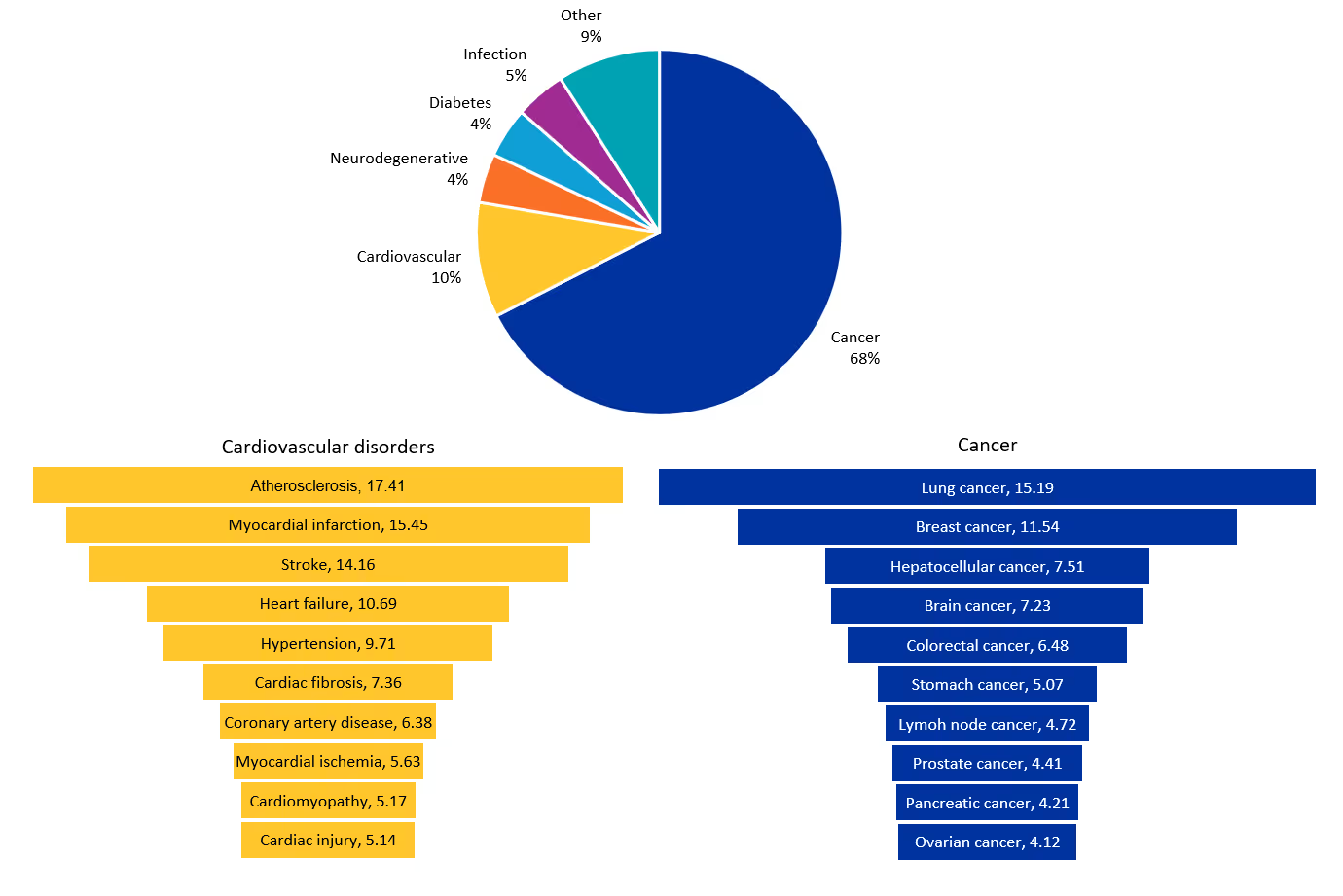
MicroRNA could address a variety of diseases due to its range of functions in gene expression. According to our analysis of the CAS Content Collection, cancer is the most prominent therapeutic area researched (67.5%), followed by cardiovascular disorders (10.2%), infections (4.5%), diabetes (4.4%), and neurodegenerative disorders (4.3%) (see Figure 4).
Cancer
Oncogenic miRNAs (oncomiRs) influence cancer development substantially by participating in many signaling pathways, including the suppression of tumor-suppressor genes and the activation of oncogenes. The miR-34 family (miR-34a, miR-34b, miR-34c), which are under the control of TP53 tumor suppressor gene regulation, downregulate several genes, like Cyclin D1, E2, CDK4, CDK6, BCl2, and Myc, leading to cell cycle arrest and apoptosis and restricting tumor growth. The MiR-17-92 cluster, commonly referred to as “oncomir-1,” targets and inhibits tumor suppressors like PTEN, p21, and E2F, leading to increased cell proliferation, survival, and angiogenesis. MiR-21 mainly targets PTEN, PDCD4, and TIMP3 and activates survival-supportive pathways like PI3K/Akt and MAPK, further promoting tumor growth, invasion, and metastasis. MicroRNAs also play a critical role in modulating drug resistance of cancer cells apart from regulating tumor suppressors and oncogenes.
Cardiovascular diseases
Recent profiling studies have identified many microRNAs that are differentially expressed in cardiovascular diseases (CVD) in a spatiotemporal manner, pointing to a new approach to regulating conditions like myocardial infarction, atherosclerosis, heart failure, stroke, and hypertension, among others. Examples include miRNA-29 in cardiac fibrosis, miRNA-21 and miR-155 in cardiomyopathy, and miRNA-34 in myocardial infarction. MiR-21 and miR-29 also play crucial roles in extracellular matrix deposition during pathological cardiac remodeling. Dicer, an enzyme required for the maturation of all microRNAs, shows aberrant expression during heart failure. Functional studies have demonstrated that cardiac-specific knock-out of Dicer leads to progressive cardiomyopathy, heart failure, and death in mice. The available data suggests collectively that Dicer/microRNAs play critical roles in normal cardiac functions as well as under pathological conditions and are being explored as therapeutic targets in CVD.
Infections
MicroRNAs are being explored in the host-pathogen interactions of more than 50 infections (bacterial, viral, fungal, and parasitic). There are multiple ways microRNAs can help combat infectious diseases. They regulate specific proteins involved in innate and adaptive immune pathways, helping to fine-tune the immune response to infections. They can be used to target pathogen genes and inhibit their replication. For example, treatments like RG-101 and miravirsen (inhibitors of miR-122) target host microRNAs to fight hepatitis C infection. MicroRNAs are also being investigated to create attenuated vaccines by incorporating microRNA response elements into viral vaccine genomes. Some pathogens, such as Ebola, produce their own microRNAs, which can be targeted to reduce their pathogenicity and improve treatment outcomes.
Diabetes
Emerging evidence suggests that microRNAs play a key role in beta-cell functions (survival, proliferation, differentiation, and insulin secretion) and in modulating insulin resistance or sensitivity. They can influence inflammatory responses, which are typically heightened in diabetic patients. By lowering inflammation, microRNAs can assist in managing complications associated with diabetes. Several pre-clinical trials and in-vitro studies aiming to find microRNA-based therapeutics for diabetes have shown promising results.
신경퇴행성 질환
마이크로RNA는 신경퇴행성 질환과 관련된 유전자 발현을 조절하고, 신경 염증을 감소시키며, 신경세포를 세포 사멸로부터 보호할 수 있습니다. 예를 들어, miR-124와 miR-132는 신경세포의 건강과 기능을 지원하며, miR-29 및 miR-34 계열은 알츠하이머병의 아밀로이드 베타 생성과 관련된 유전자를 표적으로 합니다. 또한 마이크로RNA는 뇌 회복에 필수적인 신경 발생을 촉진할 수 있는데, miR-9와 miR-124는 신경 발생에 중요한 역할을 하는 것으로 알려져 있습니다. 마이크로RNA 조절 장애는 신경학적 악화와 신경퇴행성 질환의 발병으로 이어질 수 있습니다. 따라서 이러한 마이크로RNA를 조절하는 것은 해당 질환 치료를 위한 새로운 방향을 제시합니다.
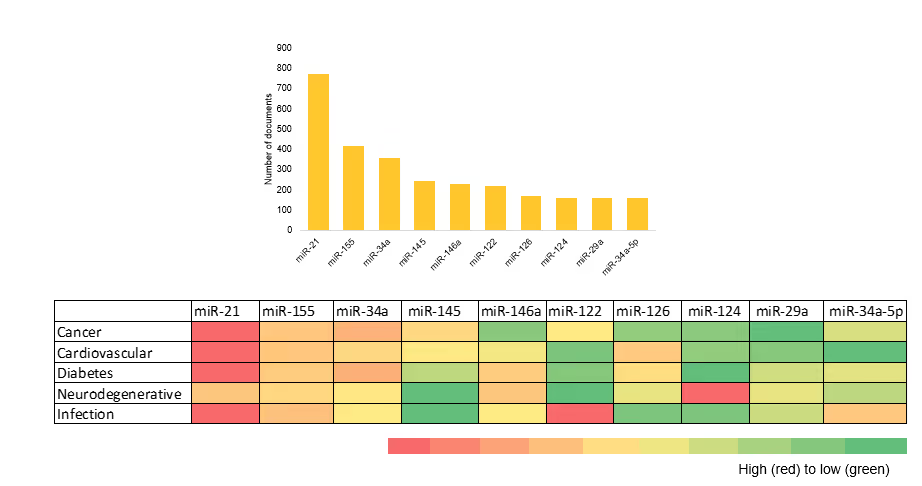
분석의 일환으로 문헌 데이터셋에서 가장 빈번하게 나타나는 마이크로RNA를 도표화하고 상위 5개 치료 영역에 걸친 분포를 시각화했습니다(그림 5 참조).
또한 문헌에서 가장 많이 다뤄지는 5가지 질환과 가장 밀접하게 연관된 마이크로RNA 치료법 유형을 파악하기 위해 동시 출현 분석을 수행했습니다(그림 6 참조).
마이크로RNA 치료제의 전망
마이크로RNA 치료법은 유망한 새로운 진전을 보이고 있습니다. 그러나 이러한 치료법이 임상 현장에서 사용되기까지는 여전히 해결해야 할 과제들이 남아 있습니다. 다양한 마이크로RNA 전략과 전달 방식의 안전성 및 효능을 확인하기 위한 임상 시험이 반드시 이루어져야 합니다. 원치 않는 면역 반응, 비특이적 조직 축적, 엔도좀 분해 등도 마이크로RNA 기반 치료제 개발에 있어 중요한 과제입니다.
최근 연구는 획기적인 성과가 나타나고 있음을 보여주며, 이러한 치료법의 미래는 밝습니다. 마이크로RNA 유전자를 표적으로 하는 CRISPR/Cas와 같은 첨단 기술 및 마이크로RNA 표적을 예측하는 인공지능 기반 모델은 마이크로RNA 치료제 개발에 흥미로운 기회를 제공합니다.
마이크로RNA 치료법은 지속적인 혁신을 통해 머지않아 수많은 질환에 대한 환자 치료 방식을 변화시킬 수 있을 것입니다.