
.avif)

Resumo executivo
- Semicondutores de banda larga e banda ultralarga podem alcançar um desempenho elétrico e térmico superior aos semicondutores de silício padrão, pois a separação de energia entre as bandas suporta aplicações de alta temperatura e alta potência.
- O carboneto de silício e o nitreto de gálio são os materiais mais pesquisados para esses semicondutores, sendo o carboneto de silício mais comum na literatura de patentes.
- Os principais dispositivos que utilizam semicondutores de banda larga e banda ultralarga são transistores, emissores de luz e circuitos integrados/dispositivos de memória, demonstrando a necessidade de semicondutores capazes de lidar com ambientes de alta intensidade.
- Optoeletrônica e eletrônica de potência são as principais aplicações para materiais de banda larga e banda ultralarga.
As aplicações de semicondutores abrangem uma gama extraordinária — desde carregadores móveis de miliwatts até sistemas industriais de gigawatts, e de sensores de alta precisão a dispositivos optoeletrônicos avançados. Por décadas, o silício (Si) tem sido a pedra angular da tecnologia de semicondutores, permitindo inúmeras inovações em todos os setores. No entanto, à medida que as demandas de desempenho aumentam em vários domínios de aplicação, as propriedades fundamentais do material do silício, como uma banda larga relativamente pequena e manuseio térmico limitado, tornaram-se um fator limitante em aplicações de alta tensão, alta temperatura e alta potência.
A solução reside nos semicondutores de banda larga (WBG) e banda ultralarga (UWBG). Esses materiais avançados possuem um intervalo de energia maior entre suas bandas de valência e condução em comparação com o silício, desbloqueando características de desempenho superiores. Isso impulsiona inúmeras vantagens de desempenho em ambientes exigentes e de alto estresse.
Pesquisadores de materiais podem usar o CAS SciFinder para pesquisar na literatura de ciência dos materiais, identificando relações estrutura-propriedade e métodos de síntese que apoiam a inovação.
O que são semicondutores de banda larga e banda ultralarga?
Materiais de banda larga e banda ultralarga alcançam desempenho superior porque suas bandas mais largas derivam de ligações mais fortes, curtas e mais iônicas ou covalentes, como C–C no diamante ou Al–N e Ga–N em semicondutores III-N. Isso localiza os elétrons e reduz a sobreposição orbital, criando uma grande separação de energia entre as bandas. Essas redes de ligação rígidas, que frequentemente envolvem átomos leves como C, N e B, produzem altas energias de fônon e excelente condutividade térmica, permitindo a operação em alta temperatura e alta potência.
Materiais WBG têm uma banda larga tipicamente na faixa de 2–4 eV, significativamente maior que a do silício (~1,2 eV). Os principais materiais incluem carboneto de silício (SiC, ~3,2 eV) e nitreto de gálio (GaN, ~3,4 eV), que são amplamente utilizados em dispositivos de potência e radiofrequência (RF) de alta tensão, alta temperatura e alta frequência. Materiais UWBG levam o desempenho ainda mais longe com bandas > 4 eV, oferecendo melhorias drásticas em relação ao silício e aos materiais WBG. Isso inclui materiais como óxido de gálio (β‑ Ga2O3, ~4,8 eV), nitreto de alumínio (AlN, ~6,2 eV) e nitreto de boro cúbico (c‑BN, ~6,4 eV). Os UWBGs também oferecem melhorias na resistência à ruptura, densidade de potência e capacidade em ambientes extremos.
Análises baseadas em dados podem nos ajudar a examinar os impulsionadores fundamentais por trás da transição para semicondutores WBG. Isso também nos permite explorar suas implicações transformadoras na eletrônica de potência e em aplicações optoeletrônicas e de sensores. Usando uma estratégia de pesquisa focada, construída a partir de números de registro CAS Registry Numbers® selecionados e termos controlados pelo CAS específicos para aplicações, identificamos mais de 77.000 artigos de periódicos e famílias de patentes da CAS Content Collection™ via CAS IP Finder, powered by STNTM.

Os dados mostram que os semicondutores WBG e UWBG são um espaço tecnológico em rápido avanço e comercialmente relevante, caracterizado por uma produção científica acelerada e fortes tendências de comercialização. As tendências de publicação de 2016-2025 mostram uma trajetória ascendente sustentada, com aceleração acentuada após 2019 e pico de atividade em 2025: sinais claros de que o campo está em transição da pesquisa exploratória para a maturidade tecnológica. O fato de as patentes superarem as publicações em periódicos ressalta essa mudança. A indústria não está mais apenas observando, mas protegendo a propriedade intelectual, escalando inovações e impulsionando dispositivos para a integração no mercado.
O carboneto de silício e o nitreto de gálio dominam o cenário de materiais
The relative contribution of journals and patents within each material category in Figure 2 (central chart), shows that journal publications are relatively balanced between WBG (57%) and UWBG (43%), whereas patent activity leans more toward WBG materials (64% WBG vs. 36% UWBG). This contrast indicates that while WBG materials are already translating into commercial technologies, UWBG materials remain largely research-driven, with broader commercialization expected to follow as technical maturity and industrial confidence increase.
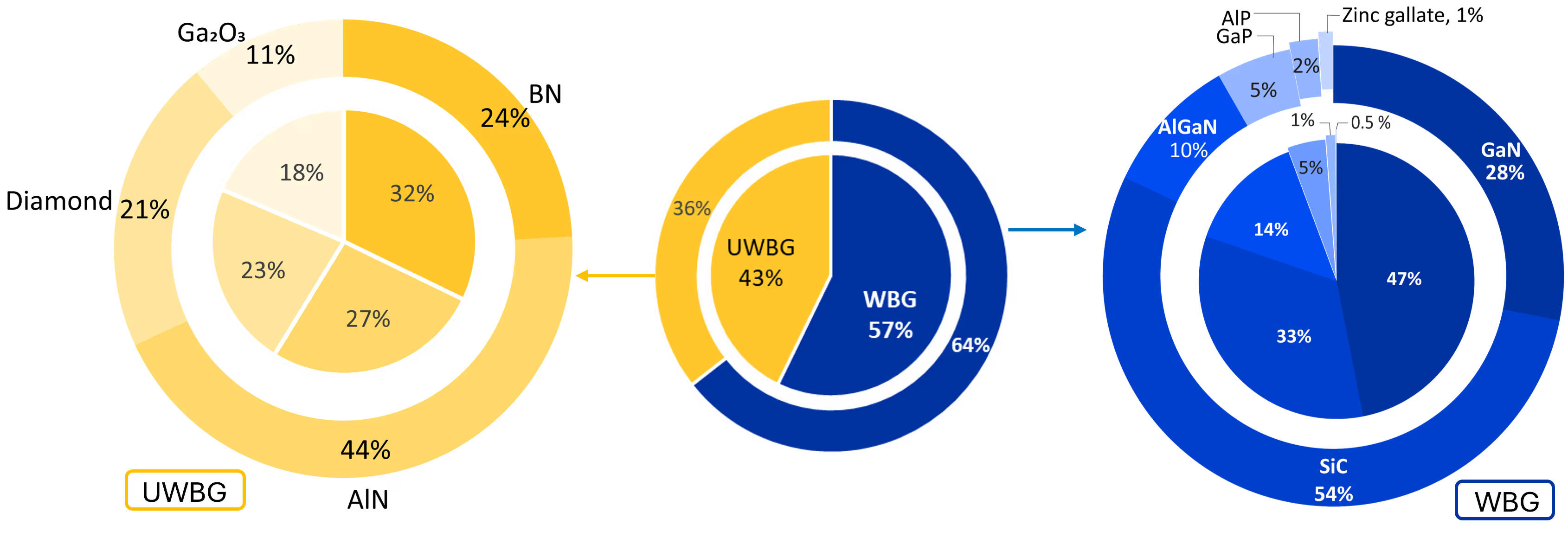
Within the WBG category (Figure 2 right), silicon carbide and gallium nitride dominate, but with notably different journal-patent dynamics. Silicon carbide exhibits a patent‑heavy profile, reflecting its industrial maturity and widespread commercialization in power electronics. Gallium nitride, by contrast, shows a more balanced journal‑to‑patent ratio, indicating active academic innovation alongside growing but less concentrated commercialization.
Additionally, AI and machine learning approaches are increasingly applied to mature WBG platforms such as silicon carbide and gallium nitride to support device modeling, defect analyses, and manufacturing yield optimization. In parallel, there’s a notable resurgence of interest in phosphide WBG materials, such as AlP and GaP, driven by revised hybrid-functional bandgap calculations that position them alongside traditional III–V semiconductors for future high-frequency and heterostructure applications.
On the UWBG side, the landscape is dominated by broad academic exploration, with significant journal activity in AlN, BN, diamond, and emerging materials like Ga2O3. Patent activity in UWBG materials is more focused, especially around AlN, which stands out as the most commercially promising candidate in this class. This is attributed to its thermal management properties bridging current market needs.
Collectively, these patterns reveal a technology pipeline in which silicon carbide and gallium nitride occupy the mature, deployment‑ready end of the spectrum, while UWBG materials remain research‑intensive but show early signs of industrial uptake, marking them as the next frontier for future extreme‑environment technologies.
Device landscape reveals the technology readiness level
To understand how these material trends translate into practical technology adoption, we used CAS-indexed concepts to map WBG and UWBG materials to specific device categories, from power electronics to radio frequency components.

The device distribution highlights how WBG and UWBG semiconductors concentrate around functions where their electrical, thermal, and optical advantages translate into performance gains (see Figure 3). Transistor technologies dominate because these materials enable voltage handling, switching speed, and heat tolerance far beyond what silicon can support. This is reflected in the strong activity across advanced transistor architectures, HEMTs, FinFETs, MISFETs, and HEFTs, which rely on high breakdown fields and fast carrier transport to deliver efficient high-power and high-frequency operations. Light-emitting devices form the next major cluster, in which wide bandgaps allow efficient photon generation across a broad spectrum, supporting LEDs, microLED displays, semiconductor lasers, and UV emitters used in communication, sensing, and sterilization.
Beyond these dominant device families, the spread into integrated circuits (ICs), memory elements, thermal-management components, energy-storage interfaces, and sensing layers shows how the stability, high-field tolerance, and chemical robustness of WBG/UWBG materials enable electronics to function reliably in high heat, voltage, and radiation conditions, as well as corrosive environments that push beyond silicon’s operating envelope.
Recent innovations describe amorphous silicon carbide combined with nano‑silicon and hydrocarbon phases to create compressive, mechanically resilient electrode frameworks that suppress volume expansion and improve cycling stability and rate performance. Silicon carbide and boron nitride also feature prominently in thermal‑management components, particularly for EV battery modules, where their high thermal conductivity, electrical insulation, and extreme temperature stability enable efficient heat spreading and robust structural performance.
Patents show their use in ceramic coatings, vapor-chamber interfaces, and heat-dissipating layers designed to maintain safe, compact battery-pack operation. In gas-sensing applications, WBG/UWBG oxides and nitrides, including AlN, Ga2O3, and GaN, provide chemically stable, high-bandgap barrier layers that support electron-tunneling detection and selective chemisorption. Developments include conformal UWBG coatings over porous sensing films to achieve drift-resistant, high-accuracy miniature gas sensors suitable for harsh environments.
Emerging device applications for wide bandgap semiconductors
While the device landscape describes how WBG and UWBG materials are distributed across device categories, examining devices through their average growth rates in recent years (2023-2025) offers a complementary view on research and patent activity.
The emerging device landscape reveals how WBG and UWBG materials are extending innovation into new regimes that were previously inaccessible (see Figure 4). One striking observation is the association of silicon carbide with femtosecond laser‑related device activity. Although silicon carbide is an indirect bandgap material and not suitable as a traditional laser medium, this link reflects rapid progress in femtosecond laser‑based color‑center engineering, where researchers can now write quantum defects inside silicon carbide with high spatial precision. This is an emerging capability known as quantum defect engineering that is unlocking new quantum photonics and sensing platforms.
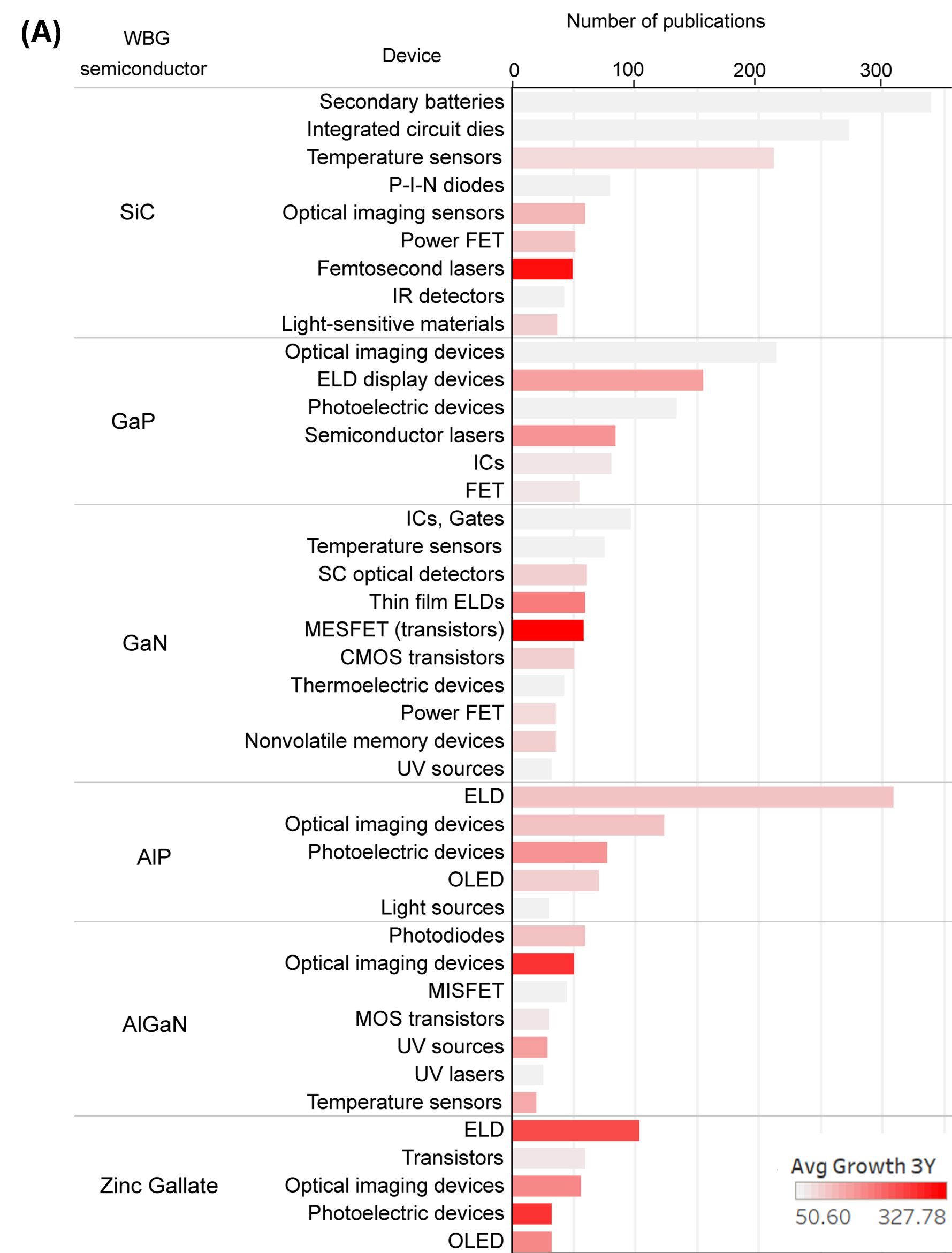
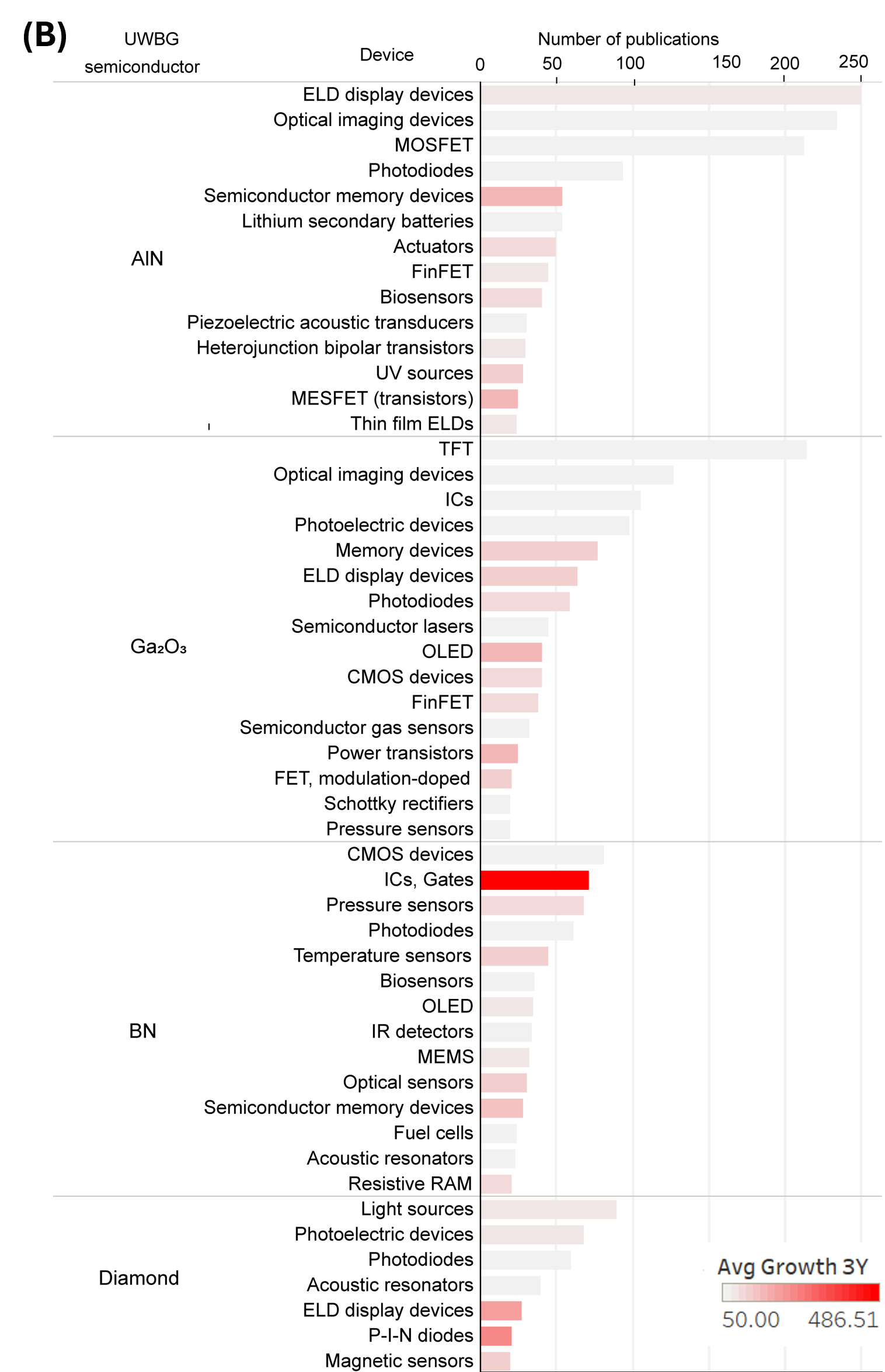
Another prominent observation is the growing appearance of boron nitride in IC‑ and gate‑related categories. Boron nitride is not an active semiconductor for logic applications. Instead, it is becoming a vital interface engineering and insulating/dielectric material in advanced transistor architectures. Its atomically flat surface, UBG, and chemically inert nature make boron nitride indispensable for 2D FETs, gate dielectrics, barrier layers, and nanoscale IC layouts, which explains its sharp rise in publications tied to ICs and gate structures.
Gallium nitride’s association with MESFETs aligns with its established role as an active semiconductor channel in these devices. Its wide bandgap ensures low leakage and high breakdown voltages, while high electron mobility and saturation velocity support efficient high‑frequency and high‑power operations. These properties make gallium nitride MESFETs well suited for fast switching and radio frequency (RF) applications.
More broadly, gallium nitride and Ga2O3 cluster around high‑power and high‑frequency device categories, reflecting intensifying demand for components capable of operating reliably under extreme thermal and electrical conditions. In contrast, GaP, AlN, and zinc gallate anchor rapidly expanding optoelectronic domains — from UV emission to advanced sensing and display technologies — while AlP appears as a small‑volume but strategically emerging material linked to next‑generation photodetectors, memory devices, and UV sources.
Overall, the landscape of emerging devices underscores how intrinsic material advantages are steering innovation across power electronics, photonics, and new nanoscale device platforms.
How devices translate to applications of wide bandgap semiconductors
We can get a sense of the major application categories for WBG and UWBG semiconductors through the device landscape. By examining overall publication volume and journal‑to‑patent ratios, however, we can identify which fields show stronger commercial pulls and which remain more research‑leaning within the broader innovation spectrum.

The application landscape shows optoelectronics and power electronics as the most publication‑dense domains, with near‑balanced journal-to-patent (J/P) ratios (≈1.0) reflecting strong academic research supported by active patenting across GaN/AlGaN‑based LEDs, UV emitters, laser architectures, SiC MOSFETs, and GaN HEMTs (see Figure 5A). Communication and sensing applications fall into a mid‑range J/P zone (≈0.7–0.8), indicating steady academic interest with more selective, early‑stage patenting as materials like GaN, AlN, and Ga2O3 enable stable, high‑accuracy RF and gas‑sensing platforms under harsh conditions.
Energy‑storage and conversion systems show the lowest J/P ratios (≈0.18), pointing to a patent‑driven profile where innovations such as silicon carbide‑reinforced anodes, boron nitride and Ga2O3 interfacial engineering, and diamond‑based electrode architectures are advanced through targeted industrial development despite lower overall publication volumes.
Optoelectronics
WBG/UWBG materials now anchor the optoelectronics stack from deep‑UV to near‑IR, with gallium nitride and silicon carbide leading publication volumes and AlN, BN, diamond, and Ga2O3 expanding capability into the UV‑C and harsh‑environment regimes (see Figure 5B). Gallium nitride and AlGaN underpin high‑efficiency LEDs, micro‑LEDs, lasers, and visible‑light communication (VLC), while silicon carbide provides thermally robust substrates and co‑integration pathways for high‑power emitters and RF front‑ends.
On the ultra-wide-bandgap frontier, AlN and boron nitride (including h-BN) enable solar-blind photodetectors and deep-UV emitters. Diamond contributes extreme thermal conductivity and quantum-photonics functionality, and Ga2O3 pushes power handling and UV detection via its high breakdown field. Around these materials, the patent corpus reveals accelerating progress in epitaxy, polarity control, nanostructuring, surface passivation, and singulation. This kind of process innovation turns lab-scale breakthroughs into scalable devices.
The device space reflects this: micro-LEDs and quantum-dot color conversion for advanced displays; III-N lasers and VCSEL-class architectures for compact, efficient light sources; and emerging superconducting-semiconducting hybrids for single-photon detection, where WBGs such as silicon carbide are used as substrate to withstand high critical temperature.
This trajectory is tightly coupled to industries where leading companies convert WBG/UWBG science into manufacturing-ready platforms. Device makers such as Samsung, Sony, AMS OSRAM, TCL Technology, and Mitsubishi Electric dominate patents in LEDs, micro-LED displays, lasers, and imaging systems. This aligns with the GaN/AlGaN publication dominance and pushes toward finer pixels, higher brightness, and better color conversion. Disco and Applied Materials contribute the enabling infrastructure, such as laser dicing, wafer thinning, bonding, surface treatment, and die-level handling, needed to process brittle, thermally demanding WBG/UWBG wafers at volume.
Foundries and integrators (e.g., TSMC, Intel) extend the stack with silicon photonics, III‑N RF integration, and back‑end packaging flows, while specialized silicon carbide and gallium nitride materials providers stabilize the substrate and epitaxy supply chain. This creates a self‑reinforcing cycle: advances in materials unlock new device concepts, which in turn drive patents in manufacturability and yield‑critical steps, thereby propelling the industry toward increasingly mature, scalable WBG/UWBG technology platforms.
Power electronics
The patent landscape reveals a power electronics ecosystem undergoing rapid maturation, driven predominantly by silicon carbide and gallium nitride (see Figure 5B). Silicon carbide stands out as the central pillar, with numerous patents on silicon carbide semiconductor devices, epitaxial wafer technologies, and high‑voltage modules designed for electric vehicles, industrial drives, and railway power systems. Its high thermal conductivity, wide bandgap, and breakdown strength make silicon carbide the material of choice for traction inverters, onboard chargers, and high‑efficiency power conversion circuits.
Gallium nitride, meanwhile, is increasingly integrated for high‑frequency and high‑power switching, with patents describing advanced HEMTs and gallium nitride layers grown over silicon carbide substrates to unlock higher power densities. Together, silicon carbide and gallium nitride form the technological backbone of modern power conversion, each reinforcing the other’s performance envelope.
Across applications, transportation and industrial power conversion dominate, with nearly one-third of patents tied to EV traction systems, mobility control, and heavy-duty automation. Power-conversion and management filings are even more prominent, emphasizing thermal-resistance reduction, advanced AlN packaging, and reliability-driven module design. A consistent theme is that WBG materials alone are insufficient. Packaging, thermomechanical design, and system-level integration must advance in parallel. Many patents focus on supporting infrastructure, including epitaxy control, defect management, wafer thinning, bonding, and specialized RF or sensing modules.
Sensing
In sensing applications, WBG/UWBG oxides and nitrides provide chemically stable, high-bandgap barrier layers supporting electron-tunneling detection and selective chemisorption. Patents focused on advanced doping and lattice engineering demonstrate efforts to create reliably doped gallium nitride AlN, and Ga2O3 materials with controlled p‑ and n‑type regions, improving sensitivity and robustness for high‑temperature pressure, gas, and chemical sensors. These materials’ high breakdown fields and wide bandgaps support deep‑UV photodetectors, RF/microwave sensing, and extreme‑environment sensor electronics, aligning with broader technology development goals highlighted in programs such as DARPA’s UWBG initiative targeting advanced sensor‑grade AlN, c‑BN, and diamond.
Communication
Materials such as gallium nitride, AlN, and SiC now anchor advanced RF communication technologies for 5G, 6G, Wi‑Fi 6E, and emerging sub‑THz systems. Patents heavily focus on high‑efficiency RF power amplifiers and front‑end modules, with gallium nitride favored for its high electron mobility, breakdown strength, and excellent high‑frequency performance. Key innovations include gallium nitride HEMTs, co‑integrated power amplifiers with on‑chip voltage regulation, and multiband front‑end circuits tailored for massive multiple input multiple output (MIMO), millimeter-wave (mmWave) access points, and satellite terminals. AlN‑based Film bulk acoustic resonator (FBAR) and Surface acoustic wave (SAW) resonators remain essential for 5G mid‑band and Wi‑Fi coexistence, leveraging high acoustic velocity and high‑Q materials for low loss and stable filtering at increasingly high frequencies.
Armazenamento de energia
As aplicações de armazenamento de energia apresentam as menores razões entre artigos científicos e patentes (~0,18), indicando um desenvolvimento impulsionado por patentes, onde ânodos reforçados com carboneto de silício, engenharia interfacial com nitreto de boro e arquiteturas de eletrodos à base de diamante avançam por meio de desenvolvimento industrial direcionado. Patentes recentes descrevem carboneto de silício amorfo combinado com nanossilício para criar estruturas de eletrodos mecanicamente resilientes que suprimem a expansão volumétrica e melhoram a estabilidade do ciclo. O carboneto de silício e o nitreto de boro são componentes importantes em sistemas de gerenciamento térmico para módulos de baterias de veículos elétricos, onde sua alta condutividade térmica e estabilidade em temperaturas extremas permitem uma dissipação de calor eficiente.
O futuro da tecnologia de semicondutores de banda larga
A trajetória dos semicondutores WBG e UWBG aponta para uma década de crescimento contínuo em capacidades e comercialização. O carboneto de silício deve permanecer como a base da conversão de alta potência, à medida que o transporte eletrificado, os sistemas de energia renovável e a automação industrial exigem maior tolerância à tensão, robustez térmica e confiabilidade a longo prazo. Enquanto isso, o nitreto de gálio está expandindo sua presença em eletrônica de potência para carregamento rápido, front-ends de RF, sistemas de ondas milimétricas e comunicações sub-terahertz emergentes.
Materiais UWBG como AlN, Ga2O3, BN e diamante devem abrir a próxima fronteira: fotônica UV profunda, sensores para ambientes extremos, comutação de ultra-alta tensão e interfaces avançadas de dielétricos e dispositivos quânticos, especialmente à medida que os desafios de dopagem, epitaxia e engenharia de defeitos continuam sendo superados.
Em todas as classes de materiais, os fatores decisivos que moldarão a adoção futura serão o gerenciamento térmico, a integração heterogênea e a fabricação escalável. Como o desempenho depende cada vez mais do encapsulamento, da engenharia de interface e do design em nível de módulo, a vantagem competitiva mudará para as empresas que conseguirem unir a inovação de materiais a uma fabricação confiável e de alto volume.
As perspectivas indicam que os semicondutores WBG e UWBG sustentarão a próxima geração de tecnologias de energia, comunicação, mobilidade e sensoriamento, servindo como os blocos fundamentais de um mundo mais eletrificado, conectado e de alta frequência.