.avif)

Resumen ejecutivo
- Los semiconductores de banda ancha y banda ultraancha pueden lograr un rendimiento eléctrico y térmico superior al de los semiconductores de silicio convencionales, ya que la separación energética entre bandas permite aplicaciones de alta temperatura y alta potencia.
- El carburo de silicio y el nitruro de galio son los materiales más investigados para estos semiconductores, siendo el carburo de silicio el más común en la literatura de patentes.
- Los principales dispositivos que utilizan semiconductores de banda ancha y banda ultraancha son los transistores, los emisores de luz y los circuitos integrados/dispositivos de memoria, lo que demuestra la necesidad de semiconductores capaces de operar en entornos de alta intensidad.
- La optoelectrónica y la electrónica de potencia son las principales aplicaciones de los materiales de banda ancha y banda ultraancha.
Las aplicaciones de los semiconductores abarcan un rango extraordinario, desde cargadores móviles de milivatios hasta sistemas industriales de gigavatios, y desde sensores de alta precisión hasta dispositivos optoelectrónicos avanzados. Durante décadas, el silicio (Si) ha sido la piedra angular de la tecnología de semiconductores, permitiendo innumerables innovaciones en todos los sectores. Sin embargo, a medida que las exigencias de rendimiento aumentan en múltiples ámbitos de aplicación, las propiedades fundamentales del material del silicio, como su banda prohibida relativamente pequeña y su limitada gestión térmica, se han convertido en un factor limitante en aplicaciones de alta tensión, alta temperatura y alta potencia.
La solución reside en los semiconductores de banda ancha (WBG) y banda ultraancha (UWBG). Estos materiales avanzados poseen una brecha energética mayor entre sus bandas de valencia y conducción en comparación con el silicio, lo que permite obtener características de rendimiento superiores. Esto impulsa numerosas ventajas de rendimiento en entornos exigentes y de alta tensión.
Los investigadores de materiales pueden utilizar CAS SciFinder para realizar búsquedas en la literatura de ciencia de materiales, identificando relaciones estructura-propiedad y métodos de síntesis que fomenten la innovación.
¿Qué son los semiconductores de banda ancha y banda ultraancha?
Los materiales de banda ancha y banda ultraancha logran un rendimiento superior porque sus bandas prohibidas más amplias se derivan de enlaces más fuertes, cortos y con mayor carácter iónico o covalente, como el C–C en el diamante o el Al–N y Ga–N en los semiconductores III-N. Esto localiza los electrones y reduce el solapamiento orbital, creando una gran separación energética entre bandas. Estas redes de enlaces rígidos, que a menudo involucran átomos ligeros como C, N y B, producen altas energías de fonones y una excelente conductividad térmica, lo que permite un funcionamiento a alta temperatura y alta potencia.
Los materiales WBG tienen una banda prohibida que suele oscilar entre 2 y 4 eV, significativamente mayor que la del silicio (~1,2 eV). Entre los materiales clave se incluyen el carburo de silicio (SiC, ~3,2 eV) y el nitruro de galio (GaN, ~3,4 eV), ampliamente utilizados en dispositivos de potencia y radiofrecuencia (RF) de alta tensión, alta temperatura y alta frecuencia. Los materiales UWBG llevan el rendimiento aún más lejos con bandas prohibidas superiores a 4 eV, ofreciendo mejoras drásticas respecto al silicio y a los materiales WBG. Esto incluye materiales como el óxido de galio (β‑ Ga2O3, ~4,8 eV), el nitruro de aluminio (AlN, ~6,2 eV) y el nitruro de boro cúbico (c‑BN, ~6,4 eV). Los UWBG también ofrecen mejoras en la resistencia a la ruptura, la densidad de potencia y la capacidad en entornos extremos.
Los análisis basados en datos pueden ayudarnos a examinar los impulsores fundamentales detrás de la transición a los semiconductores WBG. También nos permiten explorar sus implicaciones transformadoras en la electrónica de potencia y en las aplicaciones optoelectrónicas y de detección. Utilizando una estrategia de búsqueda enfocada, construida a partir de números de registro CAS Registry Numbers® seleccionados y términos controlados por CAS específicos para cada aplicación, identificamos más de 77.000 artículos de revistas y familias de patentes de la CAS Content Collection™ a través de CAS IP Finder, con tecnología de STNTM.

Los datos muestran que los semiconductores WBG y UWBG son un espacio tecnológico de rápido avance y relevancia comercial, caracterizado por una producción científica acelerada y fuertes tendencias de comercialización. Las tendencias de publicación de 2016 a 2025 muestran una trayectoria ascendente sostenida, con una marcada aceleración después de 2019 y un pico de actividad en 2025: señales claras de que el campo está pasando de la investigación exploratoria a la madurez tecnológica. El hecho de que las patentes superen a las publicaciones en revistas subraya este cambio. El sector ya no se limita a observar, sino que protege la propiedad intelectual, escala las innovaciones e impulsa los dispositivos hacia la integración en el mercado.
El carburo de silicio y el nitruro de galio dominan el panorama de materiales
The relative contribution of journals and patents within each material category in Figure 2 (central chart), shows that journal publications are relatively balanced between WBG (57%) and UWBG (43%), whereas patent activity leans more toward WBG materials (64% WBG vs. 36% UWBG). This contrast indicates that while WBG materials are already translating into commercial technologies, UWBG materials remain largely research-driven, with broader commercialization expected to follow as technical maturity and industrial confidence increase.
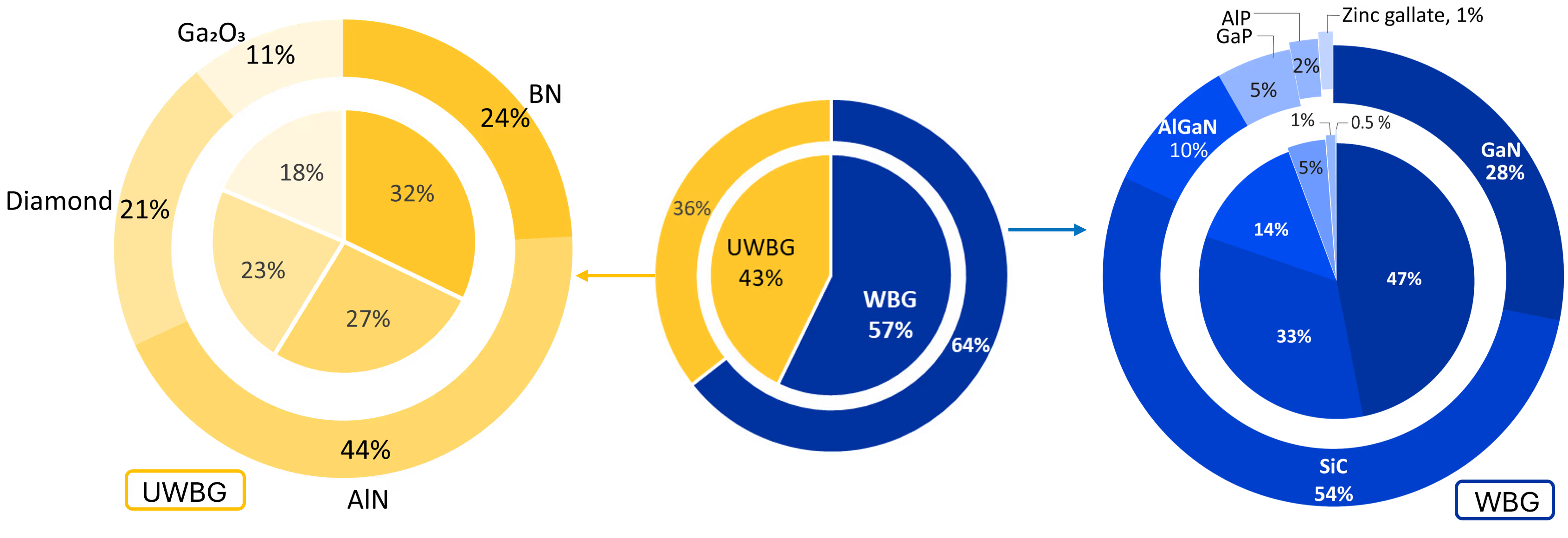
Within the WBG category (Figure 2 right), silicon carbide and gallium nitride dominate, but with notably different journal-patent dynamics. Silicon carbide exhibits a patent‑heavy profile, reflecting its industrial maturity and widespread commercialization in power electronics. Gallium nitride, by contrast, shows a more balanced journal‑to‑patent ratio, indicating active academic innovation alongside growing but less concentrated commercialization.
Additionally, AI and machine learning approaches are increasingly applied to mature WBG platforms such as silicon carbide and gallium nitride to support device modeling, defect analyses, and manufacturing yield optimization. In parallel, there’s a notable resurgence of interest in phosphide WBG materials, such as AlP and GaP, driven by revised hybrid-functional bandgap calculations that position them alongside traditional III–V semiconductors for future high-frequency and heterostructure applications.
On the UWBG side, the landscape is dominated by broad academic exploration, with significant journal activity in AlN, BN, diamond, and emerging materials like Ga2O3. Patent activity in UWBG materials is more focused, especially around AlN, which stands out as the most commercially promising candidate in this class. This is attributed to its thermal management properties bridging current market needs.
Collectively, these patterns reveal a technology pipeline in which silicon carbide and gallium nitride occupy the mature, deployment‑ready end of the spectrum, while UWBG materials remain research‑intensive but show early signs of industrial uptake, marking them as the next frontier for future extreme‑environment technologies.
Device landscape reveals the technology readiness level
To understand how these material trends translate into practical technology adoption, we used CAS-indexed concepts to map WBG and UWBG materials to specific device categories, from power electronics to radio frequency components.

The device distribution highlights how WBG and UWBG semiconductors concentrate around functions where their electrical, thermal, and optical advantages translate into performance gains (see Figure 3). Transistor technologies dominate because these materials enable voltage handling, switching speed, and heat tolerance far beyond what silicon can support. This is reflected in the strong activity across advanced transistor architectures, HEMTs, FinFETs, MISFETs, and HEFTs, which rely on high breakdown fields and fast carrier transport to deliver efficient high-power and high-frequency operations. Light-emitting devices form the next major cluster, in which wide bandgaps allow efficient photon generation across a broad spectrum, supporting LEDs, microLED displays, semiconductor lasers, and UV emitters used in communication, sensing, and sterilization.
Beyond these dominant device families, the spread into integrated circuits (ICs), memory elements, thermal-management components, energy-storage interfaces, and sensing layers shows how the stability, high-field tolerance, and chemical robustness of WBG/UWBG materials enable electronics to function reliably in high heat, voltage, and radiation conditions, as well as corrosive environments that push beyond silicon’s operating envelope.
Recent innovations describe amorphous silicon carbide combined with nano‑silicon and hydrocarbon phases to create compressive, mechanically resilient electrode frameworks that suppress volume expansion and improve cycling stability and rate performance. Silicon carbide and boron nitride also feature prominently in thermal‑management components, particularly for EV battery modules, where their high thermal conductivity, electrical insulation, and extreme temperature stability enable efficient heat spreading and robust structural performance.
Patents show their use in ceramic coatings, vapor-chamber interfaces, and heat-dissipating layers designed to maintain safe, compact battery-pack operation. In gas-sensing applications, WBG/UWBG oxides and nitrides, including AlN, Ga2O3, and GaN, provide chemically stable, high-bandgap barrier layers that support electron-tunneling detection and selective chemisorption. Developments include conformal UWBG coatings over porous sensing films to achieve drift-resistant, high-accuracy miniature gas sensors suitable for harsh environments.
Emerging device applications for wide bandgap semiconductors
While the device landscape describes how WBG and UWBG materials are distributed across device categories, examining devices through their average growth rates in recent years (2023-2025) offers a complementary view on research and patent activity.
The emerging device landscape reveals how WBG and UWBG materials are extending innovation into new regimes that were previously inaccessible (see Figure 4). One striking observation is the association of silicon carbide with femtosecond laser‑related device activity. Although silicon carbide is an indirect bandgap material and not suitable as a traditional laser medium, this link reflects rapid progress in femtosecond laser‑based color‑center engineering, where researchers can now write quantum defects inside silicon carbide with high spatial precision. This is an emerging capability known as quantum defect engineering that is unlocking new quantum photonics and sensing platforms.
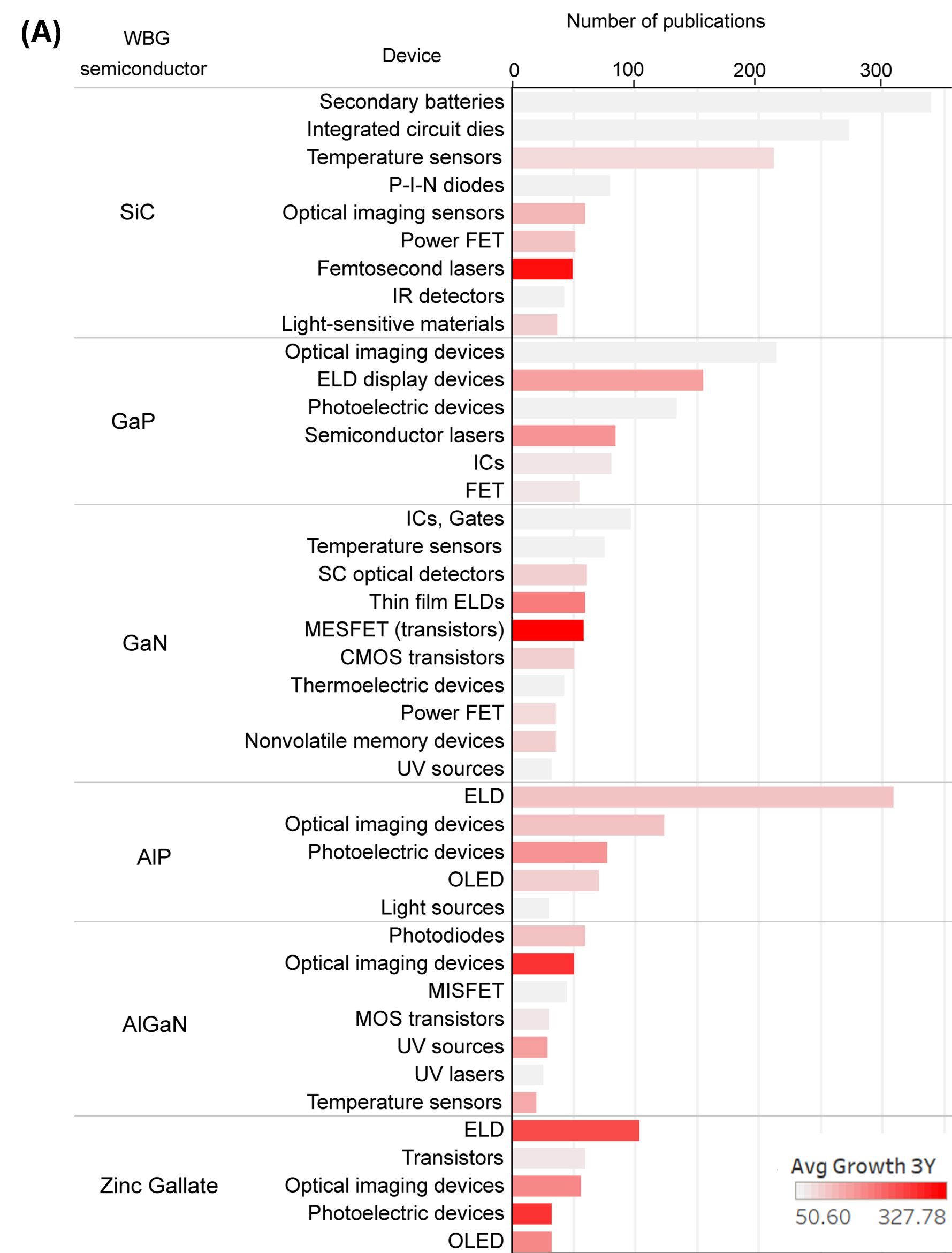
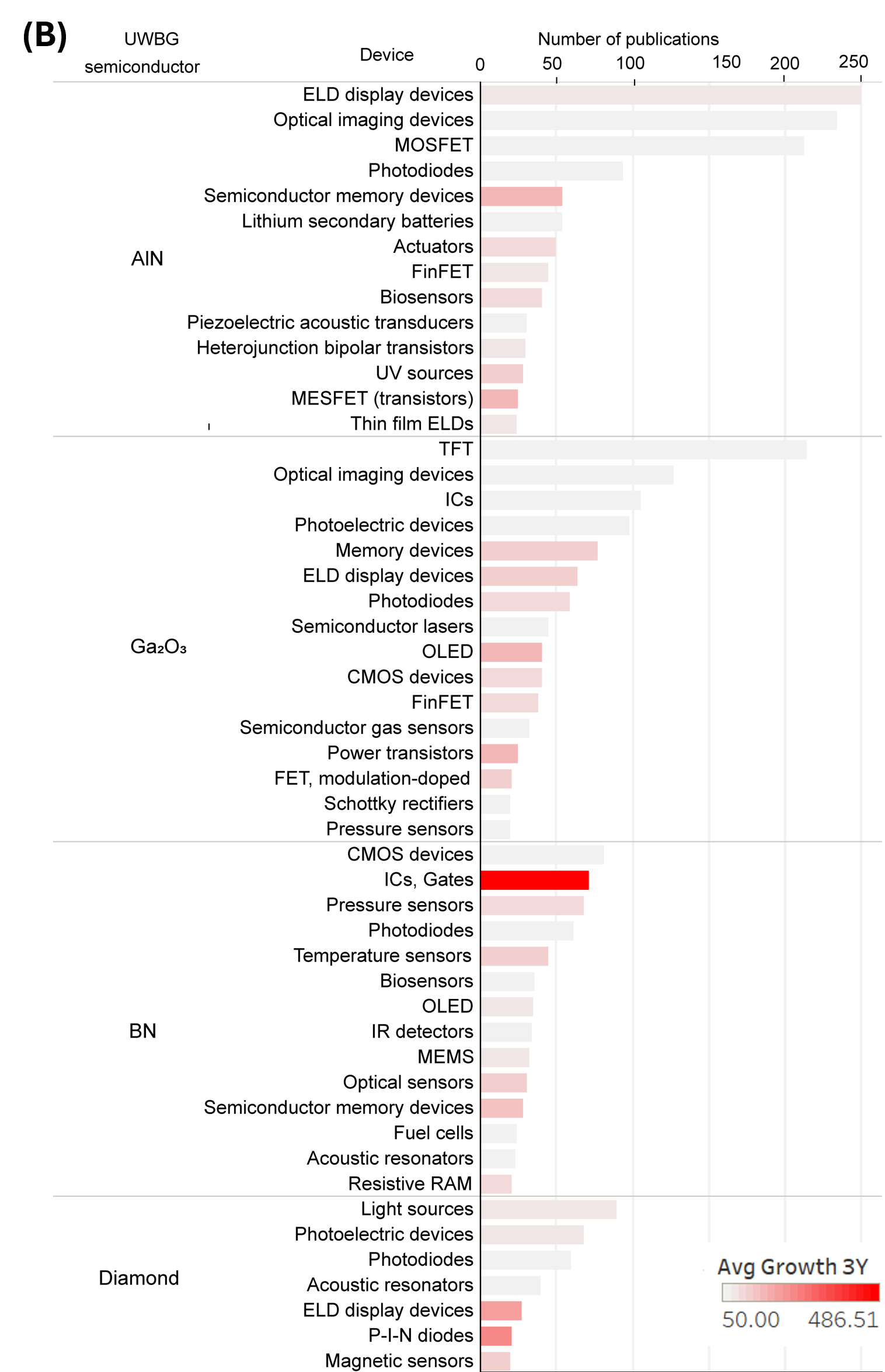
Another prominent observation is the growing appearance of boron nitride in IC‑ and gate‑related categories. Boron nitride is not an active semiconductor for logic applications. Instead, it is becoming a vital interface engineering and insulating/dielectric material in advanced transistor architectures. Its atomically flat surface, UBG, and chemically inert nature make boron nitride indispensable for 2D FETs, gate dielectrics, barrier layers, and nanoscale IC layouts, which explains its sharp rise in publications tied to ICs and gate structures.
Gallium nitride’s association with MESFETs aligns with its established role as an active semiconductor channel in these devices. Its wide bandgap ensures low leakage and high breakdown voltages, while high electron mobility and saturation velocity support efficient high‑frequency and high‑power operations. These properties make gallium nitride MESFETs well suited for fast switching and radio frequency (RF) applications.
More broadly, gallium nitride and Ga2O3 cluster around high‑power and high‑frequency device categories, reflecting intensifying demand for components capable of operating reliably under extreme thermal and electrical conditions. In contrast, GaP, AlN, and zinc gallate anchor rapidly expanding optoelectronic domains — from UV emission to advanced sensing and display technologies — while AlP appears as a small‑volume but strategically emerging material linked to next‑generation photodetectors, memory devices, and UV sources.
En términos generales, el panorama de los dispositivos emergentes subraya cómo las ventajas intrínsecas de los materiales están impulsando la innovación en la electrónica de potencia, la fotónica y las nuevas plataformas de dispositivos a nanoescala.
Cómo se traducen los dispositivos en aplicaciones de semiconductores de banda ancha
Podemos hacernos una idea de las principales categorías de aplicación de los semiconductores WBG y UWBG a través del panorama de los dispositivos. Sin embargo, al examinar el volumen global de publicaciones y la proporción entre revistas y patentes, podemos identificar qué campos muestran un mayor atractivo comercial y cuáles siguen orientados a la investigación dentro del espectro más amplio de la innovación.

El panorama de las aplicaciones muestra que la optoelectrónica y la electrónica de potencia son los ámbitos con mayor densidad de publicaciones, con ratios de revistas frente a patentes (J/P) casi equilibrados (≈1,0), lo que refleja una sólida investigación académica respaldada por una activa actividad de patentado en LED basados en GaN/AlGaN, emisores UV, arquitecturas láser, MOSFET de SiC y HEMT de GaN (véase la Figura 5A). Las aplicaciones de comunicación y detección se sitúan en una zona J/P intermedia (≈0,7–0,8), lo que indica un interés académico constante con un patentado más selectivo y en fase inicial, a medida que materiales como el GaN, el AlN y el Ga2O3 permiten plataformas estables y de alta precisión para radiofrecuencia y detección de gases en condiciones adversas.
Los sistemas de almacenamiento y conversión de energía muestran los ratios J/P más bajos (≈0,18), lo que apunta a un perfil impulsado por las patentes en el que innovaciones como los ánodos reforzados con carburo de silicio, la ingeniería interfacial de nitruro de boro y Ga2O3, y las arquitecturas de electrodos basadas en diamante avanzan gracias a un desarrollo industrial específico, a pesar de los menores volúmenes globales de publicación.
Optoelectrónica
Los materiales WBG/UWBG son ahora la base de la pila optoelectrónica desde el UV profundo hasta el infrarrojo cercano, con el nitruro de galio y el carburo de silicio liderando los volúmenes de publicación, y el AlN, el BN, el diamante y el Ga2O3 ampliando su capacidad hacia los regímenes UV-C y de entornos hostiles (véase la Figura 5B). El nitruro de galio y el AlGaN sustentan LED de alta eficiencia, micro-LED, láseres y comunicación por luz visible (VLC), mientras que el carburo de silicio proporciona sustratos térmicamente robustos y vías de cointegración para emisores de alta potencia y front-ends de RF.
En la frontera de la banda ultraancha, el AlN y el nitruro de boro (incluido el h-BN) permiten fotodetectores ciegos a la luz solar y emisores UV profundos. El diamante aporta una conductividad térmica extrema y funcionalidad de fotónica cuántica, y el Ga2O3 potencia el manejo de energía y la detección UV gracias a su alto campo de ruptura. En torno a estos materiales, el corpus de patentes revela un progreso acelerado en epitaxia, control de polaridad, nanoestructuración, pasivación de superficies y singulación. Este tipo de innovación en los procesos convierte los avances a escala de laboratorio en dispositivos escalables.
El espacio de los dispositivos refleja esto: micro-LED y conversión de color por puntos cuánticos para pantallas avanzadas; láseres III-N y arquitecturas de clase VCSEL para fuentes de luz compactas y eficientes; e híbridos semiconductores-superconductores emergentes para detección de fotón único, donde los WBG como el carburo de silicio se utilizan como sustrato para soportar altas temperaturas críticas.
Esta trayectoria está estrechamente vinculada a sectores en los que empresas líderes convierten la ciencia WBG/UWBG en plataformas listas para la fabricación. Fabricantes de dispositivos como Samsung, Sony, AMS OSRAM, TCL Technology y Mitsubishi Electric dominan las patentes en LED, pantallas micro-LED, láseres y sistemas de imagen. Esto se alinea con el dominio de las publicaciones sobre GaN/AlGaN y presiona hacia píxeles más finos, mayor brillo y mejor conversión de color. Disco y Applied Materials contribuyen con la infraestructura necesaria, como el corte por láser, el adelgazamiento de obleas, la unión, el tratamiento de superficies y la manipulación a nivel de chip, necesaria para procesar obleas WBG/UWBG frágiles y térmicamente exigentes a gran escala.
Las fundiciones e integradores (por ejemplo, TSMC, Intel) amplían la pila con fotónica de silicio, integración de RF III-N y flujos de empaquetado back-end, mientras que los proveedores especializados en materiales de carburo de silicio y nitruro de galio estabilizan la cadena de suministro de sustratos y epitaxia. Esto crea un ciclo de autorrefuerzo: los avances en materiales desbloquean nuevos conceptos de dispositivos, que a su vez impulsan las patentes en capacidad de fabricación y pasos críticos para el rendimiento, impulsando así a la industria hacia plataformas tecnológicas WBG/UWBG cada vez más maduras y escalables.
Electrónica de potencia
El panorama de las patentes revela un ecosistema de electrónica de potencia en rápida maduración, impulsado predominantemente por el carburo de silicio y el nitruro de galio (véase la Figura 5B). El carburo de silicio destaca como el pilar central, con numerosas patentes sobre dispositivos semiconductores de carburo de silicio, tecnologías de obleas epitaxiales y módulos de alta tensión diseñados para vehículos eléctricos, accionamientos industriales y sistemas de potencia ferroviarios. Su alta conductividad térmica, su amplia banda prohibida y su resistencia a la ruptura hacen del carburo de silicio el material preferido para inversores de tracción, cargadores a bordo y circuitos de conversión de potencia de alta eficiencia.
El nitruro de galio, por su parte, se integra cada vez más para la conmutación de alta frecuencia y alta potencia, con patentes que describen HEMT avanzados y capas de nitruro de galio cultivadas sobre sustratos de carburo de silicio para desbloquear mayores densidades de potencia. Juntos, el carburo de silicio y el nitruro de galio forman la columna vertebral tecnológica de la conversión de potencia moderna, reforzando cada uno el envolvente de rendimiento del otro.
En todas las aplicaciones, el transporte y la conversión de potencia industrial dominan, con casi un tercio de las patentes vinculadas a sistemas de tracción de vehículos eléctricos, control de movilidad y automatización de servicio pesado. Las solicitudes de conversión y gestión de energía son aún más destacadas, haciendo hincapié en la reducción de la resistencia térmica, el empaquetado avanzado de AlN y el diseño de módulos basado en la fiabilidad. Un tema constante es que los materiales WBG por sí solos son insuficientes. El empaquetado, el diseño termomecánico y la integración a nivel de sistema deben avanzar en paralelo. Muchas patentes se centran en la infraestructura de apoyo, incluido el control de la epitaxia, la gestión de defectos, el adelgazamiento de obleas, la unión y los módulos especializados de RF o detección.
Detección
En las aplicaciones de detección, los óxidos y nitruros WBG/UWBG proporcionan capas de barrera de banda ancha químicamente estables que soportan la detección por tunelización de electrones y la quimisorción selectiva. Las patentes centradas en dopaje avanzado e ingeniería de red demuestran los esfuerzos por crear materiales de nitruro de galio, AlN y Ga2O3 dopados de forma fiable con regiones de tipo p y n controladas, mejorando la sensibilidad y la robustez para sensores de presión, gas y químicos de alta temperatura. Los altos campos de ruptura y las amplias bandas prohibidas de estos materiales soportan fotodetectores UV profundos, detección de RF/microondas y electrónica de sensores para entornos extremos, alineándose con los objetivos de desarrollo tecnológico más amplios destacados en programas como la iniciativa UWBG de DARPA dirigida a AlN, c-BN y diamante de grado sensor avanzado.
Comunicación
Materiales como el nitruro de galio, el AlN y el SiC son ahora la base de las tecnologías de comunicación por RF avanzadas para 5G, 6G, Wi-Fi 6E y los sistemas sub-THz emergentes. Las patentes se centran en gran medida en amplificadores de potencia de RF y módulos front-end de alta eficiencia, siendo el nitruro de galio el preferido por su alta movilidad electrónica, resistencia a la ruptura y excelente rendimiento en alta frecuencia. Las innovaciones clave incluyen HEMT de nitruro de galio, amplificadores de potencia cointegrados con regulación de tensión en chip y circuitos front-end multibanda adaptados para múltiple entrada múltiple salida (MIMO) masivo, puntos de acceso de ondas milimétricas (mmWave) y terminales de satélite. Los resonadores de película acústica (FBAR) y los resonadores de ondas acústicas superficiales (SAW) basados en AlN siguen siendo esenciales para la coexistencia de la banda media 5G y el Wi-Fi, aprovechando la alta velocidad acústica y los materiales de alto Q para obtener bajas pérdidas y un filtrado estable a frecuencias cada vez más altas.
Almacenamiento de energía
Las aplicaciones de almacenamiento de energía presentan las ratios revista-patente más bajas (~0,18), lo que indica un desarrollo impulsado por patentes en el que los ánodos reforzados con carburo de silicio, la ingeniería interfacial con nitruro de boro y las arquitecturas de electrodos basados en diamante avanzan mediante un desarrollo industrial específico. Las patentes recientes describen carburo de silicio amorfo combinado con nanosilicio para crear estructuras de electrodos mecánicamente resistentes que suprimen la expansión volumétrica y mejoran la estabilidad del ciclo. El carburo de silicio y el nitruro de boro destacan en los componentes de gestión térmica para módulos de baterías de vehículos eléctricos, donde su alta conductividad térmica y su estabilidad ante temperaturas extremas permiten una disipación eficiente del calor.
El futuro de la tecnología de semiconductores de banda ancha
La trayectoria de los semiconductores WBG y UWBG apunta a una década de crecimiento continuo en capacidades y comercialización. El carburo de silicio está llamado a seguir siendo la base de la conversión de alta potencia, a medida que el transporte electrificado, los sistemas de energía renovable y la automatización industrial exigen una mayor tolerancia al voltaje, robustez térmica y fiabilidad a largo plazo. Mientras tanto, el nitruro de galio está ampliando su presencia en la electrónica de potencia de carga rápida, front-ends de RF, sistemas de ondas milimétricas y las comunicaciones emergentes de sub-terahertz.
Se espera que los materiales UWBG como AlN, Ga2O3, BN y el diamante abran la próxima frontera: fotónica UV profunda, detección en entornos extremos, conmutación de ultra alto voltaje e interfaces avanzadas de dispositivos dieléctricos y cuánticos, especialmente a medida que se sigan superando los retos de dopaje, epitaxia e ingeniería de defectos.
En todas las clases de materiales, los factores decisivos que determinarán su adopción futura serán la gestión térmica, la integración heterogénea y la fabricación escalable. Dado que el rendimiento depende cada vez más del encapsulado, la ingeniería de interfaces y el diseño conjunto a nivel de módulo, la ventaja competitiva se desplazará hacia las empresas capaces de combinar la innovación en materiales con una fabricación fiable y de gran volumen.
Las perspectivas indican que los semiconductores WBG y UWBG serán la base de la próxima generación de tecnologías de energía, comunicación, movilidad y detección, sirviendo como pilares fundamentales de un mundo más electrificado, conectado y de alta frecuencia.