

La inmunoterapia es una de las fronteras más prometedoras de la medicina en el tratamiento del cáncer, al transformar ingeniosamente el sistema inmunitario de los pacientes en arsenales personalizados contra la enfermedad. Al eliminar las células malignas y preservar los tejidos sanos, este tipo de tratamiento logra potencia y precisión, los dos pilares del éxito en la terapia oncológica.
Aunque la primera oleada de inmunoterapias ya ha revolucionado la oncología, está surgiendo una innovación notable: los engagers biespecíficos de células T (Bi-TCE). Estas proteínas diseñadas representan quizás la solución más elegante hasta la fecha: puentes moleculares que fuerzan físicamente la unión de las células cancerosas y las células inmunitarias, creando un encuentro mortal inevitable del que las células cancerosas no pueden escapar.
Los equipos de descubrimiento de fármacos pueden utilizar CAS BioFinder para acceder a datos integrados de biología y química.
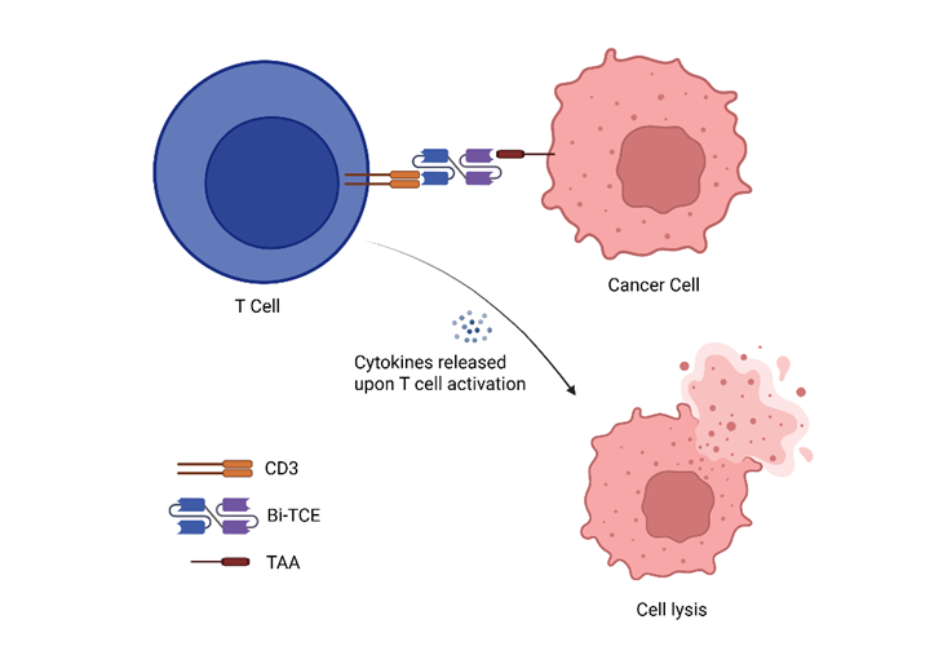
Más informaciónEstructuralmente, los Bi-TCE consisten en dos fragmentos variables de cadena sencilla (scFv) conectados por un conector flexible. Un scFv se une a un antígeno asociado a tumores (TAA), mientras que el otro se dirige a CD3, un componente clave del complejo receptor de células T. Esta doble especificidad permite que los Bi-TCE vinculen físicamente cualquier célula T que exprese CD3 con las células cancerosas, evitando la necesidad de reconocimiento péptido-MHC. Tras la unión, los Bi-TCE desencadenan una potente cascada inmunológica que activa las células T, promueve su proliferación e induce la liberación de perforinas y granzimas que median la lisis de las células tumorales (véase la Figura 1). Este mecanismo de acción ha demostrado ser eficaz en neoplasias hematológicas, lo que posiciona a los Bi-TCE como una frontera prometedora en la inmunoterapia oncológica.
Los engagers biespecíficos de células T en el panorama de la inmunoterapia oncológica
¿Cómo se comparan los Bi-TCE con el enfoque predominante de inmunoterapia oncológica, CAR-T? Una diferencia clave es su método de producción: las terapias CAR-T se desarrollan mediante la ingeniería genética de las propias células T del paciente, mientras que los Bi-TCE se producen mediante la ingeniería de proteínas en anticuerpos a partir de líneas celulares de mamíferos. Esto convierte a los Bi-TCE en un tipo de fármaco "listo para usar" que es más sencillo de producir que las terapias CAR-T individualizadas.
Existen otras comparaciones importantes, resumidas a continuación en la Tabla 1:
| Características | Células CAR-T | Bi-TCE |
|---|---|---|
| Estructura | Células T del paciente modificadas con un receptor sintético, que incluye un dominio de unión al antígeno diana (scFv), una región bisagra, un dominio transmembrana y un dominio de señalización intracelular | Anticuerpo recombinante con dos regiones scFv conectadas; una dirigida a un TAA y otra a CD3, parte del complejo TCR en las células T |
| Reclutamiento de células T | Activo, redirige células T modificadas para eliminar células tumorales | Pasivo, depende de las células T endógenas y las redirige para eliminar células tumorales |
| Mecanismo de citotoxicidad | Liberación de perforina y granzima B por parte de las células CAR-T | Liberación de perforina y granzima B por parte de las células T endógenas activadas por el Bi-TCE |
| Tratamiento de linfodepleción previo a la terapia | Requerido (fármacos como fludarabina y ciclofosfamida) | No requerido |
| Vida media | Larga (semanas a meses) | Corta (horas); requiere infusiones repetidas |
| Producción | Ingeniería genética de las células T del paciente in vitro | Ingeniería de proteínas de anticuerpos a partir de líneas celulares de mamíferos |
| Disponibilidad | Proceso de producción individual para cada paciente | Fármacos listos para su uso con procesos de producción relativamente sencillos |
| Indicaciones | Principalmente neoplasias hematológicas; el desarrollo clínico en fase temprana para tumores sólidos está en curso | Principalmente neoplasias hematológicas; los resultados preliminares en tumores sólidos sugieren que, en comparación con las células CAR-T, los Bi-TCE podrían ofrecer ligeras ventajas en tumores sólidos |
Las tendencias de publicación muestran oportunidades crecientes en la investigación oncológica y otros ámbitos
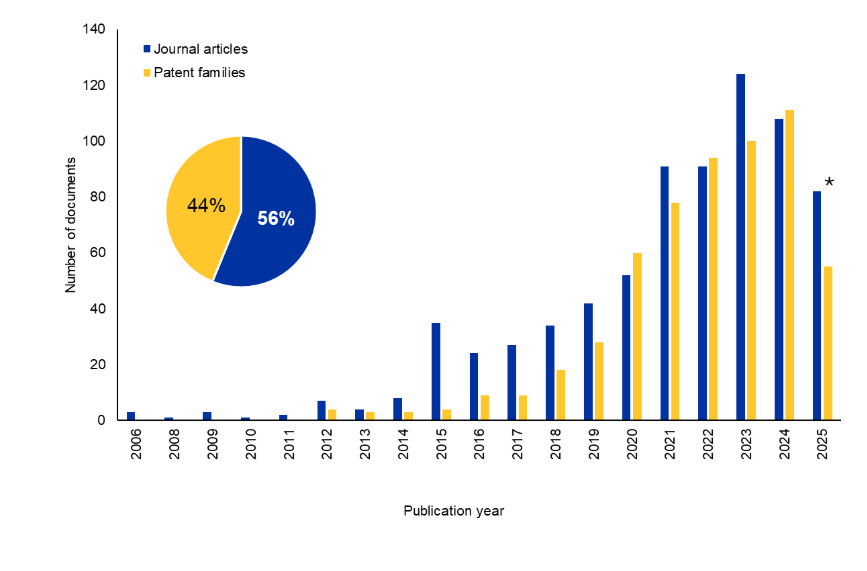
Hemos examinado la CAS Content CollectionTM, el mayor repositorio de información científica curada por expertos, para comprender mejor el panorama de investigación de los Bi-TCE. En los últimos 10 años se ha producido un aumento significativo en el número de artículos de revistas y documentos de patentes. Resulta interesante observar que las patentes representan el 44 % del total de documentos, lo que sugiere un interés comercial sostenido en esta área (véase la Figura 2).
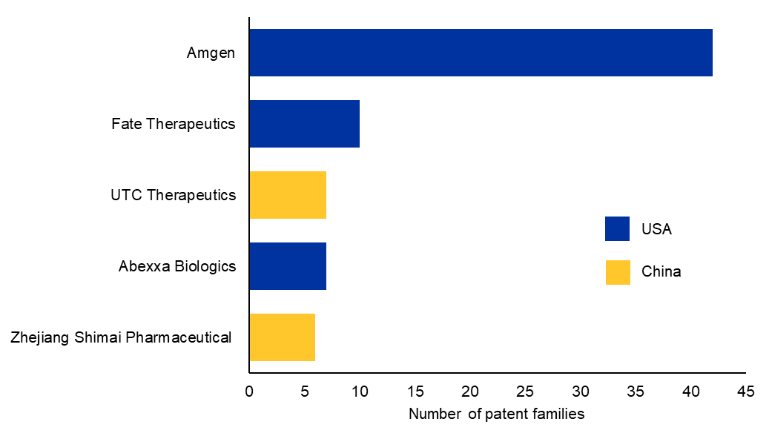
Analizamos los datos de patentes para identificar a los 10 principales titulares comerciales (véase la Figura 3). Amgen fue la primera empresa en desarrollar una molécula Bi-TCE aprobada a nivel mundial en hematología y sigue siendo líder en este campo con su tecnología patentada BiTE®.
También exploramos las principales áreas terapéuticas en el contexto de los Bi-TCE utilizando los conceptos indexados por CAS a los que se accede a través de CAS STNext®. Nuestro análisis del panorama muestra que el desarrollo de los Bi-TCE se concentra predominantemente en tumores sólidos, con el mayor número de documentos sobre cáncer de pulmón, mama, páncreas, próstata y ovario. Las neoplasias hematológicas constituyen la segunda área de interés principal, impulsada en gran medida por programas dirigidos al mieloma múltiple y las leucemias agudas (véase la Figura 4).
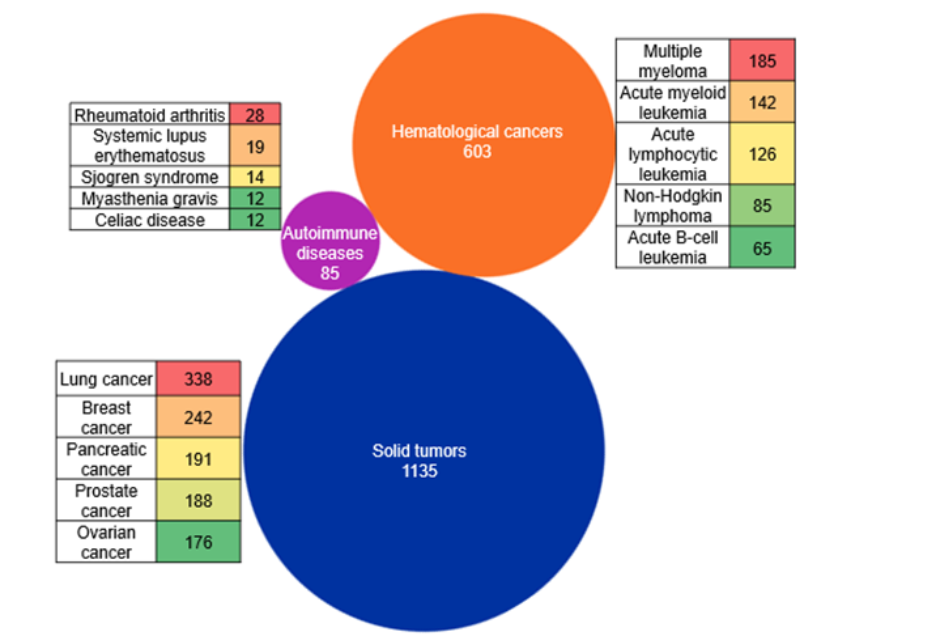
Por el contrario, las enfermedades autoinmunes representan un área de exploración emergente más pequeña, con un interés distribuido en afecciones como la artritis reumatoide, el lupus eritematoso sistémico y el síndrome de Sjögren. Cabe destacar que la mayoría de los Bi-TCE aprobados por la FDA hasta la fecha están destinados a indicaciones hematológicas. Sin embargo, en nuestro análisis observamos que el número de documentos es mayor en el caso de los tumores sólidos. Esto se debe probablemente al aumento de los esfuerzos actuales para utilizar eficazmente los Bi-TCE en indicaciones de tumores sólidos.
El primer Bi-TCE aprobado por la FDA, blinatumomab, recibió la aprobación en 2014. Se dirige a CD19 y CD3 y está indicado para la leucemia linfoblástica aguda de células B recidivante o refractaria. Desde entonces, muchos otros tratamientos con Bi-TCE han obtenido la aprobación acelerada de la FDA para diversos tipos de cáncer, incluidas dos indicaciones para tumores sólidos. Los detalles se resumen en la Tabla 2 a continuación:
| Nombre del Bi-TCE | Año de aprobación | Indicación de la enfermedad | Diana en células tumorales |
|---|---|---|---|
| Blinatumomab (Blincyto) | 2014 | Leucemia linfoblástica aguda | CD19 en células B |
| Mosunetuzumab (Lunsumio) | 2022 | Linfoma folicular en recaída o refractario | CD20 en células B |
| Tebentafusp (Kimmtrak) | 2022 | Melanoma uveal irresecable o metastásico | Péptido gp100-HLA-A en células de melanoma uveal |
| Teclistamab (Tecvayli) | 2022 | Mieloma múltiple R/R | BCMA en células de mieloma |
| Elranatamab (Elrexfio) | 2023 | Mieloma múltiple R/R | BCMA en células de mieloma |
| Epcoritamab (Epkinly) | 2023 | Linfoma difuso de células B grandes en recaída o refractario | CD20 en células B |
| Glofitamab (Columvi) | 2023 | Linfoma difuso de células B grandes R/R, no especificado; linfoma de células B grandes | CD20 en células B |
| Talquetamab (Talvey) | 2023 | Mieloma múltiple R/R | GPRC5D en células de mieloma |
| Tarlatamab (Imdelltra) | 2024 | Cáncer de pulmón de células pequeñas (CPCP) | DLL3 en células de CPCP |
Tabla 2:Resumen de los Bi-TCE aprobados por la FDA (incluidas las aprobaciones aceleradas, a noviembre de 2025). CD: grupo de diferenciación; gp100, glucoproteína 100; HLA-A, antígeno leucocitario humano A; BCMA: antígeno de maduración de células B; GPRC5D: receptor acoplado a proteína G familia C grupo 5 miembro D; DLL3: ligando 3 tipo Delta; R/R: recidivante o refractario. Fuente: Administración de Alimentos y Medicamentos de los EE. UU. (FDA)
Limitaciones de los Bi-TCE como cura contra el cáncer
Los Bi-TCE se consideran transformadores en los cánceres hematológicos, pero aún enfrentan varias limitaciones. Los Bi-TCE clásicos (por ejemplo, los BiTE como el blinatumomab) son fragmentos de anticuerpos pequeños (~55 kDa) que carecen de un dominio Fc. Esto significa que se eliminan rápidamente mediante filtración renal, lo que resulta en una semivida plasmática de solo unas pocas horas. Se requiere una infusión intravenosa continua para mantener las concentraciones terapéuticas, lo que aumenta la carga para los pacientes y los recursos sanitarios.
Los Bi-TCE inducen la activación policlonal de células T mediante la reticulación de CD3 con antígenos tumorales, lo que provoca una secreción masiva de citocinas (IL-6, IFN-γ, TNF-α) conocida como síndrome de liberación de citocinas (SRC). El SRC se manifiesta con fiebre, hipotensión y disfunción multiorgánica. Los Bi-TCE también se asocian con un riesgo de neurotoxicidad, específicamente un síndrome de neurotoxicidad asociada a células efectoras inmunitarias (ICANS). Estas toxicidades pueden poner en peligro la vida y requieren hospitalización, corticosteroides o bloqueo del receptor de IL-6 (por ejemplo, tocilizumab).
Los Bi-TCE muestran una fuerte actividad en neoplasias hematológicas, pero han demostrado un éxito clínico limitado en tumores sólidos. Las barreras incluyen la penetración tumoral, la heterogeneidad antigénica y el microambiente inmunosupresor. Otra limitación crítica de los Bi-TCE es el fenómeno de toxicidad "on-target, off-tumor" (diana correcta, tejido incorrecto). Muchos antígenos asociados a tumores (por ejemplo, CD19, BCMA, EpCAM) también se expresan en niveles bajos en tejidos normales. En consecuencia, los Bi-TCE pueden redirigir a las células T para atacar células sanas, lo que provoca daños colaterales en los tejidos y limita la selección de antígenos.
Desarrollos recientes en la investigación del cáncer con Bi-TCE
Los avances recientes en los Bi-TCE reflejan un esfuerzo concertado para abordar los desafíos mencionados anteriormente e impulsar un mayor impacto clínico con estos tratamientos. Las innovaciones en curso están mejorando su precisión, seguridad y durabilidad, posicionando a los Bi-TCE como una clase de inmunoterapias en rápida evolución con un potencial creciente en diversos tipos de cáncer. Algunos de los enfoques más notables incluyen:
Bi-TCE de semivida extendida (HLE Bi-TCE):
Las moléculas de Bi-TCE canónicas tienen una semivida corta de dos a cuatro horas debido a la ausencia de un dominio Fc, lo que requiere una infusión intravenosa continua. Para solucionar esto, se están desarrollando Bi-TCE HLE que fusionan el Bi-TCE con un dominio Fc, lo que permite el reciclaje por FcRn y una circulación prolongada. Los estudios preclínicos y clínicos iniciales muestran que los Bi-TCE HLE mantienen la actividad, y los Bi-TCE HLE dirigidos a CD19 y BCMA alcanzan semividas de hasta 210 horas, lo que permite una dosificación semanal.
Ajuste de CD3 y formatos 2:1:
El ajuste de CD3 en los Bi-TCE implica modificar la afinidad del brazo de unión a CD3 para controlar la activación de las células T. Una unión a CD3 de menor afinidad reduce la liberación excesiva de citocinas, al tiempo que permite una eliminación eficaz de las células tumorales, mejorando así la seguridad. El formato 2:1 incorpora dos dominios de unión para el antígeno tumoral y uno para CD3, aumentando la selectividad y la potencia frente al tumor al garantizar una interacción más fuerte con las células cancerosas antes de activar las células T. En conjunto, el ajuste de CD3 y el formato 2:1 son estrategias de ingeniería clave para equilibrar la eficacia y la tolerabilidad en las terapias Bi-TCE de próxima generación.
Engagers de doble diana y triespecíficos:
Para abordar la heterogeneidad y el escape antigénico, los investigadores están desarrollando engagers de doble diana y triespecíficos que se dirigen simultáneamente a dos antígenos tumorales para aumentar la especificidad y la cobertura, o que añaden un brazo coestimulador para potenciar la aptitud de las células T en entornos inmunosupresores. Los engagers de células T de doble especificidad poseen dos sitios de unión: uno para CD3 en las células T y otro para un antígeno asociado a tumores, lo que fuerza la formación de la sinapsis inmunitaria y la citotoxicidad. Los engagers triespecíficos (TriTEs) amplían este diseño con un tercer sitio de unión, que puede dirigirse a un segundo antígeno tumoral para prevenir el escape o activar un receptor coestimulador, como CD28, para mejorar la activación de las células T. Este dominio adicional aumenta la selectividad y la potencia, asegurando un reconocimiento tumoral más fuerte antes de la activación de las células T. Los enfoques de tipo «puerta lógica AND» que aprovechan la doble diana de antígenos tumorales son útiles para reducir la toxicidad «on-target, off-tumor» de los Bi-TCE.
Sistemas de administración novedosos:
Los nuevos sistemas de administración de Bi-TCE tienen como objetivo superar las limitaciones de la semivida corta y la perfusión continua. La terapia génica basada en AAV permite la expresión in vivo
Otras estrategias incluyen dirigirse a nuevos antígenos tumorales para ampliar su eficacia en tumores sólidos. Algunos Bi-TCE utilizan la activación mediada por el microentorno, uniéndose únicamente bajo condiciones específicas del tumor para reducir la toxicidad fuera de la diana. Se están añadiendo dominios de unión a albúmina a los Bi-TCE para prolongar la semivida y mejorar la farmacocinética aprovechando el reciclaje natural de la albúmina. Los Bi-TCE también se están combinando con inhibidores de puntos de control, citocinas o terapias celulares para potenciar la activación inmunitaria y superar los mecanismos de resistencia.
Los ensayos clínicos sugieren las direcciones futuras de las terapias Bi-TCE
Hemos analizado los datos de Clinicaltrials.gov para obtener información sobre el panorama actual de los ensayos clínicos en este campo. Como se observa en la Figura 5, la mayoría de los ensayos con estado «Activo, reclutando» corresponden a candidatos bien establecidos y aprobados por la FDA, que dominan el ámbito de los cánceres hematológicos (196 ensayos). Una proporción menor, pero significativa, se dirige a tumores sólidos (33 ensayos), con esfuerzos limitados en enfermedades autoinmunes, amiloidosis por cadenas ligeras (amiloidosis AL) y trastornos renales.
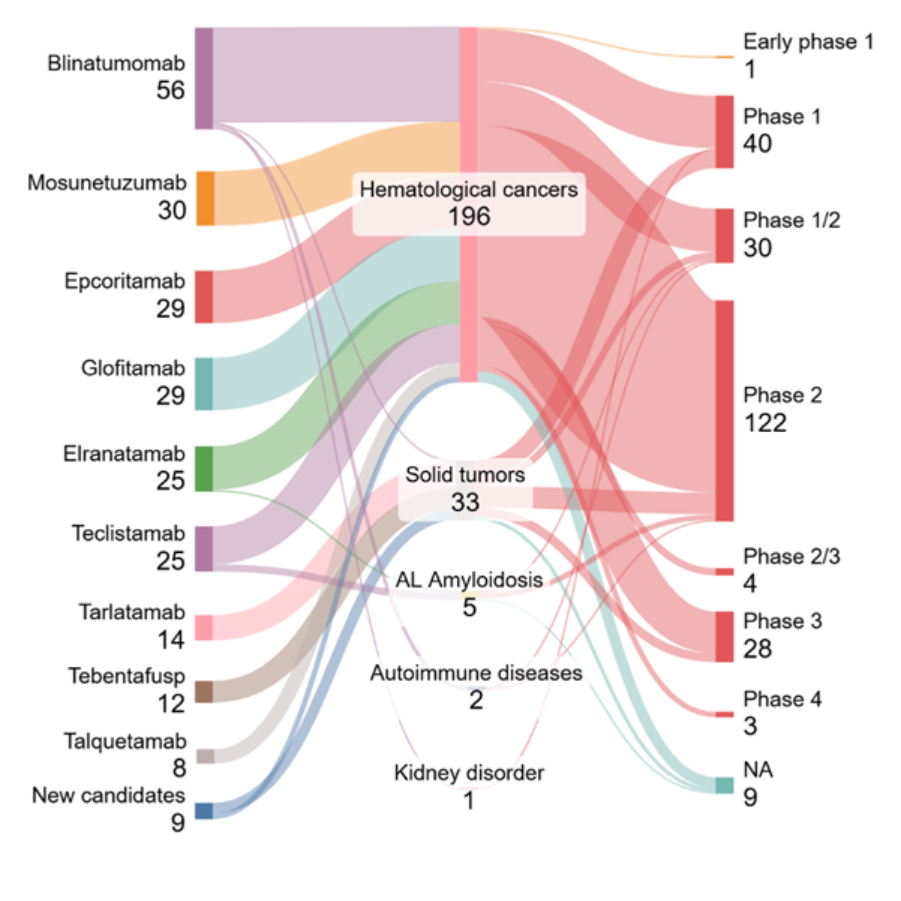
En todas las indicaciones, la mayor concentración de ensayos se encuentra en fase 2 (122), seguida de la fase 1 (40) y la fase 1/2 (30), lo que indica una cartera clínica en fase de maduración pero aún centrada en actividades de etapas tempranas a intermedias. Solo unos pocos candidatos han alcanzado la fase 3 (28 ensayos), lo que refleja los desafíos de trasladar las terapias de redirección de células T más allá de los entornos hematológicos.
Nuestro análisis destaca dos tendencias principales: un fuerte impulso clínico en las neoplasias de células B y una expansión gradual de los Bi-TCE hacia tumores sólidos y enfermedades no oncológicas. Algunos de los ensayos clínicos de fase 3 para tumores sólidos incluyen fármacos aprobados en combinación con otros tratamientos de quimioterapia o inhibidores de puntos de control inmunitario (por ejemplo, Tebentafusp + Pembrolizumab).
Los candidatos más recientes, que aún no han sido aprobados por la FDA, y sus detalles se resumen en la Tabla 3:
| Candidato Bi-TCE (Empresa) | Indicación | Diana en células tumorales | ID del ensayo clínico, Fase | Aspecto innovador |
|---|---|---|---|---|
| AZD0486 (AstraZeneca) | Neoplasias malignas de células B | CD19 | NCT06564038, Fase 1/2 | CD3 de baja afinidad para reducir el SRC |
| XmAb541 (Xencor, Inc.) | Cáncer de ovario, cáncer de endometrio, tumor de células germinales | CLDN6 | NCT06276491, fase 1 | Formato 2+1 para mayor selectividad |
| BI764532 (Boehringer Ingelheim) | Carcinoma microcítico de pulmón, tumores neuroendocrinos | DLL3 | NCT05882058, fase 2 | Bi-TCE para tumores sólidos con diana en DLL3 |
| BA3182 (BioAtla, Inc.) | Adenocarcinoma avanzado | EpCAM | NCT05808634, fase 1 | Unión condicionalmente activa, solo en el microambiente tumoral |
| CLN-049 (Cullinan Therapeutics Inc.) | LMA en recaída/refractaria, SMD | FLT3 | NCT05143996, fase 1 | Nuevo antígeno tumoral (FLT3) |
| AMG 509 (Amgen) | Cáncer de próstata | STEAP1 | NCT04221542, fase 1 | Formato 2+1, nuevo antígeno de tumor sólido (STEAP1) |
| AMG 305 (Amgen) | Tumores sólidos avanzados | CDH3/MSLN | NCT05800964, fase 1 | Bi-TCE de doble diana |
| VNX-202 (Vironexis Biotherapeutics Inc.) | Tumores sólidos que expresan HER2 | HER2 | NCT07192432, fase 1/2 | Terapia génica con AAV para la administración in vivo de Bi-TCE |
| VNX-101 (Vironexis Biotherapeutics Inc.) | Neoplasias malignas de células B | CD19 | NCT06533579, fase 1/2 | Terapia génica con AAV para la administración in vivo de Bi-TCE |
Tabla 3: Resumen de candidatos a Bi-TCE destacados en desarrollo clínico. Abreviaturas: R/R: recidivante/refractario; LMA: leucemia mieloide aguda; SMD: síndrome mielodisplásico; EpCAM: molécula de adhesión celular epitelial; CLDN6: claudina-6; FLT3: tirosina quinasa 3 tipo Fms; STEAP1: antígeno epitelial prostático de seis dominios transmembrana 1; CDH3: caderina-3; MSLN: mesotelina; HER2: receptor 2 del factor de crecimiento epidérmico humano; AAV: virus adenoasociado.
Estos nuevos Bi-TCE han demostrado un potencial considerable y resultados favorables en estudios clínicos iniciales. Ponen de manifiesto la rápida evolución del campo, y el desarrollo de Bi-TCE de nueva generación tiene como objetivo aumentar la eficacia y mejorar los perfiles de seguridad.
Los Bi-TCE se están labrando un nicho crucial en el tratamiento oncológico y están preparados para ofrecer mejores resultados a los pacientes. También podrían desempeñar un papel importante en el tratamiento de enfermedades distintas del cáncer. A medida que la investigación se amplía, pronto podrían impulsar nuevos avances y ofrecer más esperanza a los pacientes de todo el mundo.
Referencias de la Tabla 1:
Slaney CY, Wang P, Darcy PK, Kershaw MH. CARs versus BiTEs: A Comparison between T Cell-Redirection Strategies for Cancer Treatment. Cancer Discov. 2018 Aug;8(8):924-934. doi: 10.1158/2159-8290.CD-18-0297. Epub 2018 Jul 16. PMID: 30012854.
Edeline, J., Houot, R., Marabelle, A. et al. CAR-T cells and BiTEs in solid tumors: challenges and perspectives. J Hematol Oncol 14, 65 (2021). https://doi.org/10.1186/s13045-021-01067-5
Dalal PJ, Patel NP, Feinstein MJ, Akhter N. Adverse Cardiac Effects of CAR T-Cell Therapy: Characteristics, Surveillance, Management, and Future Research Directions. Technology in Cancer Research & Treatment. 2022;21. doi:10.1177/15330338221132927
Caso práctico relacionado: Las soluciones de API personalizadas aceleran el descubrimiento de fármacos: descubra cómo el Instituto Calibr-Skaggs colaboró con CAS para optimizar su proceso de descubrimiento de fármacos.
Consulte el caso práctico