
张力螺杂环作为有价值的三维生物电子等排体,在药物发现中日益受到重视。这些刚性的三维分子框架为制药行业提供了一种“摆脱平面化”的潜在解决方案,与传统的平面芳香族化合物相比,这些骨架能更好地与复杂的生物结合位点互补。尽管螺[3.3]庚烷的优良特性已得到广泛证实,但其较低的同系物——螺[2.3]己烷(一种由三元环与四元环通过共享螺碳原子稠合而成的张力子集)由于合成难度大且生物学数据有限,目前仍处于探索阶段。
这是一个被忽视的机会,因为除了刚性的几何结构外,这些张力螺环系统还能增强靶点选择性、改善溶解度、提高代谢稳定性并减少脱靶效应。此外,它们还在此前难以触及的化学空间中提供了全新的知识产权优势。
研究人员如何才能更好地获取这些基序,以理解潜在的靶点-配体相互作用,并预测哪些 3D 候选分子在药物开发中最具前景?为了回答这个问题,意大利巴里大学“A. Moro”的 Renzo Luisi 教授领导的科研团队开发了一种合成九种螺[2.3]己烷类似物的新方法,并利用 CAS BioFinder® 中全新的人工智能驱动预测分析技术,评估了它们作为生物活性化合物的潜力。该项目获得了欧盟“地平线欧洲”框架计划 SusPharma 项目(授权协议号 101057430)的资助。该研究的完整结果近期已作为《德国应用化学》国际版上的一篇研究论文发表。
该方法通过实现基于文献的快速计算机模拟(in silico)评估配体-靶点相互作用及药理潜力,为加速该领域的研究提供了一种实用途径,从而有助于从这一未充分开发的化学领域中发现一类具有治疗意义的新分子。
螺[2.3]己烷的优势与合成挑战
“摆脱平面化”和“构象限制”的概念表明,增加候选药物中sp³杂化碳中心的比例,与化合物从发现阶段到临床获批的成功率提高相关。张力高、sp³含量丰富的螺环骨架满足这些标准,使其成为药物发现中极具价值的结构基序,并受到药物化学家的青睐。
迄今为止,药物化学家已将大量精力投入到含杂原子的螺[3.3]庚烷(两个螺稠合的四元环)研究中,并将其作为哌嗪或吗啉等传统非张力杂环的生物电子等排替代物进行探索。这些研究表明,引入此类张力高、sp³含量丰富的基序,可以获得理化性质得到改善并能进入临床试验的化合物。
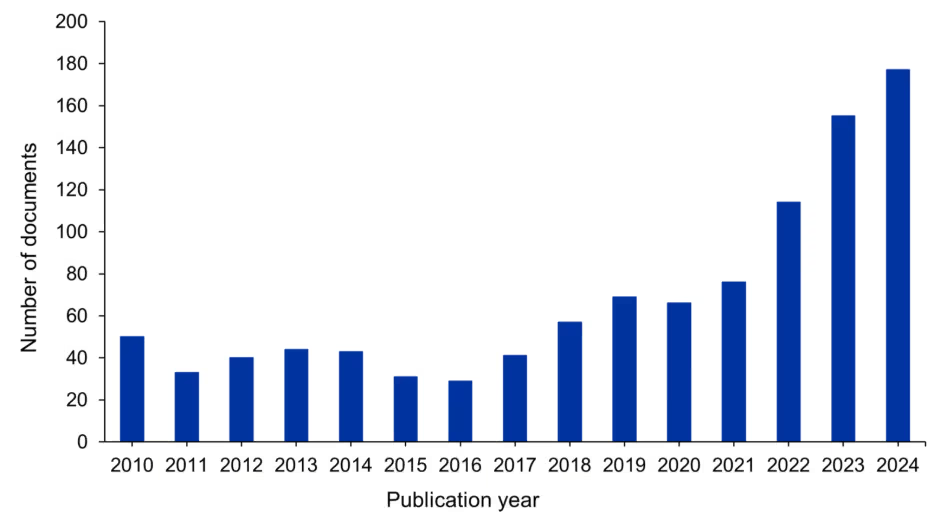
对CAS SciFinder® 中发表数据的分析揭示了螺[3.3]庚烷的实用性,这得益于已报道的大量合成衍生物,以及围绕该骨架的大量专利申请和学术出版物(见图 1)。尽管较低的同系物螺[2.3]己烷在过去五年中受到越来越多的学术关注,如图 2 中相关出版物数量的增加所示,但对其生物电子等排潜力的系统性研究仍然匮乏。尽管它们具有相当的理化性质,且已有包括抑制HDAC1/3和HIPT1在内的生物活性报道,但情况依然如此。
Researchers conducting similar searches across bioisosteric databases and materials literature can access training on structure-based queries and property filtering that demonstrates workflows for narrowing candidate materials.
表 1 中提供的综合 CAS SciFinder 数据展示了文献中报道的九种不同螺[2.3]己烷结构基序的普遍性。值得注意的是,大多数螺[2.3]己烷的杂环类似物仍处于开发不足的状态,学术报告有限,且几乎没有或完全没有发现相关的专利申请。

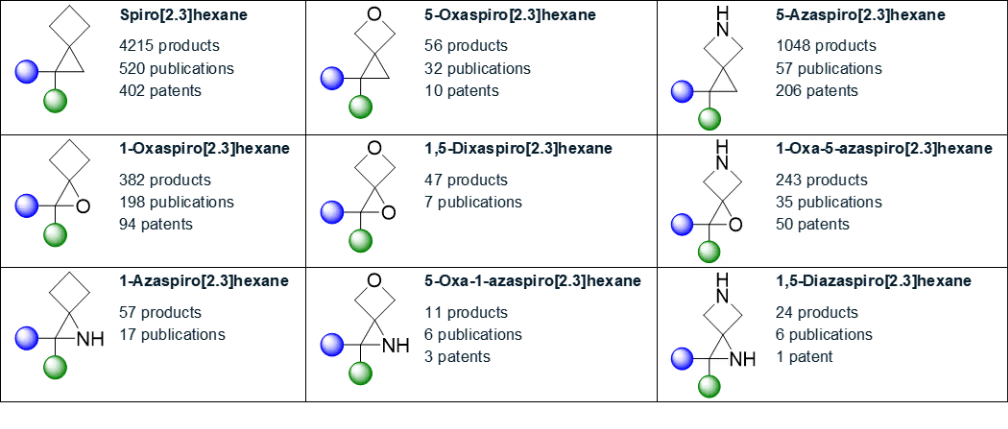
Synthetic challenges associated with the efficient incorporation of such motifs, together with scarce chemical reactivity and stability data, have likely curtailed their widespread implementation in drug discovery.
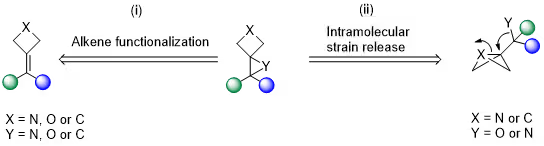
Traditional syntheses of spiro[2.3]hexanes typically install the three-membered ring onto a preassembled four-membered scaffold via epoxidation, aziridination, or cyclopropanation [see Scheme 1A (i)]. These methods, however, often require harsh conditions, tolerate few functional groups, and lack modularity, as structural variation of the substituents on the three-membered ring necessitates resynthesis of the precursor.
A more flexible strategy has recently emerged based on intramolecular strainrelease reactions of bicyclo[1.1.0]butanes, enabling modular access to the spiro[2.3]hexane framework [see Scheme 1A (ii)]. Nonetheless, this approach still depends on reactive intermediates and is incompatible with the preparation of cyclopropane and oxetane-derived spiro analogues.
To address the aforementioned shortcomings and allow rapid access to a library of heteroatom-containing spiro[2.3]hexanes, the team designed novel sulfonium salts bearing four-membered rings, which can be transferred under mild conditions to a range of π-electrophiles (alkenes, carbonyls and imines) via a Johnson-Corey-Chaykovsky-type reaction to assemble nine different spiro[2.3]hexane motifs in a modular fashion, as shown in Scheme 1B.
A)
B)

Scheme 1. A) State of the art approaches for the synthesis of spiro[2.3]hexanes. B) A synthetic plan for the construction of spiro[2.3]hexane frameworks and their heteroatom-containing analogues employing four-membered ring-containing sulfonium salts as key precursors.
Synthesis of spiro[2.3]hexanes
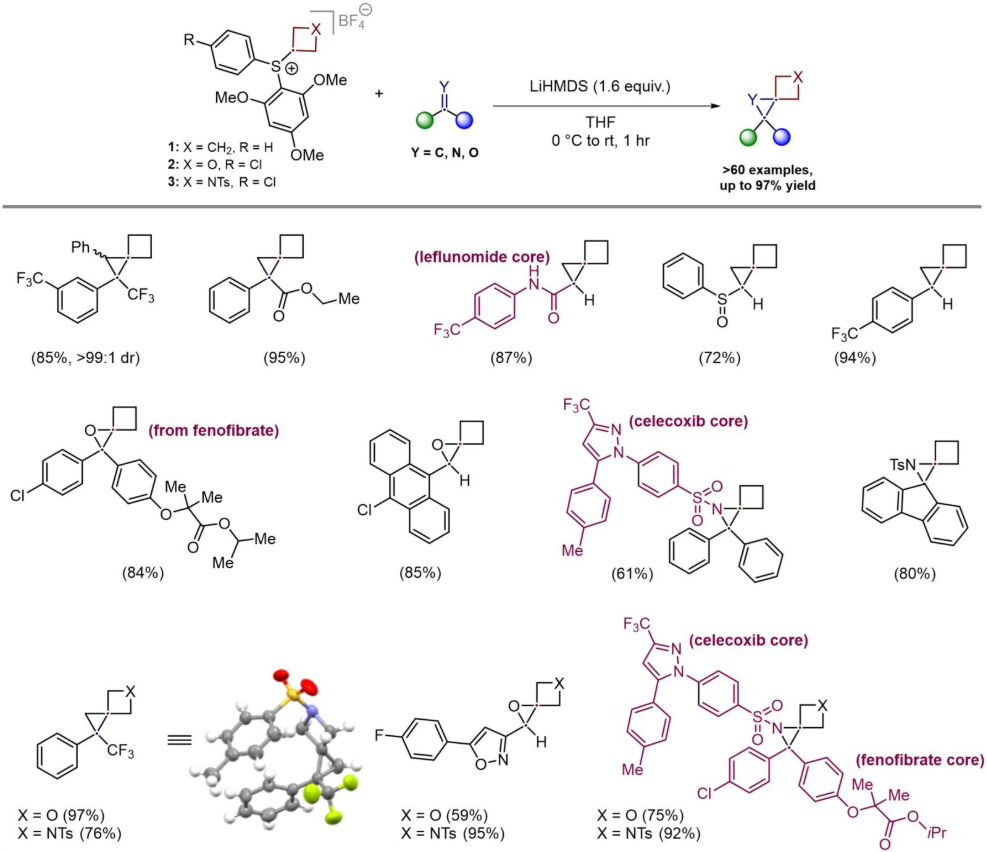
To realize the design plan shown in Scheme 1B, three novel sulfonium-based reagents bearing four-membered rings 1-3 (cyclobutane, oxetane, and azetidine) were developed. An aryl sulfide bearing the four-membered ring was found to be the key intermediate, which was oxidized to the sulfoxide, before being converted to the sulfonium salt by reaction with 1,3,5-trimethoxybenzene and triflic anhydride. This route was scalable to multigram-quantities and the reagents were found to be stable, free-flowing solids, meaning they are easy to handle in the laboratory, adding an important practicality aspect to the approach. Full details for the preparation can be found in the original article.
After optimization of the desired Johnson-Corey-Chaykovsky reaction, the practicality and modularity of this synthetic strategy was showcased by accessing over 60 substrates representing all nine spiro[2.3]hexane cores, fulfilling all predefined objectives. Some representative examples are shown in Scheme 2. For example, reaction with a range of electron-deficient alkenes, including styrenes, vinyl sulfoxides, acrylates, and acrylamides affords the desired spiro[2.3]hexanes and allows incorporation of pharmaceutically relevant cores, such as the leflunomide derivative. The differing reactivity of the sulfonium salt toward electron rich and electron deficient alkenes indicates that the reaction proceeds via nucleophilic attack by the ylide rather than carbene insertion. The corresponding epoxide derivatives are accessible by reaction with ketones and aldehydes, and this was amenable to the incorporation of active pharmaceutical ingredient fenofibrate. Last, the aziridine-bearing analogues can be obtained by reaction of the sulfonium salts 1-3 with imines. The strategy also enabled the installation of spiro[2.3]hexane motifs into complex imines, facilitated by the facile functionalization of the imine nitrogen. Accordingly, spiroaziridines incorporating the celecoxib core alone, as well as spiroaziridines bearing both celecoxib and fenofibrate cores, were successfully synthesized, demonstrating the capability of this method to deliver druglike molecules featuring spiro[2.3]hexane motifs (see Scheme 2). Notably, the reaction proceeded well regardless of the nature of the four-membered ring, allowing access to heteroatom-bearing spiro[2.3]hexane derivatives.
Systematic evaluation of bioisosteric potential of spiro[2.3]hexane analogues
The availability of all nine spiro[2.3]hexane analogues enables a systematic investigation of their bioisosteric potential, analogous to that of spiro[3.3]heptanes. To date, a thorough systematic characterization of these structural motifs has not been conducted.
To perform this evaluation, we developed a bioisostere identification strategy with a three-step workflow as presented in Scheme 3.
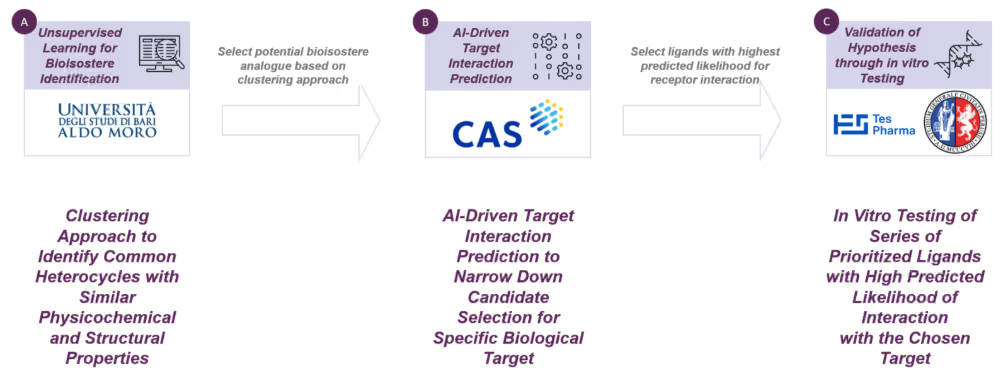
Step 1. Clustering-based approach to identify heterocycles with shared physicochemical properties:
First, an unsupervised learning approach was employed to compare all nine obtained (heteroatom-containing) spiro[2.3]hexane cores against a virtual database of over 70 commonly used drug discovery heterocycles to identify potential bioisosterism between spiro[2.3]hexanes and popular heterocycles in medicinal chemistry.
Thus, all structures were subjected to DFT optimization (ωB97XD3BJ/631++G(d,p)) to obtain energetically minimized three-dimensional conformations and their associated properties. One-dimensional (molecular weight, heteroatom count), two-dimensional (druglikeness, logP, topological polar surface area), and three-dimensional (dipole moment, plane of best fit, asphericity) molecular descriptors were selected and computed using RDKit to enable comparison of physicochemical properties and assessment of druglikeness.
To ensure robust statistical analysis, descriptors were manually inspected and excluded when log₁₀(VIF) ≥ 5. Dimensionality reduction via principal component analysis (PCA) and k-Medoids clustering enabled visualization of the high-dimensional dataset. PCA reduced the chemical space dimensionality and evaluated descriptor contributions, while k-Medoids clustering identified five distinct clusters (k = 5) based on Silhouette score analysis.
Eight of nine spiro[2.3]hexane analogues clustered together alongside pharmaceutically relevant heterocycles: isoxazole (found in leflunomide) and pyridine. Although in different clusters, piperidine showed spatial proximity to spiro[2.3]hexane cores. In 3D PCA space, piperidine and 5-azaspiro[2.3]hexane displayed average intra-cluster distances of 3.20 ± 0.76 and 2.28 ± 1.11, respectively, with an inter-cluster distance of only 1.69, confirming physicochemical similarity. Similarly, spiro[2.3]hexane showed an average intracluster distance of 3.59 ± 1.18 and a piperidine distance of 3.18. Compared to piperidine, spiro[2.3]hexane, 5-azaspiro[2.3]hexane, and 5-oxaspiro[2.3]hexane exhibited similar molecular volumes (crucial for binding site compatibility) and superior 3D drug-likeness indicators (PBF). Notably, 5-azaspiro[2.3]hexane showed comparable dipole moment, but increased strain energy. The clustering proximity and molecular descriptor similarities support 5-azaspiro[2.3]hexane as a promising strained piperidine bioisostere (see Table 2).
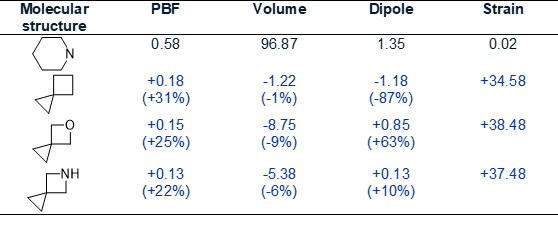
步骤 2。利用人工智能驱动的靶点-配体相互作用预测,优化特定生物靶点的候选药物筛选:
在通过计算机模拟确定了其与哌啶的潜在相似性后,我们通过一个实际案例对该假设进行了验证。哌替啶是一种含有哌啶结构的 μ-阿片受体激动剂,由于其结构与当前方法论的兼容性,且临床上对更安全替代药物存在需求(考虑到其代谢产物去甲哌替啶具有毒性),因此被选为测试案例(见图 3a)。为了识别最有可能对 μ-阿片受体产生作用的类似物,并确定体外测试的候选药物优先级,我们采用了人工智能增强的预测分析技术。为此,我们选择了 CAS BioFinder 平台。该平台通过利用从科学文献中提取的精选化学-生物关系对蛋白质-配体相互作用进行建模,实现了对药理活性的快速、数据驱动的计算机模拟预测。我们应用迭代预测分析工作流程,评估了含有 5-氮杂螺[2.3]己烷核心的哌替啶类似物针对人类 μ-阿片受体的活性(见图 3b)。
初步筛选(pAct 和置信度评分;表 3)确定类似物4和5具有前景,其预测的 pAct 值分别为 6.54 和 5.92。通过聚类分析被认为前景较差的螺[2.3]己烷和 5-氧杂螺[2.3]己烷类似物(6和7)未显示出预测活性。在这些结果的指导下,我们通过调节酯侧链进一步探索了 5-氮杂螺[2.3]己烷衍生物。将乙酯替换为甲酯(8)或异丙基(9)基团后,预测的 pAct 值仅略有下降(分别为 6.50 和 6.48)。有趣的是,引入氮杂环丁烷酯( (10)显著提高了预测活性(pAct 7.22),而氧杂环丁烷酯( (11)对评估靶点未显示出预测活性。
![Structures of pethidine and the uploaded spiro[2.3]hexane derivatives tested against it.](https://cdn.prod.website-files.com/650867962272bf8f15c1034b/69cd636d726d7a8ccab9336e_download.avif)
![Predicted activity scores of spiro[2.3]hexane derivatives at the mu-type opioid receptor.](https://cdn.prod.website-files.com/650867962272bf8f15c1034b/69cd63aede6a3f875713e763_download.avif)
步骤 3。体外验证与所选靶点具有高相互作用概率的优先配体:
为了通过实验评估该预测分析方法,我们选择了对 μ-阿片受体预测活性(pAct)最高的三个配体(化合物4、8和10)进行体外测试,并将螺[2.3]己烷6作为阴性对照。所有这些化合物均使用开发的方法合成,并使用无标记结合测定法(PerkinElmer 的 EnSpire 平台)在表达 μ-阿片受体的 SHSY5Y 神经母细胞瘤细胞上进行评估。通过检测折射率变化的各种光学生物传感器,对系列稀释液(0.03–150 μM)进行了分析,并使用已知的 μ-阿片受体激动剂 DAMGO 作为阳性对照。
剂量-反应分析显示,所有测试化合物均具有微摩尔级的结合活性(10–39 μM),证实了其与 μ-阿片受体的结合(见图 4)。观察到的预测活性化合物(4、8和10)的结合情况与计算机模拟预测结果一致,验证了 5-氮杂螺[2.3]己烷核心作为哌啶生物电子等排体的适用性。在 CAS BioFinder 上预测 pAct 值最高的类似物10表现出最佳的结合活性(10 μM)。
虽然无监督学习能够识别出普遍适用的生物电子等排骨架,但人工智能驱动的靶点预测有效地确定了实验验证的候选药物优先级。值得注意的是,化合物6尽管在聚类分析中与哌啶结构接近,但被预测为无活性,然而它也表现出了可测量的结合活性,这凸显了预测模型在应用于现有训练数据中代表性有限的骨架时存在的局限性。
![Four spiro[2.3]hexane derivatives with measured EC50 values from 10 to 39 micromolar.](https://cdn.prod.website-files.com/650867962272bf8f15c1034b/69cd63f5b5c481c802e57b91_download.avif)
药物发现中生物电子等排体识别的新方法
我们开发了一种简单、通用且对官能团耐受性良好的策略,利用三种新型锍盐试剂获取此前未被充分探索的螺[2.3]己烷类似物。该合成平台被证明具有广泛的适用性,缺电子烯烃、羰基化合物(酮和醛)以及亚胺均可作为有效的反应伙伴,分别用于形成螺环环丙烷、环氧化合物和氮杂环丙烷。该研究共报道了 60 多个实例,突显了该方法的多功能性和稳健性。
除了合成开发外,我们还利用结合了无监督学习和人工智能增强预测分析的综合计算机模拟工作流程,系统地评估了螺[2.3]己烷的生物电子等排潜力。CAS BioFinder 的应用实现了基于从科学文献中提取的精选化学-生物关系的数据驱动型蛋白质-配体相互作用预测。通过在短短几分钟内将候选名单从 66 种化合物缩小到 4 种可能的候选物,CAS BioFinder 仅在此项目中就节省了至少 15,000 美元的外部测试费用,并将从最初项目设计到生物验证的整体项目周期缩短至八个月。如果没有 CAS BioFinder,类似项目通常需要数年时间。
该分析基于 5-氮杂螺[2.3]己烷的预测结构和相互作用特征,将其确定为一种有前景的哌啶生物电子等排体。以产科镇痛中使用的哌啶类 μ-阿片受体激动剂哌替啶作为模型系统,该假设随后通过体外结合研究得到了验证。
总体而言,这项工作展示了现代人工智能驱动的预测工具(如 CAS BioFinder)如何通过指导以靶点为中心的化合物选择,并加速从发现新化学空间到体外生物评估的时间线,从而对合成化学形成补充。借助 CAS BioFinder 透明且有据可查的预测,合成化学家可以更轻松地为那些最初无法通过合理药物设计方法设计的全新分子确定靶点。从更短、经过预筛选的候选名单开始体外测试,通过预验证和聚焦,降低了体外测试的风险和成本。
预计本文所述的锍盐试剂将在有机合成中得到更广泛的应用,而这种通往螺[2.3]己烷的模块化路线,结合预测分析,将促进这些基序作为药物化学中重要核心的进一步探索。
---
点击此处观看网络研讨会录像,Natho 博士在会上演示了一个实用的、人工智能驱动的工作流程,该流程使寻找合适分子骨架的过程变得更快、更高效。他们展示了灵活的新合成方法与人工智能驱动的预测分析相结合,如何在投入昂贵的实验室测试之前快速识别出最有前景的候选药物。
---
P.Natho, A.Vicenti, F.Mastrolorito, F.De Franco, L.Walsh-Benn, M.Colella, E.Mesto, E.Schingaro, O.Nicolotti, A.Gioiello, R.Luisi, Angew. Chem. Int. Ed. 2026, 65, e21633.https://doi.org/10.1002/anie.202521633