
변형된 스피로 헤테로고리 화합물은 신약 개발에서 가치 있는 3차원 바이오아이소스테어로 점점 더 주목받고 있습니다. 이러한 견고한 3차원 분자 프레임워크는 기존의 평면 방향족 화합물보다 복잡한 생물학적 결합 부위를 더 잘 보완할 수 있는 골격을 제공함으로써 제약 산업에 "평면성에서 벗어날(escape from flatland)" 수 있는 잠재적 해결책을 제시합니다. 스피로[3.3]헵탄의 유익한 특성은 광범위하게 입증되었지만, 공유된 스피로 탄소를 통해 3원자 고리와 4원자 고리가 융합된 변형된 하위 집합인 하위 동족체 스피로[2.3]헥산은 합성의 어려움과 제한된 생물학적 데이터로 인해 아직 탐구되지 않은 상태로 남아 있습니다.
이는 놓치기 아까운 기회입니다. 이러한 변형된 스피로 시스템은 견고한 기하학적 구조를 넘어 향상된 표적 선택성, 개선된 용해도, 증가된 대사 안정성 및 오프 타겟 효과 감소를 유도할 수 있기 때문입니다. 또한, 이들은 이전에 접근할 수 없었던 화학적 공간에서 새로운 지적 재산권상의 이점을 제공합니다.
연구원들은 어떻게 이러한 모티프에 더 잘 접근하여 잠재적인 표적-리간드 상호 작용을 이해하고, 어떤 3D 후보 물질이 신약 개발에 가장 유망할지 예측할 수 있을까요? 이 질문에 답하기 위해 이탈리아 바리 "A. 모로" 대학교의 렌조 루이지(Renzo Luisi) 교수팀은 9가지 스피로[2.3]헥산 유사체에 대한 새로운 합성 접근법을 개발하고, CAS BioFinder®에서 제공하는 새로운 AI 기반 예측 분석을 사용하여 생물학적 활성 화합물로서의 잠재력을 평가했습니다. 이 프로젝트는 유럽연합 집행위원회의 호라이즌 유럽 프레임워크, SusPharma 프로젝트(보조금 계약 번호 101057430)의 재정 지원을 받았습니다. 이 연구의 전체 결과는 최근 Angewandte Chemie International Edition의 연구 논문으로 발표되었습니다.
이 방법은 리간드-표적 상호 작용 및 약리학적 잠재력에 대한 신속하고 문헌에 근거한 인실리코(in silico) 평가를 가능하게 함으로써 이 분야의 연구를 가속화하는 실용적인 방법이며, 이를 통해 아직 탐구되지 않은 화학적 영역에서 치료적으로 유의미한 새로운 종류의 분자를 발견하는 데 도움을 줍니다.
스피로[2.3]헥산의 장점 및 합성 과제
"평면성에서 벗어나기(escape from flatland)" 및 "구조적 제한(conformational restriction)" 개념은 신약 후보 물질에서 sp³ 혼성 탄소 중심의 비율을 높이는 것이 화합물이 발견 단계에서 임상 승인 단계로 진행될 때 더 높은 성공률과 관련이 있음을 보여줍니다. 변형된, sp³가 풍부한 스피로고리 골격은 이러한 기준을 충족하므로 신약 개발에서 가치 있는 구조적 모티프이며 의약 화학자들에게 매력적입니다.
지금까지 의약 화학자들은 헤테로원자를 포함하는 스피로[3.3]헵탄(두 개의 스피로 융합된 4원자 고리)에 상당한 관심을 기울여 왔으며, 이를 피페라진이나 모르폴린과 같은 기존의 변형되지 않은 헤테로고리 화합물을 대체할 바이오아이소스테어로 탐구하고 있습니다. 이러한 연구들은 입증했습니다 이러한 변형된, sp³가 풍부한 모티프를 통합하면 임상 시험으로 진행되는 개선된 물리화학적 특성을 가진 화합물을 제공할 수 있다는 것을.
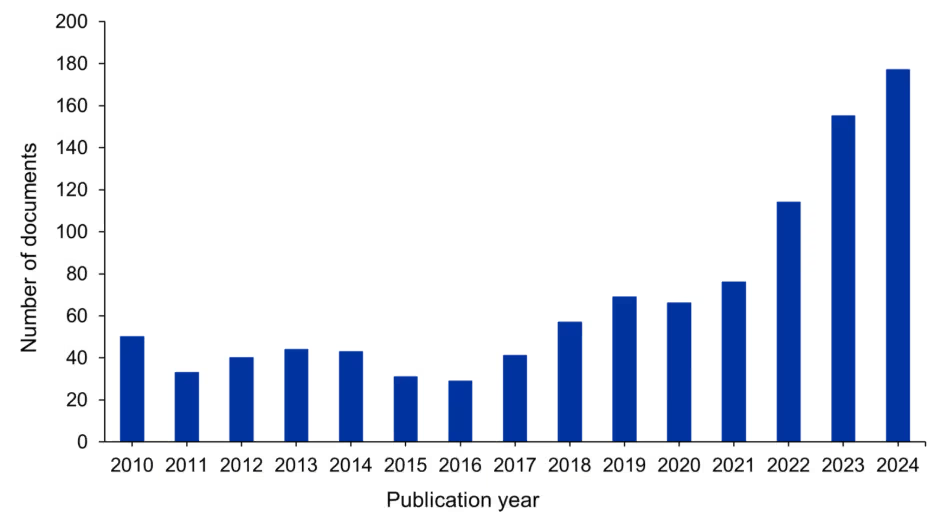
An analysis of publication data in CAS SciFinder® reveals the utility of the spiro[3.3]heptanes due to the presence of substantial number of reported synthetic derivatives and the large volume of patent applications and academic publications centered on this scaffold (see Figure 1). Although the lower homologue spiro[2.3]hexanes have attracted increasing academic attention over the past five years, demonstrated by a rising number of related publications shown in Figure 2, a systematic investigation of their bioisosteric potential remains elusive. This is despite their comparable physicochemical properties and reported biological activities, including inhibition of HDAC1/3 and HIPT1.
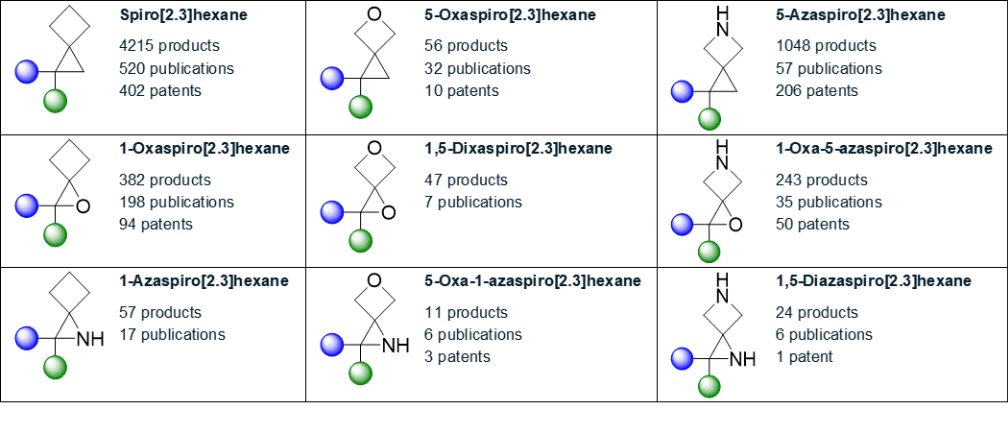
표 1에 제시된 포괄적인 CAS SciFinder 데이터는 문헌에 보고된 9가지의 독특한 스피로[2.3]헥산 구조 모티프의 보급률을 보여줍니다. 특히, 스피로[2.3]헥산의 대부분의 헤테로고리 유사체는 학술 보고서가 제한적이고 특허 출원이 거의 없거나 전혀 확인되지 않아 여전히 개발이 미진한 상태입니다.

Synthetic challenges associated with the efficient incorporation of such motifs, together with scarce chemical reactivity and stability data, have likely curtailed their widespread implementation in drug discovery.
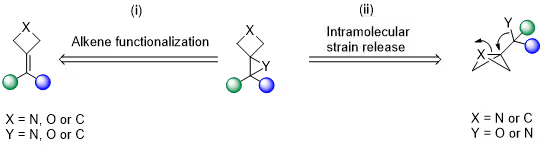
Traditional syntheses of spiro[2.3]hexanes typically install the three-membered ring onto a preassembled four-membered scaffold via epoxidation, aziridination, or cyclopropanation [see Scheme 1A (i)]. These methods, however, often require harsh conditions, tolerate few functional groups, and lack modularity, as structural variation of the substituents on the three-membered ring necessitates resynthesis of the precursor.
A more flexible strategy has recently emerged based on intramolecular strainrelease reactions of bicyclo[1.1.0]butanes, enabling modular access to the spiro[2.3]hexane framework [see Scheme 1A (ii)]. Nonetheless, this approach still depends on reactive intermediates and is incompatible with the preparation of cyclopropane and oxetane-derived spiro analogues.
To address the aforementioned shortcomings and allow rapid access to a library of heteroatom-containing spiro[2.3]hexanes, the team designed novel sulfonium salts bearing four-membered rings, which can be transferred under mild conditions to a range of π-electrophiles (alkenes, carbonyls and imines) via a Johnson-Corey-Chaykovsky-type reaction to assemble nine different spiro[2.3]hexane motifs in a modular fashion, as shown in Scheme 1B.
A)
B)

Scheme 1. A) State of the art approaches for the synthesis of spiro[2.3]hexanes. B) A synthetic plan for the construction of spiro[2.3]hexane frameworks and their heteroatom-containing analogues employing four-membered ring-containing sulfonium salts as key precursors.
Synthesis of spiro[2.3]hexanes
To realize the design plan shown in Scheme 1B, three novel sulfonium-based reagents bearing four-membered rings 1-3 (cyclobutane, oxetane, and azetidine) were developed. An aryl sulfide bearing the four-membered ring was found to be the key intermediate, which was oxidized to the sulfoxide, before being converted to the sulfonium salt by reaction with 1,3,5-trimethoxybenzene and triflic anhydride. This route was scalable to multigram-quantities and the reagents were found to be stable, free-flowing solids, meaning they are easy to handle in the laboratory, adding an important practicality aspect to the approach. Full details for the preparation can be found in the original article.
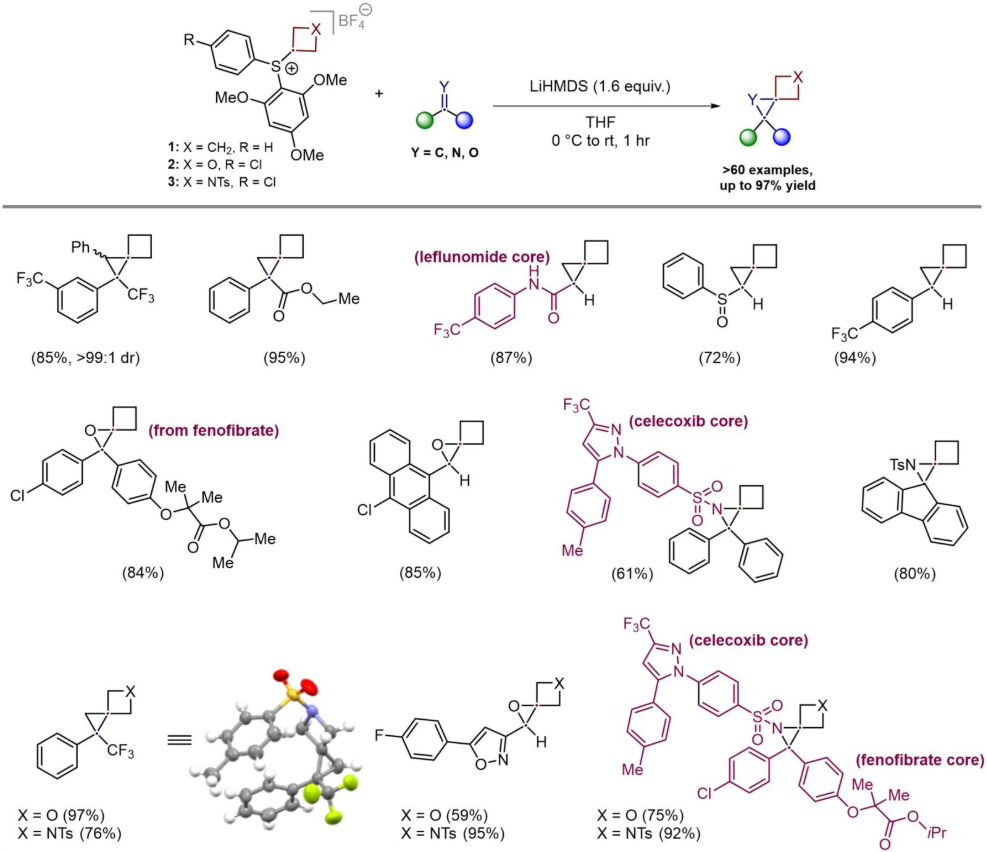
After optimization of the desired Johnson-Corey-Chaykovsky reaction, the practicality and modularity of this synthetic strategy was showcased by accessing over 60 substrates representing all nine spiro[2.3]hexane cores, fulfilling all predefined objectives. Some representative examples are shown in Scheme 2. For example, reaction with a range of electron-deficient alkenes, including styrenes, vinyl sulfoxides, acrylates, and acrylamides affords the desired spiro[2.3]hexanes and allows incorporation of pharmaceutically relevant cores, such as the leflunomide derivative. The differing reactivity of the sulfonium salt toward electron rich and electron deficient alkenes indicates that the reaction proceeds via nucleophilic attack by the ylide rather than carbene insertion. The corresponding epoxide derivatives are accessible by reaction with ketones and aldehydes, and this was amenable to the incorporation of active pharmaceutical ingredient fenofibrate. Last, the aziridine-bearing analogues can be obtained by reaction of the sulfonium salts 1-3 with imines. The strategy also enabled the installation of spiro[2.3]hexane motifs into complex imines, facilitated by the facile functionalization of the imine nitrogen. Accordingly, spiroaziridines incorporating the celecoxib core alone, as well as spiroaziridines bearing both celecoxib and fenofibrate cores, were successfully synthesized, demonstrating the capability of this method to deliver druglike molecules featuring spiro[2.3]hexane motifs (see Scheme 2). Notably, the reaction proceeded well regardless of the nature of the four-membered ring, allowing access to heteroatom-bearing spiro[2.3]hexane derivatives.
Systematic evaluation of bioisosteric potential of spiro[2.3]hexane analogues
The availability of all nine spiro[2.3]hexane analogues enables a systematic investigation of their bioisosteric potential, analogous to that of spiro[3.3]heptanes. To date, a thorough systematic characterization of these structural motifs has not been conducted.
To perform this evaluation, we developed a bioisostere identification strategy with a three-step workflow as presented in Scheme 3.
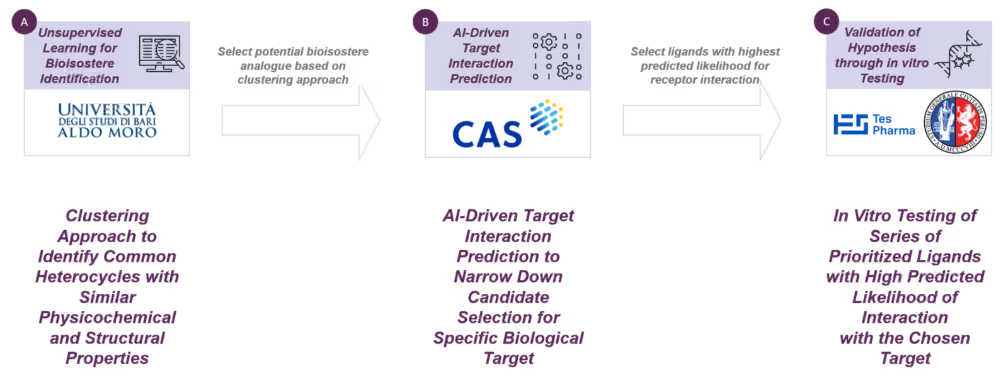
Step 1. Clustering-based approach to identify heterocycles with shared physicochemical properties:
First, an unsupervised learning approach was employed to compare all nine obtained (heteroatom-containing) spiro[2.3]hexane cores against a virtual database of over 70 commonly used drug discovery heterocycles to identify potential bioisosterism between spiro[2.3]hexanes and popular heterocycles in medicinal chemistry.
Thus, all structures were subjected to DFT optimization (ωB97XD3BJ/631++G(d,p)) to obtain energetically minimized three-dimensional conformations and their associated properties. One-dimensional (molecular weight, heteroatom count), two-dimensional (druglikeness, logP, topological polar surface area), and three-dimensional (dipole moment, plane of best fit, asphericity) molecular descriptors were selected and computed using RDKit to enable comparison of physicochemical properties and assessment of druglikeness.
To ensure robust statistical analysis, descriptors were manually inspected and excluded when log₁₀(VIF) ≥ 5. Dimensionality reduction via principal component analysis (PCA) and k-Medoids clustering enabled visualization of the high-dimensional dataset. PCA reduced the chemical space dimensionality and evaluated descriptor contributions, while k-Medoids clustering identified five distinct clusters (k = 5) based on Silhouette score analysis.
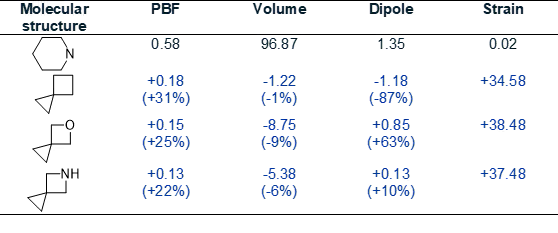
Eight of nine spiro[2.3]hexane analogues clustered together alongside pharmaceutically relevant heterocycles: isoxazole (found in leflunomide) and pyridine. Although in different clusters, piperidine showed spatial proximity to spiro[2.3]hexane cores. In 3D PCA space, piperidine and 5-azaspiro[2.3]hexane displayed average intra-cluster distances of 3.20 ± 0.76 and 2.28 ± 1.11, respectively, with an inter-cluster distance of only 1.69, confirming physicochemical similarity. Similarly, spiro[2.3]hexane showed an average intracluster distance of 3.59 ± 1.18 and a piperidine distance of 3.18. Compared to piperidine, spiro[2.3]hexane, 5-azaspiro[2.3]hexane, and 5-oxaspiro[2.3]hexane exhibited similar molecular volumes (crucial for binding site compatibility) and superior 3D drug-likeness indicators (PBF). Notably, 5-azaspiro[2.3]hexane showed comparable dipole moment, but increased strain energy. The clustering proximity and molecular descriptor similarities support 5-azaspiro[2.3]hexane as a promising strained piperidine bioisostere (see Table 2).
단계 2. 특정 생물학적 표적에 대한 후보 물질 선정을 정교화하기 위한 AI 기반 표적-리간드 상호작용 예측:
컴퓨터 시뮬레이션(in-silico)을 통해 피페리딘과의 잠재적 유사성을 확인한 후, 이 가설을 실제 사례에 적용하여 검증했습니다. 피페리딘을 포함하는 μ-오피오이드 수용체 작용제인 페티딘을 테스트 사례로 선정했는데, 이는 현재의 방법론과 구조적으로 호환될 뿐만 아니라 (독성 대사산물인 노르페티딘 형성 문제로 인해) 더 안전한 대안이 임상적으로 필요했기 때문입니다(그림 3a 참조). μ-오피오이드 수용체에 활성을 보일 가능성이 가장 높은 유사체를 식별하고 in vitro 테스트 후보를 우선순위화하기 위해 AI 강화 예측 분석을 활용했습니다. 이를 위해 CAS BioFinder를 선택했습니다. 이 플랫폼은 과학 문헌에서 추출한 큐레이팅된 화학-생물학적 관계를 사용하여 단백질-리간드 상호작용을 모델링함으로써 약리학적 활성을 신속하고 데이터 기반으로 in-silico 예측할 수 있게 해주었습니다. 5-아자스피로[2.3]헥산 코어를 포함하는 페티딘 유사체를 인간 μ-오피오이드 수용체에 대해 평가하기 위해 반복적인 예측 분석 워크플로우가 적용되었습니다(그림 3b 참조).
초기 스크리닝(pAct 및 신뢰도 점수; 표 3) 결과, 유사체 4와 5가 유망한 것으로 확인되었으며, 예측된 pAct 값은 각각 6.54와 5.92였습니다. 클러스터링을 통해 유망하지 않은 것으로 확인된 스피로[2.3]헥산 및 5-옥사스피로[2.3]헥산 유사체(6 및 7)는 예측된 활성이 없었습니다. 이러한 결과를 바탕으로 에스테르 측쇄를 조절하여 추가적인 5-아자스피로[2.3]헥산 유도체를 탐색했습니다. 에틸 에스테르를 메틸(8) 또는 이소프로필(9) 그룹으로 치환했을 때 예측된 pAct 값은 약간 감소했습니다(6.50 및 6.48). 흥미롭게도 아제티딘 에스테르( (10)를 도입하자 예측된 활성이 크게 증가(pAct 7.22)한 반면, 옥세탄 에스테르( (11)는 평가된 표적에 대해 예측된 활성을 보이지 않았습니다.
![Structures of pethidine and the uploaded spiro[2.3]hexane derivatives tested against it.](https://cdn.prod.website-files.com/650867962272bf8f15c1034b/69cd636d726d7a8ccab9336e_download.avif)
![Predicted activity scores of spiro[2.3]hexane derivatives at the mu-type opioid receptor.](https://cdn.prod.website-files.com/650867962272bf8f15c1034b/69cd63aede6a3f875713e763_download.avif)
단계 3. In vitro 선택된 표적과 높은 상호작용 확률을 보이는 우선순위 리간드의 검증:
예측 분석 접근 방식을 실험적으로 평가하기 위해 μ-오피오이드 수용체에 대해 가장 높은 예측 활성(pAct)을 보인 세 가지 리간드(화합물 4, 8, 및 10)를 음성 대조군인 스피로[2.3]헥산 6과 함께 in vitro 테스트 대상으로 선정했습니다. 이 모든 화합물은 개발된 방법론을 사용하여 합성되었으며, μ-오피오이드 수용체를 발현하는 SHSY5Y 신경모세포종 세포를 사용하는 라벨 프리 결합 분석(PerkinElmer의 EnSpire 플랫폼)을 통해 평가되었습니다. 굴절률 변화를 감지하는 광학 바이오센서를 통해 연속 희석액(0.03–150 μM)을 분석했으며, 알려진 μ-오피오이드 수용체 작용제인 DAMGO를 양성 대조군으로 사용했습니다.
용량-반응 분석 결과, 테스트된 모든 화합물에서 마이크로몰 단위의 결합 활성(10–39 μM)이 나타나 μ-오피오이드 수용체와의 결합이 확인되었습니다(그림 4 참조). 예측된 활성 화합물(4, 8, 및 10)에서 관찰된 결합은 in silico 예측과 일치하며, 치환된 피페리딘 바이오아이소스터로서 5-아자스피로[2.3]헥산 코어의 적합성을 입증합니다. CAS BioFinder에서 가장 높은 pAct가 예측되었던 유사체 10이 가장 우수한 결합 활성(10 μM)을 보였습니다.
비지도 학습을 통해 일반적으로 적합한 바이오아이소스터 스캐폴드를 식별할 수 있었지만, AI 기반 표적 예측은 실험적 검증을 위한 후보 물질의 우선순위를 효과적으로 정해주었습니다. 특히 클러스터링 분석에서 피페리딘과 구조적으로 가깝지만 비활성으로 예측되었던 화합물 6조차도 측정 가능한 결합 활성을 보였는데, 이는 가용 학습 데이터에서 제한적으로 표현되는 스캐폴드에 예측 모델을 적용할 때의 현재 한계를 보여줍니다.
![Four spiro[2.3]hexane derivatives with measured EC50 values from 10 to 39 micromolar.](https://cdn.prod.website-files.com/650867962272bf8f15c1034b/69cd63f5b5c481c802e57b91_download.avif)
신약 개발을 위한 바이오아이소스터 식별의 새로운 접근법
세 가지 새로운 설포늄 염 시약을 사용하여 이전에 거의 탐구되지 않았던 스피로[2.3]헥산 유사체에 접근하기 위한 간단하고 범용적이며 작용기 허용성이 높은 전략이 개발되었습니다. 이 합성 플랫폼은 전자 부족 알켄, 카르보닐 화합물(케톤 및 알데히드), 이민이 각각 스피로고리형 시클로프로판, 에폭사이드, 아지리딘 형성을 위한 효과적인 반응 파트너로 작용하며 광범위하게 적용될 수 있음이 입증되었습니다. 총 60개 이상의 사례가 보고되어 이 방법론의 다재다능함과 견고함을 강조했습니다.
합성 개발을 넘어, 스피로[2.3]헥산의 바이오아이소스터 잠재력을 비지도 학습과 AI 강화 예측 분석을 결합한 통합 in silico 워크플로우를 사용하여 체계적으로 평가했습니다. CAS BioFinder를 적용하여 과학 문헌에서 추출한 큐레이팅된 화학-생물학적 관계를 기반으로 단백질-리간드 상호작용을 데이터 기반으로 예측할 수 있었습니다. CAS BioFinder는 단 몇 분 만에 후보 목록을 66개 화합물에서 4개의 유망한 후보로 좁힘으로써, 이 단일 프로젝트에서 외부 테스트 비용을 최소 15,000달러 절감하고 초기 프로젝트 설계부터 생물학적 검증까지의 전체 프로젝트 일정을 8개월로 단축했습니다. 유사한 프로젝트들은 CAS BioFinder 없이 진행할 경우 종종 수년이 걸립니다.
이 분석을 통해 5-아자스피로[2.3]헥산이 예측된 구조적 및 상호작용 특징을 바탕으로 유망한 피페리딘 바이오아이소스터임을 확인했습니다. 산과적 진통에 사용되는 피페리딘 함유 μ-오피오이드 수용체 작용제인 페티딘을 모델 시스템으로 사용하여 이 가설을 후속적으로 in vitro 결합 연구를 통해 검증했습니다.
전반적으로 이 연구는 CAS BioFinder와 같은 현대적인 AI 기반 예측 도구가 표적 중심의 화합물 선정을 안내하고 새로운 화학적 공간의 발견과 in vitro 생물학적 평가 사이의 기간을 단축함으로써 합성 화학을 어떻게 보완할 수 있는지 보여줍니다. CAS BioFinder의 투명하고 근거 있는 예측을 통해 합성 화학자들은 합리적인 약물 설계로는 애초에 설계되지 않았을 완전히 새로운 분자의 표적을 더 쉽게 식별할 수 있습니다. 더 짧고 사전 선별된 후보 목록으로 in vitro 테스트를 시작함으로써 사전 검증과 집중을 통해 in vitro 테스트의 위험과 비용을 줄일 수 있습니다.
본 연구에서 설명된 설포늄 염 시약이 유기 합성 분야에서 더 폭넓게 응용되고, 스피로[2.3]헥산에 대한 이러한 모듈식 경로가 예측 분석과 결합되어 의약 화학에서 가치 있는 코어로서 이 모티프들에 대한 추가 탐구를 촉진할 것으로 기대됩니다.
---
여기에서 녹화본을 시청하세요. Natho 박사가 올바른 분자 스캐폴드를 찾는 과정을 더 빠르고 효율적으로 만드는 실용적인 AI 기반 워크플로우를 설명하는 웨비나입니다. 이들은 유연한 새로운 합성 방법과 AI 기반 예측 분석을 결합하여 값비싼 실험실 테스트를 시작하기 전에 가장 유망한 후보를 빠르게 식별하는 방법을 보여줍니다.
---
P.Natho, A.Vicenti, F.Mastrolorito, F.De Franco, L.Walsh-Benn, M.Colella, E.Mesto, E.Schingaro, O.Nicolotti, A.Gioiello, R.Luisi, Angew. Chem. Int. Ed. 2026, 65, e21633. https://doi.org/10.1002/anie.202521633