

Resumo executivo
- Um grupo de doenças respiratórias graves em navios de cruzeiro em maio de 2026 atraiu atenção renovada para o hantavírus, um vírus de RNA transmitido por roedores identificado pela primeira vez em 1978, que causa cerca de 10.000 a 100.000 infecções globalmente a cada ano.
- O hantavírus produz duas síndromes principais: a febre hemorrágica com síndrome renal (FHSR) na Ásia e na Europa, com taxas de letalidade de 5% a 15%, e a síndrome cardiopulmonar por hantavírus (SCPH) nas Américas, com taxas de letalidade de 20% a 40%. Atualmente, não existe terapia antiviral direcionada amplamente aprovada.
- Mudanças ambientais, expansão agrícola e o aumento da mobilidade global estão remodelando onde e como o hantavírus aparece, com números crescentes de casos na América do Sul e um novo escrutínio sobre o vírus Andes, a única cepa documentada a ser transmitida de pessoa para pessoa.
Em maio de 2026, relatos de um pequeno grupo de doenças respiratórias graves ligadas ao hantavírus atraíram a atenção global, não por sua escala, mas por terem surgido em um cenário inesperado: navios de cruzeiro. Para muitos leitores, este incidente marcou um primeiro contato com um vírus que raramente aparece em discussões científicas ou médicas convencionais. No entanto, os hantavírus são conhecidos há décadas. O vírus recebe o nome do rio Hantan, na Coreia do Sul, onde foi isolado pela primeira vez em 1978 após surtos anteriores de febre hemorrágica, e continua a causar doenças graves em todo o mundo.
O hantavírus não é um patógeno recém-descoberto, nem é amplamente transmissível como a gripe ou o SARS-CoV-2. Em vez disso, compreende um grupo de vírus de RNA transmitidos por roedores que infectam humanos principalmente por meio de exposição ambiental. Globalmente, estima-se que ocorram 10.000 a mais de 100.000 infecções anualmente, com a maioria na Ásia (particularmente China e Coreia do Sul) e na Europa. Embora o número de casos nas Américas seja menor, tipicamente centenas por ano, os resultados podem ser graves quando a infecção ocorre. As taxas de mortalidade variam de acordo com a síndrome e a geografia: a febre hemorrágica com síndrome renal (FHSR), predominante na Ásia e na Europa, tem taxas de letalidade de 5% a 15%, enquanto a síndrome cardiopulmonar por hantavírus (SCPH) nas Américas apresenta uma taxa desproporcionalmente alta de 20% a 40%. Atualmente, não existe terapia antiviral direcionada amplamente aprovada.
Historicamente, os hantavírus ocuparam um nicho relativamente especializado na pesquisa de doenças infecciosas, sendo frequentemente considerados zoonoses regionais em vez de ameaças globalmente relevantes. No entanto, a evolução dos padrões epidemiológicos e cenários de exposição incomuns estão começando a desafiar essa percepção.
Entendendo o hantavírus: Biologia, transmissão e patogênese
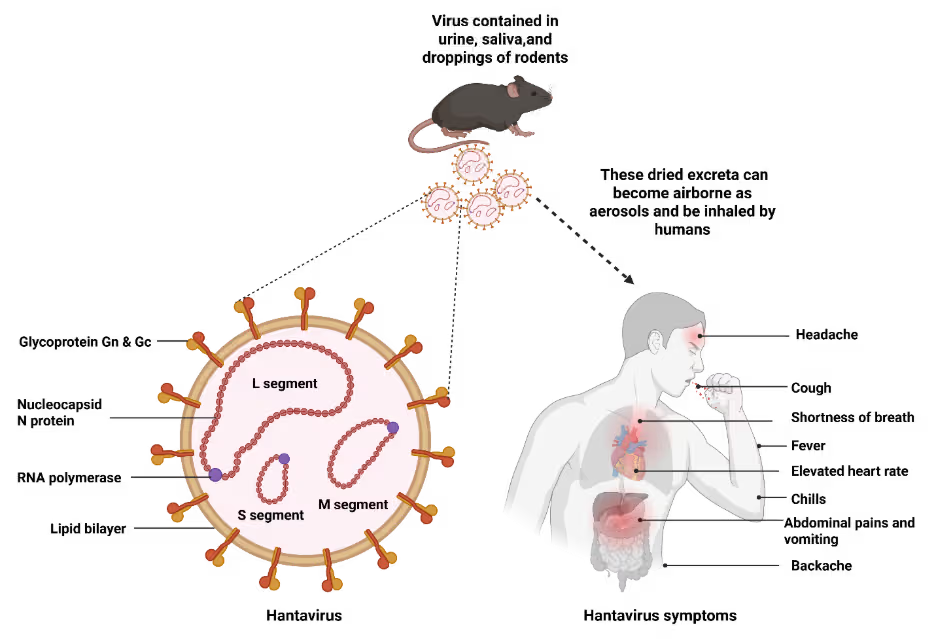
Os hantavírus pertencem à família Hantaviridae e são caracterizados por um genoma de RNA de fita simples negativa, segmentado em três partes, envolto em um envelope lipídico (Figura 1). Cada espécie de hantavírus é tipicamente associada a um hospedeiro roedor específico, com o qual coevoluiu por longos períodos. Esses hospedeiros reservatórios permanecem assintomáticos, permitindo que o vírus persista silenciosamente nos ecossistemas naturais.
A infecção humana ocorre principalmente através da inalação de partículas virais aerossolizadas provenientes de urina, fezes ou saliva seca de roedores. Após um período de incubação de uma a seis semanas, os pacientes apresentam inicialmente sintomas inespecíficos, incluindo febre, dores musculares, fadiga e tontura. À medida que a doença progride, surgem manifestações específicas da síndrome: desconforto respiratório grave na SCPH ou disfunção renal e complicações hemorrágicas na FHSR.
O vírus exibe efeitos citopáticos diretos limitados. Em vez disso, a doença é impulsionada pela desregulação da barreira endotelial mediada pelo hospedeiro, desencadeando respostas imunes que aumentam a permeabilidade vascular e causam vazamento de plasma para os tecidos circundantes. Na SCPH, isso leva ao edema pulmonar e colapso cardiovascular, enquanto na FHSR manifesta-se como dano renal e complicações hemorrágicas. Esse mecanismo patogênico único, onde a gravidade da doença reflete a desregulação imune em vez da destruição viral direta, complica o desenvolvimento terapêutico.
Tendências emergentes no risco de hantavírus
Desenvolvimentos recentes sugerem uma mudança sutil, mas importante, na forma como o risco de hantavírus é distribuído e reconhecido. Em partes da América do Sul, os casos relatados de síndrome cardiopulmonar por hantavírus aumentaram nos últimos anos, com algumas regiões apresentando taxas de letalidade mais altas do que as médias históricas. Esses padrões estão amplamente ligados a fatores ambientais, incluindo variabilidade de chuvas, expansão agrícola e mudanças no uso da terra, que permanecem como os determinantes predominantes da transmissão do hantavírus por meio de seus efeitos na abundância de roedores reservatórios e na exposição humana.
Ao mesmo tempo, uma atenção renovada tem se voltado para o vírus Andes, endêmico na Argentina e no Chile e notável por ser o único hantavírus associado à transmissão documentada, embora rara, de humano para humano. Tais eventos normalmente exigem contato próximo e prolongado e representam uma exceção, e não um desvio das dinâmicas de transmissão amplamente mediadas pelo meio ambiente que caracterizam as infecções por hantavírus globalmente. Investigações recentes associadas a viagens, incluindo grupos ligados a ambientes confinados ou móveis, renovaram a atenção sobre o potencial de transmissão de pessoa para pessoa envolvendo esta cepa, embora a inferência tenha se baseado principalmente em evidências epidemiológicas em vez de uma ligação virológica definitiva. Esforços estão atualmente em andamento para delinear melhor as vias de transmissão e avaliar a contribuição da possível disseminação de pessoa para pessoa.
A mobilidade global aumenta ainda mais essa complexidade. Como o período de incubação geralmente varia de uma a seis semanas, os indivíduos podem desenvolver sintomas longe do local da exposição inicial, obscurecendo as vias de transmissão e atrasando o diagnóstico, particularmente em locais não endêmicos. Juntos, esses fatores indicam que, embora a exposição ambiental continue sendo central para o risco de hantavírus, as mudanças nas condições ecológicas e nos padrões de movimento humano estão remodelando a forma como esse risco é detectado e gerenciado.
Desafios no diagnóstico e manejo clínico
A detecção precoce da infecção por hantavírus continua difícil. Os sintomas iniciais são inespecíficos, incluindo febre, mialgia e fadiga, e podem se assemelhar a muitas outras doenças infecciosas. Quando as manifestações cardiopulmonares ou renais características se desenvolvem, a doença pode já estar avançada. As abordagens diagnósticas atuais incluem a detecção de RNA viral via RT-PCR, identificação sorológica de anticorpos específicos do vírus e análise imuno-histoquímica de amostras de tecido em casos fatais. No entanto, como as infecções por hantavírus são raras, particularmente em regiões não endêmicas, os médicos podem não incluí-las rotineiramente nos diagnósticos diferenciais, o que pode afetar significativamente os resultados.
Apesar dos avanços sustentados na compreensão da organização do genoma, estrutura viral e interações hospedeiro-vírus do hantavírus, o progresso em direção a intervenções clínicas aprovadas permanece limitado. Isso se deve, em parte, à natureza esporádica dos surtos e aos complexos mecanismos da doença envolvidos, nos quais manifestações graves são impulsionadas em grande parte pela disfunção vascular mediada pelo hospedeiro, em vez de efeitos citopáticos virais diretos. Esses fatores continuam a complicar o diagnóstico e o desenvolvimento terapêutico.
Tendências na pesquisa de hantavírus: Insights da CAS Content Collection
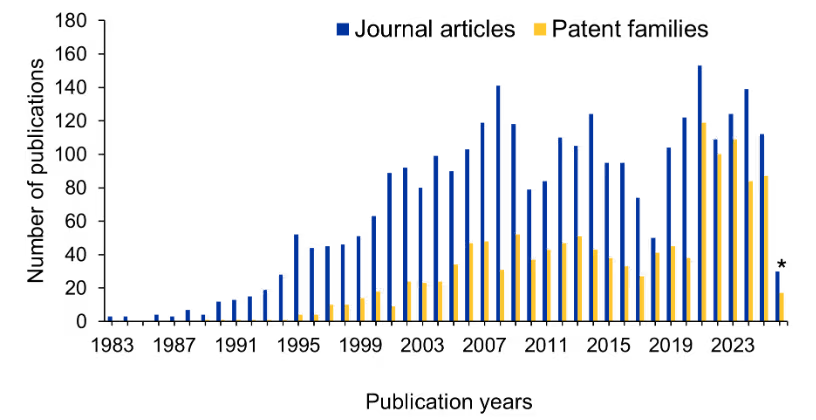
Uma análise das tendências de publicações e patentes usando as ferramentas SciFinder® e CAS IP Finder, com tecnologia STNTM, que fornecem acesso à CAS Content Collection™, o maior repositório de informações científicas publicadas com curadoria humana, oferece uma visão geral da atividade de pesquisa relacionada ao hantavírus ao longo do tempo (Figura 2). A produção geral permaneceu relativamente estável, com contribuições tanto da literatura acadêmica quanto de patentes. No cenário de patentes, uma parcela notável dos registros refere-se a tecnologias associadas a vacinas, juntamente com atividade documentada em diagnósticos e abordagens terapêuticas, incluindo agentes antivirais. Isso ilustra o engajamento contínuo em pesquisa em múltiplas estratégias de intervenção para o hantavírus.
Contexto adicional é fornecido pela Figura 3, que resume os principais termos indexados pela CAS associados a publicações de periódicos e patentes identificadas usando o CAS IP Finder em componentes virais, respostas imunes e estratégias terapêuticas investigadas no contexto da pesquisa sobre hantavírus.
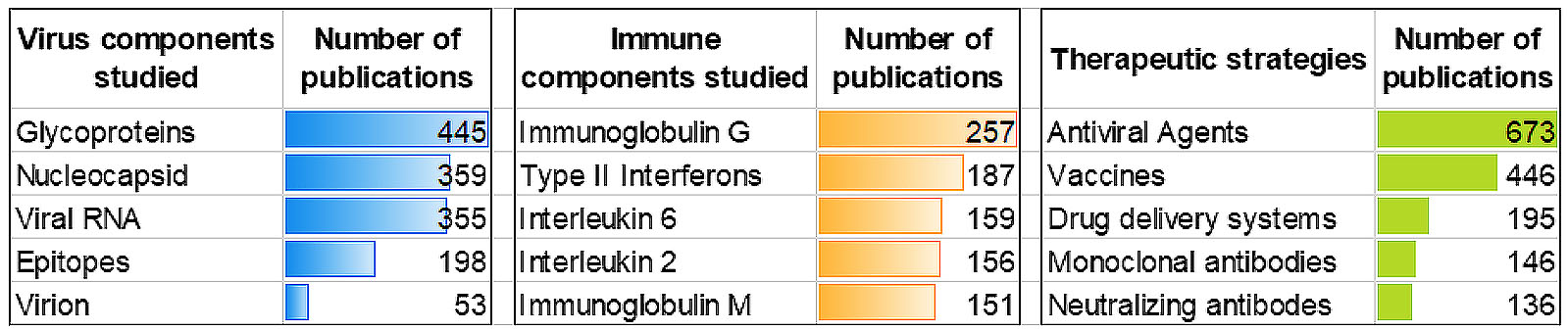
Entre os componentes virais, glicoproteínas, proteínas do nucleocapsídeo e RNA viral são as entidades estudadas com mais frequência, refletindo seus papéis centrais na entrada viral, replicação e reconhecimento imune. Pesquisas relacionadas a epítopos destacam ainda mais os esforços sustentados na caracterização antigênica relevante para diagnósticos, design de vacinas e estudos de resposta imune. Do lado do hospedeiro, componentes imunes como imunoglobulina G (IgG), imunoglobulina M (IgM), interferons tipo II e interleucinas-chave aparecem com destaque, refletindo a investigação contínua das respostas imunes associadas à infecção e à progressão da doença.
Dentro das estratégias terapêuticas, os agentes antivirais representam a maior parte das publicações, refletindo uma ampla exploração de compostos e abordagens destinadas a inibir a replicação viral ou modular as interações hospedeiro-vírus. A pesquisa nesta área expandiu-se além da ribavirina para incluir análogos de nucleosídeos de amplo espectro, como o favipiravir, que demonstrou eficácia protetora contra múltiplas espécies de hantavírus em modelos animais por meio da inibição da atividade da RNA polimerase dependente de RNA viral. Esforços mais recentes exploraram antivirais direcionados ao hospedeiro e abordagens baseadas em interferência de RNA visando segmentos conservados do genoma viral, embora desafios relacionados à entrega in vivo, estabilidade e durabilidade permaneçam.
A pesquisa relacionada a vacinas também representa uma proporção substancial da literatura, refletindo a avaliação contínua de estratégias profiláticas direcionadas a antígenos virais, particularmente glicoproteínas. Estudos recentes apontam para um interesse crescente em plataformas de ácidos nucleicos baseadas em glicoproteínas, incluindo vacinas de DNA e mRNA projetadas para estabilizar conformações de pré-fusão do complexo Gn/Gc, com o objetivo de aumentar a imunogenicidade e a eficácia protetora.
Paralelamente, sistemas de entrega de medicamentos, incluindo abordagens baseadas em nanopartículas e outras abordagens avançadas de entrega, estão representados, indicando interesse contínuo em estratégias orientadas à entrega, juntamente com a pesquisa de antivirais e vacinas. Publicações indexadas sob anticorpos monoclonais e anticorpos neutralizantes refletem ainda mais estratégias terapêuticas direcionadas focadas na neutralização viral e intervenção mediada pelo sistema imune. Anticorpos monoclonais totalmente humanos isolados de sobreviventes de hantavírus, bem como preparações de anticorpos policlonais, como o SAB 163 produzido usando bovinos transcromossômicos, demonstraram forte proteção pós-exposição contra diversas cepas de hantavírus em modelos pré-clínicos.
Prevenção e estratégias de saúde pública
Na ausência de tratamentos antivirais específicos, a prevenção continua sendo a pedra angular do controle do hantavírus. Estratégias ambientais eficazes incluem a vedação de edifícios contra roedores, a proteção do armazenamento de alimentos, a eliminação de locais de nidificação perto de habitações humanas e a manutenção de um gerenciamento de resíduos adequado para reduzir a atração de roedores. Medidas de proteção pessoal, como o uso de respiradores com filtro HEPA ao limpar espaços potencialmente contaminados, o emprego de técnicas de limpeza úmida para minimizar a aerossolização e evitar habitats de roedores, também são cruciais.
A educação pública também é essencial, particularmente em regiões endêmicas. A comunicação de risco direcionada, avisos de viagem e treinamento para grupos de alto risco, como trabalhadores ao ar livre e pesquisadores, podem reduzir significativamente a exposição. Em regiões onde o vírus Andes circula, precauções adicionais para contatos próximos de indivíduos infectados podem ser justificadas.
Hantavírus em um mundo em transformação
O hantavírus fornece insights importantes sobre a dinâmica evolutiva das doenças zoonóticas. Como outros patógenos transmitidos por roedores, ele persiste em reservatórios naturais com transbordamento periódico para populações humanas. O surgimento de cepas capazes de transmissão limitada de humano para humano destaca o potencial evolutivo desses vírus e ressalta a importância da abordagem de Saúde Única (One Health), integrando sistemas de vigilância humana, animal e ambiental.
De forma mais ampla, o hantavírus ilustra os desafios impostos por infecções emergentes "negligenciadas", patógenos que causam doenças esporádicas, porém graves, sem transmissão sustentada. Essas ameaças exigem estratégias de preparação distintas focadas em monitoramento ecológico, detecção precoce e sistemas robustos de cuidados de suporte.
Embora seja improvável que o hantavírus cause grandes surtos globais, sua importância reside no que revela sobre a mudança nos riscos de doenças. Alterações ambientais, modificações nos habitats de roedores e o aumento da mobilidade humana estão redefinindo os padrões de exposição de formas sutis, porém significativas.
Compreender o hantavírus hoje, portanto, não se trata apenas de rastrear surtos isolados, mas de reconhecer como vírus estabelecidos se adaptam a condições ecológicas e sociais em transformação. Isso é fundamental, pois muitos casos são silenciosos e graduais, mas podem rapidamente se tornar evidentes e graves.