


Resumo executivo
- O vírus Ebola pertence à família Filoviridae e existe como múltiplas espécies com patogenicidade variável, com taxas de mortalidade que historicamente atingiram 90% em alguns surtos.
- O vírus se espalha por meio do contato direto com sangue, fluidos corporais e materiais infectados, bem como pela exposição a reservatórios de vida selvagem infectados, como morcegos frugíveros e primatas não humanos.
- A resposta a surtos evoluiu drasticamente: a epidemia de 2018-2020 na RDC demonstrou o impacto de uma vigilância aprimorada, diagnósticos rápidos e estratégias de vacinação coordenadas em comparação com epidemias anteriores.
- As vacinas atualmente aprovadas utilizam plataformas de vetores virais (sistemas rVSV e adenovirais) com eficácia comprovada contra o Zaire ebolavirus, mas não existem vacinas licenciadas amplamente distribuídas para as espécies Sudão ou Bundibugyo.
Em maio de 2026, autoridades de saúde na África Central soaram novamente o alarme sobre um novo surto da doença pelo vírus Ebola (DVE) que se espalha por partes da República Democrática do Congo e de Uganda. O que preocupou imediatamente os cientistas foi o envolvimento suspeito da rara cepa Bundibugyo, uma espécie para a qual não existe atualmente nenhuma vacina licenciada especificamente validada ou amplamente distribuída. O surto reacendeu rapidamente as discussões sobre a preparação global para surtos, vigilância transfronteiriça, equidade na vacinação e a crescente ameaça de transbordamentos zoonóticos em regiões ecologicamente perturbadas.
Este ressurgimento serve como um lembrete contundente de por que o Ebola continua sendo uma das doenças infecciosas mais temidas: as taxas de mortalidade podem chegar a 90%, o vírus se espalha por contato humano durante os surtos e pode devastar sistemas de saúde já frágeis em poucas semanas. Além das manchetes alarmantes, o Ebola também se tornou um campo de testes crucial para a ciência moderna de surtos, desde a vigilância genômica em tempo real até plataformas de vacinas revolucionárias que foram implantadas em poucos meses durante surtos recentes.
A família do vírus Ebola
O vírus Ebola pertence à família Filoviridae, gênero Orthoebolavirus e é caracterizado por uma estrutura filamentosa e um genoma de RNA de fita simples de sentido negativo (Figura 1). Várias espécies do vírus são conhecidas por infectar humanos, incluindo o Zaire ebolavirus (EBOV), o vírus Sudão (SUDV) e o vírus Bundibugyo (BDBV), cada um com graus variados de patogenicidade. Entre eles, o Zaire ebolavirus tem sido historicamente associado às taxas de mortalidade mais altas, chegando a 90% em alguns surtos, embora surtos mais recentes com melhor manejo clínico tenham mostrado taxas de letalidade menores. O vírus foi identificado pela primeira vez em 1976 durante surtos simultâneos no que é hoje a República Democrática do Congo e o Sudão, estabelecendo as bases para décadas de investigação virológica e epidemiológica. Compreender as diferenças entre essas espécies é fundamental para a resposta a surtos: cada uma requer abordagens diagnósticas personalizadas e a cobertura vacinal varia significativamente; embora a Ervebo proteja contra o Zaire ebolavirus, não existem vacinas licenciadas para as espécies Bundibugyo ou Sudão, deixando as populações vulneráveis durante surtos causados por essas cepas.

Figura 1: Representação esquemática do vírion do vírus Ebola. Ilustração criada usando BioRender
Manifestação da doença e dinâmica de transmissão
A doença pelo vírus Ebola (DVE) é uma enfermidade aguda, muitas vezes grave, caracterizada por sintomas inespecíficos como febre de início súbito, fadiga, mialgia, dor de cabeça e dor de garganta, que podem progredir para vômitos, diarreia, erupções cutâneas, comprometimento das funções renal e hepática e, em muitos casos, hemorragias internas e externas. A transmissão ocorre por meio do contato direto com sangue, secreções, órgãos ou outros fluidos corporais de indivíduos infectados ou superfícies contaminadas, bem como pela exposição a animais selvagens infectados (particularmente morcegos frugíveros e primatas não humanos), que são considerados reservatórios naturais. A patogênese da DVE envolve a entrada do vírus através de superfícies mucosas ou pele lesionada, seguida de replicação rápida em monócitos, macrófagos e células dendríticas, levando a respostas imunes desreguladas, tempestade de citocinas e danos teciduais generalizados. Isso é acompanhado por disfunção endotelial, coagulopatia e aumento da permeabilidade vascular, resultando em falência de múltiplos órgãos e, em casos graves, morte.
Principais surtos de Ebola
Vários surtos de Ebola ocorreram desde 1976. A maior e mais devastadora epidemia ocorreu na África Ocidental entre 2014 e 2016, afetando principalmente a Guiné, a Libéria e Serra Leoa, com mais de 28.600 casos e 11.300 mortes (Figura 2).A escala desta epidemia sobrecarregou sistemas de saúde frágeis, expondo lacunas críticas na preparação, incluindo a escassez de equipamentos de proteção individual, profissionais de saúde treinados e capacidade diagnóstica, causando medo generalizado e perturbação econômica. Respostas internacionais tardias, combinadas com desconfiança social e desinformação, dificultaram ainda mais os esforços de controle.
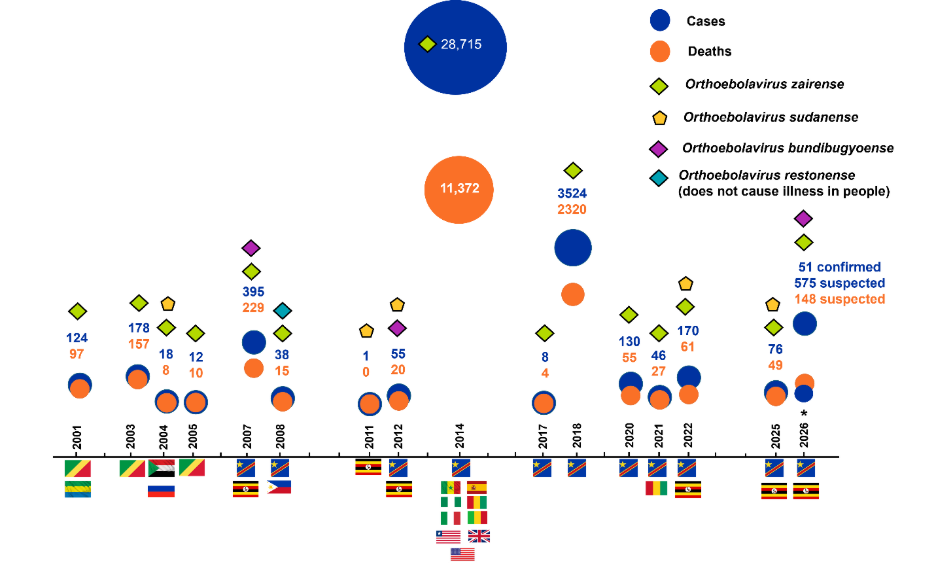
Figura 2: Tendências nos surtos da doença pelo vírus Ebola (2001–2026), mostrando casos e mortes por países e surtos. Marcadores coloridos indicam as espécies de Ebolavirus, destacando padrões na distribuição geográfica e ocorrência específica de cepas. *Dados de 2026 incluídos até 21 de maio. Fonte: Centros de Controle e Prevenção de Doenças
Outro grande surto ocorreu na República Democrática do Congo (RDC) entre 2018 e 2020, resultando em aproximadamente 3.481 casos e 2.299 mortes, apesar de desafios como conflitos armados e deslocamento populacional. Crucialmente, este surto demonstrou como é uma preparação eficaz: vigilância aprimorada, diagnósticos rápidos, estratégias de vacinação e resposta global coordenada contribuíram para um confinamento mais eficaz em comparação com epidemias anteriores.
O Zaire ebolavirus tem sido responsável por quase todos os grandes surtos, incluindo a epidemia de 2014–2016, enquanto os vírus Sudão e Bundibugyo causaram surtos menores e menos frequentes. Em todos os surtos, as taxas de letalidade permanecem altas, geralmente com média em torno de 50% e variando de ~25% a 90%, dependendo do surto e da cepa. Surtos recorrentes e localizados, particularmente na RDC, destacam a natureza endêmica contínua da doença pelo vírus Ebola na África Central.
Tendências globais em pesquisa e inovação sobre o Ebola
Uma análise das tendências de publicações e patentes usando o SciFinder® da CAS e o CAS IP Finder, com tecnologia STNTM, ferramentas que fornecem acesso à CAS Content Collection™, o maior repositório de informações científicas publicadas com curadoria humana, oferece uma visão geral da atividade de pesquisa relacionada ao Ebolavirus ao longo do tempo (Figura 3). A pesquisa sobre o Ebola tem sido impulsionada predominantemente pela produção acadêmica, com publicações em periódicos representando a maioria (~63%) e superando substancialmente a atividade de patentes. Essa distribuição indica uma forte ênfase na ciência fundamental e exploratória, em vez da comercialização imediata. No entanto, o aumento paralelo nos pedidos de patentes, juntamente com as publicações, reflete uma mudança gradual em direção à pesquisa aplicada e ao desenvolvimento terapêutico à medida que observamos mais surtos.
Os dados revelam um padrão preocupante: esperamos por desastres para agir. A atividade de pesquisa aumenta drasticamente após grandes surtos e, em seguida, estabiliza. Esse ciclo reativo nos deixa perpetuamente despreparados. Apenas a epidemia de 2014–2016 catalisou avanços sem precedentes no desenvolvimento de vacinas e terapias baseadas em anticorpos, demonstrando tanto a capacidade da sociedade para a inovação rápida quanto a tendência de se desengajar assim que as manchetes desaparecem. Isso levanta uma questão crítica: como podemos sustentar o ímpeto da pesquisa entre os surtos para garantir uma preparação genuína?
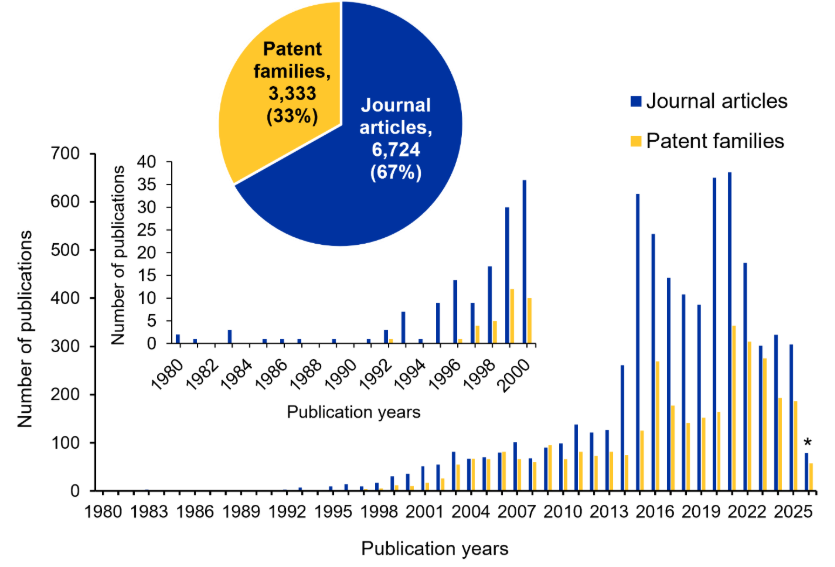
Figura 3: Tendências anuais na produção de pesquisa sobre o Ebola, mostrando artigos de periódicos e famílias de patentes de 1980 a 2026. O detalhe destaca a atividade inicial (1980–2000), e o gráfico de pizza resume a distribuição geral de artigos de periódicos e famílias de patentes. *Dados de 2026 parciais até 21 de maio. Fonte: CAS Content Collection.
Panorama dos ensaios clínicos da doença pelo vírus Ebola
Os dados de ensaios clínicos para a doença pelo vírus Ebola refletem mudanças nas prioridades de pesquisa e um pipeline de desenvolvimento em maturação. Os ensaios concluídos estão amplamente concentrados nas fases iniciais, enquanto os estudos em andamento estão principalmente nas Fases II–III e Fase IV, indicando a progressão de candidatos existentes em vez da expansão de novos. O número limitado de ensaios ativos de Fase I sugere uma desaceleração na inovação em estágio inicial (Figura 4A).
Estudos focados em vacinas dominam os ensaios concluídos e em andamento, com comparativamente menos investigações terapêuticas (Figura 4B; veja a Tabela 1 para mais detalhes sobre o desenvolvimento de vacinas). Esse desequilíbrio reflete os desafios inerentes à pesquisa sobre o Ebola, incluindo a viabilidade de ensaios dependentes de surtos, requisitos rigorosos de biossegurança e restrições logísticas.
Obstáculos operacionais também moldaram o panorama dos ensaios. Conduzir estudos durante surtos levanta desafios éticos e práticos, como definir grupos de controle, obter consentimento informado em condições de crise e manter a infraestrutura em regiões com recursos limitados ou afetadas por conflitos. Requisitos de cadeia de frio, escalabilidade de fabricação e desconfiança da comunidade complicam ainda mais a execução.
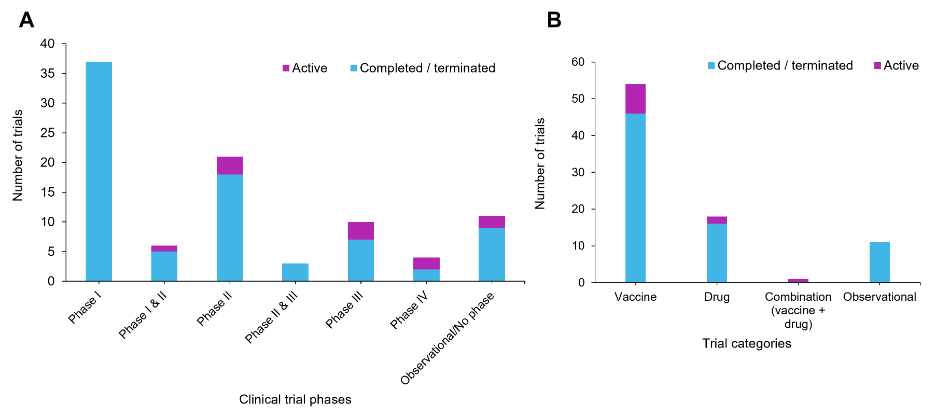
Figura 4: Distribuição de ensaios clínicos de intervenções para a doença pelo vírus Ebola. (A) Distribuição por fase dos ensaios clínicos categorizados como concluídos e em andamento em diferentes fases. (B) Distribuição de ensaios clínicos por tipo de intervenção para estudos concluídos e em andamento. Fonte: ClinicalTrials.gov acessado em 21 de maio de 2026
Apesar dessas barreiras, a pesquisa sobre o Ebola impulsionou inovações importantes. Desenhos de ensaios adaptativos, vias regulatórias rápidas e modelos de engajamento comunitário surgiram para equilibrar a urgência com a segurança. Notavelmente, os ensaios de vacinação em anel forneceram uma abordagem ética e eficiente para avaliar vacinas. Essas inovações informaram posteriormente as estratégias clínicas e regulatórias da COVID-19, ressaltando o impacto mais amplo do Ebola na preparação para epidemias.
Terapias para o Ebola: Status atual e desafios
O desenvolvimento terapêutico para a DVE tem se concentrado em agentes antivirais e intervenções baseadas em anticorpos monoclonais, sendo que estes últimos demonstraram o sucesso clínico mais significativo. Terapias com anticorpos monoclonais, como Inmazeb (REGN-EB3) e ansuvimab (Ebanga), mostraram reduções substanciais na mortalidade em ensaios clínicos randomizados e receberam aprovação da FDA em 2020. Essas terapias atuam visando a glicoproteína viral, neutralizando assim a entrada do vírus e promovendo sua eliminação.
Em contraste, antivirais de pequenas moléculas que visam a polimerase de RNA viral, incluindo o remdesivir, demonstraram eficácia comparativamente limitada em ambientes clínicos. Outras abordagens investigacionais, como favipiravir, galidesivir e brincidofovir, mostraram promessas in vitro ou pré-clínicas iniciais, mas produziram resultados inconsistentes ou inconclusivos na avaliação clínica. Terapias baseadas em interferência de RNA, incluindo formulações de siRNA como o TKM-130803, também foram exploradas, embora os benefícios clínicos permaneçam não comprovados. Apesar desses avanços, o pipeline terapêutico permanece relativamente estreito, com poucos candidatos novos progredindo no desenvolvimento em estágio inicial. Desafios persistentes, incluindo a execução de ensaios dependentes de surtos, altos requisitos de biossegurança e limitações de infraestrutura, continuam a restringir a expansão e a diversificação de estratégias terapêuticas nesta área.
Vacinas contra o Ebola: Progresso e direções futuras
O desenvolvimento de vacinas contra o Ebola progrediu de conceitos experimentais para estratégias preventivas validadas, com várias vacinas agora aprovadas para uso. Plataformas baseadas em vetores virais, particularmente o vírus da estomatite vesicular recombinante (rVSV) e sistemas adenovirais, dominam o panorama atual, refletindo a convergência em torno de tecnologias eficazes e escaláveis. Essas vacinas diferem em seu design, oferecendo compensações entre proteção rápida de dose única, adequada para o controle de surtos, e regimes de múltiplas doses que fornecem uma imunidade mais ampla e potencialmente mais duradoura. Apesar do sucesso demonstrado, permanecem desafios importantes, incluindo requisitos de cadeia de frio, conformidade com múltiplas doses e a influência da imunidade pré-existente ao vetor. As principais características das vacinas atualmente aprovadas estão resumidas na Tabela 1. Consequentemente, os esforços atuais estão direcionados para abordagens de próxima geração que priorizam a preparação proativa, incluindo cobertura contra pan-filovírus, melhor termoestabilidade, imunidade de longa duração e plataformas adaptáveis, como o mRNA. Essa mudança sinaliza uma transição da resposta reativa a surtos para a prontidão estratégica, apoiada por avanços na fabricação, estocagem e capacidades de implantação rápida.
Tabela 1: Principais características das vacinas aprovadas contra o Ebola
| Vacina | Ervebo (rVSV-EBOV) | Zabdeno/Mvabea (Ad26–MVA) | Ad5-EBOV | GamEvac-Combi |
|---|---|---|---|---|
| Plataforma/vetor | Vírus da estomatite vesicular recombinante (rVSV), vivo atenuado, com competência de replicação | Adenovírus sorotipo 26 (Ad26) como dose inicial + Modified Vaccinia Ankara (MVA) como reforço | Adenovírus recombinante tipo 5 (Ad5) | Vetor heterólogo VSV + Ad5 |
| Fabricante | Merck, NewLink Genetics, PHAC | Johnson & Johnson (divisão Janssen), Bavarian Nordic | BIT, CanSino (China) | Instituto de Pesquisa Gamaleya de Epidemiologia e Microbiologia (Rússia) |
| Esquema de dosagem | Dose única | Duas doses (com oito semanas de intervalo) | Dose única | Duas doses (com 21 dias de intervalo) |
| Alvo (antígeno/cobertura) | Glicoproteína (GP) do EBOV; principalmente Zaire ebolavirus | Multivalente: EBOV, vírus do Sudão (SUDV), vírus de Marburg (via Mvabea) | GP do EBOV | GP do EBOV |
| Principais vantagens | Alta eficácia (~97–100% em surtos); proteção rápida; forte imunogenicidade; anticorpos duradouros (até ~2 anos); adequado para surtos (vacinação em anel) | Proteção ampla (potencial pan-filovírus); não replicante (boa segurança); termoestabilidade; adequado para populações vulneráveis | Dosagem simples; imunogênica; estável entre 2–8°C; bem tolerada | Combina as vantagens das plataformas VSV e adenovirais; dose de reforço aumenta a resposta imune |
| Limitações | Requer armazenamento ultracongelado (< -60°C); estabilidade limitada em temperatura ambiente; potencial eliminação viral | Proteção tardia (não ideal para surtos); eficácia inferior em comparação ao Ervebo; adesão a múltiplas doses; possível interferência da imunidade ao adenovírus | A imunidade preexistente ao Ad5 pode reduzir a eficácia; dados limitados sobre durabilidade e nível de proteção | Possível redução da eficácia devido à imunidade ao Ad5; dados publicados limitados sobre durabilidade e limiares de proteção |
| Status regulatório | Aprovada pela FDA e EMA; recomendada pela OMS | Aprovada pela EMA (sob uso excepcional); recomendada pela OMS | Aprovada para uso emergencial (China) | Aprovada para uso emergencial (Rússia) |
| PHAC, Agência de Saúde Pública do Canadá; BIT, Instituto de Tecnologia de Pequim | ||||
Como podemos prevenir futuros surtos da doença pelo vírus Ebola?
O contraste entre os surtos de 2014–2016 e 2018–2020 ilustra o que uma preparação eficaz pode alcançar: a implementação precoce de vacinas, o melhor engajamento comunitário e uma resposta internacional coordenada reduziram significativamente a mortalidade. No entanto, lacunas críticas permanecem. Ainda não temos vacinas amplamente validadas e disponíveis para espécies que não sejam o Zaire Ebolavirus, as opções terapêuticas continuam limitadas e caras, e o financiamento para pesquisa segue um ciclo de altos e baixos atrelado à ocorrência de surtos, em vez de uma preparação sustentada.
Talvez o mais importante seja que a prevenção de surtos por meio de abordagens de Saúde Única, incluindo a redução do desmatamento, a melhoria das práticas de manuseio de carne de caça e o fortalecimento da vigilância de doenças em animais selvagens, recebe muito menos atenção do que a resposta aos surtos. Como o ressurgimento de espécies raras, como o Bundibugyo, destaca, a dependência de estratégias reativas impõe riscos contínuos. O investimento sustentado, o acesso equitativo a contramedidas médicas e a integração de perspectivas ecológicas na prevenção de doenças devem se tornar a norma, não a exceção.