

Executive Summary

  • Composting has shifted from an empirical waste practice into a precision-engineered bioprocess, with industrial facilities now controlling aeration, temperature, and microbial activity at a level of rigor once reserved for chemical reactors.
  • Modern composting performance hinges on four tightly coupled technical domains: environmental parameter control, biological process engineering, materials engineering, and emission control technologies.
  • Materials innovation, ranging from biochar matrices to porous PDMS loaded with iron-based metal-organic frameworks, has moved from passive bulking toward actively designed substrates that steer microbial networks and suppress NH₃ and N₂O emissions.
  • Machine learning, sensor integration, and pilot-scale digital twins are pushing composting from reactive operation toward predictive and prescriptive control, positioning it as a foundational technology for circular bioeconomy and resource recovery strategies.

Composting has quietly moved from backyard piles of leaves to industrial-scale, engineered bioprocesses. Modern facilities now monitor aeration, temperature, and microbial activity with the rigor once reserved for chemical reactors, turning an empirical practice into a controlled biological system. This shift to precision-engineered composting is occurring across four technical domains: environmental parameter control, biological process engineering, materials engineering, and emission control.

Not just for home gardens

Composting is a biologically driven process in which organic waste is transformed into stabilized, nutrient‑rich material through controlled aerobic degradation. Backyard composting is a simple, small-scale process in which household organic waste is biologically decomposed under natural conditions. Typically, it involves layering nitrogen-rich “green” materials (such as kitchen scraps, grass clippings, and fresh leaves) with carbon-rich “brown” materials (such as dry leaves, paper, or wood chips) in a compost bin or pile. The materials are periodically turned to improve aeration, while moisture is maintained at a damp but not waterlogged level to support microbial activity. Over time, naturally occurring microorganisms break down the waste, generating heat and transforming it into a stable, nutrient-rich compost that can be used to improve soil health.

At larger scales, these same principles are translated into industrial operations, where large volumes of organic waste are processed in engineered systems such as windrows, aerated static piles, or invessel reactors. These systems are designed to handle continuous feedstock inputs while maintaining controlled conditions, scaling simple composting practices into structured, high-throughput processes.

To explore how this transformation is reflected in research and innovation, CAS researchers used a search strategy built from CAS‑controlled terms and analyzed data from the CAS Content Collection™ via CAS IP Finder powered by STN™. This analysis identified over 41,970 journal articles and patent families published between 2016 and 2026, providing a strong data foundation to examine how composting practices are being translated into industrial engineering frameworks, as discussed in the following sections.

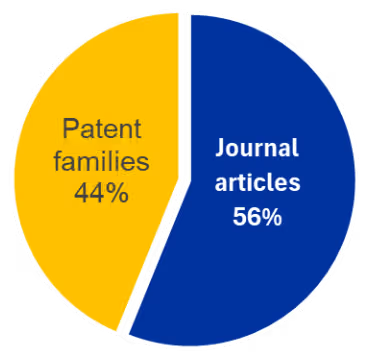
Figure 1. Pie chart comparing showing counts of journal articles and patent families from 2016 through April 2026. Patents make up 44% of the total, and journal articles 56%
Figure 1. Publication distribution of composting research. Data includes 41,970 journal articles and patent families from 2016 to 2026 (data for 2026 is through April). Source: CAS Content Collection.

This data-driven perspective highlights the evolving research landscape, where approximately 56% of journal publications focus on fundamental biological mechanisms, while 44% of patents emphasize applied innovation, showing composting’s progression into a technologically driven field.  

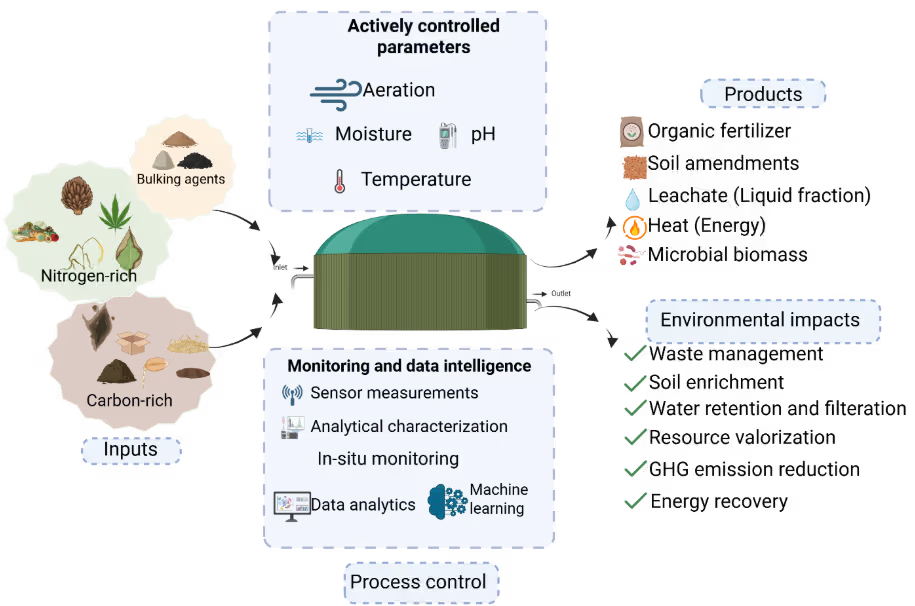
The framework presented in Figure 2 builds on insights derived from this CAS dataset, illustrating how composting has evolved into a structured, controllable bioprocess. In this framework, nitrogen-rich and carbon-rich materials, moisture, and bulking agents are treated as defined input substrates, moving beyond simple waste categorization toward detailed characterization of composition and physicochemical properties.

The composting process is then regulated through controlled parameters, including aeration, moisture, pH, and temperature, which influence microbial activity and degradation kinetics. These controls are supported by a layer of monitoring and data intelligence, where sensor measurements, analytical characterization, in-situ monitoring, and machine learning enable real-time tracking and predictive optimization of process conditions.

Figure 2 Composting framework schematic based on controlled terminologies identified across journal and patent publications. Source: CAS Content Collection. Image Created in  https://BioRender.com. Abbreviations: greenhouse gases: GHG
Figure 2 Composting framework schematic based on controlled terminologies identified across journal and patent publications. Source: CAS Content Collection. Image Created in  https://BioRender.com. Abbreviations: greenhouse gases: GHG

This integrated system produces multiple outputs beyond stabilized compost. The primary product is nutrient-rich compost suitable for soil amendment, while secondary outputs include gaseous emissions (such as CO₂, NH₃, and N₂O), liquid leachates containing dissolved nutrients, and, in some cases, thermal energy (heat) generated during microbial metabolism.  

Beyond material outputs, composting delivers significant environmental and resource-management benefits. It plays a critical role in waste management by diverting organic residues from landfills, while the resulting compost supports soil enrichment, improving nutrient availability, structure, and microbial health.  

Compost application also enhances water retention and filtration capacity, contributing to better soil moisture dynamics and reduced runoff. From a circular economy perspective, composting enables resource valorization by converting waste into valuable products. At the same time, optimized composting systems can contribute to greenhouse gas (GHG) emission reduction compared to uncontrolled decomposition, while the heat generated during microbial activity offers opportunities for energy recovery.

The emergence of data analytics, machine learning, and AI is poised to shift composting from reactive management to predictive and prescriptive control, enabling maturity forecasting, quality prediction, anomaly detection, and multi-objective optimization across energy use, emissions, and product quality. Early deployments of AI-assisted control, pilot-scale digital twins, and molecular diagnostics signal a transition from automation toward increasing autonomy.  

The framework demonstrates how modern composting operates as a closed-loop, data-enabled system in which inputs, process control, monitoring, and outputs are tightly interconnected, enabling optimization across performance, sustainability, and environmental impact objectives.

To further understand the mechanisms underlying this transformation, the key components of modern composting systems can be examined across four technical domains: environmental parameter control, biological process engineering, materials engineering, and emission control technologies.

Environmental parameter control

Environmental conditions establish the operational boundaries within which composting occurs. Recent studies demonstrate the following factors that fundamentally govern composting trajectories.

  • Temperature management, including hyperthermophilic regimes (~70–110 °C) and cold‑adapted strategies (−5 to 30 °C), alters microbial functional potential, decomposition rates, and nitrogen pathways.
  • Aeration rate repeatedly emerges as a critical control knob, affecting microbial succession, oxygen availability, greenhouse gas emissions, humification, and leachate quality. Moderate aeration often achieves the best trade‑off between maturity, emissions mitigation, and nutrient conservation.
  • Initial mixture design (C/N ratio, free air space, moisture) strongly influences downstream outcomes; mathematical optimization models and pilot‑scale validation show that an optimized start reduces process iteration and regulatory risk.

Composting performance is sensitive to early‑stage parameter calibration, which motivates predictive modeling and continuous monitoring.

Biological process engineering

Biological activity is the central driver of composting, transforming complex organic substrates into stable humic matter through coordinated microbial and enzymatic processes. Contemporary biological process engineering prioritizes active optimization of this activity rather than passive accommodation.

Modern studies analyze compost microbiomes using metagenomics sequencing, transcriptomics, and proteomics to characterize microbial succession, functional gene expression, and metabolic pathways. Fungal and bacterial groups play complementary roles in degrading cellulose, hemicellulose, lignin, and bio‑based polymers. This is not merely descriptive; enzyme kinetics modeling quantifies reaction rates, substrate affinity, and inhibition effects, enabling targeted interventions such as optimized microbial consortium inoculation or tailored feedstock design. Similarly, growing patent activity around engineered microbial formulations signals a clear transition from passive biological processes toward actively designed biological systems.

Materials engineering

Materials engineering has introduced improved control over composting dynamics. Recent patents illustrate how composting and organic fertilizer systems are increasingly engineered through materials chemistry to control biological activity, nutrient dynamics, and emissions. Carbon-based biochar matrices derived from agricultural residues function as multifunctional additives. Their high surface area and redox-active functional groups serve simultaneously as microbial carriers, adsorption surfaces, and porosity modifiers. More advanced functional composites, such as porous PDMS (polydimethylsiloxane) loaded with iron-based metal–organic frameworks (Fe‑BTC), reduce ammonia emissions by adsorbing NH₃ and altering gas–surface interactions, while maintaining structural integrity under composting conditions. These materials do not simply improve existing processes; they introduce new design variables for steering microbial networks and emission pathways. In addition to these advanced materials, conventional bulking agents and amendments play a dual role: structural regulation and microbial modulation.

  • Different bulking agents (garden waste, straw, spent mushroom substrate, leaves) reshape pore structure, aeration, and microbial networks, leading to distinct trade‑offs between biodegradation efficiency and gas emissions.
  • Biochar and ceramsite improve free air space, thermal stability, and moisture regulation while influencing microbial succession and nitrogen pathways.
  • Process-integrated materials, such as functional membranes and rotary drum systems, enhance heat retention, gas management, and energy efficiency.

Emission control technologies

As composting systems scale, emission management has become a central engineering challenge, increasingly treated as an integrated design problem linking material properties, microbial activity, and environmental conditions. Emissions, including odorous compounds, greenhouse gases, leachates, and particulates, are influenced by process inefficiencies such as poor oxygenation or moisture imbalance, which drive the formation of volatile organic compounds, ammonia, and sulfur species. Metrics such as COD (chemical oxygen demand: the amount of oxygen required to chemically oxidize both organic and inorganic substances present in water), BOD (biochemical oxygen demand: the amount of oxygen required by microorganisms to biologically decompose organic matter in water), turbidity, and gas permeability are used to assess emission risks, while mitigation strategies now emphasize prevention alongside treatment. Technologies such as biofilters, advanced aeration, photocatalysis, UV degradation, and microwave-assisted stabilization are being deployed to control emissions through improved process design.

Nitrogen dynamics remain critical, with NH₃ and N₂O emissions governed by microbial pathways. Additives like biochar, calcium superphosphate, functional membranes, and bulking agents reduce nitrogen loss by influencing nitrification–denitrification processes and enriching N₂O-reducing microbial communities. Studies consistently show that parameters such as C/N ratio, pH, and inorganic nitrogen species regulate nitrogen cycling genes and emission profiles, highlighting that effective emission control depends on aligning physicochemical conditions with microbial metabolism rather than relying solely on chemical interventions.

What can AI do in composting?

Artificial intelligence (AI) is enabling composting systems to transition from empirical operation to predictive, data-driven control. Machine learning models use process parameters such as temperature, moisture, and C/N ratio to accurately predict compost maturity and optimize degradation pathways. For example, neural network–based prediction of compost stability and composting kinetics have been developed using machine learning. On the monitoring side, studies have highlighted the integration of sensor-based datasets (temperature, gas emissions, moisture) with machine learning algorithms to optimize composting conditions and improve degradation efficiency. AI-enabled composting is already being implemented in industrial systems, where companies are employing sensor and IoT-integrated monitoring and data-driven control to optimize process conditions, improve efficiency, and reduce emissions. AI enables adaptive, sensor-integrated composting systems capable of improving efficiency, reducing emissions, and ensuring consistent product quality.

The future of composting

For your home garden, your biggest concern about composting may be whether or not curbside pickup is available in your area. However, at larger scales, composting is transitioning from a traditional waste management practice to a precision-engineered, data-driven bioprocess. Advances in process control, materials design, and real-time monitoring are enabling greater efficiency, scalability, and consistency in compost production. Integrated systems combining sensor technologies, computational modeling, and AI now allow for improved control of microbial activity, emissions, and nutrient dynamics. As a result, composting is emerging as a key technology within circular economy frameworks, supporting not only waste valorization but also resource recovery, energy integration, and sustainability objectives.

How does home composting compare to its industrial equivalent?

Composting works differently depending on scale, and the science shifts with it. Our research shows roughly four times as many studies on industrial-scale composting as on home and garden composting, which reflects how complex municipal waste processing has become. Here is how the two approaches compare.

Home Composting vs. Industrial Composting
Category Home composting Industrial composting
Scale A few pounds of kitchen scraps and yard waste each week. Tons of organic waste per day.
Activities Hand collection, personal labor, usually part of a home or neighborhood garden. Mechanical aeration, continuous monitoring, multi-stage systems, sometimes combined with other treatments such as anaerobic digestion.
Ingredients Clean, source-separated materials like vegetable peels, coffee grounds, grass clippings, and leaves. Organic material sources that also include plastics, microplastics, heavy metals, and other contaminants.
Research focus Personal health concerns, allergies, and motivation. Greenhouse gas emissions, odor control, life cycle environmental impacts, and the agricultural quality of the finished product.
Latest technology Smart collection bins, compact countertop systems, and heat recovery from residential setups. Energy and nutrient recovery, monitoring, regulatory compliance metrics, and inclusion in broader municipal waste programs.


The two approaches are both important, as each solve different parts of the same problem. Industrial systems divert massive volumes of food and yard waste from landfills. Home and community composting reduces what enters the waste stream in the first place and returns finished compost directly to local soil. Together, they accomplish what neither could manage alone.

Inside the CAS employee composting program

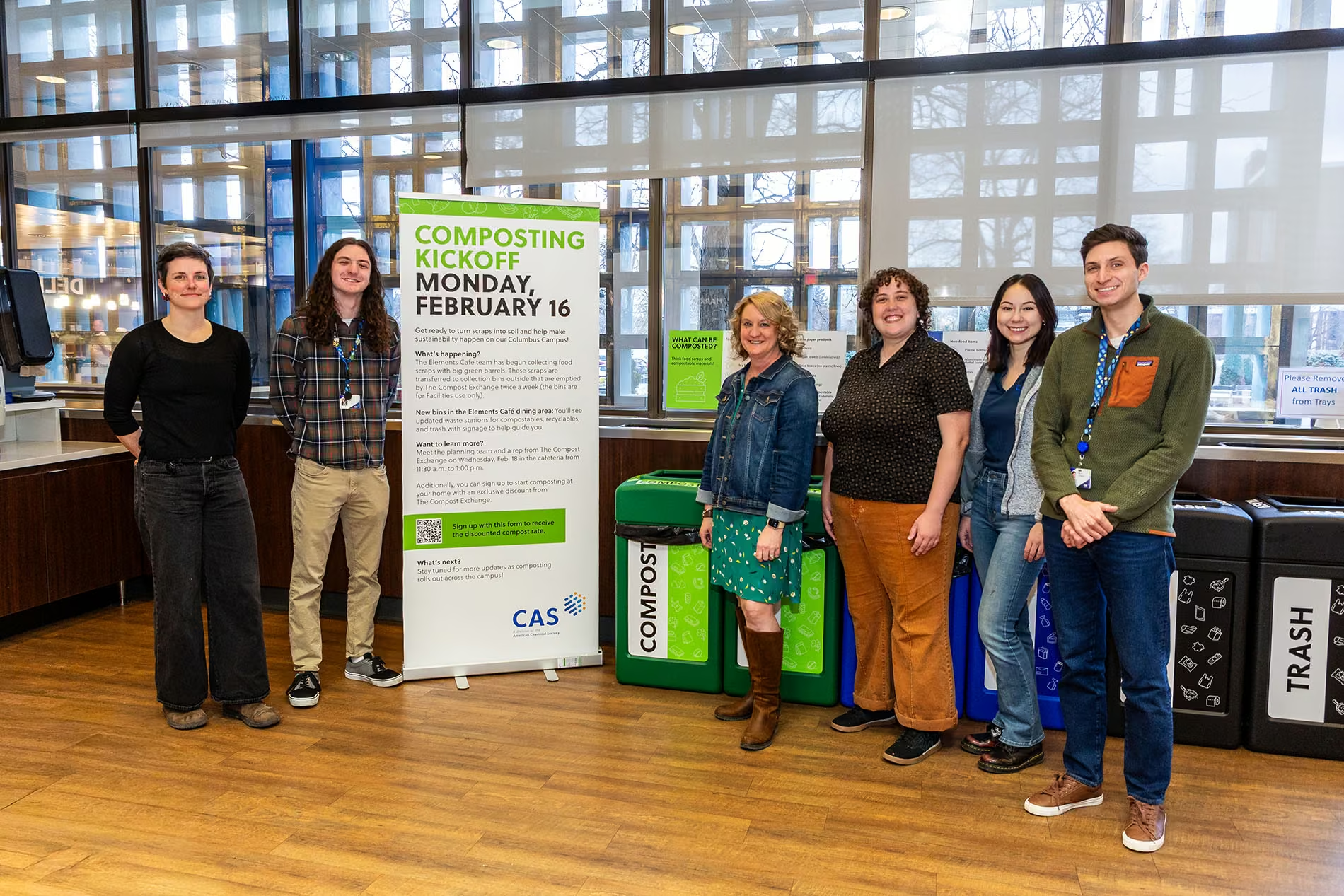
For CAS staff at our Columbus, Ohio campus, composting has become part of the daily routine. Through a partnership with The Compost Exchange, employees sort food scraps, compostables, and recyclables at clearly labeled waste stations in the café, canteens, and conference rooms. In addition, the Compost Exchange offers Columbus colleagues a discount on residential curbside service, helping composting habits make the commute home. The program diverts roughly 5,000 pounds of waste from landfill each month.

From left to right: Madeleine Wright, Noah Fox, Stacy Gibson, Zampa Provenzale, Terra Williams, David Curren

Questions and answers

How is industrial composting different from backyard composting?

Where does composting fit in a green, circular economy?

Are there any downsides to industrial composting?

Related CAS Insights

バイオテクノロジー

A therapeutic revolution: RNA in COVID-19 and beyond

バイオテクノロジー

Bioorthogonal chemistry: exploring the importance of sugars in the cell

バイオテクノロジー

Can we use existing drugs to cure Parkinson’s disease?

Gain new perspectives for faster progress directly to your inbox.