
执行摘要
- 共价有机框架(COFs)是由有机结构单元通过强共价键连接而成的结晶多孔材料。它们完全由碳、氢、氮、氧和硼等轻元素构成,通常结合了超高比表面积(通常超过 2,000 m²/g)、可调孔径以及优异的化学和热稳定性,使其非常适用于催化、能源存储、生物医学和环境应用。
- COFs 常被视为金属有机框架(MOFs)的一种更具可持续性的替代材料,后者获得了 2025 年诺贝尔化学奖。与 MOFs 不同,COFs 不含金属节点,从而消除了潜在的毒性和环境隐患,同时提高了可回收性、水解稳定性和生物相容性。
- 迄今为止研究最广泛的 COFs 包括 TpPa-1、TAPB-DMTA 和 TFB-PDA,它们占据了已发表文献的大部分。大多数领先的 COFs 使用亚胺或 β-酮烯胺键,因其兼具合成简便性、结构多样性以及在酸性或潮湿条件下的化学稳健性而备受重视。
- COFs 的应用涵盖催化(主要研究领域)、电池电极、药物递送、光动力疗法、水净化、气体分离和光电子学。目前仍面临的主要挑战包括扩大合成规模、实现一致的结晶度、提高导电性以及确保在实际环境中的稳定性。人工智能辅助设计以及将 COFs 与 MOFs、聚合物或纳米材料相结合的混合材料,正在加速各方面的进展。
共价有机框架(COFs)是一类引人注目的结晶多孔材料,近年来备受关注。这些有序结构由通过强共价键连接的有机结构单元构成,形成了具有可预测拓扑结构和卓越结构控制能力的扩展二维(2D)或三维(3D)网络。
其他类型的多孔材料近期也频频见诸报端,尤其是金属有机框架(MOFs),它们是2025 年诺贝尔化学奖的主题。MOFs 在气体分离、催化、能源存储以及传感器等生物医学应用方面前景广阔。由于功能相似,COFs 也可用于这些领域。然而,与 MOFs 或沸石等其他多孔材料不同,COFs 完全由碳、氢、氮、氧和硼等轻元素组成。
研究人员可以使用 CAS SciFinder 检索专业的生物学和化学文献,从而识别新型化合物、机制及应用。
了解更多这种无金属的组成使 COF 材料更轻、更不易水解,并赋予其出色的化学和热稳定性。此外,虽然 MOFs 含有可能具有毒性并引发环境问题的金属节点,但 COFs 提供了一种更具可持续性的替代方案,具有实现可回收性和降低毒性的潜力。
COFs 还表现出超高的比表面积(通常超过 2000 m²/g)以及从微孔到介孔尺度的可调孔径。它们具有多项关键优势,包括永久孔隙率、低密度、易于表面功能化,以及进行合成前和合成后修饰的能力。
结晶孔隙、可调架构和结构精确性的独特结合,使 COFs 处于气体存储与分离、催化、传感和光电子学等应用的前沿。随着该领域研究的不断扩展,COFs 有望在下一代技术中发挥更重要的作用,涵盖从碳捕集和清洁能源存储到先进药物递送系统及环境修复等领域。
出版数据证实了人们对 COFs 的兴趣日益浓厚。通过分析CAS Content Collection™(全球最大的人工标引科学信息库),我们确认自 2005 年 Yaghi 等人发现 COFs 以来,该领域呈指数级增长(见图 1)。Yaghi et. al(见图 1)。
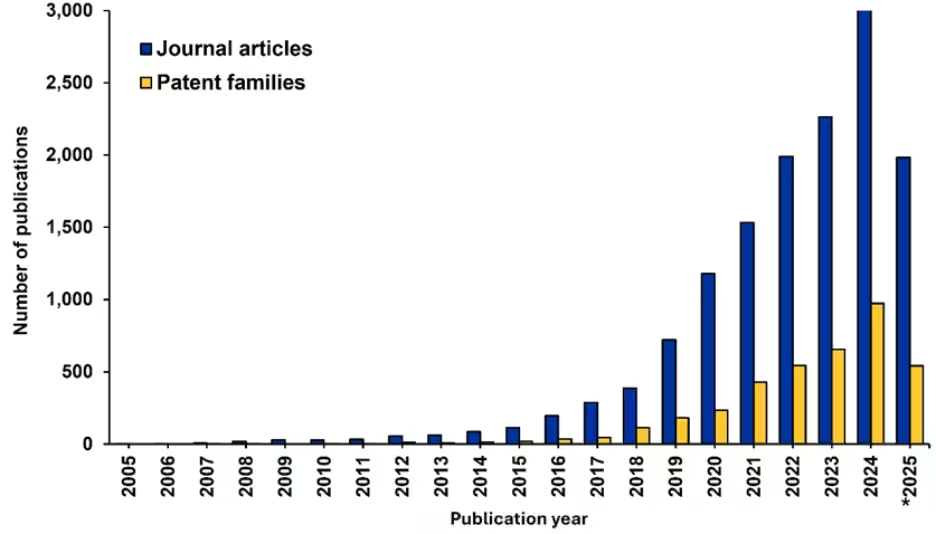
在最初的十年里,出版活动相对平稳,反映了该领域处于早期的探索阶段。从 2016 年左右开始,期刊文章和专利族数量出现了急剧且持续的增长——这一趋势标志着从基础研究向更广泛的应用驱动型研究的转变。这种增长反映了科学界对 COFs 的兴趣不断扩大,及其在现实世界创新中的相关性日益增强。
COF 结构的工作原理
The exceptional versatility of COFs is attributed to their modular synthesis, wherein carefully selected organic monomers are systematically linked to form extended crystalline networks. These monomers are combined under solvothermal or mechanochemical conditions to form specific linkages, such as imine (C=N), β-ketoenamine, boronate ester, hydrazone, azine, and triazine.
The choice of monomers — their geometry, functionality, and linkage type — directly determines whether the COF adopts a 2D layered structure or a 3D framework. In 2D COFs, planar sheets stack via π–π interactions, while in 3D COFs, tetrahedral or C₃-symmetric building blocks lead to interconnected polyhedral networks. In addition, 2D COFs offer high in-plane conductivity, while 3D COFs provide higher surface areas and interconnected pore networks.
Leveraging tools including CAS SciFinder® and CAS STNext® with the data contained in the CAS Content Collection, we identified the most widely used monomers found in COF structures (see Figure 2a). These monomers included aldehydes such as 1,3,5-Triformylphloroglucinol (Tp), 1,3,5-Benzenetricarboxaldehyde (TFB), 2,5-Dimethoxy-1,4-benzenedicarboxaldehyde (DMTA) and amines such as p-Phenylenediamine (Pa-1 or PDA) , 1,3,5-Tris(4-aminophenyl)benzene (TAPB) and 4,4′,4′′-(1,3,5-Triazine-2,4,6-triyl)tris[benzenamine] (TAPT), each offering distinct reactivity, strong conjugation, and structural influence, which support 2D and 3D architectures.
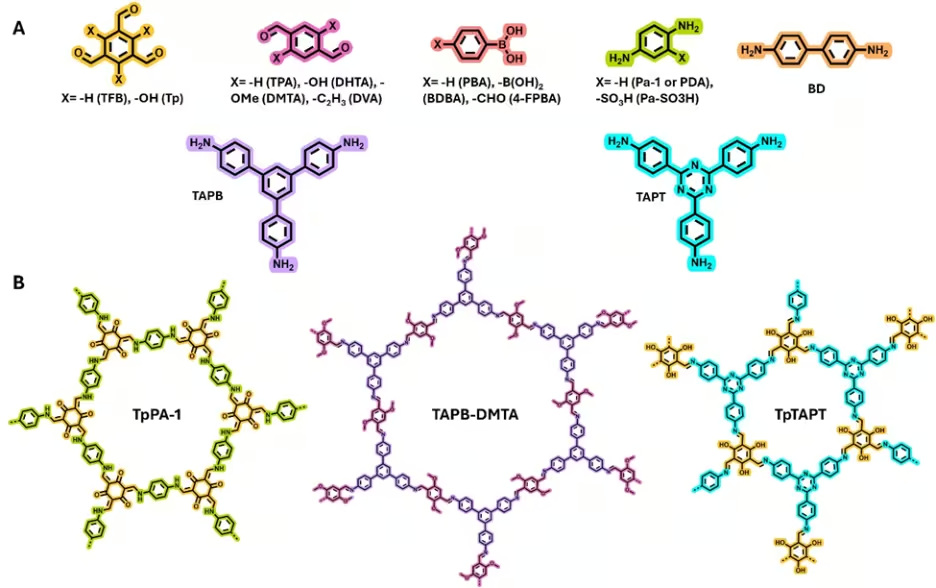
For instance, Tp is valued for forming chemically robust β-ketoenamine linkages when reacting with aromatic amines, leading to COFs that maintain crystallinity even under acidic or humid conditions. This COF structure is therefore ideal for catalysis, sensing, and energy storage.
In addition, more complex, C₃-symmetric amines such as TAPB and TAPT introduce extended π-systems and electron-deficient triazine cores, respectively, which improve crystallinity and chemical resilience. Figure 2b showcases a set of representative COF structures made up of these monomers, like TpPa-1, TpTAPT, and TAPB-DMTA, illustrating the diversity in topology, pore geometry, and dimensionality. These examples demonstrate how variations in monomer geometry (e.g., linear vs. trigonal) and linkage type directly influence material properties such as porosity, crystallinity, and chemical robustness.
We also analyzed the top 10 most frequently utilized COFs in the CAS database (see Figure 3), which revealed TpPa-1 is the most dominant framework, followed by TAPB-DMTA and TFB-PDA. TpPa-1 forms a 2D layered architecture with β-ketoenamine linkages, which confers exceptional stability under harsh chemical and thermal conditions.
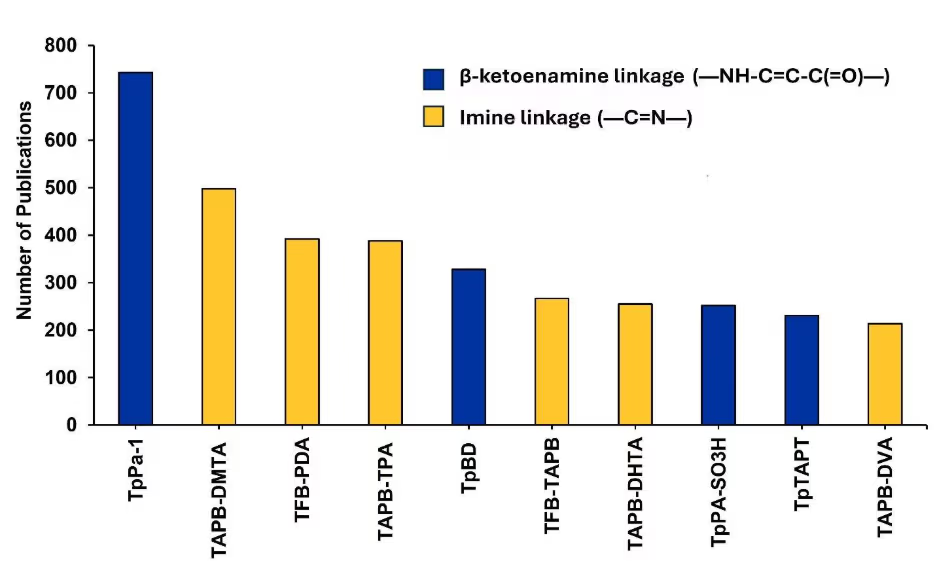
In contrast, TAPB-DMTA and TFB-PDA incorporate imine linkages that facilitate high crystallinity, superior hydrolytic stability, and well-defined pore structures, making them particularly suitable for applications requiring precise molecular organization. Notably, all ten COFs presented in Figure 3 feature either imine or β-ketoenamine linkages, reflecting the widespread use of these linkages in COF design. These linkages offer a unique combination of synthetic accessibility, structural versatility, and chemical robustness. Their ability to form stable, crystalline frameworks with tunable properties makes them the preferred choice for numerous COF research and applications.
COF applications in energy, environmental remediation, and biotechnology
COFs are gaining prominence for their versatility across various scientific and technological domains, including catalysis, biomedicine, sensing, energy and gas storage, and electronics (see Figure 4A). The distribution of relevant publications shows catalysis leading, followed by energy storage and biomedical applications. COFs are also widely employed in environmental remediation due to their non-toxic nature, biocompatibility, and tunable pore sizes tailored to specific pollutants.

Figure 4B focuses on some of the most promising applications of COFs across these domains. For instance, photoactive units (e.g., triazine, porphyrin, benzothiadiazole) and extended π-conjugation in COFs enable visible light absorption, charge separation, and transport. This makes them suitable for photocatalytic and electronic applications such as semiconductors and optoelectronic devices, including light-emitting diodes (LEDs), field-effect transistors (FETs), and photodetectors.
In the energy storage sector, COFs are primarily used in batteries, largely as electrode materials, owing to their ordered porous channels for fast ion diffusion (e.g., Li⁺ or Na⁺) and redox-active sites (e.g., carbonyls, imines, azo units) for reversible charge storage.
In the biomedical field, COFs’ biocompatibility, and modularity support drug delivery and therapeutic uses such as photodynamic therapy, photothermal therapy, and combination therapy. Their high surface area, ordered crystalline porosity, and tunable chemical functionality also enable water purification and desalination; selective sensing of biomolecules, gases, and ions; and efficient adsorption and separation of gases such as CO₂, H₂, and CH₄.
Returning to the top 10 most frequently cited COFs in the literature, we can see how these are used across seven major application domains (see Figure 5). This analysis reveals that nearly all COFs are employed in catalysis, owing to their high surface area, facile functional modification, and excellent recyclability, making them ideal platforms for efficient and selective catalytic processes.
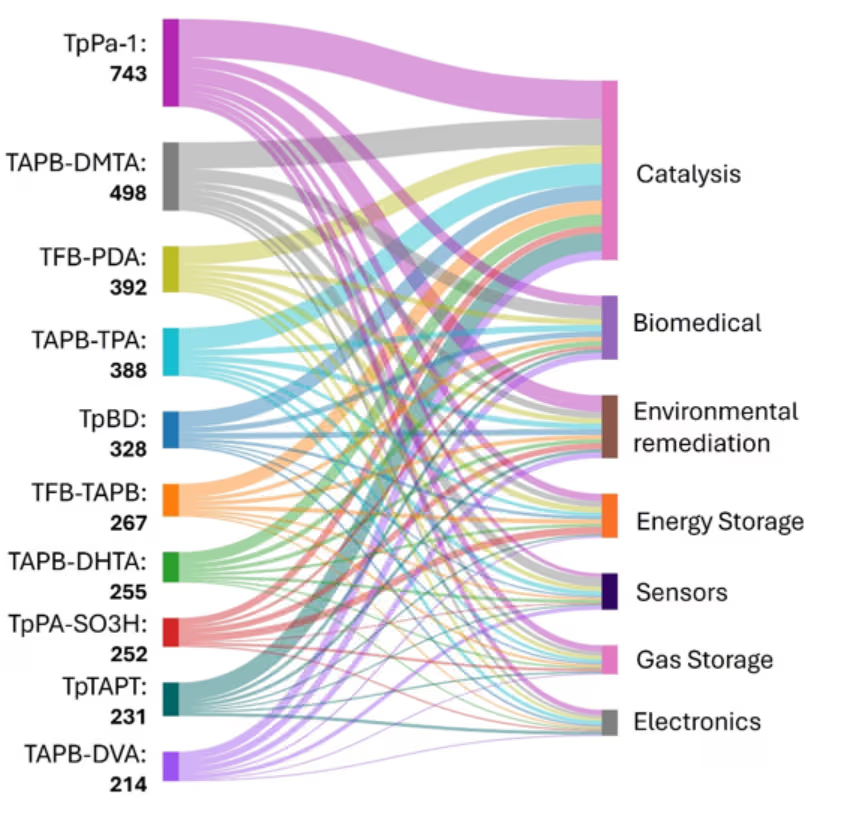
Moreover, while TpPa-1 is also employed for environmental remediation, TAPB-DMTA is widely used for biomedical and sensor applications. Additionally, TpPa-SO3H is prominently used in the energy storage domain. This highlights how the structural and chemical diversity of COFs enables their tailored use across many advanced technologies.
Future outlook for COFs
Despite their promising properties, COFs face several critical challenges that have limited their widespread adoption and commercialization. One of the primary issues is the lack of scalability and reproducibility in synthesis. Many COFs require specific conditions such as solvothermal treatments, long reaction times, or harsh solvents, making large-scale production difficult. Additionally, while COFs are often valued for their crystallinity, achieving high crystallinity and structural uniformity remains a significant challenge, and poor crystallinity can compromise performance.
Limited electrical conductivity in many COFs also restricts their direct use in electronic and energy devices without further modification. Their integration into practical devices remains challenging due to difficulties in processing them into thin films or composites and their susceptibility to degradation in humid, acidic, or oxidative environments.
为应对这些挑战,研究人员正在采取多种战略方法。目前正在开发包括机械化学、微波辅助和室温反应在内的可扩展且更环保的合成方法,以 取代 传统的溶剂热工艺,从而提高生产效率并实现环境友好。
拓扑预测和人工智能辅助设计方面的最新进展,显著加快了新型共价有机框架(COF)结构的发现。通过 引入金属有机框架(MOF)、聚合物甚至纳米材料来开发混合型 COF,也正在开启多功能应用,将 COF 与传统材料的优势相结合。这些进展表明,COF 正突破复杂合成的局限,并朝着特定应用导向的设计方向发展。
得益于其模块化、结晶性和可调性,COF 在能源、气体存储到生物医学等广泛领域具有巨大的改进潜力。随着合成方法学、功能设计和计算筛选技术的不断进步,COF 有望从实验室研究材料转型为可持续和高性能技术的关键赋能者。
相关白皮书: 地缘政治格局变动下半导体化学创新的知识产权战略演进
优化您的战略决策---
本文使用的缩写包括:PBA,苯硼酸;4-FPBA,4-甲酰基苯硼酸;Pa-1 或 PDA,对苯二胺;TpPa-1,1,3,5-三甲酰基间苯三酚与对苯二胺;TAPB-DMTA,1,3,5-三(4-氨基苯基)苯与2,5-二甲氧基-1,4-苯二甲醛;TFB-PDA,1,3,5-苯三甲醛与对苯二胺;TAPB-TPA,1,3,5-三(4-氨基苯基)苯与1,4-苯二甲醛;TpBD,1,3,5-三甲酰基间苯三酚与4,4′-二氨基联苯;TFB-TAPB,1,3,5-苯三甲醛与1,3,5-三(4-氨基苯基)苯;TAPB-DHTA,1,3,5-三(4-氨基苯基)苯与2,5-二羟基-1,4-苯二甲醛;TpPA-SO3H,1,3,5-三甲酰基间苯三酚与2,5-二氨基苯磺酸;TpTAPT,1,3,5-三甲酰基间苯三酚与4,4′,4′′-(1,3,5-三嗪-2,4,6-三基)三苯胺;TAPB-DVA,1,3,5-三(4-氨基苯基)苯与2,5-二乙烯基-1,4-苯二甲醛;TFB,1,3,5-苯三甲醛;Tp,1,3,5-三甲酰基间苯三酚;TAPB,1,3,5-三(4-氨基苯基)苯;TpPa-1,1,3,5-三甲酰基间苯三酚与对苯二胺;TAPB-DMTA,1,3,5-三(4-氨基苯基)苯与2,5-二甲氧基-1,4-苯二甲醛;TpTAPT,1,3,5-三甲酰基间苯三酚与4,4′,4′′-(1,3,5-三嗪-2,4,6-三基)三苯胺;TAPT,4,4′,4′′-(1,3,5-三嗪-2,4,6-三基)三苯胺;BDBA,1,4-苯二硼酸;DHTA,2,5-二羟基-1,4-苯二甲醛;DMTA,2,5-二甲氧基-1,4-苯二甲醛;DVA,2,5-二乙烯基-1,4-苯二甲醛;TPA,1,4-苯二甲醛;Pa-SO3H,2,5-二氨基苯磺酸;BD,4,4′-二氨基联苯