
요약
- 공유 유기 골격(COF)은 강력한 공유 결합으로 연결된 유기 빌딩 블록으로 조립된 결정성 다공성 소재입니다. 탄소, 수소, 질소, 산소, 붕소와 같은 가벼운 원소로만 구성되며, 일반적으로 초고비표면적(종종 2,000 m²/g 이상), 조정 가능한 기공 크기, 우수한 화학적 및 열적 안정성을 결합하여 촉매, 에너지 저장, 생물의학 및 환경 분야에 매우 적합합니다.
- COF는 종종 2025년 노벨 화학상을 수상한 금속 유기 골격(MOF)의 보다 지속 가능한 대응물로 평가받습니다. MOF와 달리 COF는 금속 노드를 포함하지 않아 잠재적인 독성 및 환경 문제를 제거하는 동시에 재활용성, 가수분해 저항성 및 생체 적합성을 향상시킵니다.
- 현재까지 가장 많이 연구된 COF는 TpPa-1, TAPB-DMTA, TFB-PDA이며, 이들이 발표된 문헌의 상당 부분을 차지합니다. 주요 COF는 대부분 이민 또는 β-케토에나민 결합을 사용하며, 이는 합성의 용이성, 구조적 다양성, 산성 또는 습한 조건에서의 화학적 견고성 덕분에 높이 평가받습니다.
- COF의 응용 분야는 촉매(주요 연구 분야), 배터리 전극, 약물 전달, 광역학 치료, 수질 정화, 가스 분리 및 광전자공학에 걸쳐 있습니다. 남아 있는 주요 과제로는 합성 규모 확대, 일관된 결정성 확보, 전기 전도도 개선, 실제 환경에서의 안정성 보장이 있습니다. AI 기반 설계와 COF를 MOF, 고분자 또는 나노 소재와 결합한 하이브리드 소재가 모든 분야에서 발전을 가속화하고 있습니다.
공유 유기 골격(COF)은 최근 더욱 주목받고 있는 결정성 다공성 소재의 매력적인 분류군입니다. 이러한 질서 정연한 구조는 강력한 공유 결합으로 연결된 유기 빌딩 블록으로 구성되며, 예측 가능한 위상과 뛰어난 구조적 제어 능력을 갖춘 확장된 2차원(2D) 또는 3차원(3D) 네트워크를 형성합니다.
최근 다른 유형의 다공성 소재가 주목받고 있는데, 특히 금속 유기 골격(MOF)이 2025년 노벨 화학상의 주제가 되었습니다. MOF는 가스 분리, 촉매, 에너지 저장 및 센서와 같은 생물의학적 용도로 유망합니다. COF 또한 유사한 기능성 덕분에 이러한 응용 분야에 사용될 수 있습니다. 그러나 MOF나 제올라이트와 같은 다른 다공성 소재와 달리 COF는 탄소, 수소, 질소, 산소, 붕소와 같은 가벼운 원소로만 구성됩니다.
연구자들은 CAS SciFinder를 사용하여 전문적인 생물학 및 화학 문헌을 검색하고 새로운 화합물, 메커니즘 및 응용 분야를 식별할 수 있습니다.
자세히 알아보기이러한 비금속 구성은 COF 소재를 더 가볍고 가수분해에 덜 취약하게 만들며, 뛰어난 화학적 및 열적 안정성을 부여합니다. 또한 MOF는 독성이 있을 수 있고 환경 문제를 야기할 수 있는 금속 노드를 포함하는 반면, COF는 잠재적 재활용성과 감소된 독성을 갖춘 보다 지속 가능한 대안을 제공합니다.
또한 COF는 초고비표면적(종종 2000 m²/g 초과)과 미세 기공에서 메조 기공 규모에 이르는 조정 가능한 기공 크기를 나타냅니다. COF는 영구적인 다공성, 낮은 밀도, 용이한 표면 기능화와 함께 합성 전후 변형이 가능하다는 여러 가지 핵심적인 이점을 제공합니다.
결정성 기공, 조정 가능한 구조 및 구조적 정밀도의 독특한 조합은 COF를 가스 저장 및 분리, 촉매, 센싱 및 광전자공학과 같은 응용 분야의 최전선에 위치시켰습니다. 이 분야의 연구가 계속 확장됨에 따라 COF는 탄소 포집 및 청정 에너지 저장부터 첨단 약물 전달 시스템 및 환경 복원에 이르는 차세대 기술에서 더욱 중요한 역할을 할 것으로 기대됩니다.
출판 데이터는 COF에 대한 관심이 증가하고 있음을 입증합니다. 인간이 큐레이션한 최대 규모의 과학 정보 저장소인 CAS Content Collection™을 분석한 결과, 2005년 Yaghi 등에 의해 COF가 발견된 이후 이 분야가 기하급수적으로 성장했음을 확인했습니다(그림 1 참조).
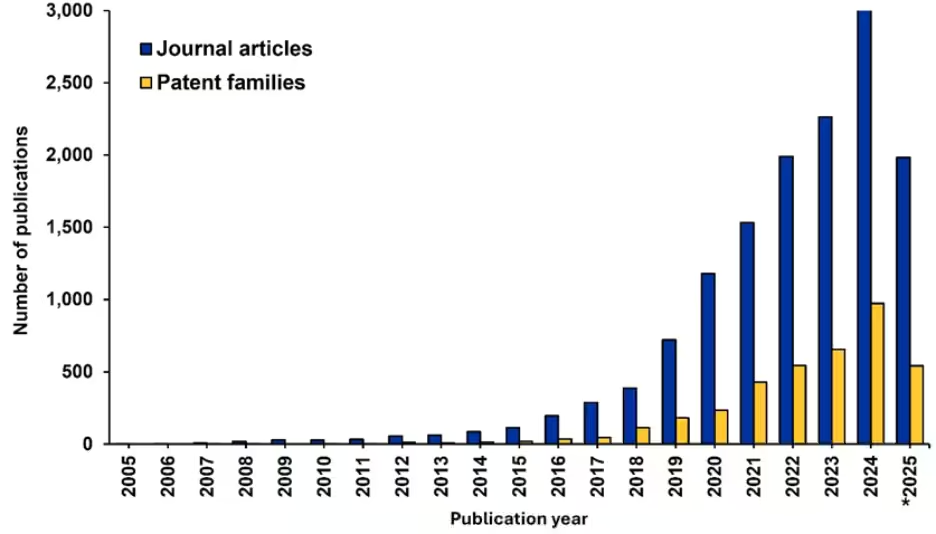
출판 활동은 첫 10년 동안 비교적 완만하게 유지되었으며, 이는 이 분야의 초기 탐색 단계를 반영합니다. 2016년경부터 학술지 논문과 특허 패밀리 수가 급격하고 지속적으로 증가했으며, 이는 기초 연구에서 보다 광범위한 응용 중심 연구로의 전환을 의미합니다. 이러한 성장은 COF에 대한 과학적 관심의 확대와 실제 혁신에서의 관련성 증가를 반영합니다.
COF 구조의 작동 원리
The exceptional versatility of COFs is attributed to their modular synthesis, wherein carefully selected organic monomers are systematically linked to form extended crystalline networks. These monomers are combined under solvothermal or mechanochemical conditions to form specific linkages, such as imine (C=N), β-ketoenamine, boronate ester, hydrazone, azine, and triazine.
The choice of monomers — their geometry, functionality, and linkage type — directly determines whether the COF adopts a 2D layered structure or a 3D framework. In 2D COFs, planar sheets stack via π–π interactions, while in 3D COFs, tetrahedral or C₃-symmetric building blocks lead to interconnected polyhedral networks. In addition, 2D COFs offer high in-plane conductivity, while 3D COFs provide higher surface areas and interconnected pore networks.
Leveraging tools including CAS SciFinder® and CAS STNext® with the data contained in the CAS Content Collection, we identified the most widely used monomers found in COF structures (see Figure 2a). These monomers included aldehydes such as 1,3,5-Triformylphloroglucinol (Tp), 1,3,5-Benzenetricarboxaldehyde (TFB), 2,5-Dimethoxy-1,4-benzenedicarboxaldehyde (DMTA) and amines such as p-Phenylenediamine (Pa-1 or PDA) , 1,3,5-Tris(4-aminophenyl)benzene (TAPB) and 4,4′,4′′-(1,3,5-Triazine-2,4,6-triyl)tris[benzenamine] (TAPT), each offering distinct reactivity, strong conjugation, and structural influence, which support 2D and 3D architectures.
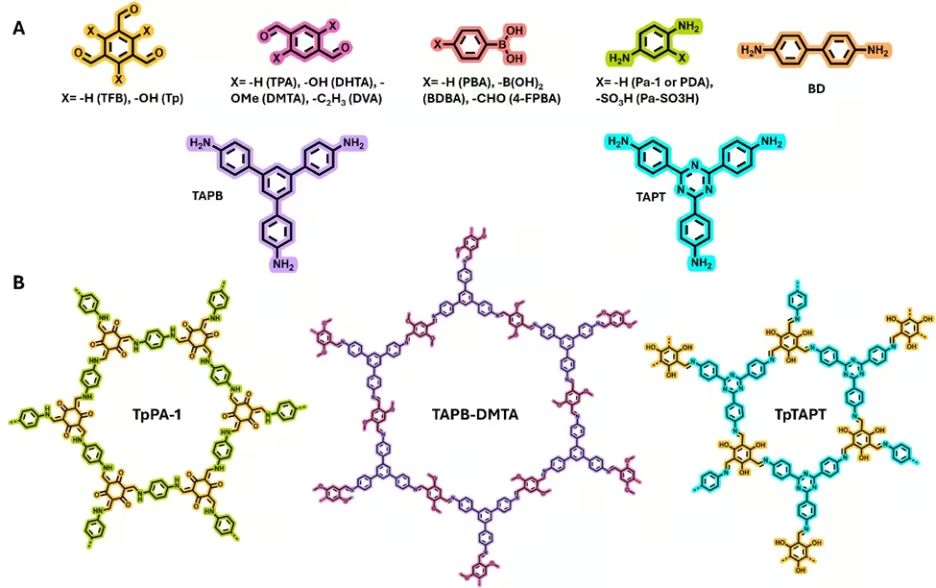
For instance, Tp is valued for forming chemically robust β-ketoenamine linkages when reacting with aromatic amines, leading to COFs that maintain crystallinity even under acidic or humid conditions. This COF structure is therefore ideal for catalysis, sensing, and energy storage.
In addition, more complex, C₃-symmetric amines such as TAPB and TAPT introduce extended π-systems and electron-deficient triazine cores, respectively, which improve crystallinity and chemical resilience. Figure 2b showcases a set of representative COF structures made up of these monomers, like TpPa-1, TpTAPT, and TAPB-DMTA, illustrating the diversity in topology, pore geometry, and dimensionality. These examples demonstrate how variations in monomer geometry (e.g., linear vs. trigonal) and linkage type directly influence material properties such as porosity, crystallinity, and chemical robustness.
We also analyzed the top 10 most frequently utilized COFs in the CAS database (see Figure 3), which revealed TpPa-1 is the most dominant framework, followed by TAPB-DMTA and TFB-PDA. TpPa-1 forms a 2D layered architecture with β-ketoenamine linkages, which confers exceptional stability under harsh chemical and thermal conditions.
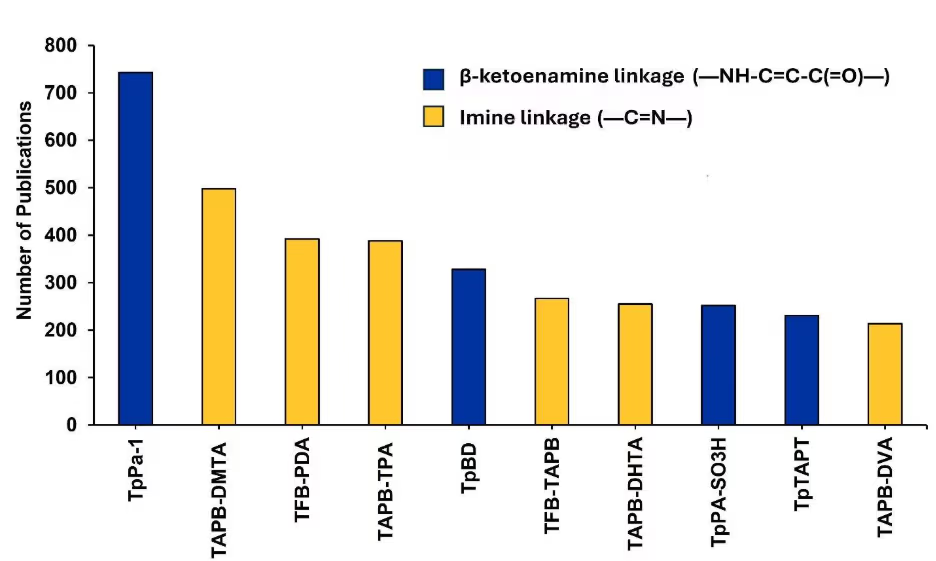
In contrast, TAPB-DMTA and TFB-PDA incorporate imine linkages that facilitate high crystallinity, superior hydrolytic stability, and well-defined pore structures, making them particularly suitable for applications requiring precise molecular organization. Notably, all ten COFs presented in Figure 3 feature either imine or β-ketoenamine linkages, reflecting the widespread use of these linkages in COF design. These linkages offer a unique combination of synthetic accessibility, structural versatility, and chemical robustness. Their ability to form stable, crystalline frameworks with tunable properties makes them the preferred choice for numerous COF research and applications.
COF applications in energy, environmental remediation, and biotechnology
COFs are gaining prominence for their versatility across various scientific and technological domains, including catalysis, biomedicine, sensing, energy and gas storage, and electronics (see Figure 4A). The distribution of relevant publications shows catalysis leading, followed by energy storage and biomedical applications. COFs are also widely employed in environmental remediation due to their non-toxic nature, biocompatibility, and tunable pore sizes tailored to specific pollutants.

Figure 4B focuses on some of the most promising applications of COFs across these domains. For instance, photoactive units (e.g., triazine, porphyrin, benzothiadiazole) and extended π-conjugation in COFs enable visible light absorption, charge separation, and transport. This makes them suitable for photocatalytic and electronic applications such as semiconductors and optoelectronic devices, including light-emitting diodes (LEDs), field-effect transistors (FETs), and photodetectors.
In the energy storage sector, COFs are primarily used in batteries, largely as electrode materials, owing to their ordered porous channels for fast ion diffusion (e.g., Li⁺ or Na⁺) and redox-active sites (e.g., carbonyls, imines, azo units) for reversible charge storage.
In the biomedical field, COFs’ biocompatibility, and modularity support drug delivery and therapeutic uses such as photodynamic therapy, photothermal therapy, and combination therapy. Their high surface area, ordered crystalline porosity, and tunable chemical functionality also enable water purification and desalination; selective sensing of biomolecules, gases, and ions; and efficient adsorption and separation of gases such as CO₂, H₂, and CH₄.
Returning to the top 10 most frequently cited COFs in the literature, we can see how these are used across seven major application domains (see Figure 5). This analysis reveals that nearly all COFs are employed in catalysis, owing to their high surface area, facile functional modification, and excellent recyclability, making them ideal platforms for efficient and selective catalytic processes.
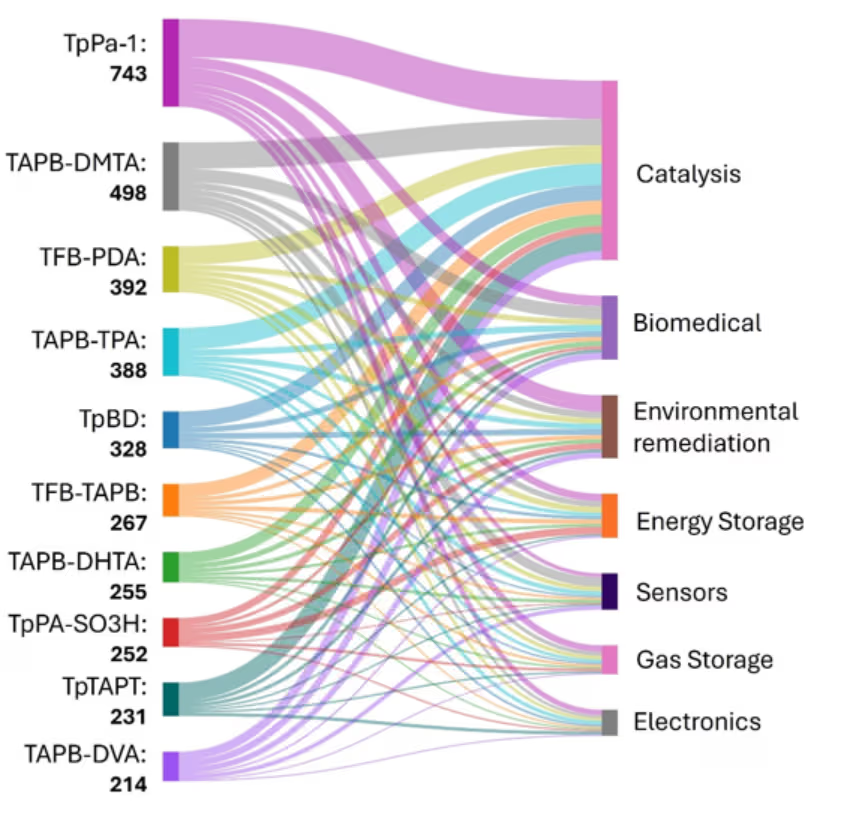
Moreover, while TpPa-1 is also employed for environmental remediation, TAPB-DMTA is widely used for biomedical and sensor applications. Additionally, TpPa-SO3H is prominently used in the energy storage domain. This highlights how the structural and chemical diversity of COFs enables their tailored use across many advanced technologies.
Future outlook for COFs
Despite their promising properties, COFs face several critical challenges that have limited their widespread adoption and commercialization. One of the primary issues is the lack of scalability and reproducibility in synthesis. Many COFs require specific conditions such as solvothermal treatments, long reaction times, or harsh solvents, making large-scale production difficult. Additionally, while COFs are often valued for their crystallinity, achieving high crystallinity and structural uniformity remains a significant challenge, and poor crystallinity can compromise performance.
Limited electrical conductivity in many COFs also restricts their direct use in electronic and energy devices without further modification. Their integration into practical devices remains challenging due to difficulties in processing them into thin films or composites and their susceptibility to degradation in humid, acidic, or oxidative environments.
이러한 과제를 해결하기 위해 연구자들은 여러 전략적 접근 방식을 취하고 있습니다. 기계화학적 반응, 마이크로파 보조 반응, 상온 반응 등 확장 가능하고 친환경적인 합성 방법이 개발되어 기존의 용매열 합성 공정을 대체함으로써 생산 효율성을 높이고 환경 친화적인 공정을 구현하고 있습니다.
최근 위상 예측 및 AI 보조 설계 분야의 발전으로 새로운 COF 구조 발견이 크게 가속화되었습니다. 또한 MOF, 고분자, 심지어 나노소재를 결합한 하이브리드 COF 개발을 통해 COF와 기존 소재의 장점을 융합한 다기능적 역량이 확보되고 있습니다. 이러한 발전은 COF가 복잡한 합성의 한계를 넘어 특정 응용 분야를 염두에 둔 설계 단계로 나아가고 있음을 시사합니다.
모듈성, 결정성, 조절 가능성 덕분에 COF는 에너지 및 가스 저장부터 생물의학에 이르기까지 광범위한 분야를 개선할 수 있는 잠재력을 지니고 있습니다. 합성 방법론, 기능적 설계, 컴퓨터 스크리닝 기술이 지속적으로 발전함에 따라, COF는 유망한 실험실 소재를 넘어 지속 가능하고 고성능인 기술을 구현하는 핵심 요소로 자리매김할 것입니다.
관련 백서: 변화하는 지정학적 환경 속에서 반도체 화학 혁신을 위한 IP 전략의 진화
전략적 의사결정 역량 강화---
본 기사에 사용된 약어는 다음과 같습니다: PBA, 페닐보론산; 4-FPBA, 4-포밀페닐보론산; Pa-1 또는 PDA, p-페닐렌디아민; TpPa-1, 1,3,5-트리포밀플로로글루시놀 및 p-페닐렌디아민; TAPB-DMTA, 1,3,5-트리스(4-아미노페닐)벤젠 및 2,5-디메톡시-1,4-벤젠디카복스알데하이드; TFB-PDA, 1,3,5-벤젠트리카복스알데하이드 및 p-페닐렌디아민; TAPB-TPA, 1,3,5-트리스(4-아미노페닐)벤젠 및 1,4-벤젠디카복스알데하이드; TpBD, 1,3,5-트리포밀플로로글루시놀 및 4,4′-디아미노디페닐; TFB-TAPB, 1,3,5-벤젠트리카복스알데하이드 및 1,3,5-트리스(4-아미노페닐)벤젠; TAPB-DHTA, 1,3,5-트리스(4-아미노페닐)벤젠 및 2,5-디히드록시-1,4-벤젠디카복스알데하이드; TpPA-SO3H, 1,3,5-트리포밀플로로글루시놀 및 2,5-디아미노벤젠술폰산; TpTAPT, 1,3,5-트리포밀플로로글루시놀 및 4,4′,4′′-(1,3,5-트리아진-2,4,6-트리일)트리스[벤젠아민]; TAPB-DVA, 1,3,5-트리스(4-아미노페닐)벤젠 및 2,5-디에테닐-1,4-벤젠디카복스알데하이드; TFB, 1,3,5-벤젠트리카복스알데하이드; Tp, 1,3,5-트리포밀플로로글루시놀; TAPB, 1,3,5-트리스(4-아미노페닐)벤젠; TAPT, 4,4′,4′′-(1,3,5-트리아진-2,4,6-트리일)트리스[벤젠아민]; BDBA, 벤젠-1,4-디보론산; DHTA, 2,5-디히드록시-1,4-벤젠디카복스알데하이드; DMTA, 2,5-디메톡시-1,4-벤젠디카복스알데하이드; DVA, 2,5-디에테닐-1,4-벤젠디카복스알데하이드; TPA, 1,4-벤젠디카복스알데하이드; Pa-SO3H, 2,5-디아미노벤젠술폰산; BD, 4,4′-디아미노디페닐