Raw material sourcing in chemical manufacturing: risks, causes, and actionable paths to resilience

solutions umbrella

Raw material sourcing in chemical manufacturing: risks, causes, and actionable paths to resilience

Global supply chain disruptions are now costing businesses an estimated $184 billion annually. Raw material sourcing is one of the business functions most affected, with 40% of companies reporting higher year-over-year sourcing costs. Many organizations struggle to anticipate the full financial impact of sourcing disruptions, leaving 63% of companies with higher-than-expected losses when supply chains stall.

While no company escapes the impact of these disruptions, chemical manufacturers face an additional, unique layer of complexity: they must trace materials to chemical origins to qualify suppliers with scientific rigor and comply with stringent regulations. Yet, most chemical companies lack the material-level visibility to deliver on these requirements, failing to understand what substances are present in a given material or formulation, where those substances originate across the supply chain, and which of them introduce regulatory, supply, or sustainability risk. As such, for chemical companies, disruptions can have outsized consequences.

A long-standing procurement logic that puts short-term margins over long-term risk mitigation only compounds the issue, leaving companies further exposed to supply breakdown and complicating the path to material sourcing stability.  

If chemical companies are to build true resilience in the face of increasing disruption, they must approach procurement in a new way. They must move from models defined by poor visibility and cost-centric, single-source procurement to composite sourcing frameworks underpinned by deep material-level visibility.  

This article examines the external forces driving sourcing uncertainty, highlights the structural vulnerabilities that amplify their impact, and provides executives and R&D leaders with the actionable strategies needed to build more resilient chemical supply chains.

‍

Three factors contributing to raw material sourcing risk

Three major forces are driving sourcing risk across today’s chemical supply chains:

1. Geopolitical tensions

Trade conflicts, sanctions, and regional tensions are disrupting established transportation routes and narrowing the availability of critical raw materials across multiple regions. For example, the war in Ukraine disrupted access to neon and titanium, while escalating U.S.-China trade tensions have prompted export restrictions on gallium and germanium. In direct response to recent geopolitical risk, 57% of companies have adjusted their raw material procurement strategies over the past 12 months.

When a critical raw material becomes unavailable, finding a viable alternative is rarely straightforward. Sources for critical materials tend to be geographically concentrated, meaning alternative suppliers often face the same regional constraints. Moreover, suppliers outside the affected region may be operating at capacity or commanding significantly higher prices, driving sharp commodity price spikes, compressed margins, and extended delays.

2. Raw material price volatility

Raw material price volatility has also become an enduring feature of material sourcing. Geopolitical instability, energy transition pressures, and regional supply-demand shifts have created a new, higher baseline of uncertainty that organizations must navigate as a chronic procurement condition.  

In the chemical industry, where raw materials account for up to 90% of total cash costs, manufacturers have limited ability to absorb price increases through operational efficiencies alone. Unreliable price forecasting adds pressure on procurement teams, weakening negotiating leverage, reducing pricing flexibility, and compressing margins.

3. Regulatory uncertainty

Regulatory requirements governing substance use are expanding across major jurisdictions, adding further complexity to raw material sourcing decisions. Between 2020 and 2025, for instance, more than 40 substances were added to the REACH Candidate List of substances of very high concern, a 20% expansion.  

Each new entry to regulatory restriction or ban lists can trigger cascading disruptions across the global supply chains that depend on those materials. For example, the push to ban PFAS is already disrupting supply chains for thousands of product categories across sectors such as aerospace, electronics, and medical devices.  

However, unlike downstream industries that can source a replacement material, chemical manufacturers must develop new synthesis routes for the substitute substance, adding a layer of R&D and regulatory complexity.

‍

How supply chain visibility gaps intensify sourcing risk

Limited insight into material origins and upstream supplier networks is common across the chemical industry. It removes the warning time that procurement teams need to respond to a geopolitical shock, a shift in feedstock prices, or a new regulatory restriction before that disruption reaches production. Each of the three forces above, therefore, compounds in a different way.

Upstream visibility gaps intensify geopolitical exposure

Chemical manufacturers sourcing critical raw materials from multi-tier supply chains are exposed to geopolitical risk that extends beyond their direct supplier relationships. However, without visibility into their upstream supply chains, organizations cannot identify their exposure to at-risk regions and are forced to absorb the impact with limited warning. Procurement teams are left with little time to reroute shipments, qualify alternative suppliers, and minimize disruption to production schedules.  

Limited upstream visibility drives reactive price absorption

The cost path for raw materials is determined by dependencies further up the supply chain. Yet, most chemical manufacturers have little visibility into precursors and synthesis routes that determine their input costs, preventing them from anticipating feedstock market pricing and adjusting purchasing strategies. Reacting to upstream cost shifts, rather than anticipating them, compounds margin pressure and limits their ability to offer stable pricing.

Supply chain blind spots and regulatory risks‍

Restricted substances can enter formulations through intermediates or sub-tier suppliers that downstream organizations have no direct relationship with. Companies without full visibility into their supply chain at a material level may therefore not know where regulated or high-risk substances exist throughout their portfolio, meaning compliance risks can remain undetected until a product is flagged or recalled and the company penalized.  

‍

An overlooked internal risk factor: Single-source procurement

In addition to the three major external factors driving supply chain risk, and the lack of visibility that compounds them, companies are also driving risk through long-established sourcing logic: lowest-cost, single-source procurement.  

While this approach can maximize purchasing leverage, simplify supplier management, and improve short-term margins, sole-sourcing of mission-critical materials is noted by the ASCM as the root cause of production halts and material shortages. When supply chain disruption occurs, the absence of an alternative source means that a single event, whether a logistics failure, a supplier shutdown, or a regulatory restriction, can halt the supply of a critical material with no immediate recourse.

For chemical manufacturers, though, the consequences extend beyond a temporary supply gap. When a single-sourced material becomes unavailable, chemical organizations cannot simply switch suppliers. Instead, they must identify, formulate, test, validate, and obtain regulatory approval for a substitute, a process that routinely spans months to years. Thus, for chemical companies, a sourcing disruption can rapidly turn into a burden that leads to lost R&D time, regulatory holdups, and possibly batch failures.  

‍

Rethinking chemical procurement: A five-lever framework to build raw material sourcing resilience

The escalating external supply chain pressures, and the inherent fragility of single-source procurement, demand a new approach to raw material sourcing: one that prioritizes supply security and long-term cost stability over the lowest unit price.  

Adapted from ASCM's five-strategy composite framework, the most operationally rigorous model for volatile raw material supply chains, the following strategies work in combination to reduce risk and build resilience across geopolitical, price, and regulatory dimensions.

  1. Build strategic inventory buffers. Maintaining targeted reserves of critical raw materials provides a buffer against short-term supply disruptions and unexpected demand spikes. Strategic inventory buffers are valuable for materials with long lead times or limited supplier availability, where the window between a disruption and its impact on production is narrow. By holding carefully selected reserves, chemical manufacturers can maintain production continuity while alternative sourcing options are evaluated and secured.
  1. Negotiate supplier-managed inventory arrangements. Supplier-managed inventory arrangements provide access to critical materials without the working capital cost of holding stock directly. Under a consignment model, materials remain under supplier ownership until drawn into production, improving supply continuity while reducing the financial burden on downstream manufacturers. However, for this model to work reliably under pressure, manufacturers will need clearly defined agreements with specified minimums and a strong trust-based relationship with the suppliers.  
  1. Diversify the supplier network. Diversifying sourcing across suppliers, distributors, and geographies reduces dependence on any single source of raw material, enabling continuity when shortages, logistics disruptions, or regulatory restrictions affect individual suppliers or regions. Given these benefits, it is little surprise that 73% of companies are now advancing dual-sourcing strategies.
  1. Shift toward localized and regional sourcing. Regional sourcing complements supplier diversification by reducing logistics complexity and shortening supply routes. 60% of companies are already regionalizing their supply chains to improve responsiveness and reduce dependence on extended logistics networks. Regionalization alone does not eliminate upstream risk. Local suppliers may still depend on globally sourced feedstocks, intermediates, or precursors. Therefore, building true sourcing resilience requires visibility into the full synthesis pathway, not simply the location of the immediate supplier.
  1. Activate distributor networks as secondary supply channels. Established distributor relationships can help extend the sourcing options available to procurement teams during periods of supply disruption. Crucially, distributors maintain access to many suppliers and can provide materials at shorter notice than direct sourcing, which is valuable for specialty chemicals and lower-volume materials, where the effort to qualify a new direct supplier often exceeds the time available to respond to a disruption.

‍

Material-level intelligence: the foundation of effective composite sourcing frameworks

The five-lever framework addresses many of the volatility risks chemical manufacturers face, but its effectiveness hinges on deep visibility and connected intelligence across the supply chain. While standard procurement tools can track vendors, pricing, inventory, and logistics, chemical manufacturers require visibility that extends to and connects substance identity, synthesis routes, upstream dependencies, and regulatory status at the material level.  

Five integrated capabilities serve as the foundational infrastructure for this chemical-level intelligence:

Substance-level traceability: identifying materials at their chemical source

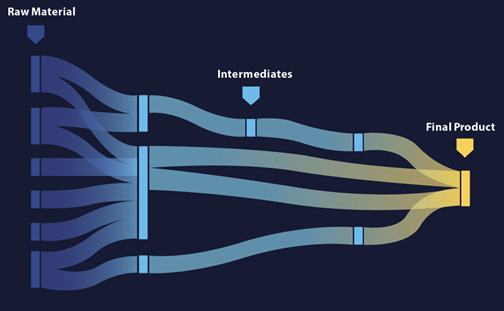
Every raw material must first be identified at the substance level before it can be traced through the supply chain. By mapping the precursors and intermediates a substance depends on, retrosynthesis analysis can help organizations reveal chemical dependencies and trace materials to their origins across multi-tier supply chains. Chemical companies that lack this foundation cannot reliably assess sourcing risk, evaluate alternatives, or determine which materials are affected when supply disruptions or regulatory changes occur.

Figure 1. From raw material to final product, every link in the synthesis chain is a potential point of risk. Substance-level visibility enables chemical companies to understand upstream dependencies across every tier of the supply chain.

Supply chain mapping: a clear view of the full sourcing network

Supply chain mapping provides a structured view of the materials, suppliers, intermediates, and geographies involved at each tier of the sourcing network. It extends visibility beyond direct supplier relationships to the upstream tiers where many sourcing risks originate, so organizations can flag and resolve vulnerabilities, including single-source dependencies, materials sourced from at-risk regions, and upstream regulatory exposure.

Connected scientific and regulatory intelligence: from substance identity to sourcing risk

Building the scientific and regulatory profile of a substance is key for understanding its sourcing implications, but creating that profile requires integrating multiple external sources, including substance registries, safety databases, regulatory publications, and scientific literature. When those information sources remain fragmented, which is often the case, teams must reconcile incomplete information across jurisdictions and data types to evaluate a sourcing decision’s full implications. However, when these dimensions are connected, procurement and R&D teams can assess availability, performance, and compliance simultaneously, as well as identify emerging regulatory risks before they force reactive substitutions.

Centralized knowledge management: connecting intelligence across functions

Material decisions in chemical manufacturing span multiple functions. While procurement evaluates cost and availability, R&D assesses performance and formulation compatibility, and compliance teams track regulatory status. However, when the information underpinning each of these functions is held in separate systems, teams can make decisions on incomplete or inconsistent data.  

With a centralized management system, though, teams get a shared understanding of materials, suppliers, and risks across the organization, improving the quality of individual decisions and the speed of cross-functional responses when disruptions occur. Industry leaders, such as BASF, Dow, and Eastman, credit this level of centralized data and digital integration as the foundation of supply chain transformation.

When supplier-level data isn't enough

Standard supply chain analysis tools focus on vendors, pricing, and logistics, leaving organizations blind to chemical dependencies, synthesis routes, and vulnerabilities in upstream raw materials. CAS supply chain intelligence services map chemical and material supply chains to their upstream raw material origins, uncovering synthesis dependencies and substance-level vulnerabilities before they become operational risks.

Learn more

Predictive analytics: spotting disruptions before they reach operations.

With predictive analytics, organizations can move away from reactive sourcing to proactive risk management via rerouting shipments, shifting sourcing, or evaluating alternative materials. For this to work, teams need the structured, connected material data, drawn from supply chain mapping, regulatory intelligence, and centralized knowledge systems. Organizations that invest in data quality and connectivity greatly strengthen their evaluation of emerging risks, model sourcing scenarios, and identify contingency options before disruptions affect operations.

Securing internal buy-in for increased visibility infrastructure demands a frameshift in procurement thinking

For finance and executive leadership teams that may be used to thinking about procurement in terms of lowest short-term cost, chemical-level visibility infrastructure build-outs can be hard to justify. Therefore, business cases must be framed in terms of fewer supply disruptions, more predictable operations, and reduced exposure to regulatory and geopolitical risk over time, which is made possible with deep, material-level visibility.

For a deeper look at how structured data insights help chemical manufacturers build resilient supply chains, download the CAS white paper on supply chain intelligence

‍

The road to resilience: steps you can take today

  1. Map raw material synthesis routes across your supply chain to identify upstream chemical dependencies and single-source exposures.
  2. Integrate physical properties, safety profiles, and supplier data into a unified view to support faster, more defensible sourcing decisions.
  3. Continuously monitor global regulatory shifts to flag substances of concern before they trigger compliance events.
  4. Evaluate alternative materials for chemical compatibility, performance equivalence, and regulatory status, not just price and availability.
  5. Apply predictive models trained on enriched scientific and market data to anticipate disruption risk and inform contingency planning.

‍

From reactive procurement to resilient material sourcing

Geopolitical instability, price volatility, and expanding regulatory requirements have changed raw material sourcing. For chemical companies, these forces are compounded by limited visibility into multi-tier supply chains: the inability to trace materials to their chemical origins, map upstream dependencies, or identify regulatory exposure before it reaches operations. Single-source, cost-centric procurement models further amplify this vulnerability, leaving organizations with no alternative when a critical material becomes unavailable.

Building supply chain resilience requires a composite sourcing approach that distributes risk across multiple suppliers, geographies, and sourcing channels. For that framework to be as effective as possible, however, it must be grounded in material-level intelligence: substance-level traceability, supply chain mapping, scientific and regulatory intelligence, centralized knowledge management, and predictive analytics. Together, these capabilities extend visibility beyond vendor lists to the chemical origins and synthesis pathways that determine true sourcing risk.

Organizations that build this foundation will be better positioned to identify vulnerabilities before they become disruptions, qualify alternatives with scientific and regulatory rigor, and make sourcing decisions from a complete understanding of the materials they depend on. In a procurement environment that will continue to evolve, material-level intelligence stands as the foundation for operating confidently today.

Explore how custom data intelligence supports supply chain decision-making.