Executive Summary

  • Quantum computing leverages quantum mechanics to process information in ways that classical and even supercomputers cannot, with particular advantages for simulating physical and chemical systems.
  • Academic publications significantly outnumber patents in quantum computing research, though a recent patent surge suggests accelerating commercial activity, particularly in superconducting and spin qubit technologies.
  • The materials landscape for qubits spans elemental silicon, III-V semiconductors, diamond, aluminum, and rare earth metals.
  • Quantum hardware is transitioning from laboratory prototypes to early commercial and cloud-accessible platforms, with the global quantum computing market projected to reach $4 billion by 2030.

Quantum computing applies principles of quantum mechanics, and it is far more powerful than classical computing and can therefore solve more complex problems. This form of computing is particularly good at modeling physical systems, making it valuable for chemistry and materials science.  

Quantum computers could revolutionize drug discovery by simulating billions of potential candidates to help cure diseases. They can screen new materials candidates for specific properties, such as room temperature superconductivity. They could even compute all global weather models instantly, making existing forecasts a thing of the past. How can quantum computing do all this? The answer lies in how it differs from the common form of computing called classical computing.

This type of computing that we know from our laptops and phones uses chips with bits that exist in definite binary states of either 0 or 1. A supercomputer is the parallel stacking of these states to process large amounts of data and is used in data centers.  

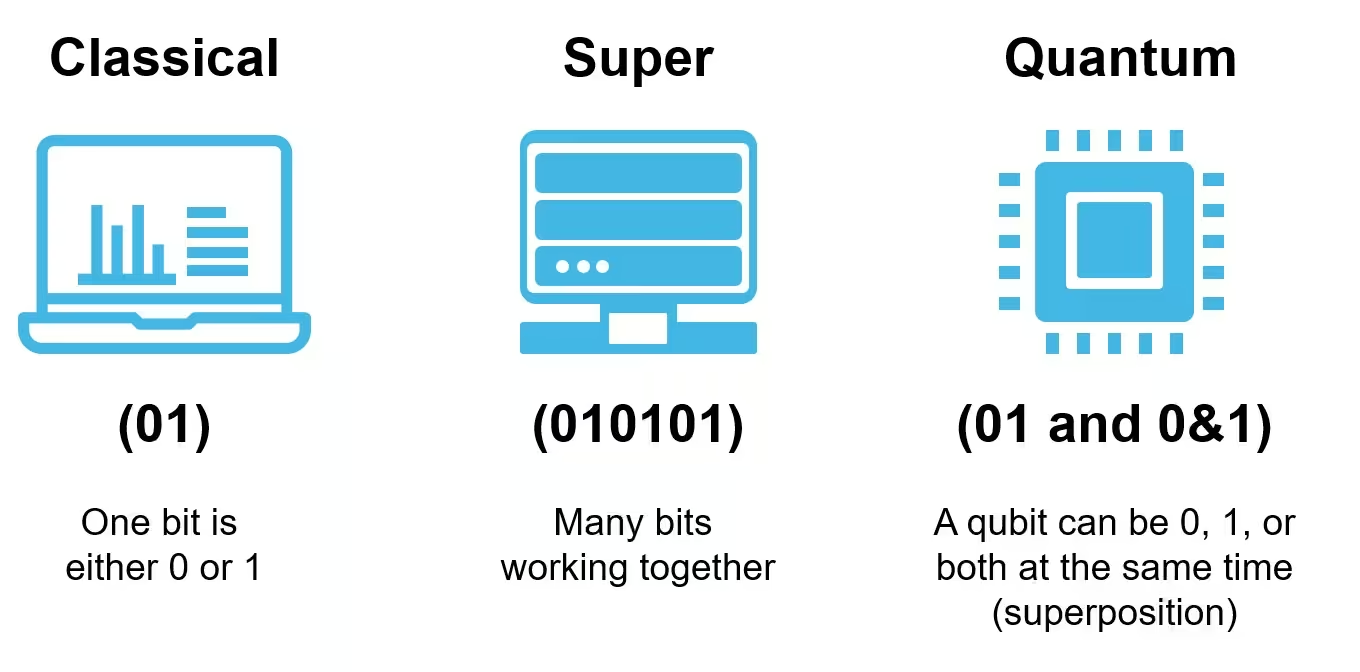
With quantum computing, the quantum bits, known as qubits, can exist in 0, 1, or both states (superposition) (see Figure 1). They operate in chips called quantum processing units (QPUs). This enables the exploration of many possible solutions simultaneously. Unlike classical computing, quantum computing is a challenging and complex field of evolving technologies and concepts with no clear “winner” yet as to the best type of qubit.

Figure 1: Diagram comparing classical, supercomputer, and quantum computing architectures. Classical bits are shown in fixed binary states (0 or 1); supercomputers stack these states in parallel; quantum bits (qubits) are shown in superposition, existing in 0, 1, or both states simultaneously. The diagram illustrates how this fundamental difference enables quantum computers to explore many solutions at once.
Figure 1: Differences between a classical, super, and quantum computer.

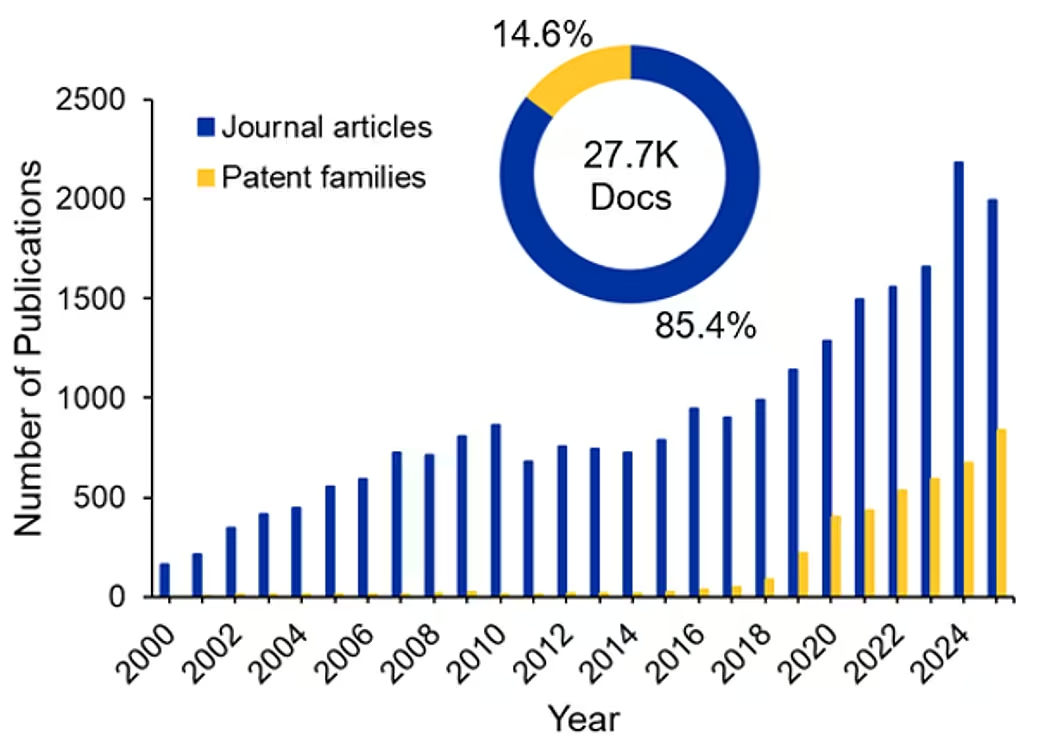
Quantum computing has been discussed and theorized for many years. While the field is still in its infancy, the technology is expanding across research institutions and commercial companies. We analyzed the CAS Content CollectionTM, the largest human-curated repository of scientific information, to better understand developments in quantum computing over the last 25 years (see Figure 2).

Figure 2: Bar chart showing publication trends in quantum computing over approximately 25 years (2000–2025). Academic publications significantly outnumber patents throughout the period. Patent volume remains relatively flat for most of the timeline but shows a marked upward spike in recent years, suggesting accelerating commercial interest and IP activity in the field.
Figure 2: Publication trends relating to quantum computing. Source: CAS Content Collection.

We found that academic publications dominate over patents. Yet, patents have recently started to spike, suggesting a potential surge in the coming years. Let’s explore how quantum computing works, and which materials are making these advances possible:

Methods of quantum computing

Quantum computing encompasses several distinct approaches, each with unique methods and applications. These methods play a key role in determining the type of qubit used:

  • Gate-based quantum computing, also called universal quantum computing, represents the most widely pursued method. In essence, it is a set of instructions or a recipe given to a qubit. In practice, gates are unitary operations that transform qubit states through precisely controlled physical signals. Semiconductor spin qubits are controlled using microwave electromagnetic pulses, while trapped-ion qubits are typically controlled using precisely tuned laser beams. These control signals implement quantum gates that enable computation. The gates or signals manipulate the qubits to perform computation capable of solving the problem.  
  • Adiabatic quantum computing follows a more controlled process where the system remains only in its ground state throughout computation. This offers advantages for optimization problems and maintaining quantum coherence during lengthy calculations.  
  • In contrast, quantum annealing takes a different approach by starting the qubits in a high-energy superposition state and gradually letting the system roll downhill toward a lower energy ground state representing optimal solutions. This approach is effective for combinatorial problems, scheduling, and machine learning tasks, though it's less versatile than gate-based logical operations. The advantage of starting the system in a superposition state is the effect of applying another phenomenon called quantum tunnelling, which is where the system can access other states that would be inaccessible classically. This lets the system have access to a broad superposition of states, giving greater chance of finding a true energy minimum.  
  • Measurement-based quantum computing starts the system with all the qubits in a highly entangled resource state (e.g., a cluster state), but then one qubit is measured. This initial measurement causes all other qubits to react and helps determine which is next to measure. Qubit measurements continue sequentially until all have been measured. The purpose seems odd at first, but it is ideal for several types of calculations, particularly statistical and quantum-property problems:
  • Probabilistic calculations need a total set of qubits in operation at the start, then a final outcome.
  • Complex quantum interference calculations can have many interferences occurring at the same time on a given system and are all interacting. It is impossible to compute these sequentially as they all react together, so a measurement-based approach is ideal for such problems.  
  • Finally, topological quantum computing represents an emerging frontier that leverages exotic particles called anyons and topological properties (surface and structural properties) to create inherently error-resistant quantum states. The anyons are a type of quasiparticle that exists in two-dimensional systems only, making them the ideal particle to manipulate on a surface. The most favorable anyon for a real-world device is called Majorana zero modes (MZMs). Unlike other forms of quantum computing, these topology anyon states are intrinsically more resistant to local noise and decoherence, providing built‑in error suppression.

Types of qubits

Superconducting qubits are the most versatile, supporting several quantum computing methods. They conduct electricity with zero resistance at low temperatures using Josephson junctions, which are a type of circuit that provides nonlinearity, allowing the circuit to have discrete, controllable quantum states.  

They excel in gate-based quantum computing due to their fast gate operations and strong coupling. Two specific subclasses of superconducting qubits include transmon qubits, a Josephson junction with a shunt capacitor that is commonly used by IBM, Google, and Rigetti, and flux qubits, a Josephson junction controlled by magnetic flux. Transmon qubits are utilized by D-Wave’s quantum annealers because they can be easily coupled to create the energy landscapes needed for optimization problems.  

Both types of superconducting qubits have different advantages. For example, transmons have reduced noise sensitivity and scalable fabrication, while flux qubits have strong tunability and well-separated energy levels. Superconducting systems also work well for adiabatic quantum computing.  

Trapped ion qubits are well-suited for gate-based quantum computing because they offer exceptional coherence times and high-fidelity operations. These qubits are ions suspended in space using electromagnetic fields, which permits their quantum states to be controlled and manipulated. Companies like IonQ and Honeywell leverage trapped ions for universal quantum computation, and they're excellent for quantum simulation, especially atomic and molecular systems since they use atoms as qubits.  

Photonic qubits are uniquely positioned for measurement-based quantum computing because they use information that is encoded in individual photons which maintain coherence at room temperature and can be easily measured. Companies like Xanadu and PsiQuantum focus on photonic approaches.

Spin qubits in quantum dots or other solid-state systems are increasingly important for gate-based quantum computing, with companies like Intel investing heavily in silicon spin qubits. These systems are attractive for materials science applications since the qubits themselves are spins. Their compatibility with conventional manufacturing makes them promising for scalable quantum processors, though they currently face challenges with control and coherence.

Topological qubits represent a highly specialized approach primarily designed for fault tolerance with gate-based quantum computing. Microsoft's approach with its Majorana 1 chip is a complex counting method that counts the number of electrons accurately down to a difference of 1, and that difference is its version of 0 or 1 in the classical sense of computation. It does this by coupling the quantum states generated from superconducting nanowires with the states of quantum dots that are embedded in the chips and then reads those states with microwaves. That wave carries the imprint of the nanowire’s quantum state. Only Microsoft has achieved a topological chip to date, but it has taken nearly 40 years to achieve.  

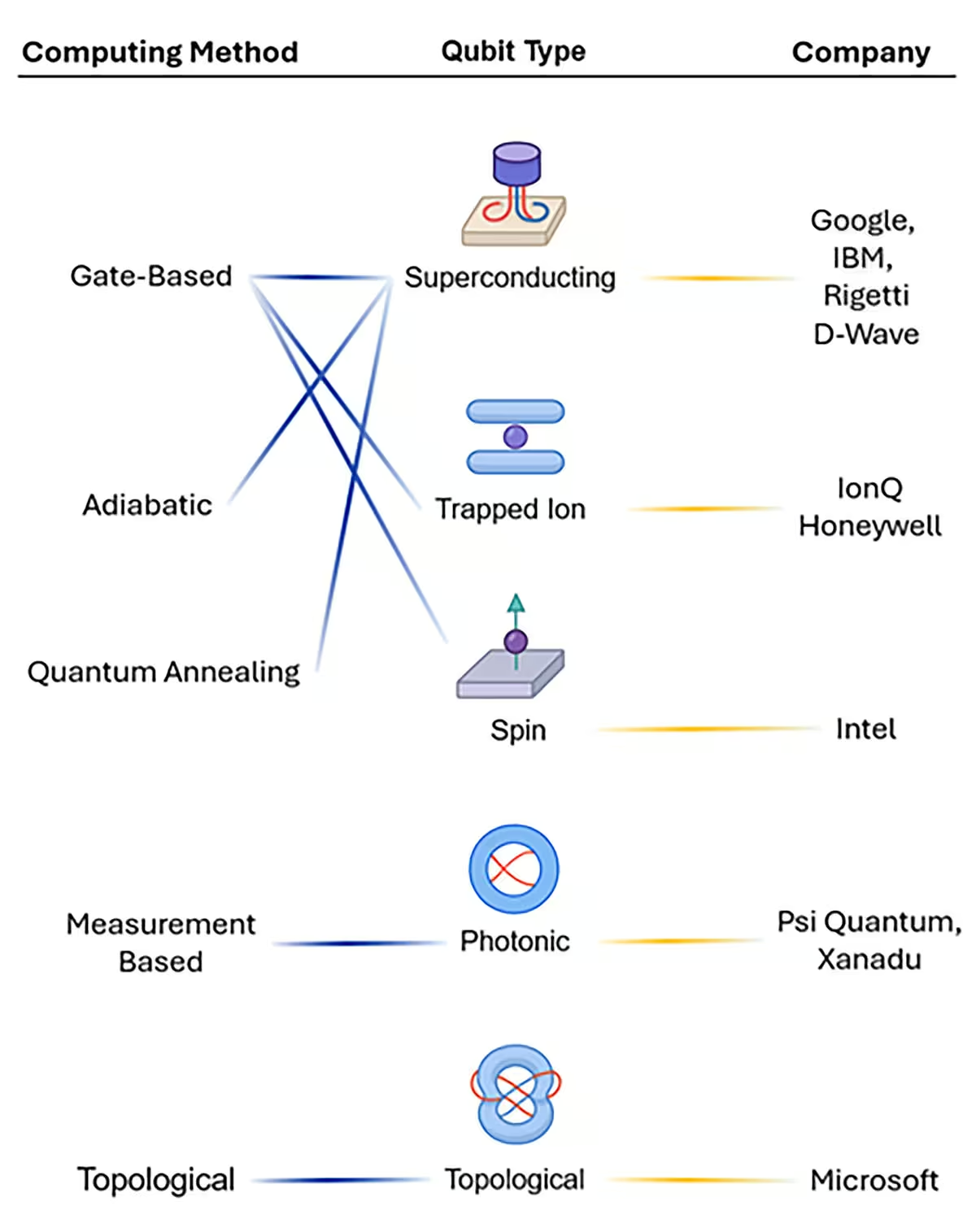
Quantum computing methods and qubit types are closely linked, and we can see which companies are using various approaches to make their version of a functioning quantum computer (see Figure 3).

Figure 3: Network diagram mapping relationships among quantum computing methods (gate-based, adiabatic, quantum annealing, measurement-based, topological), corresponding qubit types (superconducting, trapped ion, photonic, spin, topological), and the major companies developing each. The diagram illustrates which companies are pursuing which approaches and highlights the dominance of superconducting qubits across multiple methods and organizations.
Figure 3: Connections between the various types of quantum computing approaches, the different qubit types, and the major companies that develop those technologies.

We also examined qubit research in the CAS Content Collection relating to the five main types of qubits. Using CAS SciFinder®, which aggregates chemistry and related scientific data from global sources, we found remarkable growth in publications on superconducting and spin cubits (see Figure 4).

Figure 4: Multi-line chart showing publication trends from 2000 through 2025 (partial) for five qubit types: superconducting, spin, photonic, trapped ion, and topological. Superconducting and spin qubits show strong and sustained growth, reaching notably higher publication volumes than the other three. Photonic, trapped ion, and topological qubits display comparatively low and relatively flat activity throughout the period.
Figure 4: Publishing trends relating to the different qubit technologies. *Data for 2025 is partial through November. Source: CAS Content Collection.  

The remaining three qubit types (photonic, trapped ion, topological) represent niche research areas with relatively low publication activity. The overall trends suggest that although superconducting and spin qubits have dominated the quantum computing research landscape to date, the latest developments by Microsoft may shift the topological trend in the coming years.

[Breaker]: The publication trends shown in Figure 4 were analyzed using CAS SciFinder, which aggregates chemistry and related science data from global sources. Researchers exploring similar trends can access AI-enabled search capabilities to identify patterns in their specific research areas.

Which materials are qubits made from?

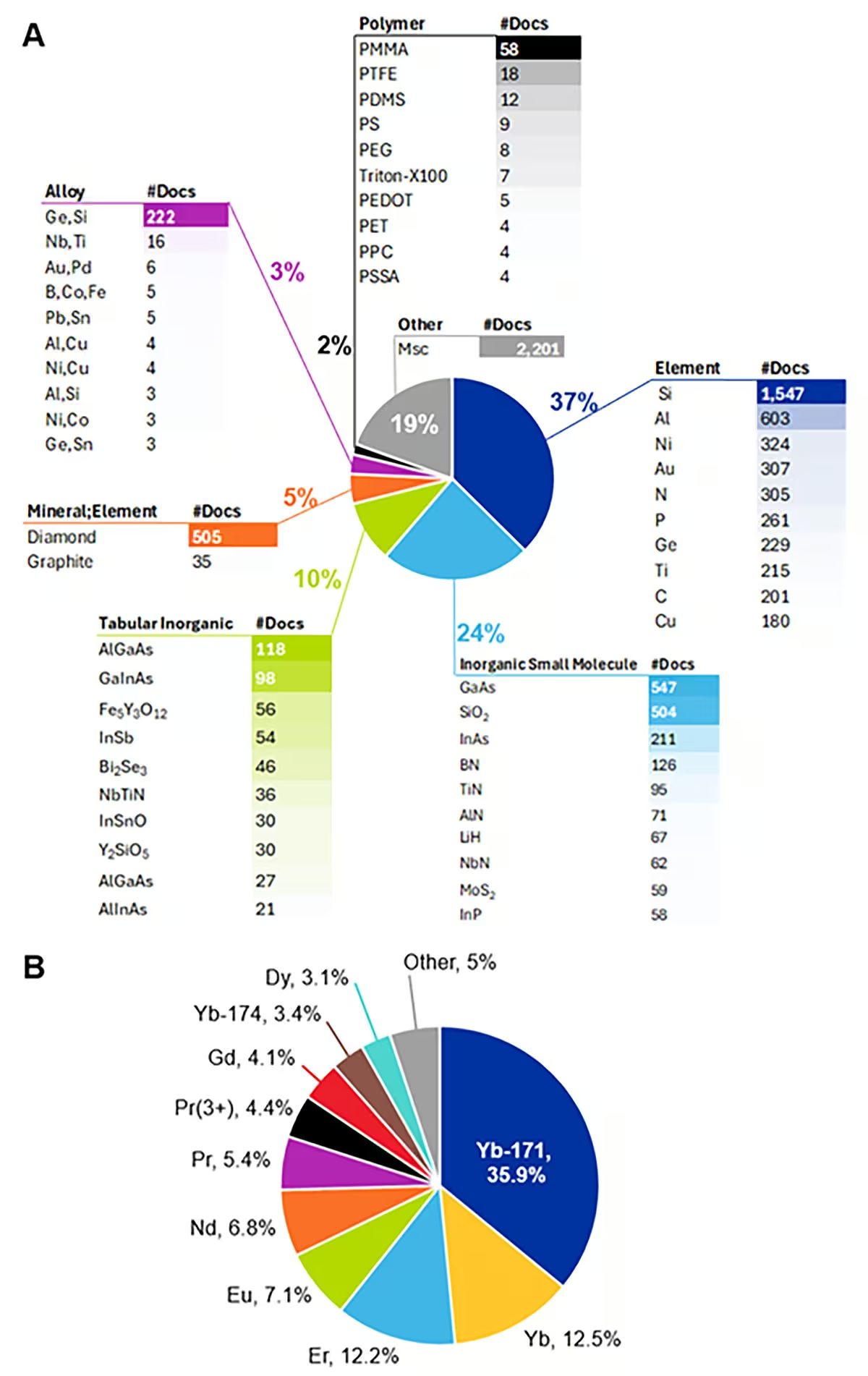
We analyzed which materials qubits are made from and grouped the most prominent substances into classes (see Figure 5A). Elemental silicon (Si) and silicon alloys (Ge,Si) are the top materials in their respective classes by document count, due to their utility as substrates, heterostructure layers, semiconducting interconnects, and silicon-based quantum dots.  

Figure 5: Two-part chart showing materials documented in quantum computing literature from 2000–2025. Panel A displays chemical substance classes by document count: elemental silicon and silicon alloys rank highest, followed by aluminum and III-V semiconductors, with diamond and polymers also represented. Panel B shows rare earth metal frequency: ytterbium-171 leads at 35.9%, followed by elemental ytterbium (12.5%), erbium (12.2%), europium (7.1%), and neodymium (6.8%), with remaining rare earths each below 5.4%.
Figure 5: Documents with A) chemical substance classes, and B) rare earth metal (REM) elements; data from journals and patents between 2000-2025. Source: CAS Content Collection.

Aluminum is also prevalent due to the growth in superconducting qubits research. For example, its use as a superconductor in Google’s previous Sycamore quantum chip and Microsoft’s Majorana 1 chip.  

Many other inorganic materials are also present, particularly III-V semiconductor types, which relates to the groups 3 and 5 of the periodic table, including gallium arsenide, aluminum gallium arsenide, indium arsenide and gallium indium arsenide. These arsenide materials are excellent at producing photons with specific energies and in single quantities, also called single-photon emitters. This makes them useful in photonic qubits, especially quantum dot-based photonic qubits. In recent advances, they have also found use in spin quantum dot qubits.  

Diamond is an allotrope of carbon that is prevalent in the literature due to its unique structure. From a nuclear perspective, the carbon atoms are sitting in a solid nondeforming lattice, and with the substitution of the carbon for certain metals and isotopes, diamond behaves as a model substrate for qubit research.  

The presence of polymers in the literature might seem surprising, but these are not for qubit components, but rather for housing. Polymers have too many impurities and solid-state defects to be used as qubits in commercial QPUs. However, poly(methyl methacrylate) (PMMA) is widely used in clear shatter-proof plastic, and poly(tetrafluoroethylene) (PTFE) is used for its chemical and mechanical resistance.  

Our analysis also uncovered the presence of rare earth metals (REMs), which are highly expensive, low-abundant metals. These are critical to many microelectronic technologies, including memory components in traditional computer chips, and magnets across different applications from microphones to advanced imaging instruments.  

The REMs and their relative amounts are presented in Figure 5B, calculated with respect to the total number of patent and journal documents. The top five REMs in descending order are an isotope of ytterbium, Yb-171 (35.9%), elemental ytterbium, Yb (12.5%), erbium, Er (12.2%), europium, Eu (7.1%), and neodymium, Nd (6.8%). Less prevalent REMs include praseodymium, gadolinium, ytterbium-174 and dysprosium at <5.4% and less. Others (5%) accounts for various isotopes and ions with low counts.  

Yb-171 is widely used as a qubit species due to long coherence times, narrow optical transitions, and stable nuclear‑spin properties. For example, it is used by eleQtron and IonQ in trapped-ion quantum computers. Elemental ytterbium (Yb) also provides high‑coherence qubits due to deeply shielded 4f‑shell electrons that reduce environmental noise. Atom Computing has patented the use of Yb in neutral-atom quantum computers. Huawei Technologies has designed a quantum computing system with nanofibers for optical readability, and Max Planck University has patented the use of Yb in advanced optically-trapped states.

Erbium (Er) has been used by several institutions, including the University of Chicago for molecular qubits that operate directly at telecom wavelengths (1.5 μm), bridging spin and the photon interface. This allows direct integration with existing fiber‑optic infrastructure for a future quantum-based internet. Henan University has patented their use as a quantum-based light source. The company Quantum Source Labs has patented these as part of their photonic qubits.

Both Eu and Nd display remarkable magnetic properties that are ideal for quantum memory components. Recent advances at the University of Illinois Urbana-Champaign on the storage timeframe, now up to 800 nanoseconds, and by the University of Warwick that embed Eu in diamond substrates as rare earth-doped laser crystal components. The U.S. Navy has patented the use of Nd in quantum-entangled photonic qubits.

Quantum computers today and into the future

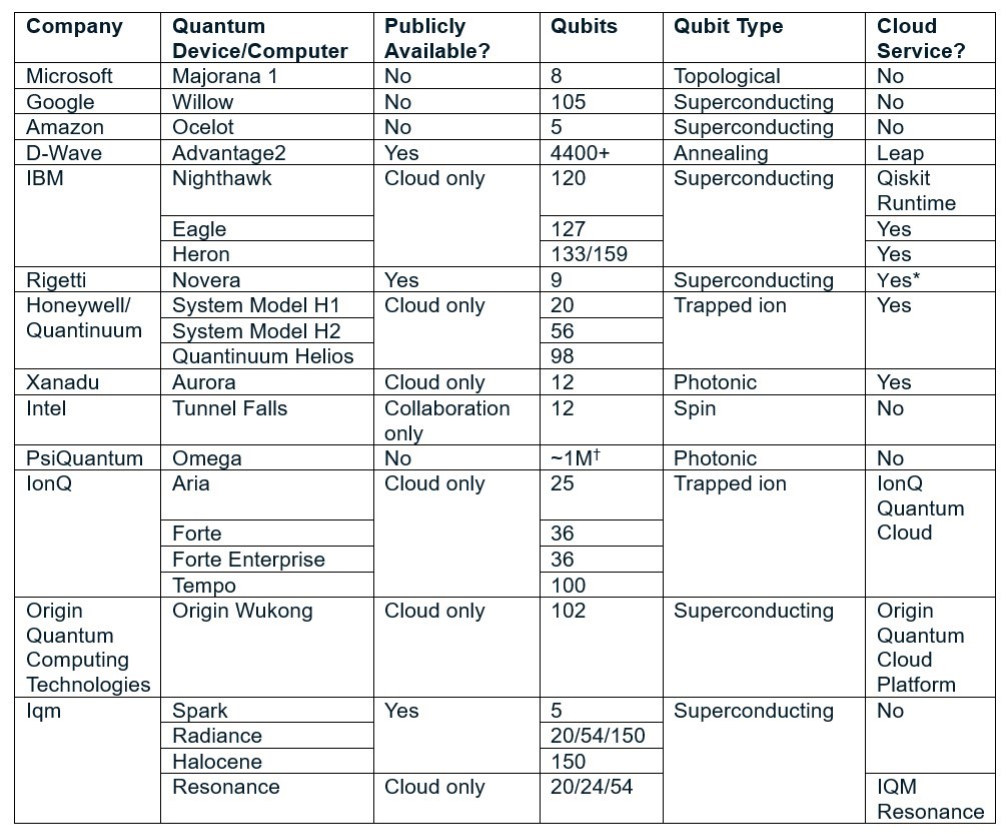
Quantum computing is now at the stage where academic research is being translated into real commercial products. Table 1 details the types and number of qubits as well as the public availability of their computers and quantum cloud services of major companies.  

Table 1: Availability of different quantum computers and cloud service QPUs. *Multiple QPUs are available, each with a different number of qubits. †Untested but designed to operate with ~1 million qubits once built. Note: This list is not exhaustive.

Microsoft (Majorana 1), Google (Sycamore,Willow), and Amazon (Ocelot) have all developed their own unique type of QPU, but none are available for public use beyond collaborative partnerships. In contrast, IBM, D-Wave, Rigetti, Quantinuum, and IonQ all enable cloud-access to their quantum computers. Origin Quantum has their own cloud-based QPU that has AI-integration options. Xanadu has developed a cloud-only QPU while Intel and PsiQuantum currently offer stand-alone QPUs.  

In terms of qubits, PsiQuantum is building facilities in three countries: Australia, the U.S., and the UK to bring about 1 million qubits online, and D-Wave currently claims to offer QPUs of 4400+ qubit systems per machine. Amazon’s Ocelot (specifically Amazon Web Service, AWS) qubit has just five qubits per chip, but is designed to be scalable thanks to the focus on the qubit phasing and oscillator strengths.  

These real-world qubit systems show that the science is not just being researched, but is developed beyond testing and private partnerships. Certain companies even offer subscriptions and pricing plans that make some of these quantum computers available to the public in real time.  

We can see far this technology has come in recent years with the number of publicly available quantum computers. Even with a relatively low patent volume, the global quantum computing market is projected to grow to $4 billion by 2030, demonstrating how valuable this field is, regardless of qubit type or quantum approach.

The various materials used, whether they’re costly rare earths or more abundant aluminum, will play a role in the affordability and growth of specific qubits. However, the overall future of quantum computing remains bright, and the opportunities for faster drug discovery and materials science breakthroughs are growing with it. This growth is already reflected in near‑term infrastructure changes, with post‑quantum cryptographic schemes being evaluated and deployed in network security protocols such as TLS, integrated into operating system kernels, and incorporated into secure hardware and cryptographic modules to mitigate future quantum threats to cybersecurity.

Questions and answers

Q: How is quantum computing different from classical computing?

Q: What are quantum computers made from?

Q: Can you use a quantum computer today?

Related CAS Insights

材料化学

Are metal-organic frameworks (MOFs) at a commercial tipping ​​point?

材料化学

Beyond insulation: New applications for aerogels

材料化学

Carbon nanotube uses, from batteries to drug delivery

Gain new perspectives for faster progress directly to your inbox.