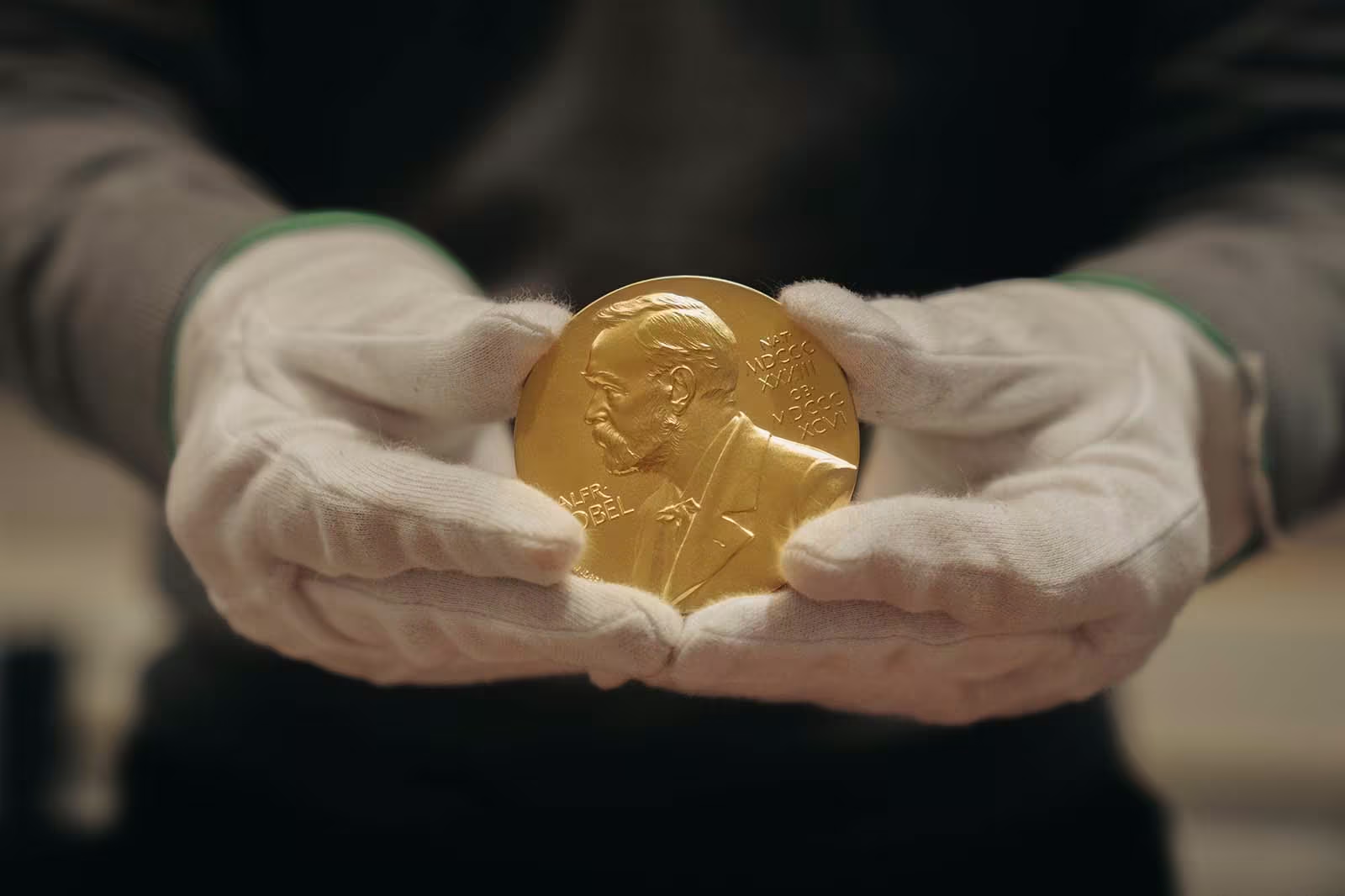
Hands in white gloves gently holding a golden Nobel Prize medal, displaying the profile of Alfred Nobel and Swedish text against a dark background.

Nobel Prize winners

The Nobel Prize in Chemistry is one of the most prestigious honors in science, awarded annually by the Royal Swedish Academy of Sciences. It recognizes individuals or teams whose discoveries have significantly advanced the field of chemistry and often the broader scientific landscape.  

Recent winners of the Nobel Prize in Chemistry

Nominations for the Nobel Prize are submitted by qualified individuals worldwide and reviewed by a Nobel Committee of experts. The selection process is confidential and rigorous, often taking years of deliberation and review of scientific impact.

Is your R&D data ready for the future? The CAS Intelligence Hub is a powerful integrated solution that transforms fragmented scientific R&D data into a harmonized, AI-ready knowledge environment.

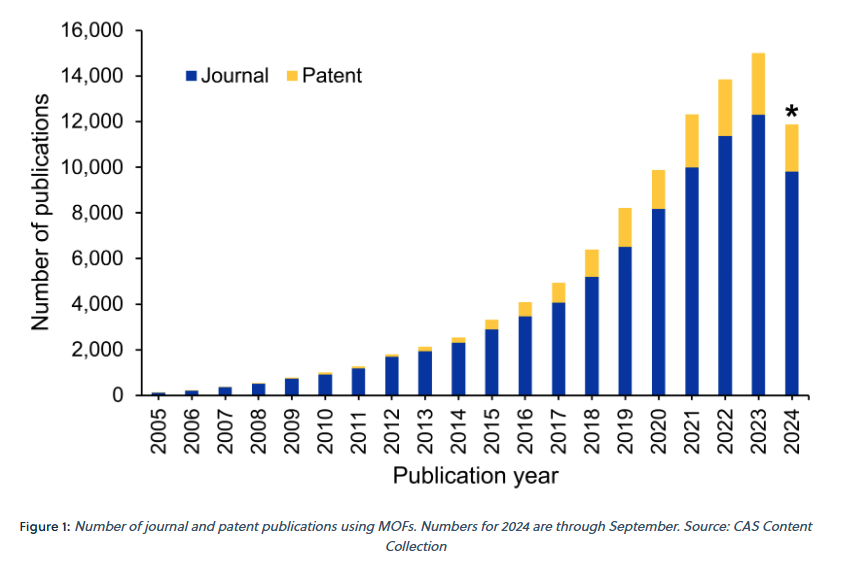
The 2025 Nobel Prize for Chemistry was announced 8 October, 2025, recognizing research related to metal-organic frameworks (MOFs), revolutionary porous crystalline materials with tunable structures and high surface areas. MOFs extraordinary versatility makes them applicable platforms for addressing global challenges in environmental remediation, renewable energy, industrial catalysis, medical diagnostics, drug delivery, electronics, and sensing technologies.

CAS scientists have had their eye on MOFs for some time (video), and suggested that it was, indeed, "Nobel ready."

For more on how MOFs are shaping the future of materials science, read what CAS scientsts say about how close they are to a "commercial tipping point."

  • 2024: David Baker was awarded for computational protein design, while Demis Hassabis and John Jumper were recognized for protein structure prediction using AI, notably AlphaFold2. Together, their work enabled the creation and understanding of proteins with unprecedented precision, transforming medicine and biology.
  • 2023: Moungi G. Bawendi, Louis E. Brus, and Aleksey Yekimov received the prize for the discovery and synthesis of quantum dots, nanoscale particles whose properties change with size and are now used in everything from LED displays to cancer surgery. Their breakthroughs laid the foundation for modern nanotechnology.
  • 2022: Carolyn R. Bertozzi, Morten Meldal, and K. Barry Sharpless were honored for pioneering click chemistry and bioorthogonal chemistry, which enable molecules to bond quickly and precisely, even within living organisms. Their work has revolutionized drug development and cellular imaging. 
  • 2021: Benjamin List and David W.C. MacMillan were jointly awarded the Nobel Prize in Chemistry for developing asymmetric organocatalysis, a method that uses small organic molecules to drive chemical reactions with high precision. This innovation has made molecular construction more efficient and environmentally friendly, especially in pharmaceutical research. 

The 2025 Nobel Prize in Chemistry will be announced on Wednesday, October 8, 2025, at 11:45 CEST.  

Three paths to a Nobel Prize in Chemistry

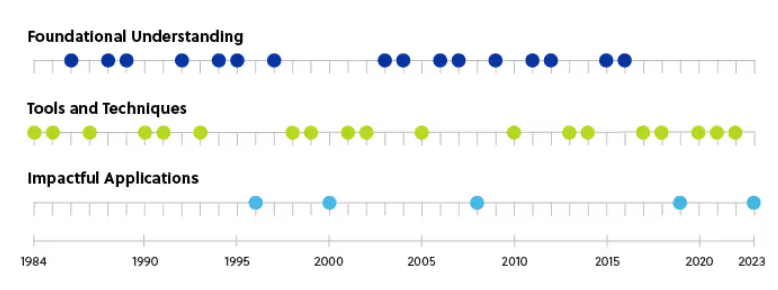
From the invention of CRISPR to the development of quantum dots, Nobel-winning research often follows one of three trajectories. Some discoveries lay the groundwork for entire fields. Many introduce transformative tools that accelerate innovation. A certain few deliver real-world applications that change lives.  

In this exclusive analysis, CAS scientists examined the publication patterns, collaboration networks, and innovation timelines behind Nobel-winning work. The result? A data-driven three-path framework that explains past awards and may help predict future ones. Examples include:

Foundational understanding

Tools and techniques

Impactful applications

One important finding of our analysis? Aspiring Nobel laureates must be patient. On average, 25 years elapse between publication of the seminal paper disclosing an initial discovery and that work being recognized with a Nobel Prize.  

What could be the next Nobel Prize?  

Scientific breakthroughs often begin with bold ideas that challenge convention, open new possibilities, and reshape entire fields. CAS scientists track emerging areas of innovation that have the potential to transform medicine, materials, and molecular design.  

Here are some of our scientists’ insights into topics they believe are overdue for consideration by the Nobel committee.

Molecular editing. Pioneered by researchers such as Mark Levin, molecular editing includes techniques like C–H functionalization, skeletal editing, and late-stage diversification, molecular editing is redefining how chemists design and optimize pharmaceutical compounds. Instead of building molecules from scratch, this approach enables precise modifications to existing structures. These methods allow scientists to generate analogs rapidly with improved potency, selectivity, and pharmacological profiles.  

Next-generation DNA Sequencing. Developed by Shankar Balasubramanian, David Klenerman, and collaborators, sequencing-by-synthesis technology has made genome sequencing faster, more affordable, and widely accessible. This innovation relies on reversible terminator chemistry, where fluorescently labeled nucleotides are incorporated one base at a time. The result is real-time detection of DNA synthesis with high accuracy and throughput. The impact spans personalized medicine, cancer treatment, pathogen identification, and global genomics research.

Solar cells. Advances in solar cell chemistry, particularly in perovskite and organic photovoltaics, have transformed renewable energy. Researchers such as Henry Snaith, Tsutomu Miyasaka, and Alex K.Y. Jen have developed hybrid materials that rival silicon in efficiency while offering low-cost, solution-based manufacturing. These technologies promise flexible, lightweight solar panels that can be printed and deployed globally. They address urgent energy needs through scalable chemical innovation and represent a significant step forward in sustainable energy solutions.

C-H activation and functionalization. C–H activation and functionalization, pioneered by John Hartwig, Jin-Quan Yu, and other leading researchers, represents a breakthrough in synthetic chemistry. This methodology has transformed how chemists construct complex molecules by enabling the direct conversion of traditionally unreactive C–H bonds into valuable C–C, C–N, C–O, and other bonds. By eliminating the need for pre-functionalized starting materials, C–H activation streamlines synthetic routes and reduces the number of steps required. The field includes major advances in transition metal catalysis, particularly with palladium, rhodium, and ruthenium systems.  

Keep an eye out on this page for updates on Nobel Prize-winning science. Remember to sign up for CAS Insights alerts and get the latest research and trends delivered right to your email inbox.  

Custom API solutions accelerate drug discovery Discover how Calibr-Skaggs seamlessly integrated CAS-quality insights into its internal processes, empowering researchers to evaluate and prioritize compounds with speed and confidence.

Download the case study

Image credit: © Nobel Prize Outreach. Photo: Clément Morin.  

Subscribe to CAS Insights for emerging trends, useful connections, and future opportunities at the intersection of science, technology, and innovation delivered to your inbox.

Sign up today.

What could be the next Nobel Prize?  

Scientific breakthroughs often begin with bold ideas that challenge convention, open new possibilities, and reshape entire fields. CAS scientists track emerging areas of innovation that have the potential to transform medicine, materials, and molecular design.  

Here are some of our scientists’ insights into topics they believe are overdue for consideration by the Nobel committee, updated in advance of the 2026 awards.

Next-generation DNA Sequencing. Developed by Shankar Balasubramanian, David Klenerman, and collaborators, sequencing-by-synthesis technologyhas made genome sequencing faster, more affordable, and widely accessible. Thisinnovation relies on reversible terminator chemistry, where fluorescentlylabeled nucleotides are incorporated one base at a time. The result isreal-time detection of DNA synthesis with high accuracy and throughput. Theimpact spans personalized medicine, cancer treatment, pathogen identification,and global genomics research.

Solar cells.Advances in solar cell chemistry, particularly in perovskite and organicphotovoltaics, have transformed renewable energy. Building on the dye-sensitizedarchitecture that Michael Grätzel introduced in 1991, researchersincluding Grätzel, Tsutomu Miyasaka, Nam-Gyu Park, Henry Snaith, and Alex K.Y. Jen have developed hybrid materialsthat rival silicon in efficiency while offering low-cost, solution-basedmanufacturing. These technologies promise flexible, lightweight solarpanels that can be printed and deployed globally. They address urgent energyneeds through scalable chemical innovation and represent a significant stepforward in sustainable energy solutions.

Carbon–nitrogen cross-coupling. The palladium-catalyzed coupling of amines with aryl halides, developed independently in the mid-1990s by Stephen Buchwald and John Hartwig, and now universally called the Buchwald–Hartwig amination, is among the most heavily used bond-forming reactions in drug discovery. Aryl amines run throughout the pharmacopeia, and successive generations of phosphine ligand design turned a once harsh, low-yielding transformation into a reliable step that works on heteroaromatics and at manufacturing scale. The 2010 prize recognized palladium-catalyzed carbon–carbon cross-coupling; carbon–nitrogen bond formation, arguably the branch of greatest pharmaceutical impact, was not included.  

Agentic AI grounded in trusted science. CAS Newton℠ enables conversational scientific discovery. Ask complex, multi-part questions and receive context-based, cited answers sourced from 150+ years of curated and human-verified science found in the CAS Content Collection™, making CAS Newton the best agentic AI for science.

Explore CAS Newton

Three paths to a Nobel Prize in Chemistry

Timeline separating foundational understanding, tools and applications from 1984 to 2023.

From the invention of CRISPR to the development of quantum dots, Nobel-winning research often follows one of three trajectories. Some discoveries lay the groundwork for entire fields. Many introduce transformative tools that accelerate innovation. A certain few deliver real-world applications that change lives.  

In this exclusive analysis, CAS scientists examined the publication patterns, collaboration networks, and innovation timelines behind Nobel-winning work. The result? A data-driven three-path framework that explains past awards and may help predict future ones. Examples include:

Foundational understanding

Tools and techniques

Impactful applications

One important finding of our analysis? Aspiring Nobel laureates must be patient. On average, 25 years elapse between publication of the seminal paper disclosing an initial discovery and that work being recognized with a Nobel Prize.  

Image credit: © Nobel Prize Outreach. Photo: Clément Morin.  

CAS scientists have identified three distinct categories of innovation that have historically been recognized with the award, each representing a unique research path to a Nobel Prize.

Explore these three timelines in depth

Related CAS Insights

__wf_예약_상속

Supercritical CO₂: A greener solvent for use in pharma, power generation, and more

__wf_예약_상속

게놈 규모의 생성적 설계: 인공지능 언어 모델이 작성한 내용과 그 작동 원리 

__wf_예약_상속

고분자 프런티어: 신흥 혁신을 탐구하는 새로운 보고서

Gain new perspectives for faster progress directly to your inbox.