What's New in the Web Version of SciFinder
New SciFinder Design (June 2013)
SciFinder's new, streamlined design lets you access powerful search options in just one click; quickly identify the latest, most relevant research via a more intuitive layout; and more easily access saved searches and alerts.
Download an overview presentation or click the image below for an interactive, introductory tutorial.
Springer Experimental Procedure Data Added to SciFinder (April 2013)
In addition to a number of system enhancements, this SciFinder maintenance release features the introduction of experimental procedure data from Springer journals and an increase to 14 days for the time a user can remain logged in using the Remember Me option.
Springer Experimental Procedure Data
Springer and CAS will collaborate to add experimental procedure data for chemical reactions reported in 165 Springer chemistry journals covering the period 1985 to the present. Read the press release.

Remember Me
Not only has the duration a user can remain signed-in been extended to 14 days, but if selected at sign-in, the option is presented as the default the next time a user is required to enter their credentials.

New SciFinder® Release Enhances User Experience with Ease-of-Use Features (December 2012)
The latest SciFinder update features several ease-of-use enhancements that improve user interaction with SciFinder and act as an introduction to more usability improvements coming in 2013.
Remember Me
Using the Remember Me option enables you to:
- Remain signed in for seven days (unless you sign out)
- Sign in with a single mouse click if you are unexpectedly timed out
- Return automatically to your default Explore page when returning to SciFinder
- Be remembered on up to three browser or computer combinations for easier access from multiple workstations

When the Remember Me box is selected, SciFinder sets a cookie with encrypted authentication on your browser. This cookie is set to expire in seven days.
User Interface Enhancements
Ongoing user interface enhancements allow you to:
- Manipulate answer sets more effectively with all Select options now grouped into a single dropdown menu
- Quickly navigate answer sets with the new page input field
- Return to your last viewed answer within an answer set using the breadcrumb link or Return button


New and Improved SciFinder Help
Streamlined SciFinder Help enhances and guides your learning experience.
Suggested workflows and interactive navigation maps quickly guide you to step-by-step instructions on how to use a specific feature. And many SciFinder features are also demonstrated with short video tutorials. View a narrated tutorial on the new Help.

View a short e-seminar overview of all the enhancements in this update. (WebEx e-seminar 13 minutes)
New SciFinder® Features Help Scientists Increase Productivity (September 2012)
The latest update improves precision and evaluation of reaction answer sets, and allows easier collaboration with other SciFinder users.
More Precise Reaction Answer Sets
- A new default role (reactant) assigned to substances or fragments to the left of the reaction arrow improves the precision of reaction searches. (The former default role of reactant/reagent is still an option.)

Group Reaction Answers by Transformation
- Quickly evaluate synthesis options and preferred pathways by grouping single-step reaction answers by transformation type.
- Classify answers in a way that is meaningful to synthetic chemists.
- Easily manage and evaluate large, comprehensive answer sets.
- Take advantage of hundreds of common transformation types.


Share SciPlanner™ Plans
- Collaboration is easier than ever with new Export/Import options that let you share your SciPlanner plans with other SciFinder users.
- Export a plan locally in the new SciPlanner exchange format (.pkx) and email or share the file with a colleague.
- Collaborators or colleagues can open your plan using the new Import feature.


New SciFinder Enhancements Provide Convenient Access to Content (April 2012)
The latest update of SciFinder debuts features that boost search convenience. The new features include direct searching of substance properties, converting CAS Registry Number® identifiers to structures, and convenient preview of substance and reference answer sets with Quick View.
Property Search
SciFinder now enables users to search substances by individual experimental or predicted property. Researchers can target substances with a particular property value or range of values in the CAS REGISTRYSM, which contains more than 70 million substances characterized by 3.8 billion experimental and predicted properties.

Convert CAS Registry Number to Structure 
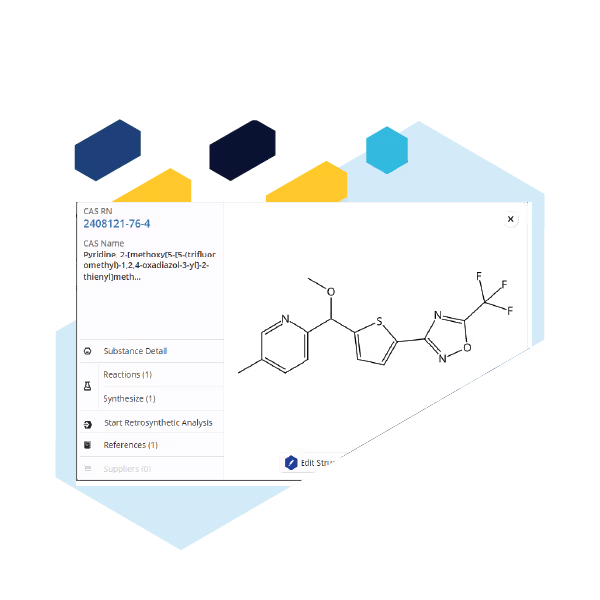
Structure searching has been made easier by the convenience of inputting a CAS Registry Number to the structure editor. As an alternative to drawing a structure, a CAS Registry Number is entered by using the Add to Editor function.
The editor displays the associated chemical structure, which can then be used or easily modified for a structure, reaction or Markush search.
Preview Substance and Reference Answer Sets with Quick View 
From multiple locations in SciFinder, users can preview additional details about a substance or reference through use of Quick View. Working with answer sets is more efficient and convenient since Quick View is presented as a pop-up screen, enabling the user to remain in their current view.
Substance Quick View
Hover over an individual compound in a substance answer set and click the magnifying glass icon to see a substance Quick View, which contains additional information such as synonyms, molecular formula and source of registration.
Quick View is interactive. Click on the CAS Registry Number link to go directly to a Substance Detail page.
Reference Quick View
In a reference answer set, Quick View includes the full abstract, bibliographic information, ACS journal Table of Contents graphics, abstract graphics and structure images for up to the first 50 indexed substances.

Within a reference Quick View, click the reference title to go directly to the Reference Detail page. Full text access is also just a click away.
Quick View is available in other locations such as the Citations and indexed Substances sections of Reference Detail.

Latest SciFinder Update Implements New Content to Improve the Scientist's Workflow (February 2012)
SciFinder now offers the researcher one-click access to commercial chemical source pricing and availability information. With the ability to access commercial chemical source pricing and availability information, you can now conduct a substance search from initial query to purchasing decision without ever having to open another search tool. Additional sorting and analysis features for pricing and availability make this new information easy to find.
Adding to SciFinder's premier collection of reaction experimental procedures are new procedures from major sources such as Taylor & Francis and German and Japanese patents.
Pricing & Availability Information for Commercially Available Compounds
- During a SciFinder session, researchers can link to pricing and availability information for substances. In addition, commercial chemical sources can be analyzed and sorted by "Pricing & Availability." This enables faster decisions on whether a substance of interest can be purchased within time and budget guidelines.
- The new links to substance pricing and availability complement SciFinder's existing feature for setting supplier preferences, thus enabling researchers to quickly find this information from their preferred supplier sources and make the most of their research time.

Additional Experimental Procedure Information
- Adding to an already substantial collection of experimental procedure information, new data from Taylor & Francis journals, and Japanese and German patents will further assist researchers in determining if a reaction is of interest. From within a reaction answer set, it will be easy to evaluate whether a procedure is of interest based on information such as reaction conditions, catalysts and nonstandard reagents.
- New sources from Taylor & Francis include Synthetic Communications, Journal of Coordination Chemistry, and Phosphorus, Sulfur, and Silicon and The Related Elements covering the period 1998-present.
- Translated English-language procedures are now included for Japanese- and German-language patents from source agencies such as JPO, WIPO and EPO covering the period 2008-present.